1995 CADILLAC ELDORADO ESP
[x] Cancel search: ESPPage 31 of 395
Downloaded from www.Manualslib.com manuals search engine HERE ARE QUESTIONS lMANyPEOPLE
ANSWERS ASKABOUTSAFETYBELTS
=-AND THE
Q : Won’t I be trapped in the vehicle after an accident if I’m wearing a safety
belt?
A: You cozdcl be -- whether you’re wearing a safety belt or not. But you
can unbuckle
a safety belt, even if you’re upside down. And your
chance
of being conscious during and after an accident, so you can
unbuckle and get out, is much greater if you are belted.
Why don’t they just put in air bags so people won ’t have to wear safety
belts?
A: Air bags are in many vehicles today and will be in more of them in
the future. But they are supplemental systems only;
so they work with
safety belts -- not instead of them. Every air bag system ever offered
for sale has required
the use of safety belts. Even if you’re in a
vehicle that has air bags, you still have to buckle up to get the most
protection. That’s true not
only in frontal collisions, but especially in
side and other collisions.
Q: If I’m a good driver, and I never drive far,from home, why should I wear
safety belts?
A: You may be an excellent driver, but if you’re in an accident -- even
one that isn’t your fault -- you and your passengers can be hurt. Being
a good driver doesn’t protect you from things beyond your control,
such
as bad drivers.
Most accidents occur within
25 miles (40 km) of home. And the
greatest number
of serious injuries and deaths occur at speeds of less
than 40 mph (65 km/h).
Safety belts are
for everyone.
1-12
Page 85 of 395
Downloaded from www.Manualslib.com manuals search engine GLOW BOX
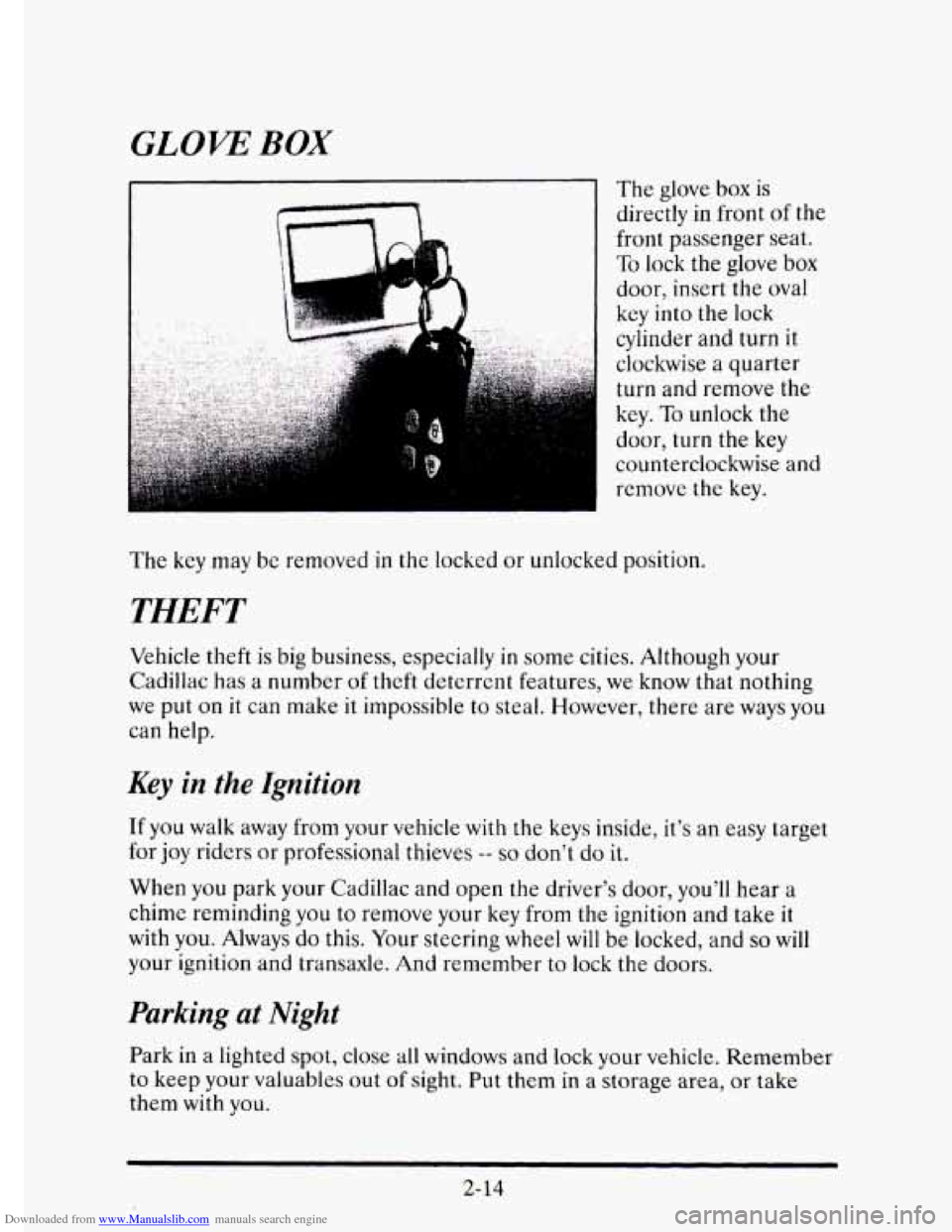
The glove box is
directly in front
of the
front passenger seat.
To lock the glove box
door, insert the oval
key into the lock
cylinder
and turn it
clockwise a quarter
turn and remove the
key. To unlock the
door, turn the key
counterclockwise and
remove
the key.
The
key may be removed in the locked or unlocked position.
THEFT
Vehicle theft is big business, especially in some cities. Although your
Cadillac has a number of theft detcrrent features, we
know that nothing
we put on
it can make it impossible to steal. However, there are ways you
can help.
Key in the Ignition
If you walk away from your vehicle with the keys inside, it's an easy target
for
joy riders or professional thieves -- so don't do it.
When you park your Cadillac and open
the driver's door, you'll hear a
chime reminding you
to remove your key from the ignition and take it
with you. Always do this. Your steering wheel will be locked, and so will
your ignition and transaxle. And remember to lock the doors.
Parking at Night
Park in a lighted spot, close all windows and lock your vehicle. Remember
to keep your valuables out
of sight. Put them in a storage area, or take
them with
you.
2-14
Page 124 of 395

Downloaded from www.Manualslib.com manuals search engine 3.
Daytime Running Lamps (Canada Only)
Daytime Running Lamps (DRL) can make it easier for others to see
the front of your vehicle during the day. DRL can be helpful
in many
different driving conditions, but they can be especially helpful
in the
short periods after dawn and before sunset.
A light sensor on top of the instrument panel makes the DRL work, so be
sure
it isn’t covered.
The DRL system
will make your low beam headlamps come on at
reduced brightness when:
0 the ignition is on,
0 the headlamp switch is off, and
0 the transaxle is not in PARK (P).
When it’s dark enough outside, your low beam headlamps will change to
full brightness. When it’s bright enough outside, the regular lamps will go
off and your low beam headlamps change to the reduced brightness of
DRL.
To idle your vehicle with the DRL off shift the transaxle into PARK (P).
The DRL will stay off until you shift out of PARK (P).
As with any vehicle, you should turn on the regular headlamp system
when you need it.
2-53
Page 163 of 395

Downloaded from www.Manualslib.com manuals search engine Road Sensing Suspension
The Road Sensing Suspension (RSS) automatically controls the ride of
your vchicle. The system controls damping forces in the shock absorbers
and struts
in response to various road and driving conditions. The system
is capable of making these changes
within milliseconds.
The Road Sensing Suspension controller is
a computer used to control
and monitor thc system.
The computer receives input from vertical rotary
position sensors, vehicle speed
sensors, lift and dive signals and
determines optimum strut valving (suspension stiffness) for your current
operating conditions. The computer
also receives feedback from the
various components to determine proper system operation.
If the
computer receives
an incorrect feedback from the system, an error code
will be set in memory and a SERVICE RIDE CONTROL message will
display on the Driver Information Center. If this message should appear,
have your vehicle serviccd
at your Cadillac dealership at your earliest
convenience.
Oil Life Indicator
This feature lets you know when to change your engine oil. It's based
upon the engine oil temperatures and your driving patterns.
To see the display press the INFORMATION button several times until
XX OIL LIFE LEFT appears.
You'll see how much
oil life you have
left as
a percentage. So, if you
see 95 OIL LIFE
LEFT, for example,
that means that
the way
you're driving
your car,
95% of your current oil
life
is still left.
2-92
Page 174 of 395
Downloaded from www.Manualslib.com manuals search engine AUDIO SYSTEMS
c
Your Delco@ audio system has been designed to operate easily and give
years
of listening pleasure. You will get the most enjoyment out of your
audio
s stem if you acquaint yourself with it first. Find out what your
Delco system can
do and how to operate all its controls, to be sure
you’re getting the most out
of the advanced engineering that went into it.
d
FM Stereo
FM stereo will give you the best sound, however, FM signals will only
reach about
10 to 40 miles (16 to 65 km). Tall buildings or hills may
interfere with FM signals causing sounds to fade and may also cause
popping, crackling or momentary hissing noises.
AM
The range for most AM stations is greater than for FM, especially at
night. The longer range, however, can cause stations
to interfere with
each other. (FCC regulations require some AM radio stations to reduce
signal strength at night to minimize interference.)
AM can pick up noise
from things
like storms and power lines. Try reducing the treble to reduce
this noise
if you ever get it.
This means your radio can produce quality
AM sound comparable to FM
stereo.
AMAX@ reduces noise without reducing the high frequencies you
need for the best sound. In addition to improved sound quality,
AMAX@includes more stations
on the AM band. You don’t have to do
anything to your radio because AMAX’ is automatic.
AM Stereo
This means the Delco’ system can receive C-QUAM@ stereo broadcasts.
Many AM stations around the country use C-QUAM@
to produce stereo,
though some do not. (C-QUAM@ is a registered trademark of Motorola,
Inc.) If your Delco@ system can get C-QUAM@, your
ST stereo light will
come on when you’re receiving it.
3-9
Page 178 of 395
Downloaded from www.Manualslib.com manuals search engine Setting the Tone
c
BASS: The slide control increases or decreases the bass response tone.
Moving the control
to the right increases bass while moving it to the left
decreases it.
TREB: The slide control increases or decreases the treble response tone.
Moving the control to
the right increases treble while moving it to the left
decreases it.
lour Cassette Tape Player
Your cassette tape player works best with tapes that are 30 to 45 minutes
long on each side. Tapes longer than that are
so thin that they may not
work
well in this player.
If you look at the tape, or on its label or box, it should say whether its bias,
or “equalization,” is
70 microseconds (70 p) or 120 microseconds (120 p).
Chrome and metal tapes are 70 ~1 sec and standard iron tapes are
120 p sec. Your tape player will adjust automatically for either type
of cassette tape.
To Play a Cassette Tape
1. Turn the radio on.
2. Insert the cassette through the tape door. (The TAPE indicator\
in the
If you hear nothing or hear just a garbled sound, the cassette may not be
in squarely. Press the
EJCT button to remove the tape and start over. The
tape equalization is automatically sensed and set. Inserting the cassette
also activates
DOLBY @ noise reduction.
DNR@ is the Dynamic Noise Reduction. It helps remove background hiss
noise from the radio.
*DNR@ is a registered trademark of National Semiconductor
Corporation. display
will light.)
3. Once the tape is playing, use
the upper and lower knobs to adjust the
volume and balance, just as
you do for the radio. Press the upper knob
to change tape direction. The arrow in the display shows which
direction the tape is being played.
3-13
Page 181 of 395
Downloaded from www.Manualslib.com manuals search engine Finding a Station
SCAN: When you press this button, the SCAN indicator in the display will
light and the radio
will find the next station and stay there for about five
seconds. Then
it will go to the next station and pause, and keep doing that
until you press either the
SCAN button again or the upper knob.
SEEK This button selects stations, but it doesn’t keep moving as SCAN
does. When you press SEEK the radio will automatically go to the next
station and stay there.
Pushbuttons: You can set the pushbuttons to get up to 10 favorite stations
(five on
FM and five more on AM.)
1. Choose either AM or FM.
2. Tune in a desired station.
3. Press the SET button.
4. Press one of the five pushbuttons within five seconds.
5. Repeat these steps for each of the five pushbuttons.
Setting the Tone
BASS: The slide control increases or decreases the bass response tone.
Moving the control to the right increases bass
while moving it to the left
decreases
it.
TREBLE: The slide control increases or decreases the treble response
tone. Moving the control
to the right increases the treble while moving it
to
the left decreases it.
Your Cassette Tape Player
Your cassette tape player works best with tapes that are 30 to 45 minutes
long on each side. Tapes longer than that are so thin that they may not
work well
in this player.
If you look at the tape, or on its label or box, it should say whether its bias,
or “equalization,” is 70 microseconds (70 p) or 120 microseconds (120 p).
Chrome and metal tapes are 70 p sec and standard iron tapes are
120 p sec. Your tape player will adjust automatically for either type
of cassette tape.
3-16
Page 191 of 395
Downloaded from www.Manualslib.com manuals search engine The BAC will be over 0.10 percent after three to six drinks (in one hour).
Of course, as we’ve seen, it depcnds on how much alcohol is in the drinks,
and
how quickly the person drinks them.
But
the ability to drive is affected well below a BAC of 0.10 percent.
Research shows that the driving skills
of many people are impaired at a
BAC approaching
0.05 percent, and that the effects are worse at night. All
drivers are impaired at BAC levels above 0.05 percent. Statistics show that
the chance of being
in a collision increases sharply for drivers who have a
BAC
of 0.05 percent or above. A driver with a BAC level of 0.06 percent
has doubled his or her chance
of having a collision. At a BAC level of
0.10 percent, the chance of this driver having a collision is twelve times
greater; at
a level of 0.15 percent, the chance is twenty-five times greater!
The body takes about an hour to rid itself
of the alcohol in one drink. No
amount of coffee or number of cold showers will speed that up. “I’ll be
careful’’ isn’t
the right answer. What if there’s an emergency, a need to
take sudden action, as when a child darts into the street? A person with
even
a moderate BAC might not be able to react quickly enough to avoid
the collision.
There’s something
else about drinking and driving that many people don’t
know. Medical research
shows that alcohol in a person’s system can make
crash injuries worse, especially injuries to the brain, spinal cord or heart.
This means that when anyone
who has been drinking -- driver or
passenger
-- is in a crash, that person’s chance of being killed or
permanently disabled
is higher than if the person had not been drinking.
I ’ CAUTION:
Drinking and then driving is very dangerous. Your reflexes,
perceptions, attentiveness and judgment
can be affected by even
a smatl amount of alcohol. You can have a serious -- or even
fatal 0- collision if you drive after drinking. Please don’t drink
and drive or ride with a driver who has been drinking. Ride
home in a cab; or if you’re with a group, designate a driver who
will not drink.
4-4