1995 BUICK REGAL no start
[x] Cancel search: no startPage 149 of 340
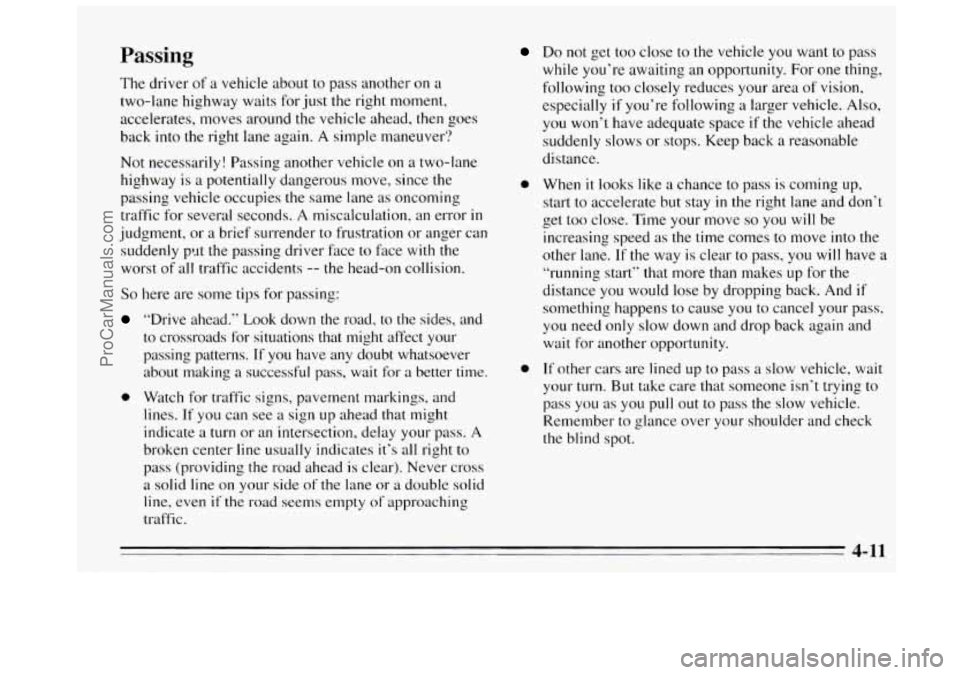
Passing
The driver of a vehicle about to pass another on a
two-lane highway waits for just the right moment,
accelerates, moves around the vehicle ahead, then goes
back into the right lane again.
A simple maneuver?
Not necessarily! Passing another vehicle on
a two-lane
highway is
a potentially dangerous move, since the
passing vehicle occupies the same lane as oncoming
traffic for several seconds. A miscalculation, an error
in
judgment, or a brief surrender to frustration or anger can
suddenly pst
the passing driver face to face with the
worst of
all traffic accidents -- the head-on collision.
So here are some tips for passing:
“Drive ahead.” Look down the road, to the sides, and
to crossroads for situations that might affect your
passing patterns.
If you have any doubt whatsoever
about making
a successful pass, wait for a better time.
0 Watch for traffic signs, pavernent markings, and
lines. If you can see
a sign up ahead that might
indicate
a turn or an intersection, delay your pass. A
broken center line usually indicates it’s all right to
pass (providing the road ahead is clear). Never cross
a solid line on your side of the lane or a double solid
line, even if
the road seems empty of approaching
traffic.
Do not get too close to the vehicle you want to pass
while you’re awaiting an opportunity. For one thing,
following
too closely reduces your area of vision,
especially
if you’re following a larger vehicle. Also,
you won’t have adequate space if the vehicle ahead
suddenly slows
or stops. Keep back a reasonable
distance.
0 When it looks like a chance to pass is coming up,
start
to accelerate but stay in the right lane and don’t
get too close.
Time your move so you will be
increasing speed
as the time comes to move into the
other lane. If the way
is clear to pass, you will have a
“running start” that more than makes up for the
distance you would lose by dropping back. And
if
something happens to cause you to cancel your pass,
you need only
slow down and drop back again and
wait for another opportunity.
0 If other cars are lined up to pass a slow vehicle, wait
your turn. But take care that someone isn’t trying
to
pass you as you pull out to pass the slow vehicle.
Remember to glance over your shoulder and check
the blind spot.
4-11
ProCarManuals.com
Page 150 of 340
Check your mirrors, glance over your shoulder, and
start your left lane change signal before moving out
of the right lane to pass. When you are far enough
ahead
of the passed vehicle to see its front in your
inside mirror, activate your right lane change signal
and move back
into the right lane. (Remember that
your right outside mirror is convex. The vehicle you
just passed may seem
to be farther away from you
than it really is.)
Try not to pass more than one vehicle at a time on
two-lane roads. Reconsider before passing the next
vehicle.
Don’t overtake a slowly moving vehicle too rapidly.
Even though the brake lights are
not flashing, it may
be slowing down or starting to turn.
If you’re being passed, make it easy for the
following driver
to get ahead of you. Perhaps you
can ease
a little to the right.
Loss of Control
Let’s review what driving experts say about what
happens when the three control systems (brakes, steering
and acceleration) don’t have enough friction where the
tires meet the road
to do what the driver has asked.
In any emergency, don’t give up. Keep trying to steer
and constantly seek an escape route or area
of less
danger.
Skidding
In a skid, a driver can lose control of the vehicle.
Defensive drivers avoid most skids by taking reasonable
care suited to existing conditions, and by not
“overdriving” those conditions.
But skids are always
possible.
The three
types of skids correspond to your Buick’s
three control systems. In the braking skid your wheels
aren’t rolling. In the steering or cornering skid,
too
much speed or steering in a curve causes tires to slip and
lose cornering force. And
in the acceleration skid too
much throttle causes the driving wheels to spin.
4-12
ProCarManuals.com
Page 151 of 340
A cornering skid and an acceleration skid are best
handled by easing your foot
off the accelerator pedal
If your vehicle starts to slide, ease your foot off the
accelerator pedal and quickly steer the way you want the
vehicle to go.
If you start steering quickly enough, your
vehicle may straighten out. Always be ready for a
second skid
if it occurs.
Of course, traction is reduced when water, snow, ice,
gravel, or other material is on
the road. For safety, you’ll
want to slow down and adjust your driving
to these
conditions.
It is important to slow down on slippery
surfaces because stopping distance will be longer and
vehicle control more limited.
While driving
on a surface with reduced traction, try
your best to avoid sudden steering, acceleration, or
braking (including engine braking by shifting
to a
lower gear). Any sudden changes could cause the tires
to slide. You may
not realize the surface is slippery until
your vehicle is skidding. Learn to recognize warning
clues
-- such as enough water, ice or packed snow on
the road to make a “mirrored surface”
-- and slow down
when
you have any doubt.
Remember: Any anti-lock brake system
(ABS) helps
avoid
only the braking skid.
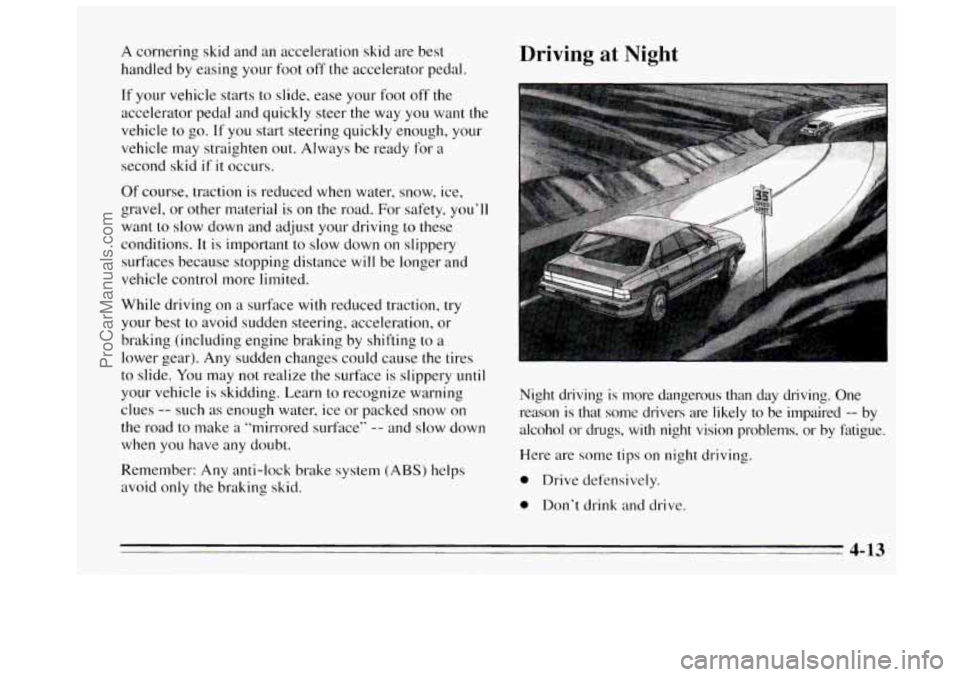
Driving at Night
Night driving is more dangerous than day driving. One
reason is that some drivers are likely to be impaired
-- by
alcohol
or drugs, with night vision problems, or by fatigue.
Here are some
tips on night driving.
0 Drive defensively.
0 Don’t drink and drive.
4-13
ProCarManuals.com
Page 153 of 340
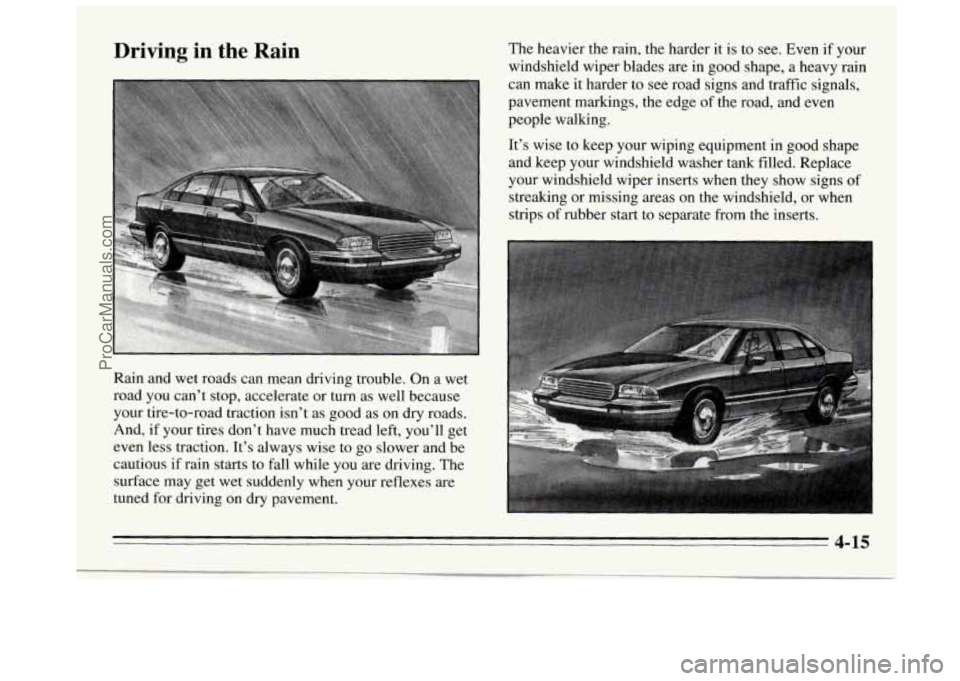
Driving in the Rain The heavier the rain, the harder it is to see. Even if your
windshield wiper blades are in good shape, a heavy rain
can make it harder to see road signs and traffic signals,
pavement markings, the edge of the road, and even
people walking.
It’s wise to keep your wiping equipment in good shape
and keep your windshield washer tank filled. Replace
your windshield wiper inserts when they show signs of
streaking or missing areas on the windshield, or when
strips of rubber start to separate from the inserts.
Rain and wet roads can mean driving trouble. On a wet
road you can’t stop, accelerate or turn as well because
your tire-to-road traction isn’t as good as on dry roads.
And, if your tires don’t have much tread left, you’ll get
even less traction. It’s always wise to go slower and be
cautious if rain starts to fall while you are driving. The
surface may get wet suddenly when your reflexes are
tuned for driving
on dry pavement.
4-15
ProCarManuals.com
Page 155 of 340
City Driving
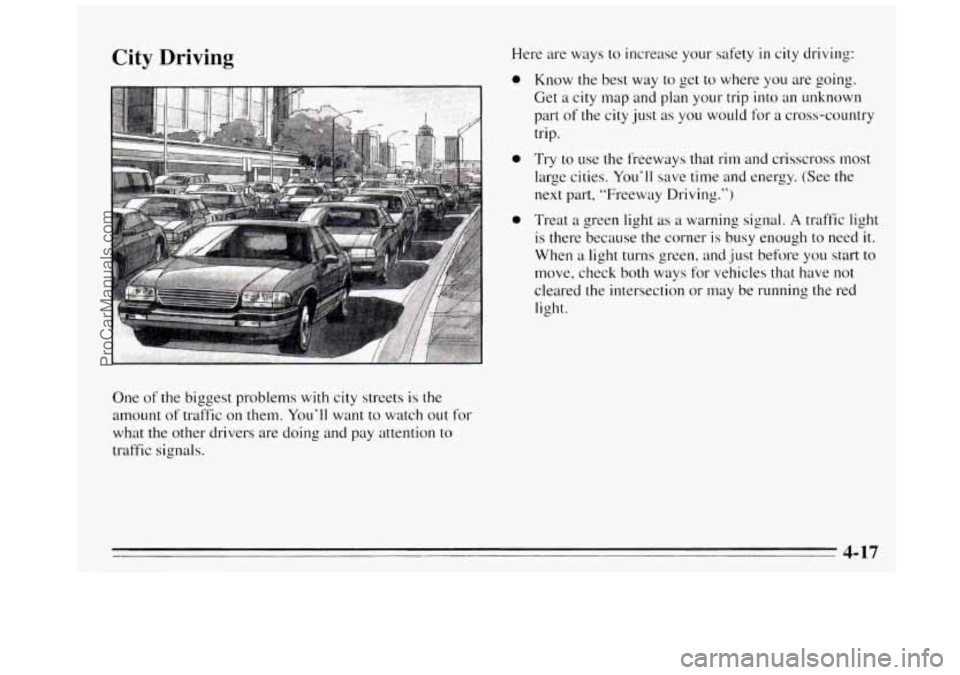
One of the biggest problems with city streets is the
amount
of traffic on them. You’ll want to watch out for
what the other drivers are doing and pay attention to
traffic signals. Here are ways to increase
your safety
in city driving:
0
0
0
Know the best way to get to where you are going.
Get
a city map and plan your trip into an unknown
part
of the city just as you would for a cross-country
trip.
Try to use the freeways that rim and crisscross most
large cities.
You’ll save time and energy. (See the
next part, “Freeway Driving.”)
Treat
a green light as a warning signal. A traffic light
is there because the corner is busy enough to need it.
When a light turns green, and just before you start to
move, check both ways for vehicles that have not
cleared the intersection or may be running the red
light.
4-17
ProCarManuals.com
Page 157 of 340
Once you are moving on the freeway, make certain you
allow a reasonable following distance. Expect to move
slightly slower at night.
When you want to leave the freeway, move to the proper
lane
well in advance. If you miss your exit do not, under
any circumstances, stop and back up. Drive
on to the
next exit.
The exit ramp can be curved, sometimes quite sharply.
The exit speed is usually posted.
Reduce your speed according to your speedometer, not
to
your sense of motion. After driving for any distance
at higher speeds,
you may tend to think you are going
slower than
you actually are.
Before Leaving on a Long Trip
Make sure you’re ready. Try to be well rested. If you
must start when you’re not fresh -- such as after a day’s
work
-- don’t plan to make too many miles that first part
of the journey. Wear comfortable clothing and shoes you
can easily drive in.
Is your vehicle ready for a long trip? If you keep it
serviced and maintained. it’s ready to go. If it needs
service, have
it done before starting out. Of course,
you’ll find experienced and able service experts
in
Buick dealers all across North America. They’ll be
ready and willing to help if you need
it.
Here are some things you can check before a trip:
0
0
0
0
0
0
Windshield Wc~slwr Fluid: Is the reservoir full‘? Are
all windows clean inside and outside?
Wiper Blades: Are they in good shape?
Fuel, Eqirze Oil, Other Fluids: Have you checked
all levels‘?
Lamps: Are they all working? Are the lenses clean?
Tires: They are vitally important to a safe,
trouble-free trip.
Is the tread good enough for
long-distance driving? Are the tires all inflated
to the recommended pressure‘?
Weather Fowcvzsrs: What’s the weather outlook
along your route? Should you delay your trip
a short
time to avoid a major storm system‘?
A4up.s: Do you have up-to-date maps?
4-19
ProCarManuals.com
Page 163 of 340
Run your engine only as long as you must. This saves
fuel. When you
run the engine, make it go a little faster
than
just idle. That is, push the accelerator slightly. This
uses ‘less fuel for the heat that you get and it keeps the
battery charged. You will need a well-charged battery to
restart the vehicle, and possibly .for signaling later on
with
your headlights. Let the heater run for awhile.
Then, shut the engine off and close the window almost
all the way to preserve the heat. Start
the engine again
and repeat this only when
you feel really uncomfortable
from the cold.
But do it as little as possible. Preserve the
fuel as long as you can. To help keep warm, you can get
out
of the vehicle and do some fairly vigorous exercises
every half hour or
so until help comes.
4-25
ProCarManuals.com
Page 167 of 340
If You Do Decide To Pull A Trailer
If you do, here are some important points.
0 There are many different laws, including speed limit
restrictions, having to do with trailering. Make sure
your rig will be legal, not only where you live but
also where you’ll be driving.
A good source for this
information can be state
01- provincial police.
Consider using a sway control.
You can ask a hitch dealer about sway controls.
0
0
0 Don’t tow a trailer at all during the first 1000 miles
(1 600 km) your new vehicle is driven. Your engine,
axle or other parts could be damaged.
Then, during the first 500 miles (800 km) that
you
tow a trailer, don’t drive over 50 mph (80 kmrdh) and
don’t make starts at full throttle. This helps your
engine and other parts of your vehicle wear in at the
heavier loads.
Obey speed
limit restrictions when towing a trailer.
Don’t drive faster than the maximum posted speed
for trailers (or no more than
55 mph (90 km/h)) to
save wear on your vehicle’s parts. Three
important considerations have to do with weight:
Weight of the Trailer
How heavy can a trailer safely be?
It should never weigh more than 1,000 pounds (450 kg),
unless you have the 2,000-pound (900 kg) trailer towing
option package. But even that can be too heavy.
It depends on how you plan to use your rig.
For
example, speed, altitude, road grades, outside
temperature and how much your vehicle is used to pull a
trailer are all important. And,
it can also depend on any
special equipment that you have on your vehicle.
You can ask your dealer for
OLI~ trailering information or
advice, or you can write 11s at Buick Motor Division,
Customer Assistance Center, 902
E. Hamilton Avenue,
Flint, MI 48550.
In Canada, write to General Motors of Canada Limited,
Customer Assistance Center, 1908 Colonel Sam Drive,
Oshawa, Ontario
L 1 H 8P7.
4-LY
ProCarManuals.com