Page 197 of 340
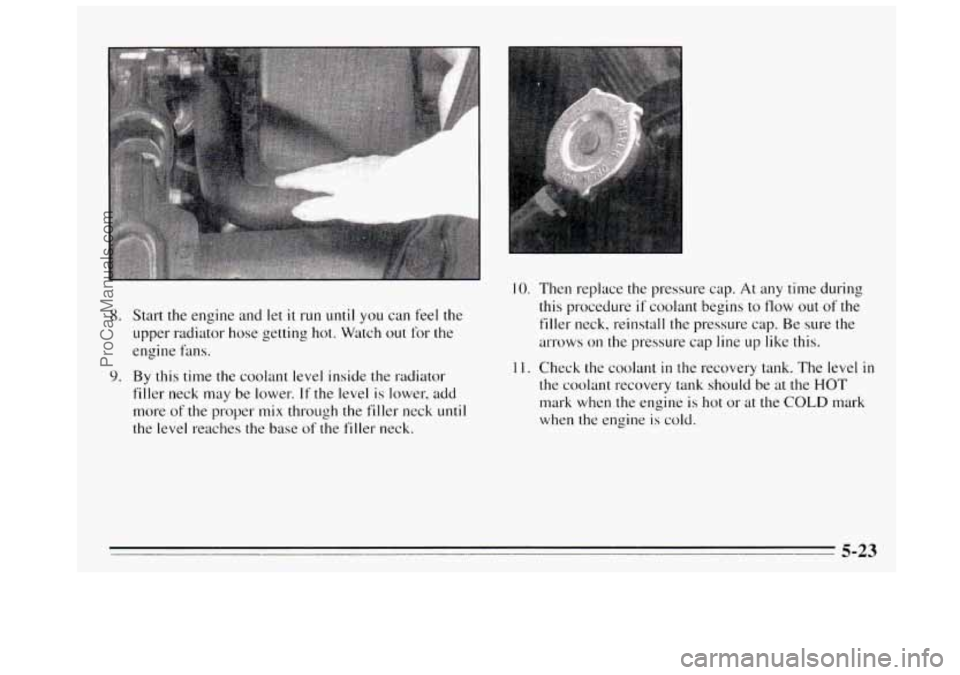
8. Start the engine and let it run until you can feel the
upper radiator hose getting hot. Watch
out for the
engine hns.
9. By this time the coolant level inside the radiator
filler neck may be lower.
If the level is lower, add
more
of the proper mix through the filler neck until
the level reaches the base of the filler neck.
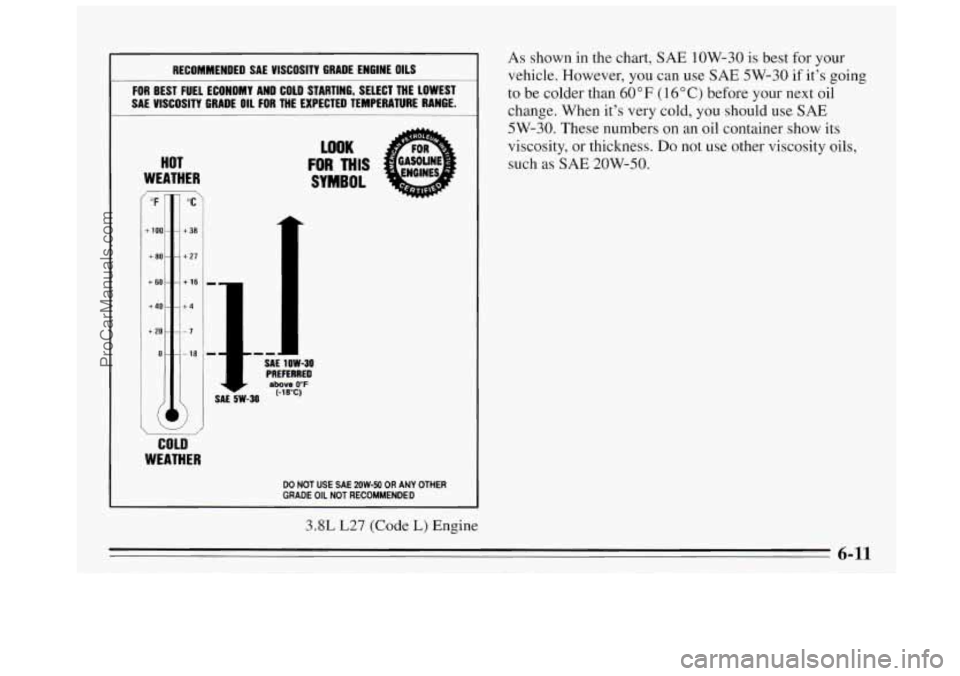
10. Then replace the pressure cap. At any time during
this procedure
if coolant begins to flow out of the
filler neck, reinstall the pressure
cap. Be sure the
BI-~OWS on the pressure cap line up like this.
1 1 - Check the coolant in the recovery tank. The level in
the coolant recovery tank should be at the HOT
mark when the engine is hot or at the COLD mark
when the engine
is cold.
5-23
ProCarManuals.com
Page 218 of 340
What Kind of Oil to Use
Oils of the proper quality for your vehicle can be
identified by looking for the “Starburst” symbol. The
“Starburst” symbol indicates that the oil has been
certified by the American Petroleum Institute (API), and
is preferred for use in your gasoline engine.
If you change your own oil,
be sure you use oil that has
the “Starburst” symbol on
the front of the oil
container.
If you have your
oil changed for you, be sure
the oil put into your engine
is American Petroleum
Institute certified for
gasoline engines.
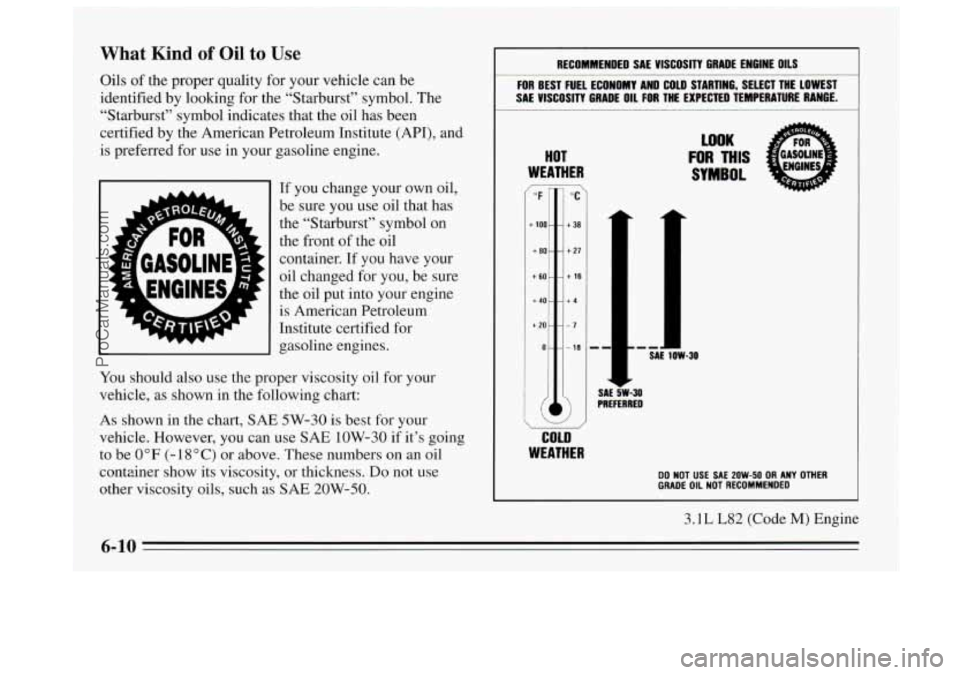
You should also use the proper viscosity oil for your
vehicle, as shown in the following chart:
As shown in the chart, SAE 5W-30 is best for your
vehicle. However, you can use SAE 1OW-30 if it’s going
to be
0°F (- 18°C) or above. These numbers on an oil
container show its viscosity, or thickness.
Do not use
other viscosity oils, such as SAE
20W-50.
RECOMMENDED SAE VISCOSITY GRADE ENGINE OILS ~~~~~ ~ ~ ~~ ~~~
FOR BEST FUEL ECONOMY AND COLD STARTING, SELECT THE LOWEST
SAE VISCOSITY GRADE OIL
FOR THE EXPECTED TEMPERATURE RANGE.
HOT
WEATHER
COLD
WEATHER
FOR THIS
LOOK
SYMBOL @&
SAE 1OW-30
r
RED
DO NOT USE SAE 2OW-50 OR ANY OTHER
GRADE OIL NOT RECOMMENDED
3.1L L82 (Code M) Engine
6-10
~
ProCarManuals.com
Page 219 of 340
RECOMMENDED SAE VISCOSITY GRADE ENGINE OILS
FOR BEST FUEL ECONOMY AND COLD STARTING, SELECT THE LOWEST
SAL VISCOSITY GRADE
OIL FOR THE EXPECTED TEMPERATURE RANGE. -
HOT
WEATHER
- "F "C
-100- - +38
+BO- - +27
+60--+16
+40--+4
+20---7
0---18
SAL SW-30
LOOK
FOR THIS
SYMBOL
SAE 1OW-30 PREFERRE0 above 0°F (-18OC)
COLD
WEATHER
DO NOT USE SAE 2OW-50 OR ANY OTHER
GRADE OIL NOT RECOMMENDED
3.8L L27 (Code L) Engine
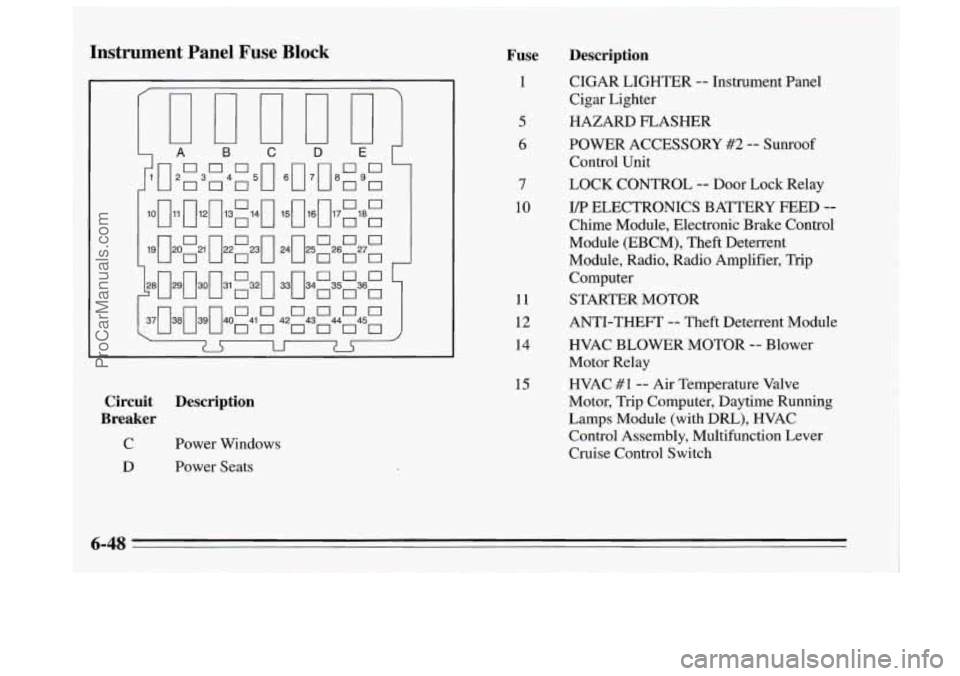
As shown in the chart, SAE 1OW-30 is best for your
vehicle. However, you can use
SAE 5W-30 if it's going
to be colder than
60°F ( 16" C) before your next oil
change. When it's very cold, you should use
SAE
5W-30. These numbers on an oil container show its
viscosity, or thickness.
Do not use other viscosity oils,
such as
SAE 20W-50.
6-11
ProCarManuals.com
Page 223 of 340
Automatic Transaxle Fluid
When to Check and Change
A good time to check your automatic transaxle fluid
level is when the engine oil is changed. Refer to the
Maintenance Schedule
to determine when to change
your fluid. See “Scheduled Maintenance Services” in
the
Index.
How to Check
Because this operation can be a little difficult, you may
choose to have this done at your Buick dealership
Service Department.
If you do it yourself, be sure
to follow all the instructions
here, or you could get
a false reading on the dipstick.
NOTICE:
Too much or too little fluid can damage your
transaxle.
Too much can mean that some of the
fluid could come out and fall on hot engine parts or exhaust system parts, starting a fire. Be sure to
get an accurate reading if you check your
transaxle fluid.
Wait at least 30 minutes before checking the transaxle
fluid level
if you have been driving:
When outside temperatures are above 90°F (32°C).
At high speed for quite a while.
0 In heavy traffic -- especially in hot weather.
While pulling a trailer.
To get the right reading, the fluid should be at normal
operating temperature, which is
180°F to 200°F (82°C
to
93 ” C).
Get the vehicle warmed up by driving about 15 miles
(24
km) when outside temperatures are above 50°F
(10°C). If it’s colder than 50°F (IOOC), you may have
to drive longer.
To check the fluid level
0 Park your vehicle on a level place. Keep the engine
running.
With the parking brake applied, place the shift lever
in PARK (P).
With your foot on the brake pedal, move the shift
lever through each gear range, pausing for about
three seconds
in each range. Then, position the shift
lever
in PARK (P).
6-15
ProCarManuals.com
Page 247 of 340
Using Foam-Type Cleaner on Fabric
0 Vacuum and brush the area to remove any loose dirt.
0 Always clean a whole trim panel or section. Mask
surrounding trim along stitch or welt lines.
0 Mix Multi-Purpose Powdered Cleaner following the
Use suds only and apply with a clean sponge.
Don’t saturate the material.
Don’t rub it roughly.
As soon as you’ve cleaned the section, use a sponge
Rinse the section with a clean, wet sponge.
Wipe off what’s left with a slightly damp paper towel
0 Then dry it immediately with a blow dryer or a heat lamp.
directions
on the
container label.
to remove the
suds.
or cloth.
NOTICE:
Be careful. A blow dryer or a heat lamp may
scorch the fabric.
Wipe with a clean cloth.
Using Solvent-Type Cleaner on Fabric
First, see if you have to use solvent-type cleaner at all.
Some spots and stains will clean off better with just
water and mild soap.
If you need
to use a solvent:
Gently scrape excess soil from the trim material
with
a clean, dull knife or scraper. Use very little
cleaner, light pressure and clean cloths (preferably
cheesecloth). Cleaning should start at the outside of
the stain, “feathering” toward the center. Keep
changing to a clean section
of the cloth.
When you clean a stain from fabric, immediately dry
the area with
a blow dryer to help prevent a cleaning
ring. (See the previous NOTICE.)
Special Cleaning Problems
Greasy or Oily Stains
Stains caused by grease, oil, butter, margarine, shoe
polish, coffee with cream, chewing gum, cosmetic
creams, vegetable oils, wax crayon, tar and asphalt can
be removed
as follows:
Carefully scrape off excess stain.
Follow the solvent-type instructions aescribed earlier.
6-39
ProCarManuals.com
Page 256 of 340
Instrument Panel Fuse Block Fuse
1
5
6
7
10
11
12
14
15
Circuit Description
Breaker
C Power Windows
Description
CIGAR LIGHTER -- Instrument Panel
Cigar Lighter
HAZARD FLASHER
POWER ACCESSORY
#2 -- Sunroof
Control Unit
LOCK CONTROL
-- Door Lock Relay
I/p ELECTRONICS BATTERY FEED --
Chime Module, Electronic Brake Control
Module (EBCM), Theft Deterrent
Module, Radio, Radio Amplifier,
Trip
Computer
STARTER MOTOR
ANTI-THEFT
-- Theft Deterrent Module
HVAC BLOWER MOTOR
-- Blower
Motor Relay
HVAC
#1 -- Air Temperature Valve
Motor,
Trip Computer, Daytime Running
Lamps Module (with
DRL), HVAC
Control Assembly, Multifunction Lever
Cruise Control Switch
D Power Seats
6-48
ProCarManuals.com
Page 257 of 340

r use
16
19
21
23
24 2s
Description
REAR DEFOG -- HVAC Control
Assembly Rear Window Defogger Switch
POWER ACCESSORY
#1-- Antenna
Relay, Power Mirror Switch, Door Lock
Switches, Door Handle Switches
AIR BAG
-- Sensing and Diagnostic
Module (SDM)
STOPLAMPS
-- TCCBrake Switch
HVAC #2
-- HVAC Control Assembly,
Solenoid Box
CTSY LAMPS
-- Vanity Mirrors, I/P
Courtesy Lamps, UP Compartment Lamp,
Trunk Courtesy Lamp, Header Courtesy
and Reading Lamp,
US Lighted Rearview
Mirror, Dome and Reading Lamp,
Quarter Courtesy Lamps
Fuse
29
30
32
33
37
3s
39
Description
WIPER -- Wiper Switch
TURN SIGNAL
-- Turn Signal Flasher
POWER LOCKS
-- Door Lock Relay
ABS -- Electronic Brake Control Module
(EBCM), ABS Relay
AUXILIARY POWER
RADIO
-- Radio, Steering Wheel Radio
Switches
I/P ELECTRONICS IGNITION FEED --
Headlamp Switch, Cruise Control
Cut-Out Switch, Sensing and Diagnostic
Module (SDM), TCCBrake Switch,
Instrument Cluster, Chime Module,
Second Gear Start Switch, Head-Up
Display (HUD) Switch, Daytime Running
Lamps Module (with DRL)
6-49
I
ProCarManuals.com
Page 305 of 340
At Least Once a Year
Key Lock Cylinders
Lubricate the key lock cylinders with the lubricant
specified
in Part D.
Body Lubrication
Lubricate all hinges and latches including those for the
body doors, hood, rear compartment, glove
box door,
console door and any folding seat hardware. Part
D tells
you what to use. More frequent lubrication may be
required when exposed to a corrosive environment.
Starter Switch
I I
When you are doing this check, the vehicle could
move suddenly. If it does, you or others could be
injured. Follow
the steps below.
1. Before you start, be sure you have enough room
around the vehicle.
2. Firmly apply both the parking brake (see “Parking
Brake”
in the Index if necessary) and the regular brake.
NOTE: Do not use the accelerator pedal, and be
ready
to turn off the engine immediately if it starts.
3. Try to start the engine in each gear. The starter
should work only
in PARK (P) or NEUTRAL (N). If
the starter works in any other position, your vehicle
needs service.
Brake-Transaxle Shift Interlock -- BTSI
I I
1. Before you start, be sure you have enough room
around the vehicle. It should
be parked on a level
surface.
2. Firmly apply the parking brake (see “Parking Brake”
in the Index
if necessary).
NOTE: Be ready to apply the regular brake
immediately
if the vehicle begins to move.
7-37
ProCarManuals.com