1995 BUICK REGAL no start
[x] Cancel search: no startPage 3 of 340
The 1995 Buick Regal Owner's Manual
I
Seats and Restraint Systems .............................................................
This section tells you how to use your seats and safety belts properly. It also explains "SRS" system.
Featuresandcontrols ..................................................................
This section explains how to start and operate your Buick.
Comfort Controls and Audio Systems .....................................................
This section tells you how to adjust the ventilation and comfort controls and how to operate your
audio system.
YourDrivingandtheRoad ..............................................................
Here y6u'll find helpful info]-mation and tips about the road and how to drive under dif-ferent conditions.
ProblemsontheRoad ..................................................................
This section tells you what to do if you have a problem while driving. such as a flat tire or
engine overheating. etc.
ServiceandAppearanceCare ............................................................
Here the manual tells you how to kccp your Buick running properly and looking good.
Maintenanceschedule ..................................................................
This section tells you when to perform vehicle maintenance and what fluids and lubricants to use.
Customer Assistance Information ........................................................
This section tells you how to contact Buick for assistance and how to get service publications. It also
gives you infortnation on "Reporting Safety Defects.' on page 8-4.
Index ........................................................................\
........
Here's an alphabetical listing of almost every sub.ject in this n1anual. You can use it to quickly find
something you want
to read.
1-1
2- 1
3-1
4- 1
5- 1
6- 1
7- 1
8- 1
9- 1
1
ProCarManuals.com
Page 23 of 340
How to Wear Safety Belts Properly
Adults
This part is only for people of adult size.
Be aware that there are special things to know about
safety belts and children.
And there are different rules
for smaller children and babies.
If a child will be riding
in your Buick, see the part of this manual called
“Children.” Follow those rules for everyone’s
protection.
First,
you’ll want to know which restraint systems your
vehicle has.
We’ll start with the driver position.
Driver Position
This part describes the driver’s restraint system.
Lap-Shoulder Belt
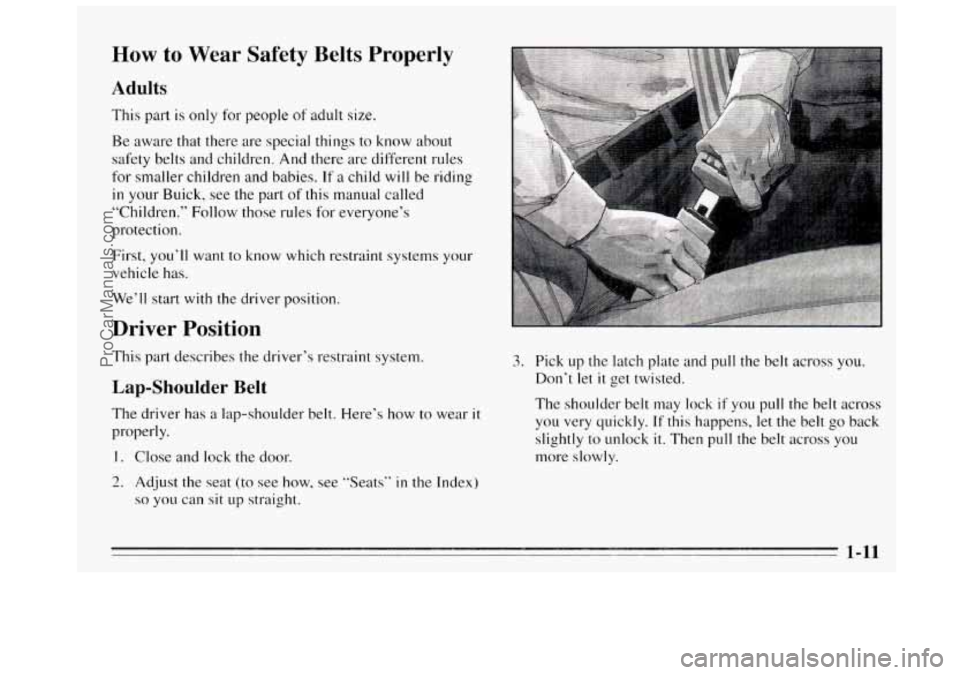
The driver has a lap-shoulder belt. Here’s how to wear it
properly.
I. Close. and lock the door.
2. Adjust the seat (to see how, see “Seats” in the Index)
so you can sit up straight. 3.
Pick up the latch plate and pull the belt across you.
Don’t let
it get twisted.
The shoulder belt may lock
if you pull the belt across
you
very quickly. If this happens, let the belt go back
slightly to unlock
it. Then pull the belt across you
more slowly.
1-11
ProCarManuals.com
Page 36 of 340
Safety Belt Use During Pregnancy
Safety belts work for everyone, including pregnant
women. Like all occupants, they are more likely to be
seriously injured if they don’t wear safety belts.
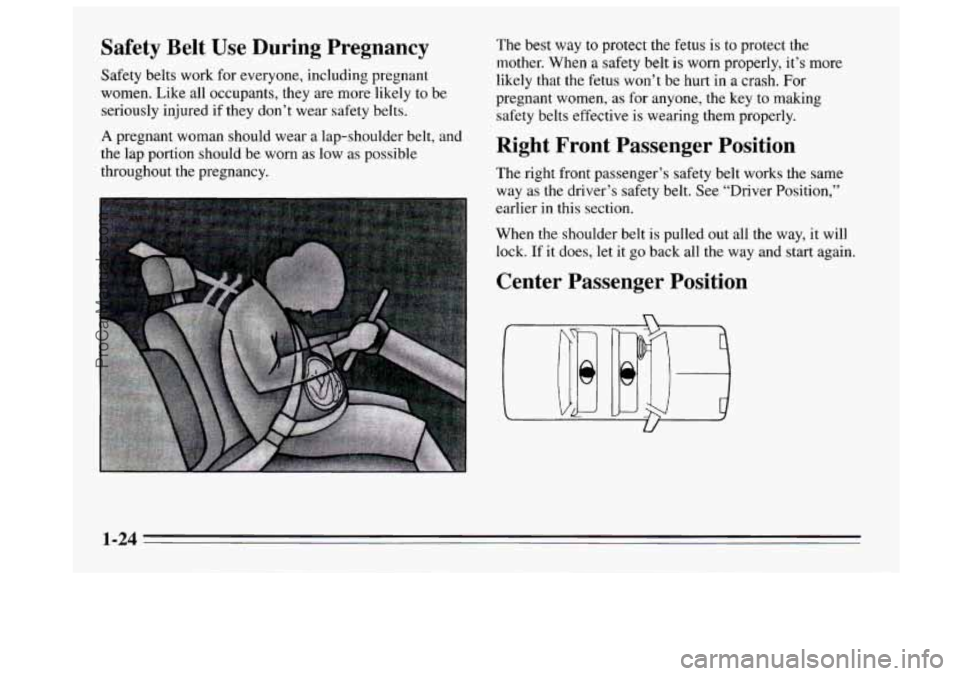
A pregnant woman should wear a lap-shoulder belt, and
the lap portion should be worn as low as possible
throughout the pregnancy. The best
way to protect the fetus
is to protect the
mother. When
a safety belt is worn properly, it’s more
likely that the fetus won’t
be hurt in a crash. For
pregnant women, as for anyone, the key to making
safety belts effective is wearing them properly.
Right Front Passenger Position
The right front passenger’s safety belt works the same
way as the driver’s safety belt. See “Driver Position,”
earlier
in this section.
When the shoulder belt is pulled out all the way, it will
lock. If
it does, let it go back all the way and start again,
Center Passenger Position
1-24
ProCarManuals.com
Page 42 of 340
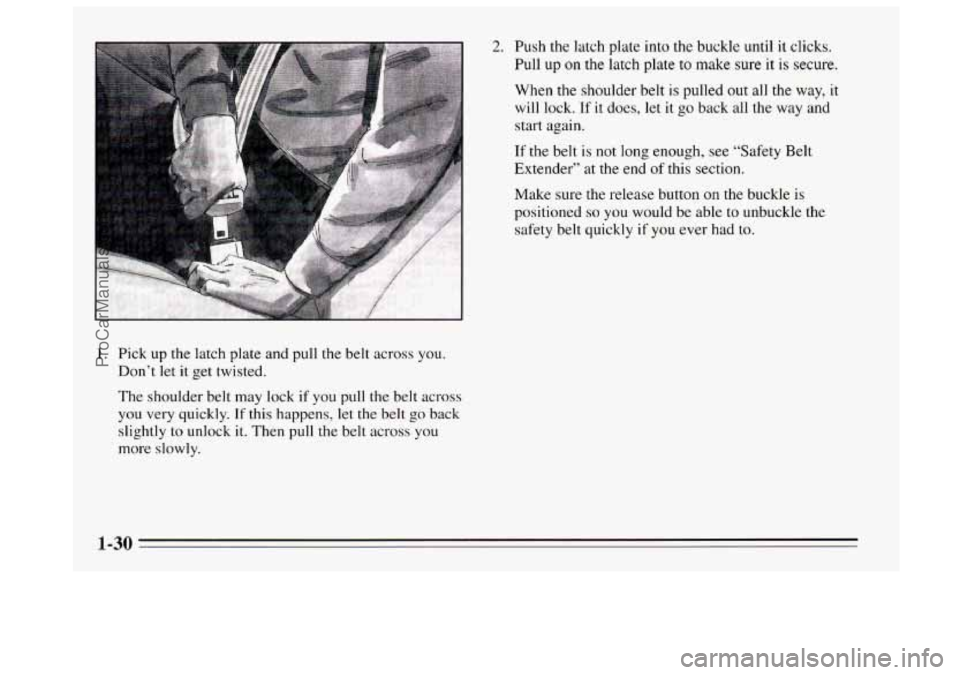
1. Pick up the latch plate and pull the belt across you.
Don’t let it get twisted.
The shoulder belt may lock
if you pull the belt across
you very quickly. If this happens, let the belt go back
slightly
to unlock it. Then pull the belt across you
more slowly.
2. Push the latch plate into the buckle until it clicks.
Pull up on the latch plate to make sure it is secure.
When the shoulder belt
is pulled out all the way, it
will lock.
If it does, let it go back all the way and
start again.
If the belt is not long enough, see “Safety Belt
Extender” at the end
of this section.
Make sure the release button
on the buckle is
positioned
so you would be able to unbuckle the
safety belt quickly if
you ever had to.
1-30
ProCarManuals.com
Page 63 of 340
Section 2 Features and Controls
Here you can learn about the many standard and
optional features on your Buick, and information on
starting, shifting and braking.
Also explained are the
instrument panel and the warning systems that
tell you if
everything is working properly -- and what to do if you
have a problem.
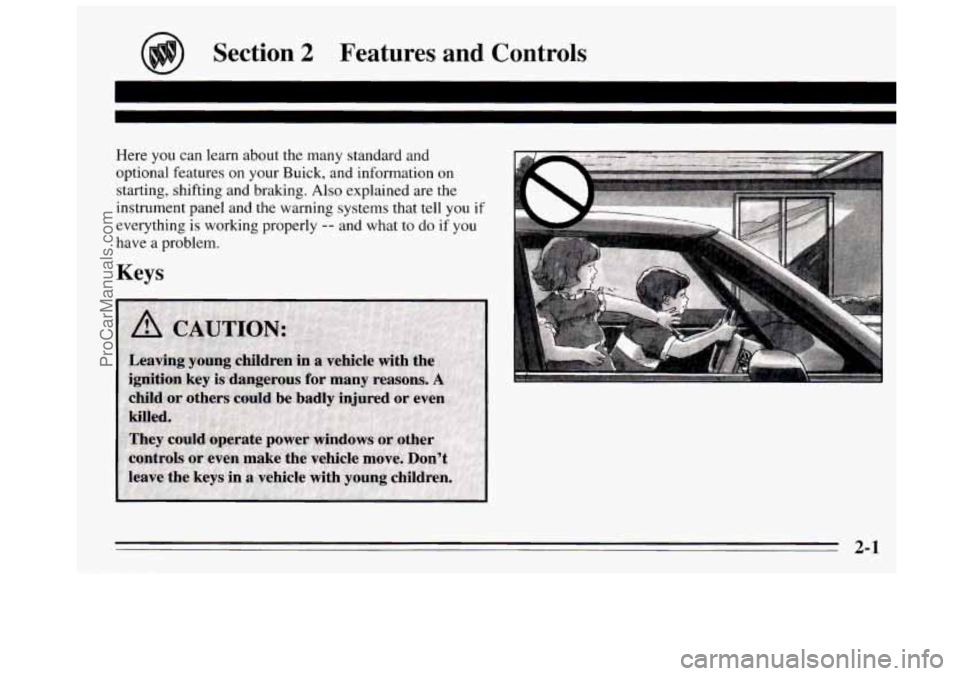
Keys
2-1
ProCarManuals.com
Page 71 of 340

PASS-Key@II
Your vehicle is equipped
with the PASS-Key%
(Personalized Automotive
Security System) theft
deterrent system.
PASS-Key% is a passive
theft deterrent system. This
means
you don’t have to do
anything different
to arm or
disarm the system.
It works when you insert or remove the key from
the
ignition. PASS-Key% uses a resistor pellet in the ignition
key that matches
a decoder in your vehicle.
When the PASS-Key% system senses that someone is
using the wrong key, it shuts down the vehicle’s starter and
fuel systems. For about three minutes, the starter won’t work and fuel won’t go to the engine. If someone tries to
start your vehicle again or uses another key during this
time, the vehicle will
not start. This discourages someone
from randomly trying different keys with different resistor
pellets in
an attempt to make a match.
The ignition key must be clean and dry before it’s
inserted in the ignition or the engine may not start. If the
engine does not
start and the SECURITY light is on, the
key may be dirty or wet. Turn the ignition off. Clean and dry the
key. Wait about three minutes and try
again. The security light may remain on during this
time. If the starter still won’t work, and the key appears
to be clean and dry, wait about three minutes and try
another ignition key. At this time, you may also want
to
check the fuse (see “Fuses and Circuit Breakers” in the
Index). If the starter won’t work with the other key, your
vehicle needs service. If your vehicle does start,
the first
ignition key may be faulty. See your Buick dealer or a
locksmith who can service
the PASS-Key@II.
If you accidentally use a key that has a damaged or
missing resistor pellet, the starter won’t work, and the
SECURITY light will flash. But
you don’t have to wait
three minutes before trying another ignition key.
See your Buick dealer or a locksmith who can service
the PASS-Key%
to have a new key made.
If you’re ever driving and the SECURITY light comes
on, you will be able to restart your engine if you turn it
off. Your PASS-Key% system, however, is not
working properly and must be serviced by
your Buick
dealer. Your vehicle is not protected by the
PASS-Key@II system.
If you lose or damage a PASS-Key% ignition
key,
see your Buick dealer or a locksmith who can service
PASS-Key@II
to have a new key made.
2-9
ProCarManuals.com
Page 72 of 340
New Vehicle “Break-In”
NOTICE:
Your modern Buick doesn’t need an elaborate
“break-in.” But it will perform better in the long
run if you follow these guidelines:
Don’t drive at any one speed -- fast or
slow
-- for the first 500 miles (804 km).
Don’t make full-throttle starts.
200 miles (322 km) or so. During this time
your new brake linings aren’t yet broken
in. Hard stops with new linings can mean
premature wear and earlier replacement.
Follow this “breaking-in” guideline every
time you get new brake linings.
Don’t tow a trailer during “break-in.” See
“Towing a Trailer’’ in the Index for more
information.
Avoid making hard stops for the first
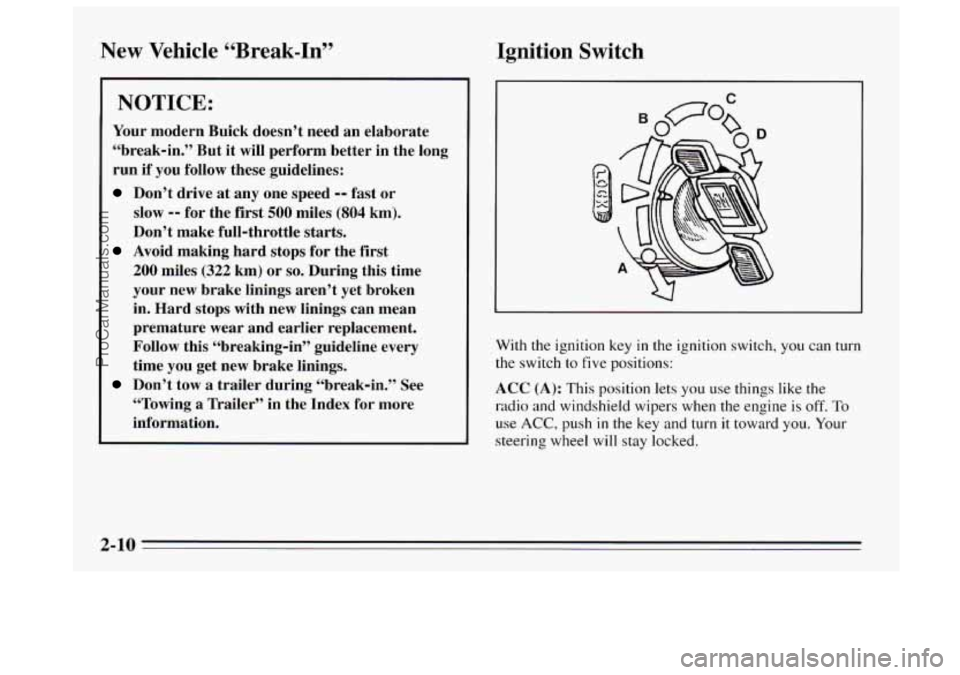
Ignition Switch
U
With the ignition key in the ignition switch, you can turn
the switch
to five positions:
ACC (A): This position lets you use things like the
radio and windshield wipers when the engine is
off. To
use ACC, push in the key and turn it toward you. Your
steering wheel will stay locked.
2-10
ProCarManuals.com
Page 73 of 340
LOCK: Before you put the key into the ignition switch,
the switch is in
LOCK. It’s also the only position in
which you can remove your key. This position locks
your ignition, steering wheel and transaxle. It’s a
theft-deterrent feature.
OFF (B): This position lets you turn off the engine but
still turn the steering wheel. It doesn’t lock the steering
wheel
like LOCK. Use OFF if you must have your
vehicle pushed or towed.
RUN (C): This position is where the key returns after
you start your vehicle. With the engine off,
you can use
RUN to display some
of your warning and indicator
lights.
START (D): This position starts your engine.
A warning chime will sound if you open the driver’s
door when
the ignition is in OFF, LOCK or ACC and
the key is
in the ignition.
NOTICE:
If your key seems stuck in LOCK and you can’t
turn it, be sure it is all the
way in. If it is, then
turn the steering wheel left and right while you
turn the key hard. But turn the key only with
your hand. Using a tool to force it could break
the key or the ignition switch. If none of this
works, then your vehicle needs service.
Starting Your Engine
Engines start differently. The 8th digit of your Vehicle
Identification Number (VIN) shows the code letter
or
number for your engine. You will find the VIN at
the top
left of your instrument panel. (See “Vehicle
Identification Number” in
the Index.) Follow the proper
steps to start
the engine.
Move your shift lever
to PARK (P) or NEUTRAL (N).
Your engine won’t start
in any other position -- that’s a
safety feature. To restart when you’re already moving,
use NEUTRAL
(N) only.
2-11
ProCarManuals.com