1994 PONTIAC BONNEVILLE power steering
[x] Cancel search: power steeringPage 53 of 290
Features & Controls
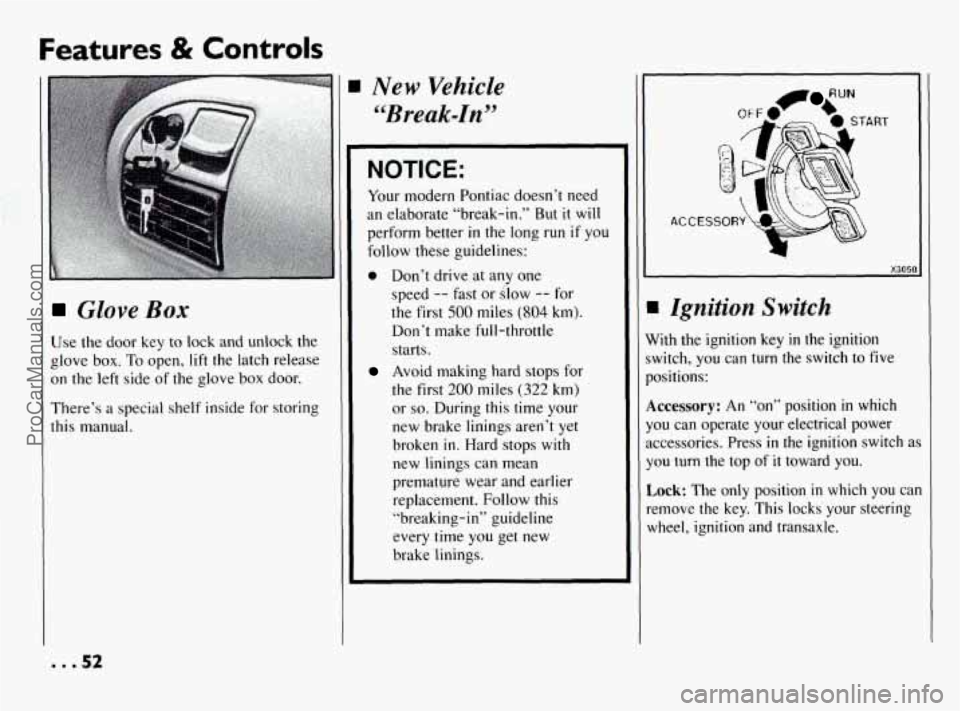
1 Glove Box
Use the door key to lock and unlock the
glove box.
To open, lift the latch release
on the
left side of the glove box door.
There’s a special shelf inside for storing
this manual.
New Vehicle
“Break-In”
NOTICE:
Your modern Pontiac doesn’t need
an elaborate “break-in.” But
it will
perform better in the long run if you
follow these guidelines:
0 Don’t drive at any one
speed
-- fast or slow -- for
the first
500 miles (804 km).
Don’t make full-throttle
starts.
Avoid making hard stops for
the first 200 miles (322 km)
or so. During this time your
new brake linings aren’t yet
broken in. Hard stops with
new linings can mean
premature wear and earlier
replacement. Follow this
“breaking-in” guideline
every
time you get new
brake linings.
RUN
x305a
I Ignition Switch
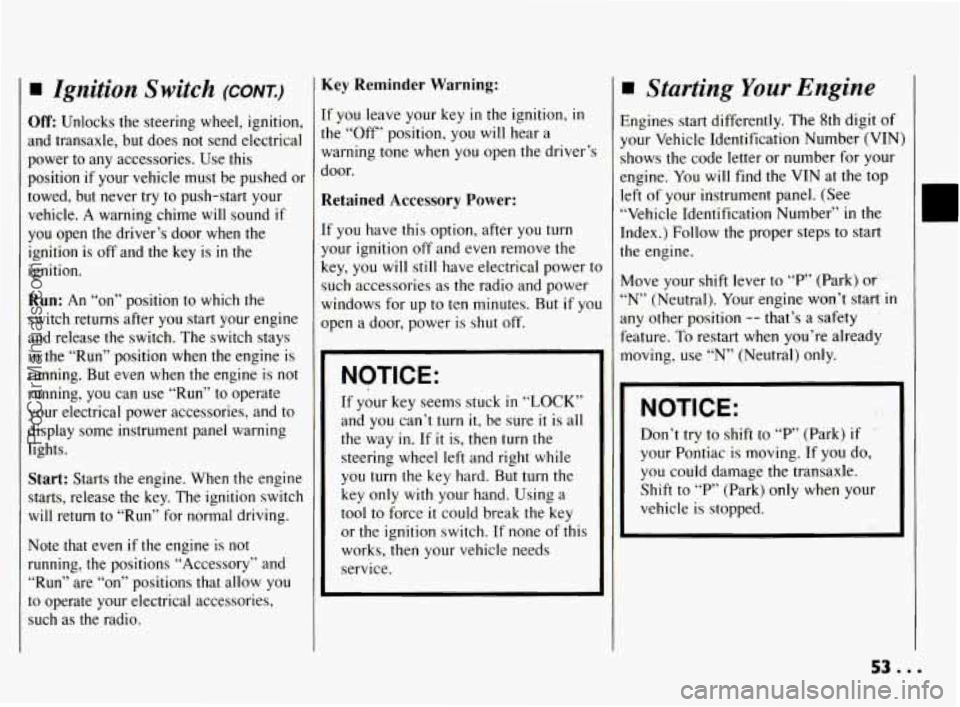
Nith the ignition key in the ignition
witch, you can
turn the switch to five
)ositions:
4ccessory: An “on” position in which
’ou can operate your electrical power
Iccessories. Press
in the ignition switch as
rou turn the top of it toward you.
,ock: The only position in which you can
‘emove the key. This locks your steering
vheel, ignition and transaxle.
... 52
ProCarManuals.com
Page 54 of 290
Ignition Switch (CONK)
Off: Unlocks the steering wheel, ignition,
and transaxle, but does not send electrical
power to any accessories. Use this
position
if your vehicle must be pushed or
towed,
but never try to push-start your
vehicle.
A warning chime will sound if
you open the driver’s door when the
ignition is off and the key is
in the
ignition.
Run: An “on” position to which the
switch returns after you start your engine
and release the switch. The switch stays
in the “Run” position when the engine is
running. But even when the engine is not
running, you can use “Run” to operate
your electrical power accessories, and to
display some instrument panel warning
lights.
Start: Starts the engine. When the engine
starts, release the key. The ignition switch
will return to “Run” for normal driving.
Note
that even if the engine is not
running, the positions “Accessory” and
“Run” are “on” positions that allow you
to operate your electrical accessories,
such as the radio.
Key Reminder Warning:
If you leave your key in the ignition, in
the “Off’ position, you will hear a
warning tone when you open the driver’s
door.
Retained Accessory Power:
If you have this option, after you turn
your ignition
off and even remove the
key, you
will still have electrical power to
such accessories as the radio and power
windows for
up to ten minutes. But if you
open
a door, power is shut off.
NOTICE:
If your key seems stuck in “LOCK”
and you can’t turn it, be sure it is all
the way
in. If it is, then turn the
steering wheel left and right
while
you turn the key hard. But turn the
key only
with your hand. Using a
tool to force it could break the key
or the ignition switch. If none
of this
works,
then your vehicle needs
service.
Starting Your Engine
Engines start differently. The 8th digit of
your Vehicle Identification Number (VIN)
shows the code letter or number for your
engine. You
will find the VIN at the top
left of your instrument panel. (See
“Vehicle Identification Number”
in the
Index.) Follow the proper steps to start
the engine.
Move your shift lever to
“P’ (Park) or
“N” (Neutral). Your engine won’t start in
any other position -- that’s a safety
feature. To restart when you’re already
loving, use
“N” (Neutral) only.
NOTICE:
Don’t try to shift to “P” (Park) if
your Pontiac is moving. If you do,
you could damage the transaxle.
Shift to
“P” (Park) only when your
vehicle is stopped.
ProCarManuals.com
Page 68 of 290
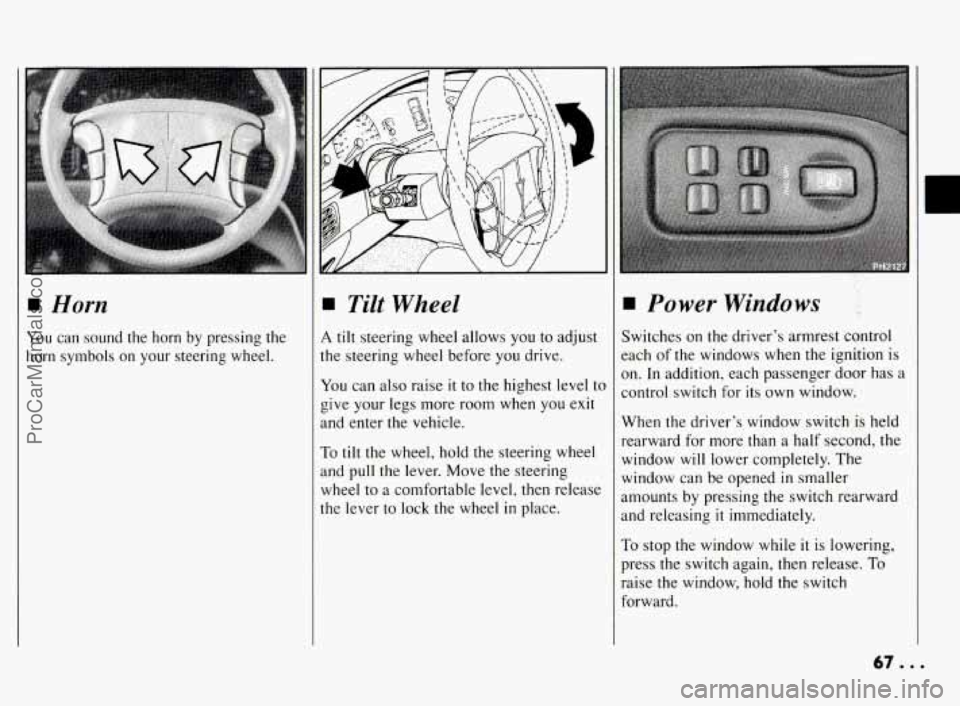
1 Horn
You can sound the horn by pressing the
horn symbols on your steering wheel.
Tilt Wheel
4 tilt steering wheel allows you to adjust
he steering wheel before
you drive.
Ir'ou can also raise it to the highest level tc
give your legs more room when you exit
tnd enter the vehicle.
To tilt the wheel, hold the steering wheel
tnd
pull the lever. Move the steering
Nheel to a comfortable level, then release
he lever to lock the wheel
in place.
Power Windows ,I
Switches on the driver's armrest control
each of the windows when the ignition is
on. In addition, each passenger door has
a
control switch for its own window:
When the driver's window switch
is held
rearward for more
than a half second, the
window
will lower completely. The
window can be opened
in smaller
amounts by pressing the switch rearward
and releasing
it immediately.
To stop the window while
it is lowering,
press the switch again, then release.
To
raise the window, hold the switch
forward.
67 ...
ProCarManuals.com
Page 112 of 290
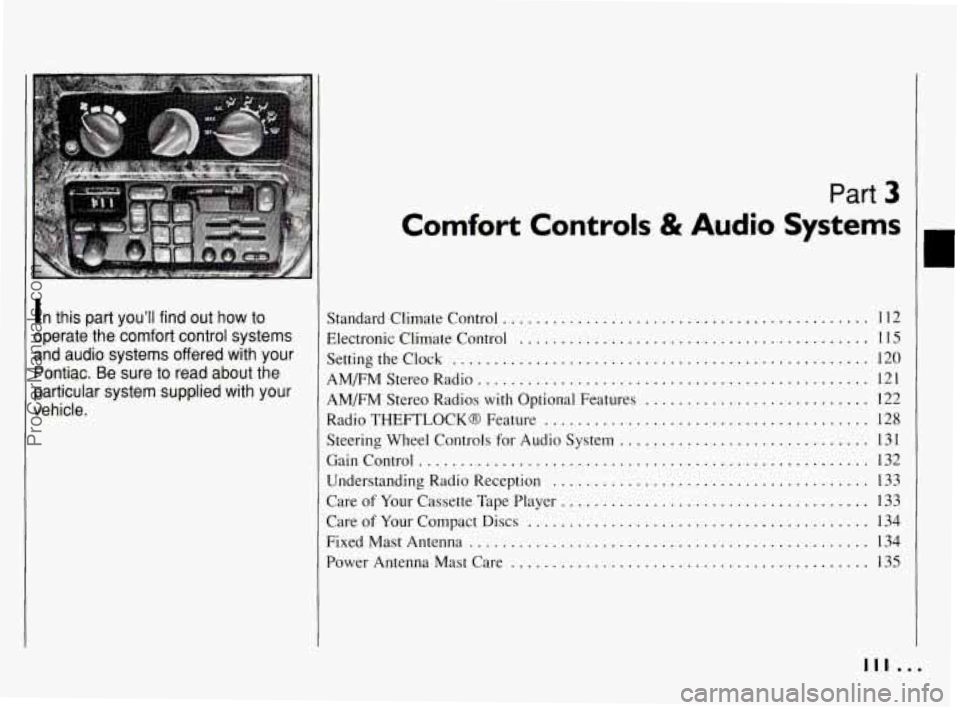
In this part you’ll find out how to
operate the comfort control systems
and audio systems offered with your
Pontiac
. Be sure to read about the
particular system supplied with your
............................................ Standard Climate Control 112
Settingtheclock
.................................................. 120
AM/FM Stereo Radio 121
Electronic
Climate Control
.......................................... 115
AM/FM Stereo Radios
with Optional Features ........................... 122
Radio
THEFTLOCK8 Feature ....................................... 128
Steering Wheel Controls for Audio System
.............................. 131
Gaincontrol
.................................................... 132
Understanding Radio Reception
........ ....................... 133
Care
of Your Cassette Tape Player ....... ....................... 133
Care of Your Compact Discs ......................................... 134
Power Antenna Mast Care
.......... .............................. 135
...............................................
FixedMastAntenna ................................................ 134
111 .I
ProCarManuals.com
Page 145 of 290
Your Driving and the Road
Traction Control System
(OPTION) (CONI)
snow. See “Rocking Your Vehicle” in the
Index.)
To turn the system off, press the
“TRACTION CONTROL” button.
The “TRACTION
OFF” warning light
will come on and stay on. If the system is
limiting wheel spin when
you press the
button, the system won’t turn off right
away. It will wait until there’s no longer a
current need to limit wheel spin.
You can turn the system back on at any
time by pressing the button again. The
“TRACTION
OFF” warning light
should go off.
Braking in Emergencies
Use your anti-lock braking system when
you need to. With anti-lock, you can steer
and brake at the same time. In many
emergencies, steering can help
you more
than even the very best braking.
Steering
Power Steering
If you lose power steering assist because
the engine stops or the system is not
functioning,
you can steer but it will take
much more effort.
Variable Effort Steering
If your vehicle is equipped with this
option,
you have a variable effort steering
system that eases steering effort at speeds
less than
20 mph (32 km/h). This is
particularly useful when parking your
vehicle.
Steering Tips
Driving on Curves
It’s important to take curves at a
reasonable speed.
A lot of the “driver lost control” accidents
mentioned on the news happen on curves.
Here’s why: Experienced driver or beginner, each
of
us is
subject to the same laws of physics
when driving on curves. The traction
of
the tires against the road surface makes it
possible for the vehicle to change its path when
you turn the front wheels. If there’s
no traction, inertia will keep the vehicle
going in the same direction. If you’ve
ever tried to steer a vehicle on wet
ice,
you’ll understand this.
The traction you can get in a curve
depends on the condition of your tires and
the road surface;
the angle at which the
curve is banked, and your speed. While
you’re in a curve, speed is the one factor
you can control.
Suppose you’re steering through a sharp
curve. Then
you suddenly accelerate.
Both control systems
-- steering and
acceleration
-- have to do their work
where the tires meet the road. Unless
you
have traction control and the system is on,
adding the sudden acceleration can
demand too much
of those places. You
can lose control.
... 144
ProCarManuals.com
Page 202 of 290
3800 Engine (CODE L)
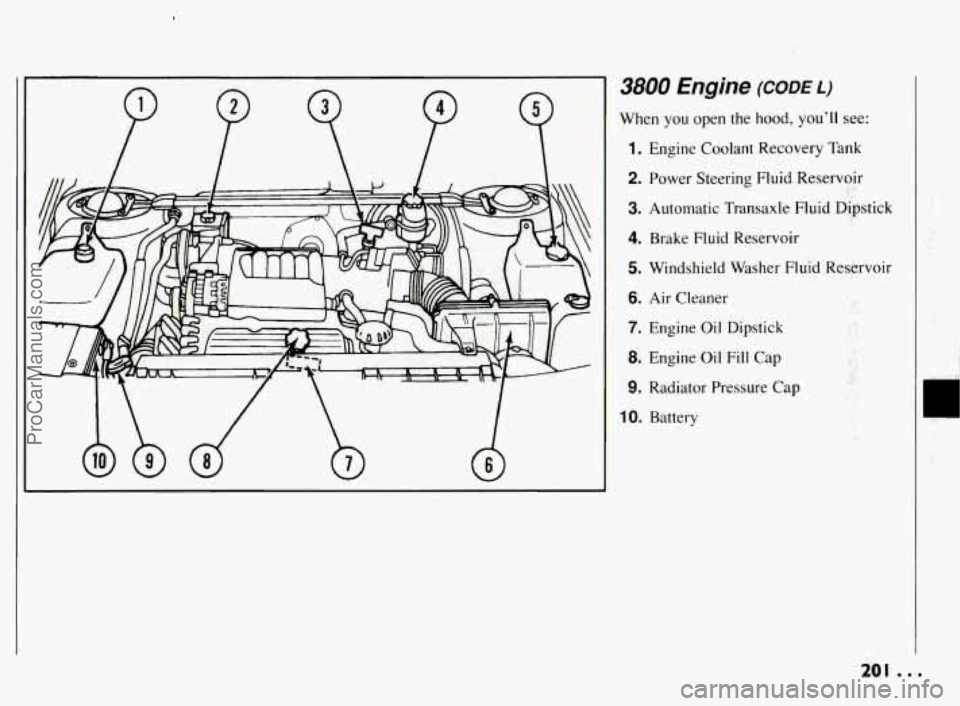
When you open the hood, you'll see:
1. Engine Coolant Recovery Tank
2. Power Steering Fluid Reservoir
3. Automatic Transaxle Fluid Dipstick
4. Brake Fluid Reservoir
5. Windshield Washer Fluid Reservoir
6. Air Cleaner
7. Engine Oil Dipstick
8. Engine Oil Fill Cap
9. Radiator Pressure Cap
10. Battery I. .. I I 5 ;;$ " :. 1. ,.:.;
201 ..*
ProCarManuals.com
Page 203 of 290
Service & Appearance Care
. 0 202
3800 SC Engine (CODE I)
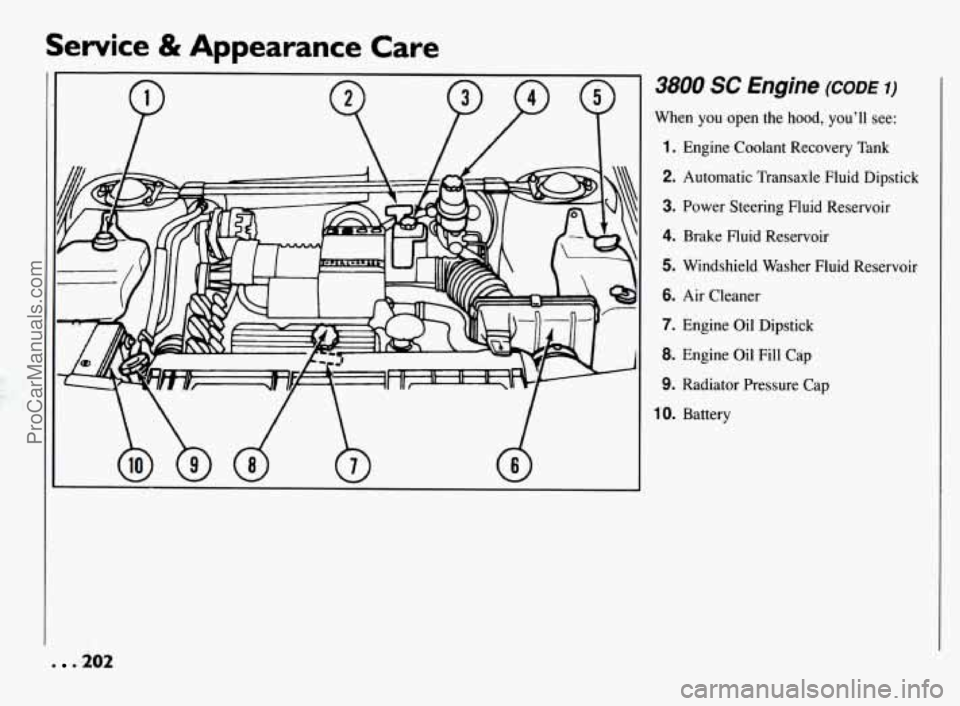
When you open the hood, you’ll see:
1. Engine Coolant Recovery Tank
2. Automatic Transaxle Fluid Dipstick
3. Power Steering Fluid Reservoir
4. Brake Fluid Reservoir
5. Windshield Washer Fluid Reservoir
6. Air Cleaner
7. Engine Oil Dipstick
8. Engine Oil Fill Cap
9. Radiator Pressure Cap
lo. Battery
ProCarManuals.com
Page 204 of 290
n
D
~~ ~~~ ~~ ~ ~~~~ ~ ~ ~
Engine Accessory Belt
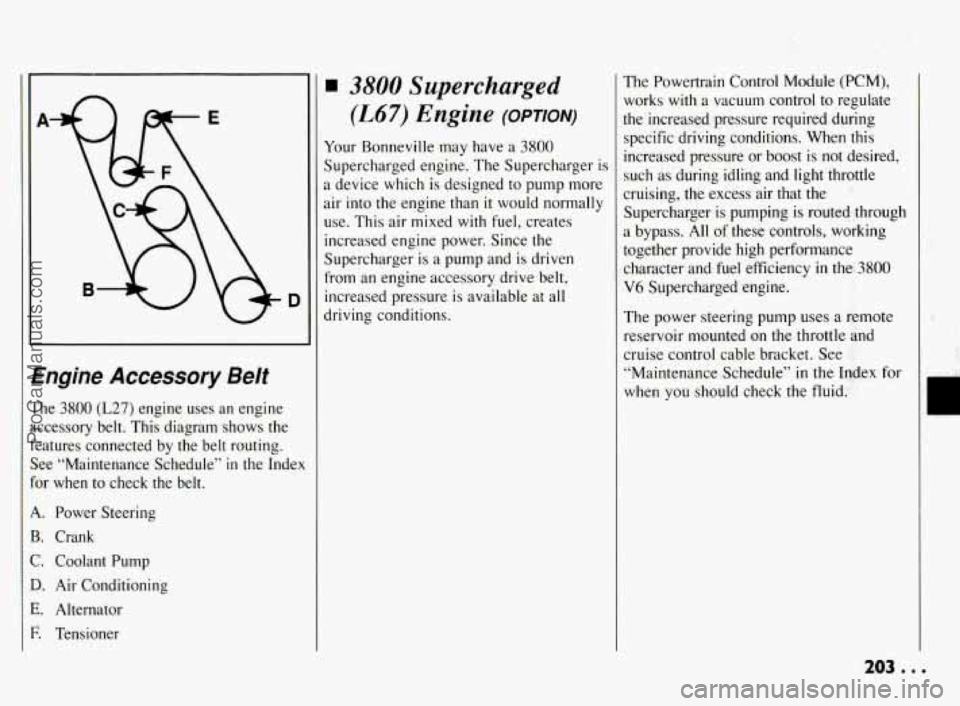
The 3800 (L27) engine uses an engine
accessory belt. This diagram shows the
features connected by the belt routing.
See “Maintenance Schedule’’
in the Index
for when to check the belt.
A. Power Steering
B. Crank
C. Coolant Pump
D. Air Conditioning
E. Alternator
F. Tensioner
3800 Supercharged
(L67) Engine (OPTION)
Your Bonneville may have a 3800
Supercharged engine. The Supercharger is
a device which is designed to pump more
air into the engine than
it would normally
use. This air mixed
with fuel, creates
increased engine power. Since the
Supercharger is a pump and is driven
from an engine accessory drive belt,
increased pressure is available at all
driving conditions, The Powertrain Control
Module
(PCM),
works with a vacuum control to regulate
the increased pressure required during
specific driving conditions. When this
increased pressure or boost is
not desired,
such as during idling and light throttle
cruising, the excess air that the
’
Supercharger is pumping is routed,through
a bypass. All of these controls, working
together provide high performance
character and fuel efficiency
in the3800
V6 Supercharged engine.
The power steering pump uses a Remote
reservoir mounted on the throttle wd
cruise control cable bracket. See
“Maintenance Schedule”
in the Index for
when you should check the fluid:
ProCarManuals.com