1994 JAGUAR XJ6 beam
[x] Cancel search: beamPage 387 of 521

Steering and Suspension
W: When checking the steering geometry, use the pull-down tools front and rear to set the ride height front and
rear to the following dimensions:
Front ride height
................................................... 153 f 5mm to underside of front
crossbeam
Rear ride height
.................................................... 160 f 5mm to underside of rear
edge of A frame
Front ride height
................................................... 143 f 5mm to underside of front
crossbeam
Rear ride height
.................................................... 160 f 5mm to underside of rear
edge of A frame
U: Sportspack derivatives whose kerb height is below the above figures can have their geometry checked at that
height.
Front Suspension
..............................................................
0
Type Independent front suspension
consisting of double wishbones
with coil springs and separate
dampers and anti
-roll bar.
Dampers
.......................................................... Telescopic, gas pressurised
Caster angle
....................................................... 3,0° to 6,0° and with opposing
wheels within Io of each other
Camberangle
...................................................... 0,3°to-0,80
Front wheel alignment .............................................. Total toe: 5 minutes in f 10 minutes
Rear Suspension
Type .............................................................. Fully independent rear suspension of double wishbone principle with
axle shaft operating as upper
wishbone incorporating coaxial
springs and dampers with optional
rear anti
-roll bar.
Camber angle
(at design ride height):
all vehicles except supercharged ................................. -0,75O f 0,4O
supercharged only -1,6O f 0,4O ..............................................
0 Rear wheel alignment .............................................. Total toe: 15 minutes in f20
Dampers .......................................................... Telescopic, gas pressurised
minutes
Power Assisted Steering
Type .............................................................. ZF
Servotronic speed-sensitive rack
and pinion
Number
of turns lock to lock ........................................ 2,768
Turning circle: (wall to wall)
....................................................... 12,9m (42ft 4in)
(curb to curb) ...................................................... 12,4m (40ft 8in)
0
X300 VSM Issue 1 August 1994 AI-95MY 4 ~~~~
Page 395 of 521

Description Capacity Type
Door guard lamp. 12V 5W Capless long life
Flasher side repeater 12V 5W Capless long life
Fog lamp - Front. 12v 55w Halogen H3
Fog lamp
- Rear guard 12v 21w Bayonet long life
Front turn indicator
I 12v21w I Bayonet long life
Pilot lamp
I 12V 5W I Capless long life
Headlamp
I 12v55w I Halogen HI
High mounted stop lamp (where fitted). 12v Capless long life
Roof console central courtesy lamp
12V 5W Capless long life.
Roof console reading lamp
12V 6W Capless
Luggage compartment lamp
12V 5W Capless long life
License plate lamp 12V 5W Festoon
Rear turn indicator
12v 21w Bayonet yellow long
Rear quarter courtesy lamp (lower section)
12V 5W Capless long life
Rear quarter reading lamp (upper section) 12V 6W Capless
Back
-up lamp 12v 21w Bayonet long life
Stop /Tail lamp
Sun visor vanity mirror lamp
12v 1,2w Capless 286
Tail lamp 12V 5W Bayonet long life
5X5W
12V 21V 5W Twin filament bayonet long life
Indicator bulbs
Bulb Designation Holder Colour Rating
Exhaust temperature warning indicator bulb Orange 12,5V 1,2W
Low oil pressure indicator bulb
Orange 12,5V 1,2W
Seat belt warning indicator bulb
Orange 12,5V 1,2W
Boot open warning indicator bulb
Orange 12,5V 1,2W
Door open warning indicator bulb
Orange 12,5V 1,2W
Coolant level warning indicator bulb
Orange 12,5V 1,2W
Air bag fault indicator bulb Orange 12,5V 1,2W
Parking brake 'on' indicator bulb Orange 12,5V 1,2W
Brake system warning indicator bulb Orange 12,5V 1,2W
Main beam 'on' indicator bulb
Orange 12,5V 1,2W
Right turn indicator bulb Orange 12,5V 1,2W
LCD illumination bulb (right)
Orange 12,5V 1,2W
LCD illumination bulb (left) Orange 12,5V 1,2W
Left turn indicator bulb
Orange 12,5V 1,2W
Traction control 'off indicator bulb
Orange 12,5V 1,2W
Transmission sport mode indicator bulb
Orange 12,5V 1,2W
Charging fault warning bulb
Orange 12,5V 1,2W
Check engine warning indicator bulb Orange 12,5V 1,2W
0
0
0
X300 VSM Issue 1 August 1994 AI-95MY 12
Page 397 of 521
Specification
w IfrnrnJ
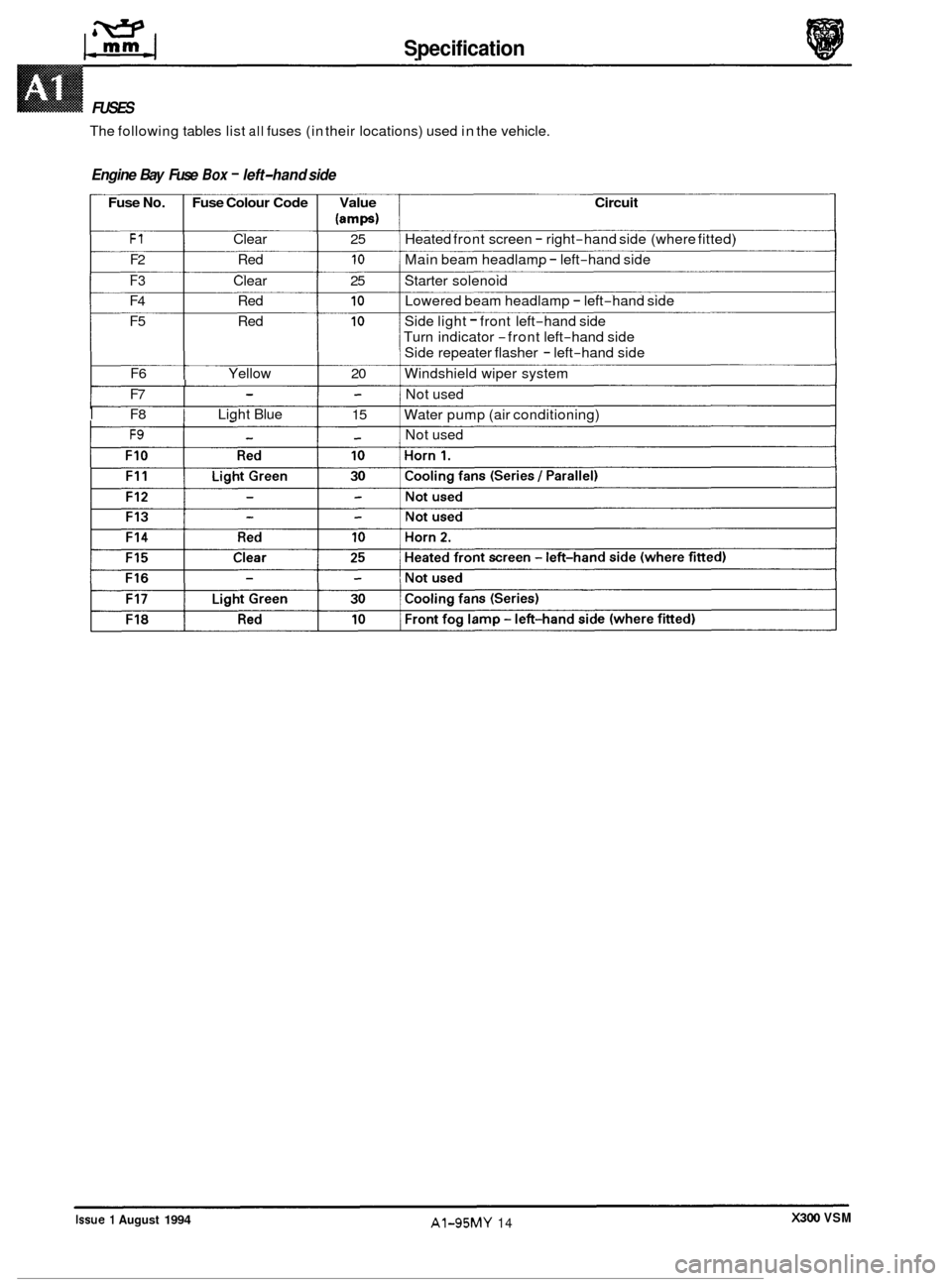
FUSES
The following tables list all fuses (in their locations) used in the vehicle.
Engine Bay Fuse Box - left-hand side
Fuse No. Fuse Colour Code Value Circuit
lamps)
F1 Clear 25 Heated front screen - right-hand side (where fitted)
F2 Red 10 Main beam headlamp - left-hand side
F3 Clear 25 Starter solenoid
F4 Red 10 Lowered beam headlamp - left-hand side
F5 Red 10 Side light - front left-hand side
Turn indicator
-front left-hand side
Side repeater flasher
- left-hand side
F6 Yellow 20 Windshield wiper system
I F8 I Light Blue
I Not used
F9 - - Not used
- - F7
15
Water pump (air conditioning) I - -
-l
X300 VSM Issue 1 August 1994 AI-95MY 14
Page 398 of 521

0
Engine Bay Fuse Box - right-hand side
Fuse No. Fuse Colour Code
- F1
F2 Red
F3
F4 Red
F5 Red
-
F6 Tan
F7 Clear
F8 Red
F9 -
FIO Tan
F12 Red
F13 Red
F14 Red F15
-
F16 Red
F17 Light Green
F18 Red
Value
(amps)
10
10
10
5
25
10
-
5
20
10
10
10
10
30
10
Circuit
Not used
Main beam headlamp
- right-hand side
Not used
Lowered beam
headlamD - riaht-hand side ."
Side light -front right-hand side
Turn indicator
-front right-hand side
Side repeater flasher
- right-hand side
Engine control module
(ECM)
Air pump (6 cyl. - where fitted)
Ignition coils
(VIZ)
Air conditioning clutch
Not used
Generator
Front lighting control module
- right-hand
Air conditioning clutch
Windshield wash
J headlamp power wash heaters and relays
Engine management system relay supply
Injectors
Engine management system
Starter relay Ignition coil sensing and air pump relay (6
cyl.)
Fuel injection relay
Engine management sensing
(VIZ)
Windshield washer pump
Lambda heaters
Idle speed control valve
Not used
Air pump control
Solenoid vacuum valve
(VIZ)
Water pump (supercharged)
Headlamp power wash pump
Front fog lamp
- right-hand side (where fitted)
0
0
Issue 1 August 1994 X300 VSM AI-95MY 15
Page 436 of 521

Body Systems
A4.2.1.1 Constructional Steel Classification
Material 1 dnnlirdiam I
High strength low alloy (HLSA).
Double sided zinc plated mild steel.
1 Boron steel
1 Mild steel.
A4.2.2 BODY ALIGNMENT
The illustrations on pages 11 - Body Dimensions PLAN, and 13 -Body Dimensions SIDE VIEW, provide specifications
for damage assessment and location of replacement parts.
These dimensions must be strictly applied whether they are used for damage assessment, component location or post
repair verification.
The plan view MASTER datums are nominated on the right
-hand side of the body with the left-hand datums dimen- sioned from them. Therefore, the right-hand datums must be known to be correct before any other cross-ar dimen- sions are checked.
W: The right-hand side is always looking towards the front, from the rear of the vehicle.
All dimensions are derived from a single
(ZERO) datum point for all three axes; X for length, Z for height and V cross- car.
Issue 1 August 1994 9 X300 VSM
A4.2 BODY STRUCTURE
A4.2.1
Introduction
The Jaguar sedan range (with standard wheelbase) has a unit construction monocoque body structure with bolt-on
front fenders and welded rear fenders. The doors feature 'lift-off' hinges and welded dropglass frames.
n@#pn.s..v..
Impact prone areas, ie. seat frame and bumper mount- ings.
Exterior body panels subject to severe conditions such
as stone chipping and weather exposure (excluding
roof panel).
Door intrusion beams
Internal brackets, fillets and strengtheners.
I
Page 459 of 521

B C D
K J H G
A. Power steering -Warning F. Headlamp beam setting adjustment B. Shock absorber fixings -Warning G. Emission control data
C. Brake fluid type -Warning H. El 1 legislation label (not all markets) D. Clutch fluid type -Warning J. Rotating components - Warning
E. Coolant pressureltemperature -Warning K. Vacuum pipe routing
0
0
X300 VSM Issue 1 August 1994 32
Page 465 of 521
Body Systems & Body Repair
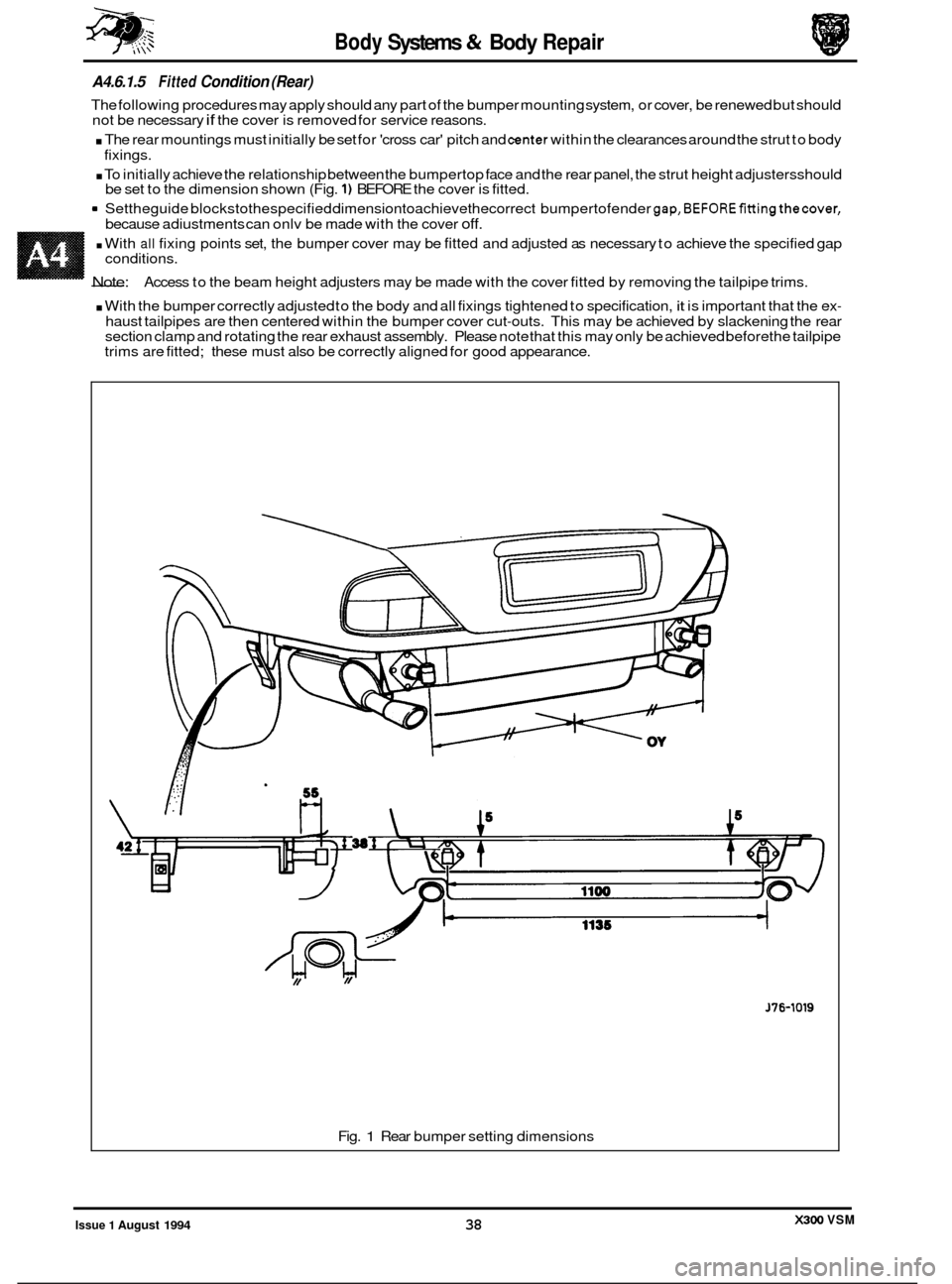
A4.6.1.5 Fitted Condition (Rear)
The following procedures may apply should any part of the bumper mounting system, or cover, be renewed but should
not be necessary if the cover is removed for service reasons.
. The rear mountings must initially be set for 'cross car' pitch and center within the clearances around the strut to body
. To initially achieve the relationship between the bumpertop face and the rear panel, the strut height adjustersshould
9 Settheguide blockstothespecified dimensiontoachievethecorrect bumpertofender gap,BEFOREfittingthecover,
fixings.
be set to the dimension shown (Fig.
1) BEFORE the cover is fitted.
because adiustments can onlv be made with the cover
off.
. With all fixing points set, the bumper cover may be fitted and adjusted as necessary to achieve the specified gap
- Note:
conditions.
Access to the beam height adjusters may be made with the cover fitted by removing the tailpipe trims.
. With the bumper correctly adjusted to the body and all fixings tightened to specification, it is important that the ex-
haust tailpipes are then centered within the bumper cover cut-outs. This may be achieved by slackening the rear
section clamp and rotating the rear exhaust assembly. Please note that this may only be achieved before the tailpipe
trims are fitted; these must also be correctly aligned for good appearance.
J76-1019
Fig. 1 Rear bumper setting dimensions
X300 VSM Issue 1 August 1994 38
Page 467 of 521

Body Systems 4% Body Repair
A4.6.3 REFINISHING
The paint refinishing system must be approved by Jaguar Cars Ltd., and be appropriate for polyurethane substrate
application. It is important that the finishing clear lacquer includes a plasticising ingredient (mixed to the manufac-
turer's recommendation) to reflect the 'semi-flex' condition of the factory finished item.
The effect of heat decreases the cover rigidity to the point that paint
-cure temperatures require that the cover must
be supported to prevent distortion and sagging; these comments apply to 'off-car' repairs.
A4.6.3.1 Original
On an original unit where damage has been repaired, the beam will provide sufficient support for the forward part of
the unit. It is recommended that the side armatures are supported as they would be on the vehicle.
A4.6.3.2 New
Where a new cover is required, the beam may be temporarily fitted priorto painting to provide the necessary support.
A4.6.3.3 All
Asimple jig (Fig. 1)should be madeto hold the unit in thecorrect working attitude for both damage repair and refinish- ing.
CAUTION: During heat cure, the effective panel temperature must not exd 95OC.
J76-1038
Fig. 1
A4.6.4 REPLACEMENT COVERS
Replacement covers will be supplied in a primed condition and therefore must be finished in accordance with A4.6.3,
this page.
Bumper covers and replacement fixings such as bumper beam adjusters and guide blocks must be fitted and adjusted
as detailed in
A4.6.1.4 and A4.6.1.5, this section.
A4.6.5 RECYCLED
MATERIALS - GENERAL NOTE
The aluminium bumper beam, as fitted to North American specification vehicles, should not be over-looked as a com- ponent for recycling.
Side armatures will be fully assembled in replacement bumper covers, please see 'note' Recycled materials, this sec
-
tion, for important information.
Issue 1 August 1994 40
0
x300 VSM