Page 74 of 385
If Your Diesel Engine Won’t Start
If you’ve run out of fuel, look at “Running Out of Fuel” (see “Diesel Fuel
Requirements and Fuel System” in the Index).
If you’re not out of fuel, and your engine won’t start, do this:
Turn your ignition key to RUN. Make sure that the “GLOW PLUGS” light
is out. Then turn the ignition key to
START.
If the light doesn’t go off, wait a few seconds, then try starting your engine
again. And, see your dealer as soon as you can for a starting system check.
If the light comes on and then goes off and you know your batteries are
charged, but your engine still won’t start, your vehicle needs service.
If the light does not come
on when the engine is cold, your vehicle needs
service.
If your batteries don’t have enough charge to start your engine, see
“Battery” in the Index.
Be sure you have the right oil for your engine, and that you’ve changed the
oil at the proper times. If you use the wrong oil, your engine may be harder
to start.
If the engine starts, runs a short time, then stops, your vehicle needs service.
Engine Coolant Heater (Engine Block Heater)
2- 19
ProCarManuals.com
Page 80 of 385
Shift Light
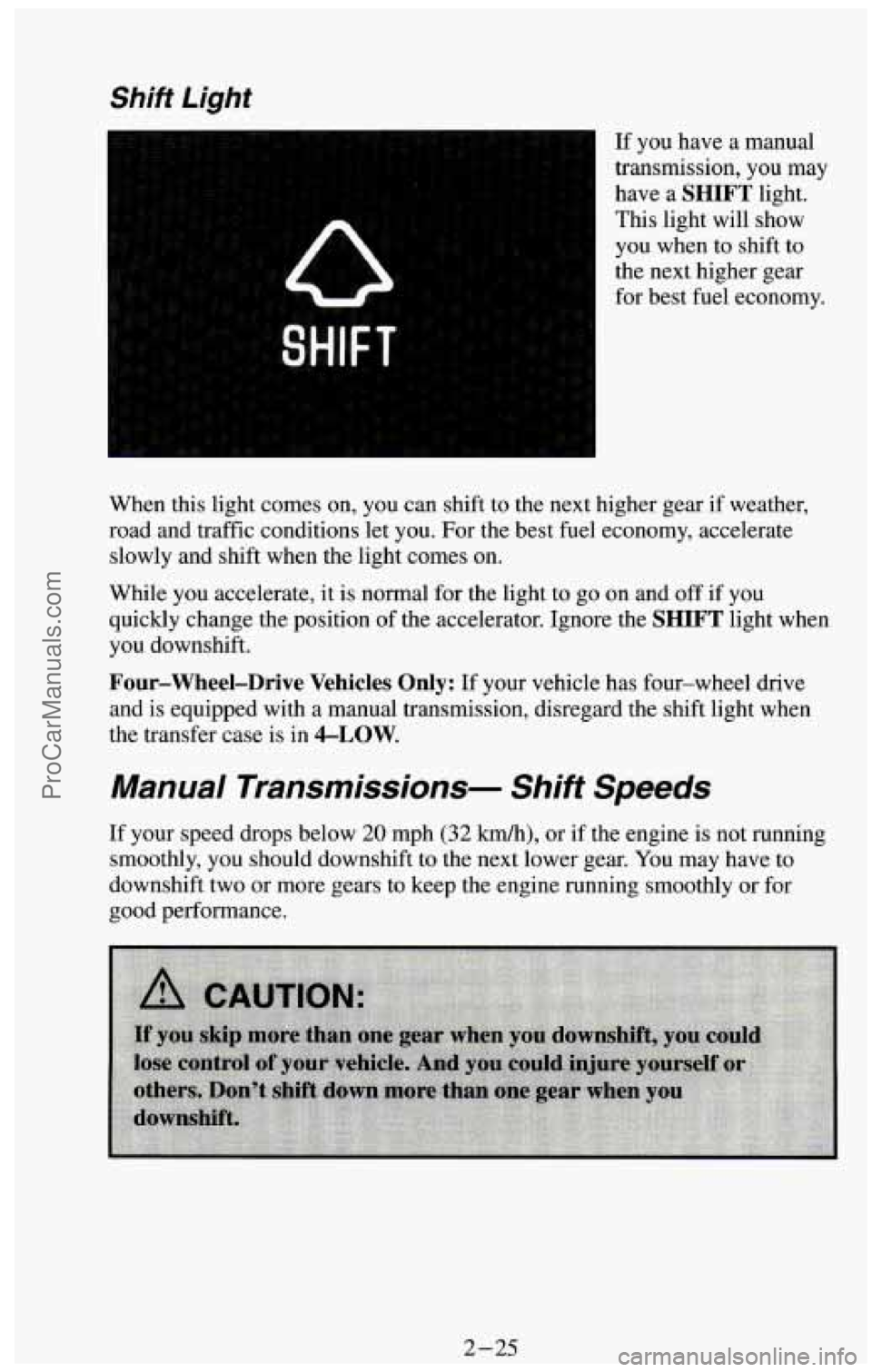
If you have a manual
transmission, you may
have a
SHIFT light.
This light will show
you when to shift to
the next higher gear
for best fuel economy.
When this light comes on, you can shift to the next higher gear if weather,
road and traffic conditions let you. For the best fuel economy, accelerate
slowly and shift when the light comes on.
While you accelerate, it is normal for the light to go on and off if you
quickly change the position of the accelerator. Ignore the
SHIFT light when
you downshift.
Four-Wheel-Drive Vehicles Only: If your vehicle has four-wheel drive
and is equipped with a manual transmission, disregard the shift light when
the transfer case is in
4-LOW.
Manual Transmissions- Shift Speeds
If your speed drops below 20 mph (32 lun/h), or if the engine is not running
smoothly, you should downshift to the next lower gear. You may have to
downshift two or more gears to keep the engine running smoothly or for
good performance.
2-25 ProCarManuals.com
Page 81 of 385
I NOTICE:
If you skip more than one gear when you downshift, or if you
race the engine when you downshift, you can damage the engine,\
clutch
or transmission.
Locking Rear Axle
If you have this feature, your rear axle can give you additional traction on
snow, mud, ice, sand or gravel. It works like a standard axle most of the
time, but when one
of the rear wheels has no traction and the other does, the
locking feature will allow the wheel with traction to move the vehicle.
Parking Brake
To set the parking brake:
Hold the regular brake
pedal down with your
right foot. Push down
the parking brake
pedal with
your left
foot.
If the ignition is on, the brake system warning light will come on.
2-26 ProCarManuals.com
Page 82 of 385
To release the parking brake:
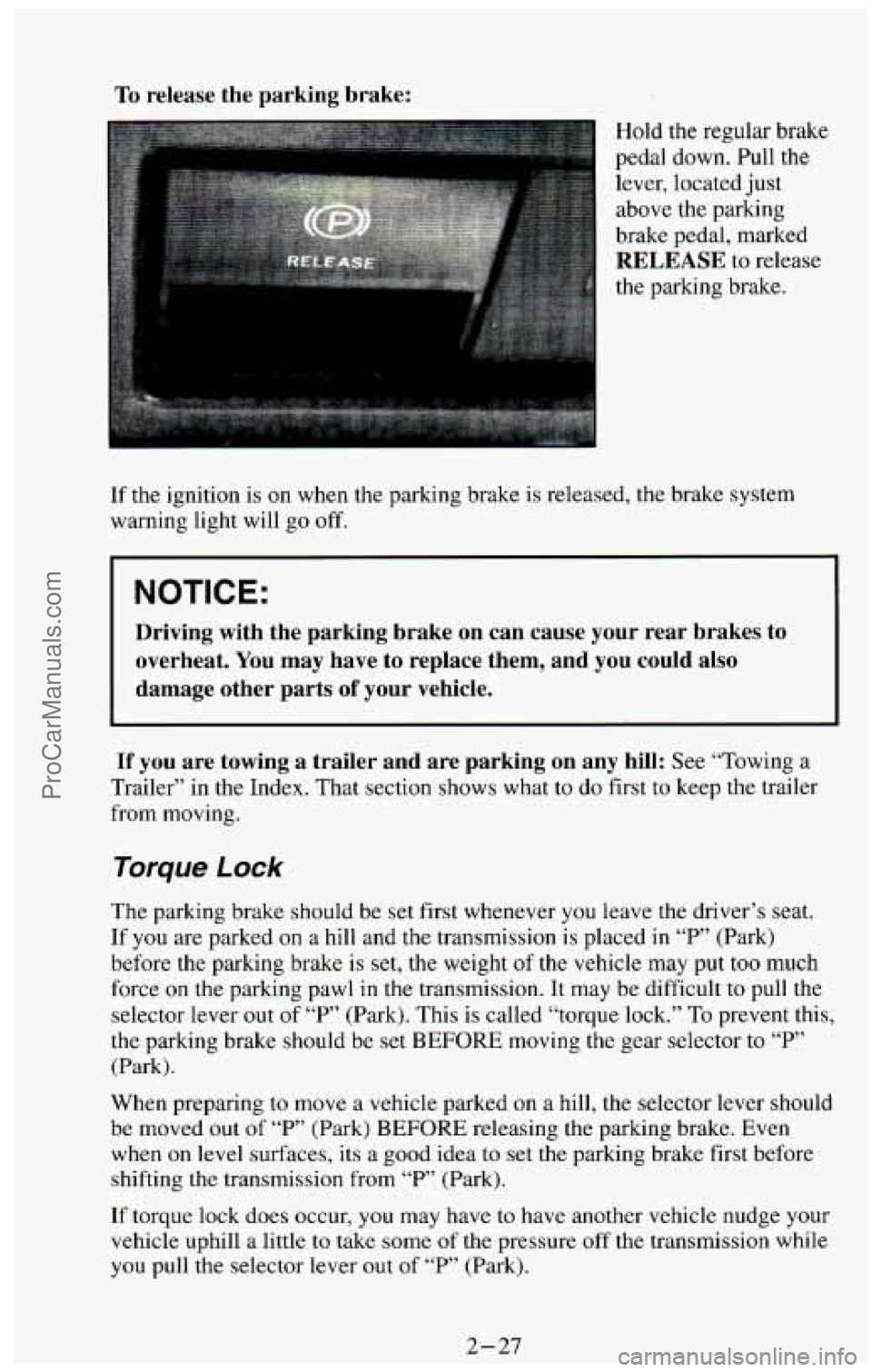
Hold the regular brake
pedal down. Pull the
lever, located just
above the parking
brake pedal, marked
RELEASE to release
the parking brake.
If the ignition is on when the parking brake is released, the brake system
warning light will
go off.
NOTICE:
Driving with the parking brake on can cause your rear brakes to
overheat. You may have to replace them, and you could also
damage other parts
of your vehicle.
If you are towing a trailer and are parking on any hill: See “Towing a
Trailer” in the Index. That section shows what to do first to keep the trailer
from moving.
Torque Lock
The parking brake should be set first whenever you leave the driver’s seat.
If you are parked on a hill and the transmission is placed in “P’ (Park)
before the parking brake is set, the weight
of the vehicle may put too much
force on the parking pawl in the transmission. It may be difficult to pull the
selector lever out
of “P” (Park). This is called “torque lock.” To prevent this,
the parking brake should be set
BEFORE moving the gear selector to “P”
(Park).
When preparing to move a vehicle parked on a hill, the selector lever should
be moved out
of “P” (Park) BEFORE releasing the parking brake. Even
when on level surfaces, its a good idea to set the parking brake first before
shifting the transmission from
“P” (Park).
If torque lock does occur, you may have to have another vehicle nudge your
vehicle uphill a
little to take some of the pressure off the transmission while
you pull the selector lever
out of “P’ (Park).
2-27
ProCarManuals.com
Page 88 of 385
NOTICE:
Driving in the 4H or 4L positions for a long time on dry or wet
pavement
could shorten the life of your vehicle’s drivetrain.
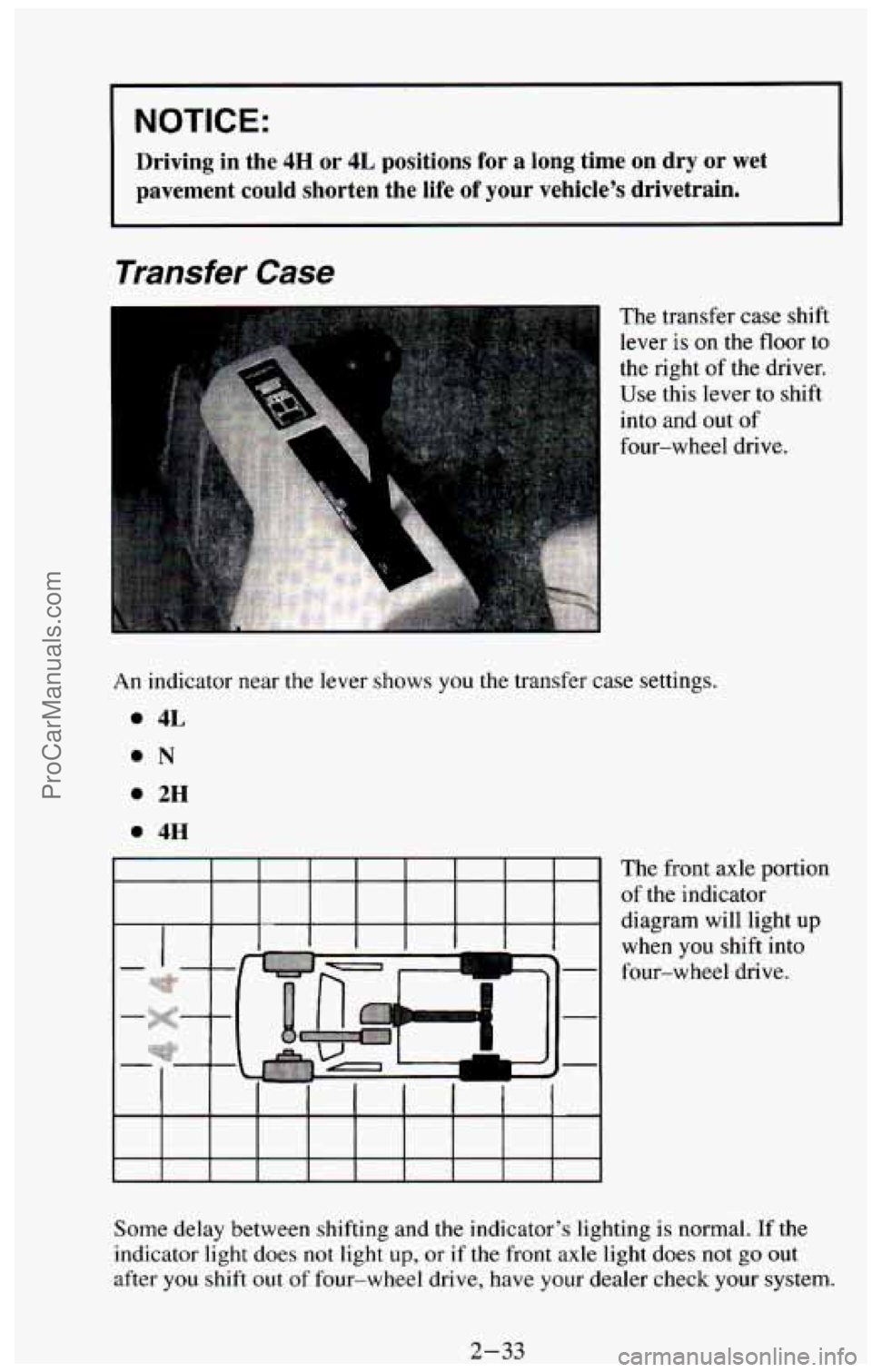
Transfer Case
The transfer case shift
lever
is on the floor to
the right
of the driver.
Use this lever to shift
into and out
of
four-wheel drive.
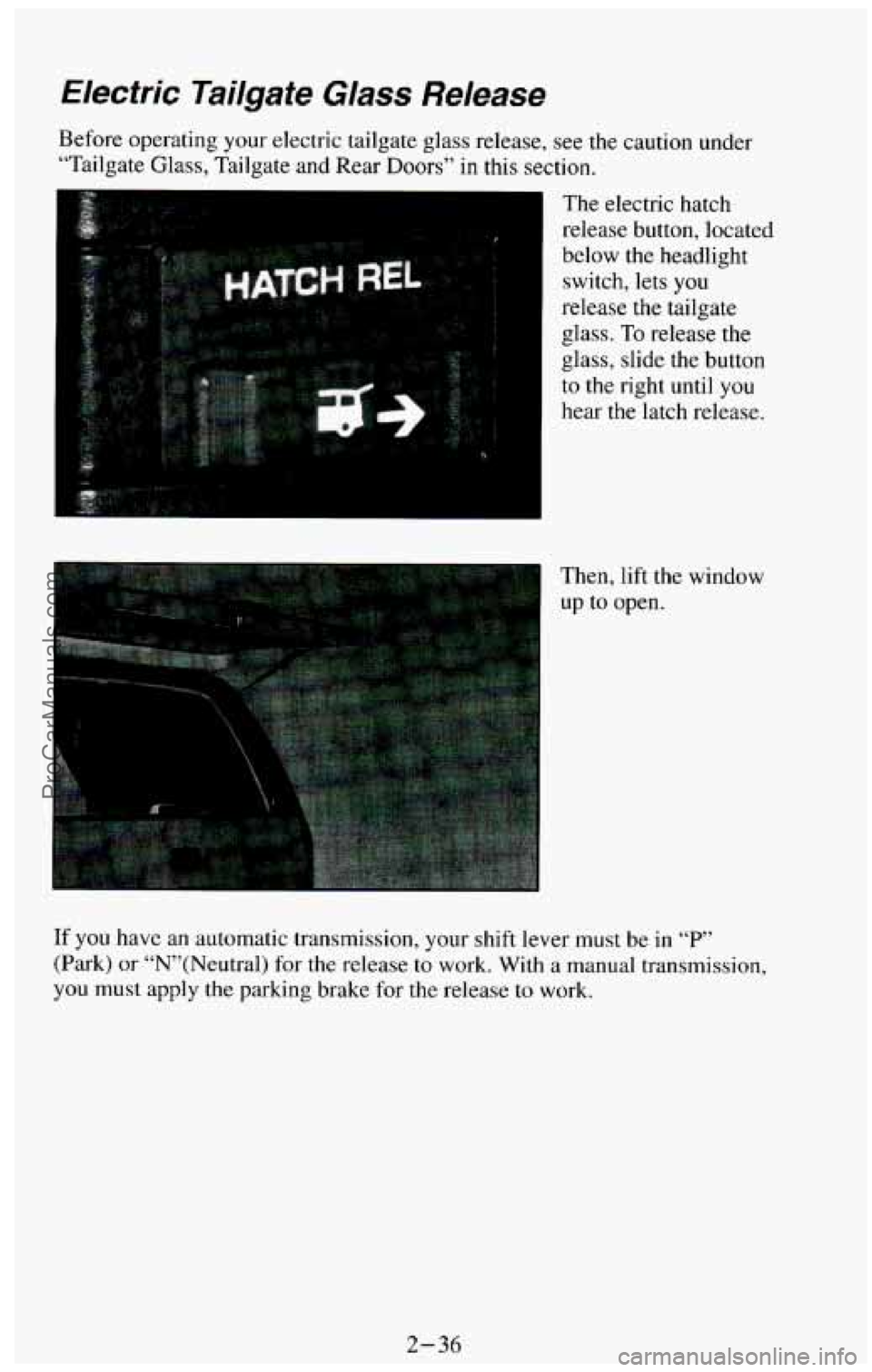
An indicator near the lever
shows you the transfer case settings.
The front axle portion
of the indicator
diagram will light
up
when you shift into
four-wheel drive.
Some delay between shifting and the indicator’s lighting
is normal. If the
indicator light does
not light up, or if the front axle light does not go out
after
you shift out of four-wheel drive, have your dealer check your system.
2-33 ProCarManuals.com
Page 89 of 385
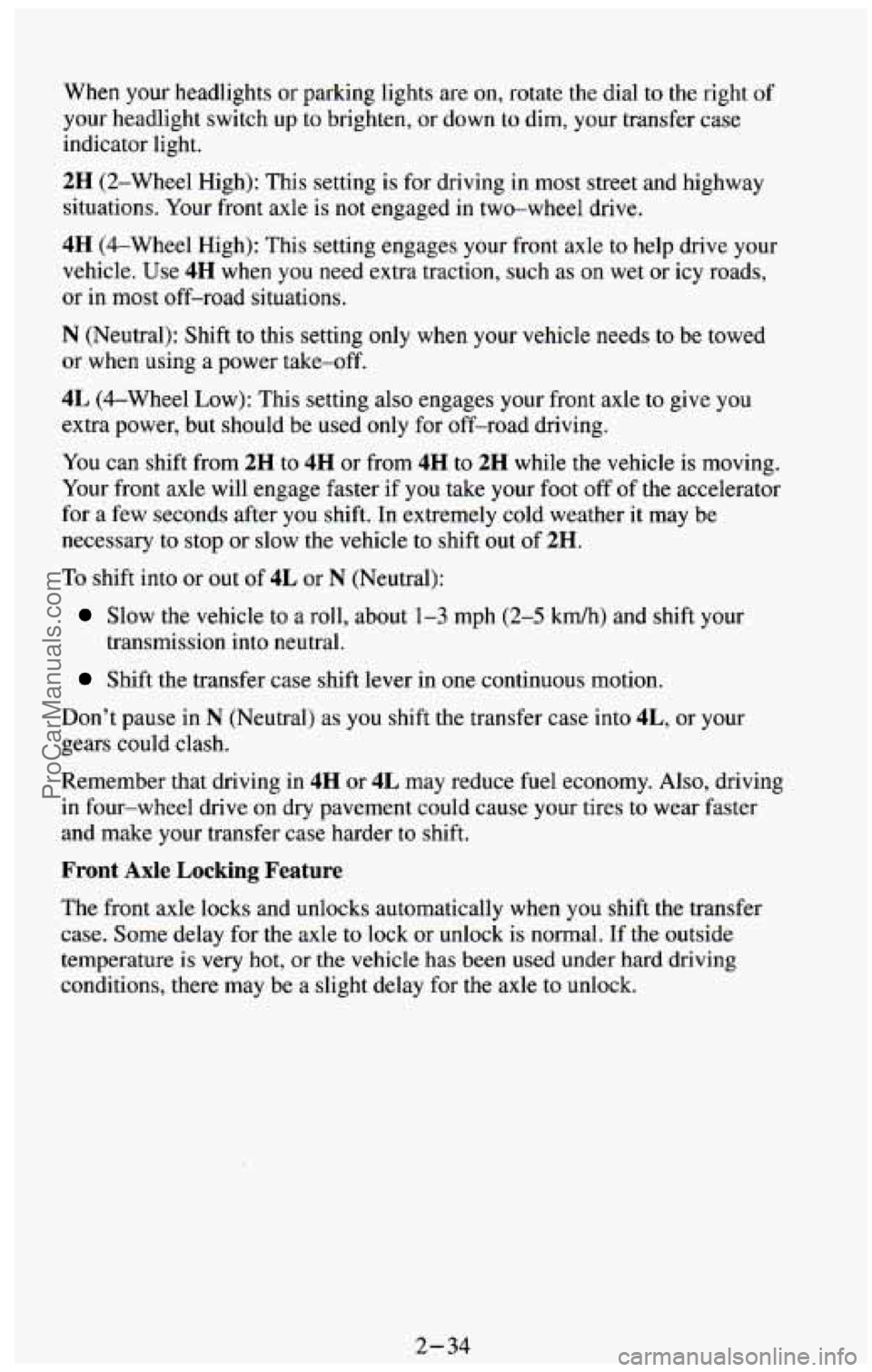
When your headlights or parking lights are on, rotate the dial to the right of
your headlight switch up to brighten, or down to dim, your transfer case
indicator light.
2H (2-Wheel High): This setting is for driving in most street and highway
situations. Your front axle
is not engaged in two-wheel drive.
4H (&Wheel High): This setting engages your front axle to help drive your
vehicle. Use
4H when you need extra traction, such as on wet or icy roads,
or
in most off-road situations.
N (Neutral): Shift to this setting only when your vehicle needs to be towed
or when using a power take-off.
4L (4-Wheel Low): This setting also engages your front axle to give you
extra power, but should be used only for off-road driving.
You can shift from
2H to 4H or from 4H to 2H while the vehicle is moving.
Your front axle will engage faster if
you take your foot off of the accelerator
for a few seconds after you shift. In extremely cold weather
it may be
necessary to stop or slow the vehicle to shift out of
2H.
To shift into or out of 4L or N (Neutral):
Slow the vehicle to a roll, about 1-3 mph (2-5 kdh) and shift your
Shift the transfer case shift lever in one continuous motion.
transmission into neutral.
Don’t pause
in N (Neutral) as you shift the transfer case into 4L, or your
gears could clash.
Remember that driving in
4H or 4L may reduce fuel economy. Also, driving
in four-wheel drive on dry pavement could cause your tires to wear faster
and make your transfer case harder to shift.
Front Axle Locking Feature
The front axle locks and unlocks automatically when you shift the transfer
case. Some delay for the axle to lock or unlock is normal. If the outside
temperature is
very hot, or the vehicle has been used under hard driving
conditions, there may be a slight delay for the axle to unlock.
2-34
ProCarManuals.com
Page 91 of 385
Hectric Tailgate Glass Release
Before operating your electric tailgate glass release, see the caution under
“Tailgate Glass, Tailgate and Rear Doors” in this section.
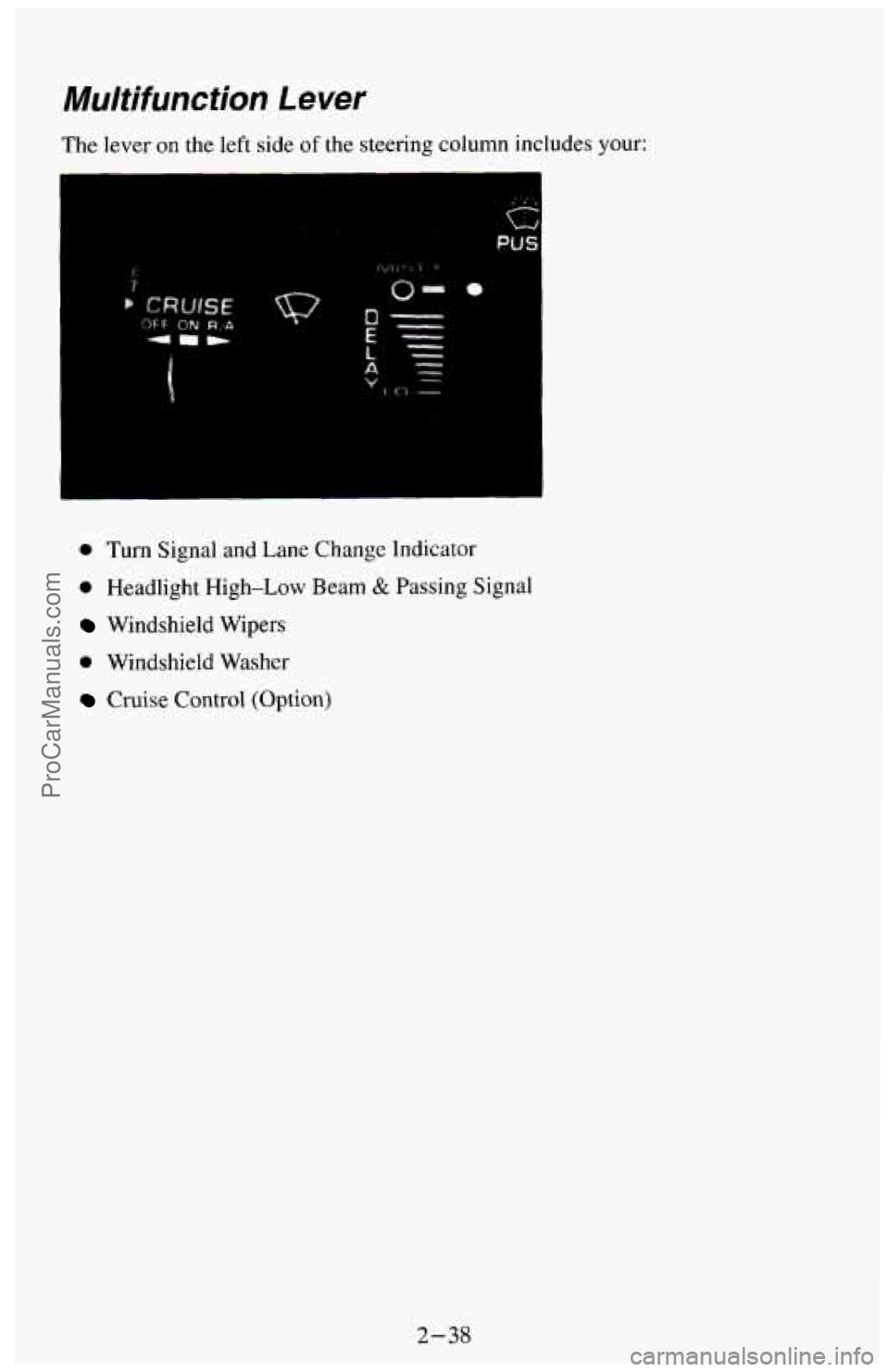
The electric hatch
release button, located
below the headlight switch, lets you
release the tailgate
glass.
To release the
glass, slide the button
to the right until
you
hear the latch release.
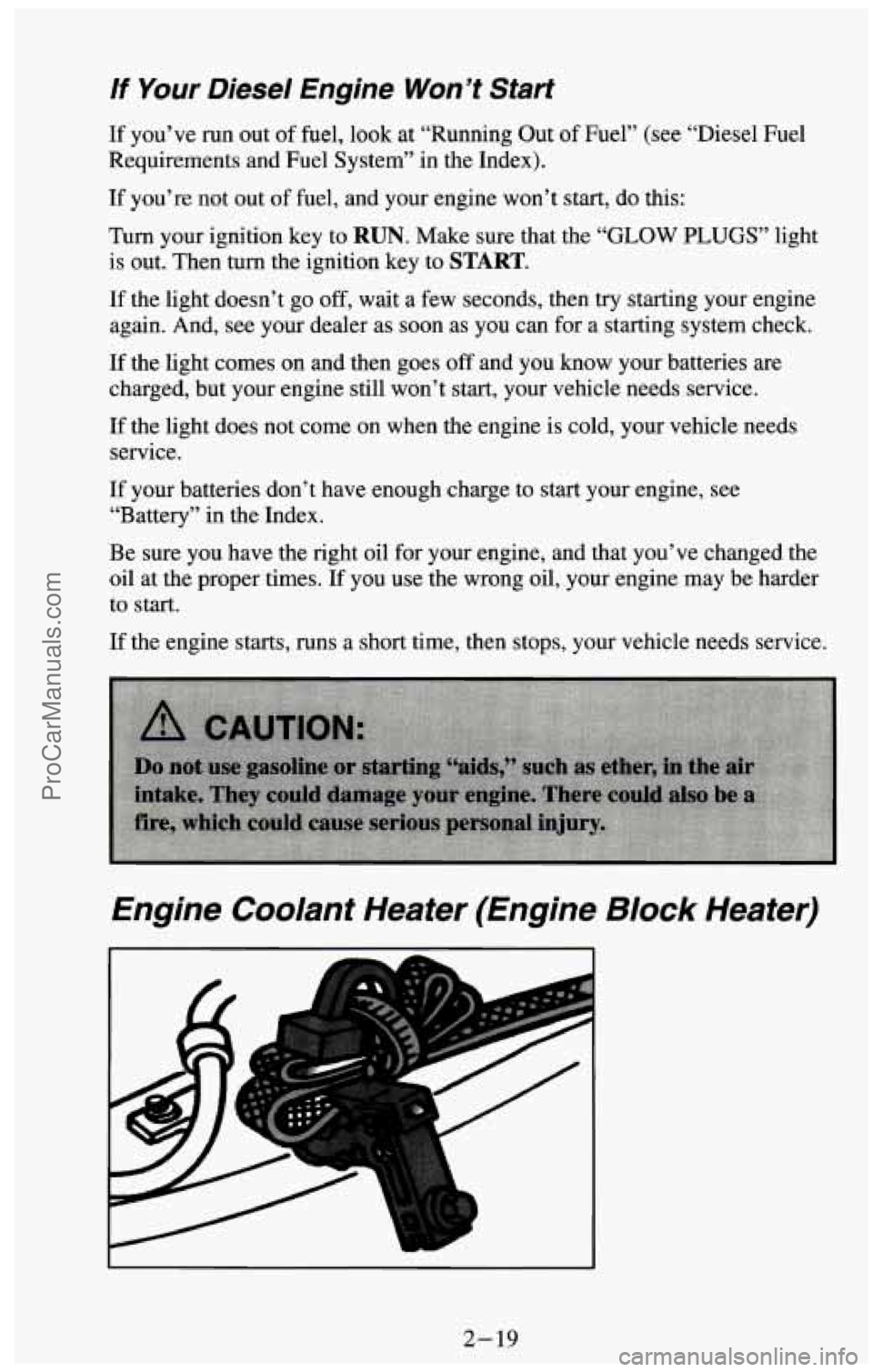
Then, lift
the window
up
to open.
If you have an automatic transmission, your shift lever must be in “P’
(Park) or “N”(Neutra1) for the release to work. With a manual transmission,
you
must apply the parking brake for the release to work.
2-36
ProCarManuals.com
Page 93 of 385
Multifunction Lever
The lever on the left side of the steering column includes your:
h I
0 Turn Signal and Lane Change Indicator
0 Headlight High-Low Beam & Passing Signal
Windshield Wipers
0 Windshield Washer
Cruise Control (Option)
2-38
ProCarManuals.com