Page 280 of 385
Front Axle
When to Check and Change Lubricant
Refer to the Maintenance Schedule to determine how often to check the
lubricant and when to change
it. See “Scheduled Maintenance Services” in
the Index.
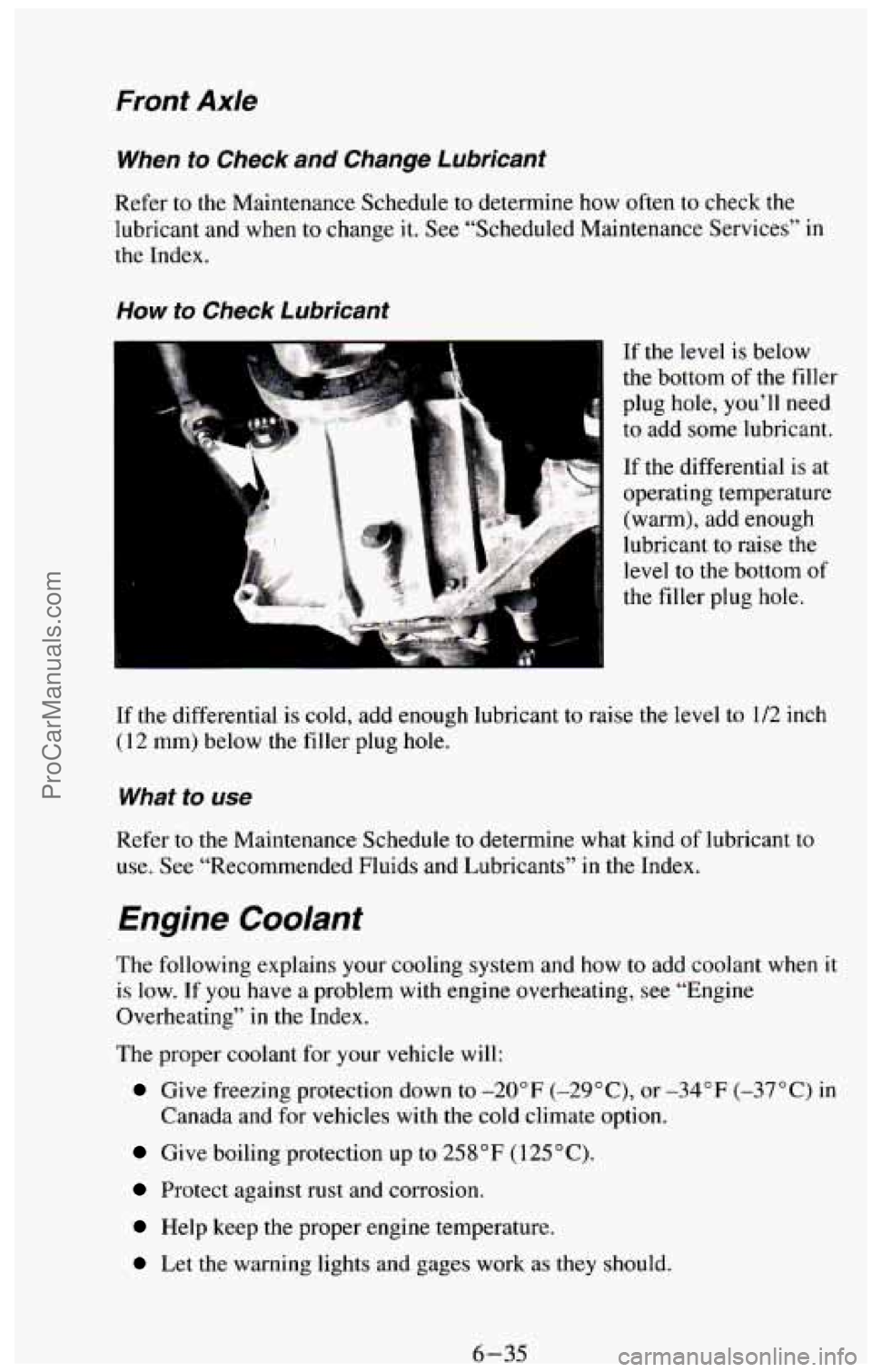
How to Check Lubricant
If the level is below
the bottom of the filler
plug hole, you’ll need
to add some lubricant.
If the differential is at
operating temperature
(warm), add enough
lubricant to raise the level
to the bottom of
the filler plug hole.
If the differential is cold, add enough lubricant to raise the level to
1/2 inch
(12 mm) below the filler plug hole.
What to use
Refer to the Maintenance Schedule to determine what kind of lubricant to
use. See “Recommended Fluids and Lubricants” in the Index.
Engine Coolant
The following explains your cooling system and how to add coolant when it
is low. If you have a problem with engine overheating, see “Engine
Overheating”
in the Index.
The proper coolant for your vehicle will:
Give freezing protection down to -20°F (-29”C), or -34°F (-37°C) in
Give boiling protection up to 258°F (1 25°C).
Protect against rust and corrosion.
Help keep the proper engine temperature.
Canada
and for vehicles with the cold climate option.
Let the warning lights and gages work as they should.
6-35 ProCarManuals.com
Page 281 of 385
What to Use
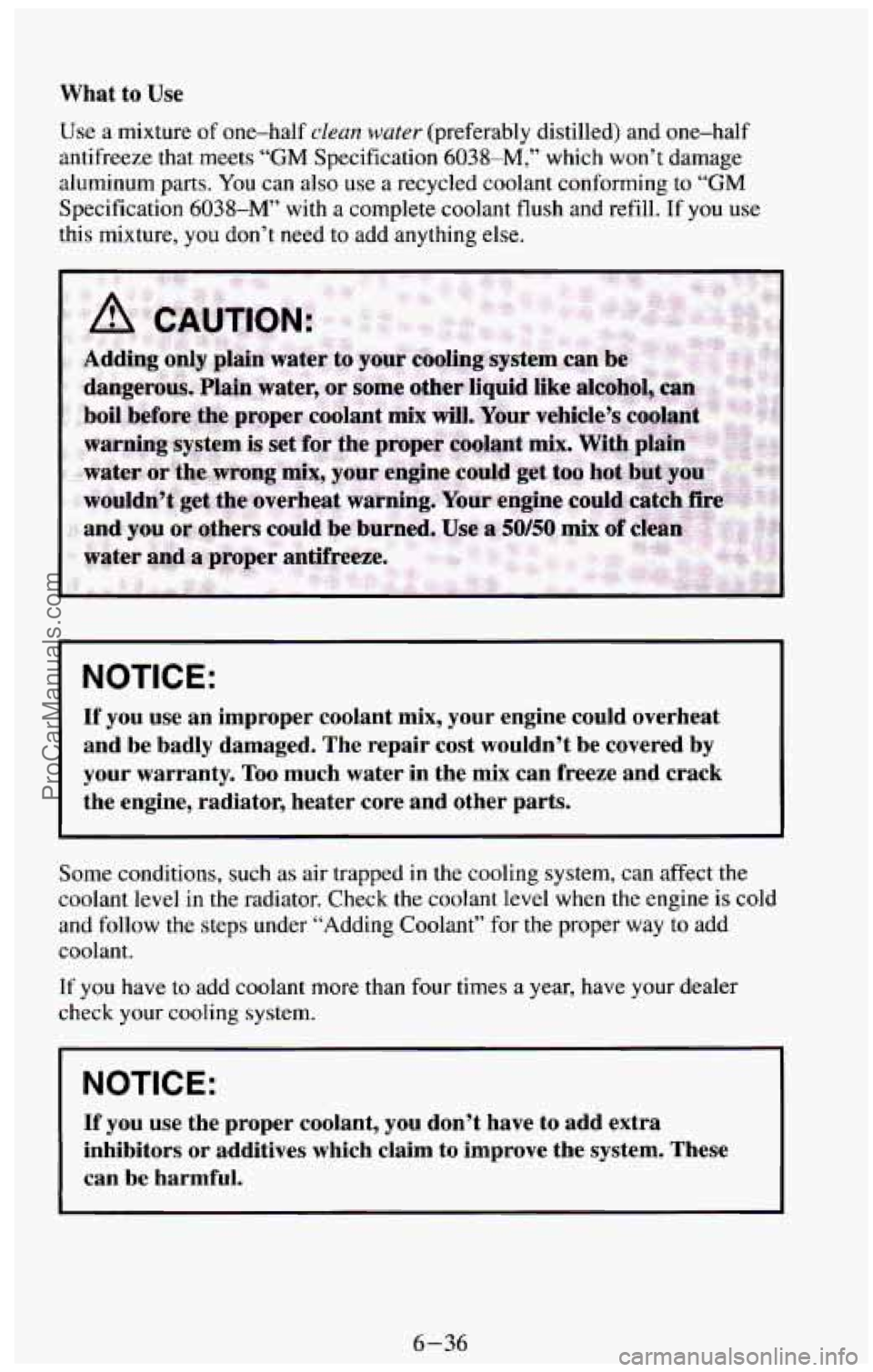
use a mixture of one-half clean water (preferably distilled) and one-half
antifreeze that meets
“GM Specification 6038-M,” which won’t damage
aluminum
parts. You can also use a recycled coolant conforming to “GM
Specification 6038-M” with a complete coolant flush and refill. If you use
this mixture, you don’t need
to add anything else.
NOTICE:
If you use an improper coolant mix, your engine could overheat
and be badly damaged. The repair cost wouldn’t be covered by
your warranty.
TOO much water in the mix can freeze and crack
the engine, radiator, heater core and other parts.
Some conditions, such as air trapped in the cooling system, can affect the
coolant level in the radiator. Check the coolant level when the engine is cold
and follow the steps under “Adding Coolant” for
the proper way to add
coolant.
If you have to add coolant more than four times a year, have your dealer
check your cooling system.
NOTICE:
If you use the proper coolant, you don’t have to add extra
inhibitors
or additives which claim to improve the system. These
can be harmful.
6-36
ProCarManuals.com
Page 282 of 385
Adding Coolant -Gas Engines
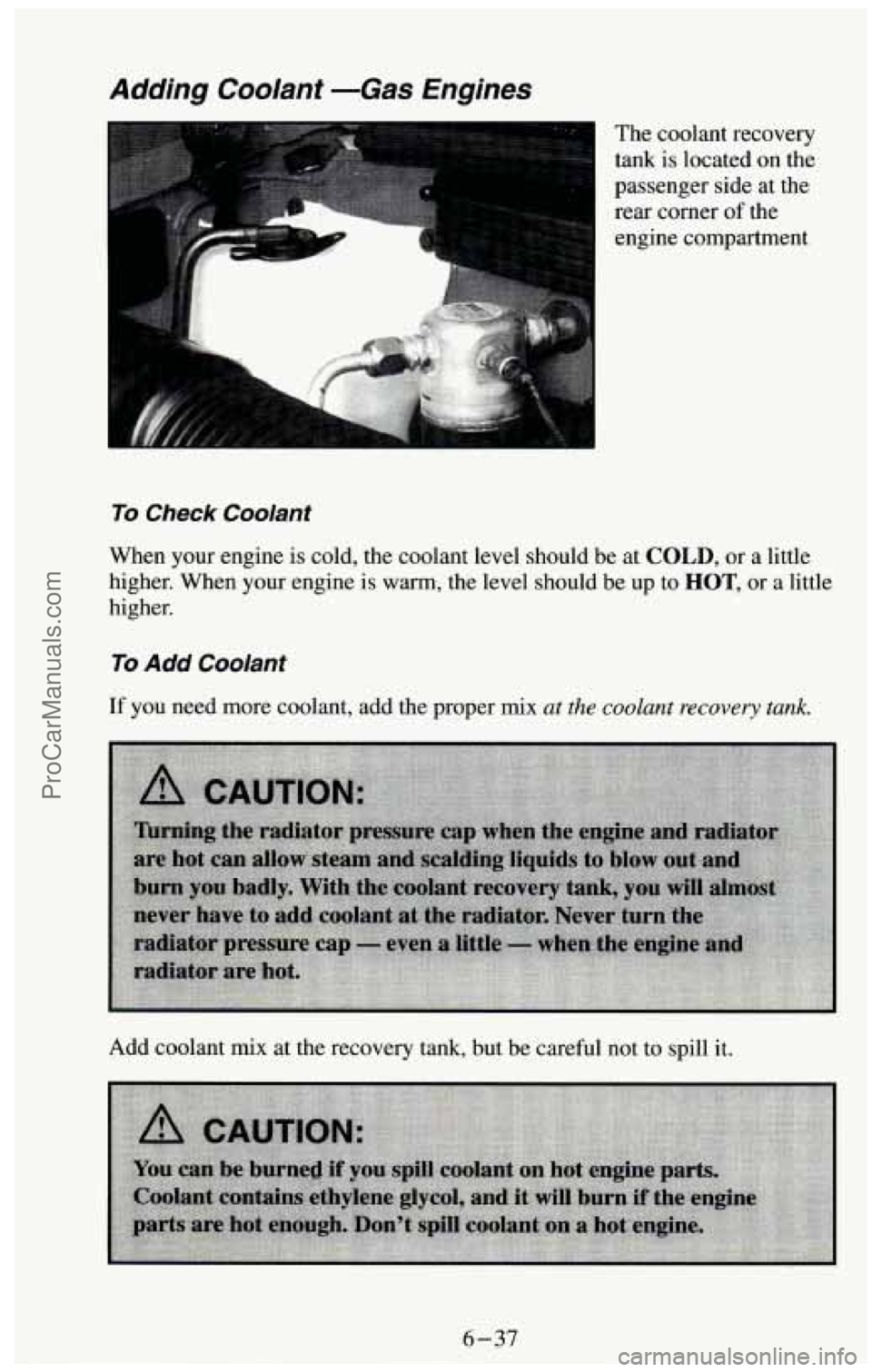
The coolant recovery
tank is located on the
passenger side at the
rear comer of the
engine compartment
To Check Coolant
When your engine is cold, the coolant level should be at COLD, or a little
higher. When your engine
is warm, the level should be up to HOT, or a little
higher.
To Add Coolant
If you need more coolant, add the proper mix at the coolant recovery tank.
Add coolant mix at the recovery tank, but be careful not to spill it.
6-37
ProCarManuals.com
Page 283 of 385
Adding Coolant -Diesel Engines
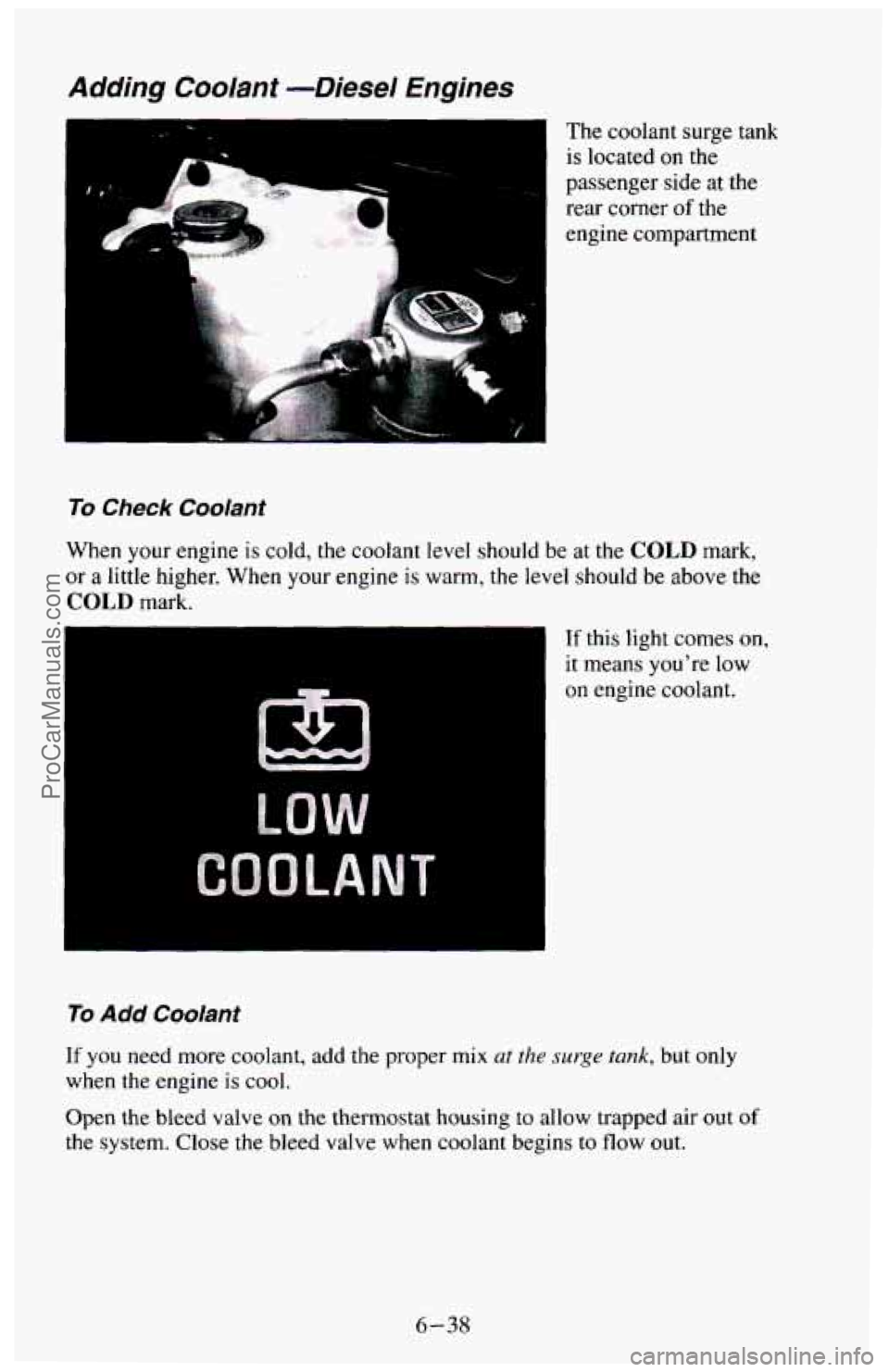
.. The coolant surge tank
is located on the
passenger side at the
rear corner
of the
engine compartment
To Check Coolant
When your engine is cold, the coolant level should be at the COLD mark,
or
a little higher. When your engine is warm, the level should be above the
COLD mark.
If this light comes on,
it means you're low
on engine coolant.
To Add Coolant
If you need more coolant, add the proper mix ut the surge tank, but only
when the
engine is cool.
Open the bleed valve
on the thermostat housing to allow trapped air out of
the system. Close the bleed valve when coolant begins to flow out.
6-38
ProCarManuals.com
Page 284 of 385
Radiator Pressure Cap-Gas Engines
I I
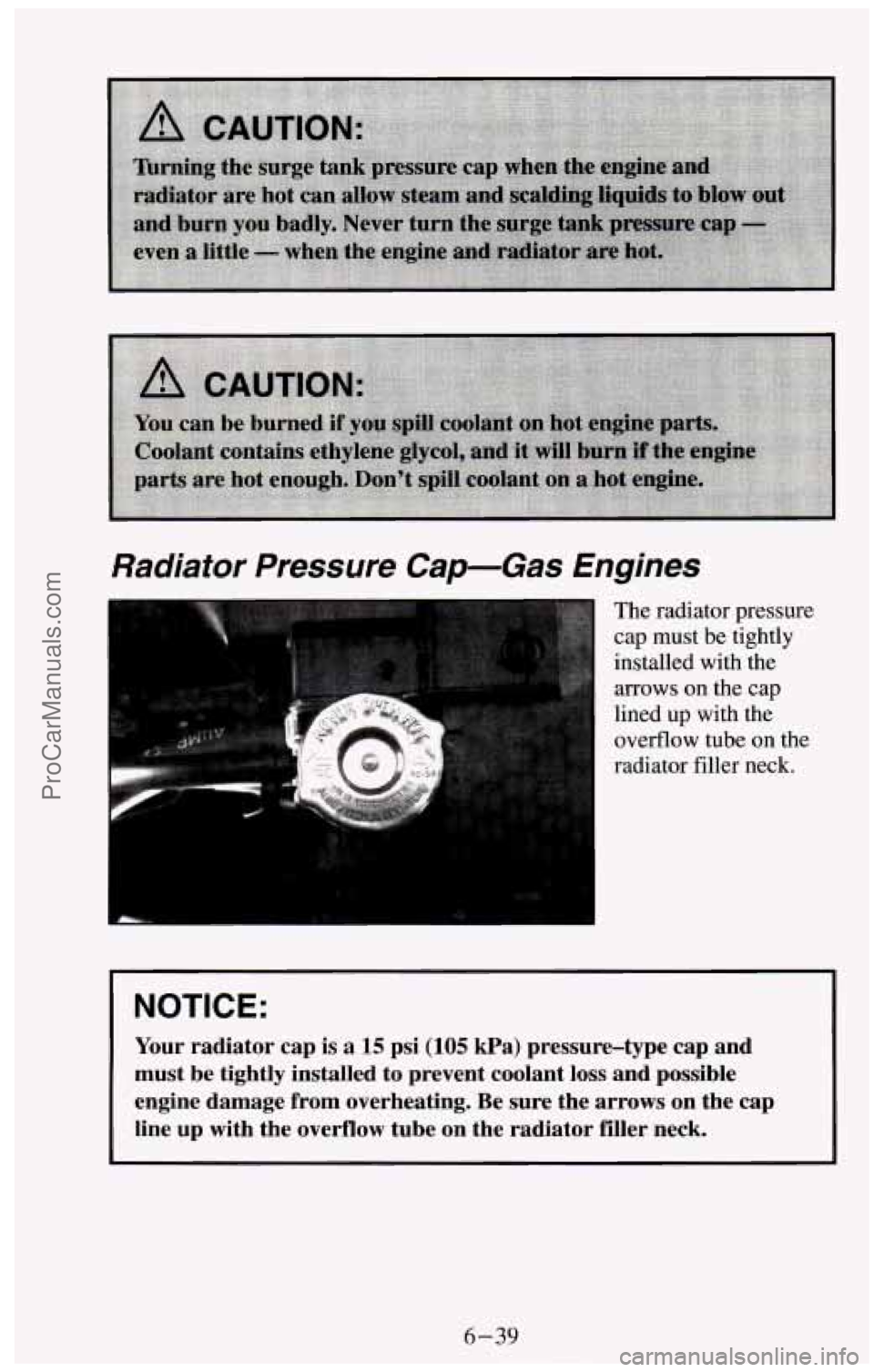
The radiator pressure
cap must be tightly
installed with the
arrows on the cap
lined up with the
ovefflow tube on the
radiator filler neck.
NOTICE:
Your radiator cap is a 15 psi (105 kPa) pressure-type cap and
must be tightly installed
to prevent coolant loss and possible
engine damage from overheating. Be sure the arrows on the cap
line up with the overflow tube on the radiator filler neck.
ProCarManuals.com
Page 285 of 385
Surge Tank Pressure Cap- Diesel Engines
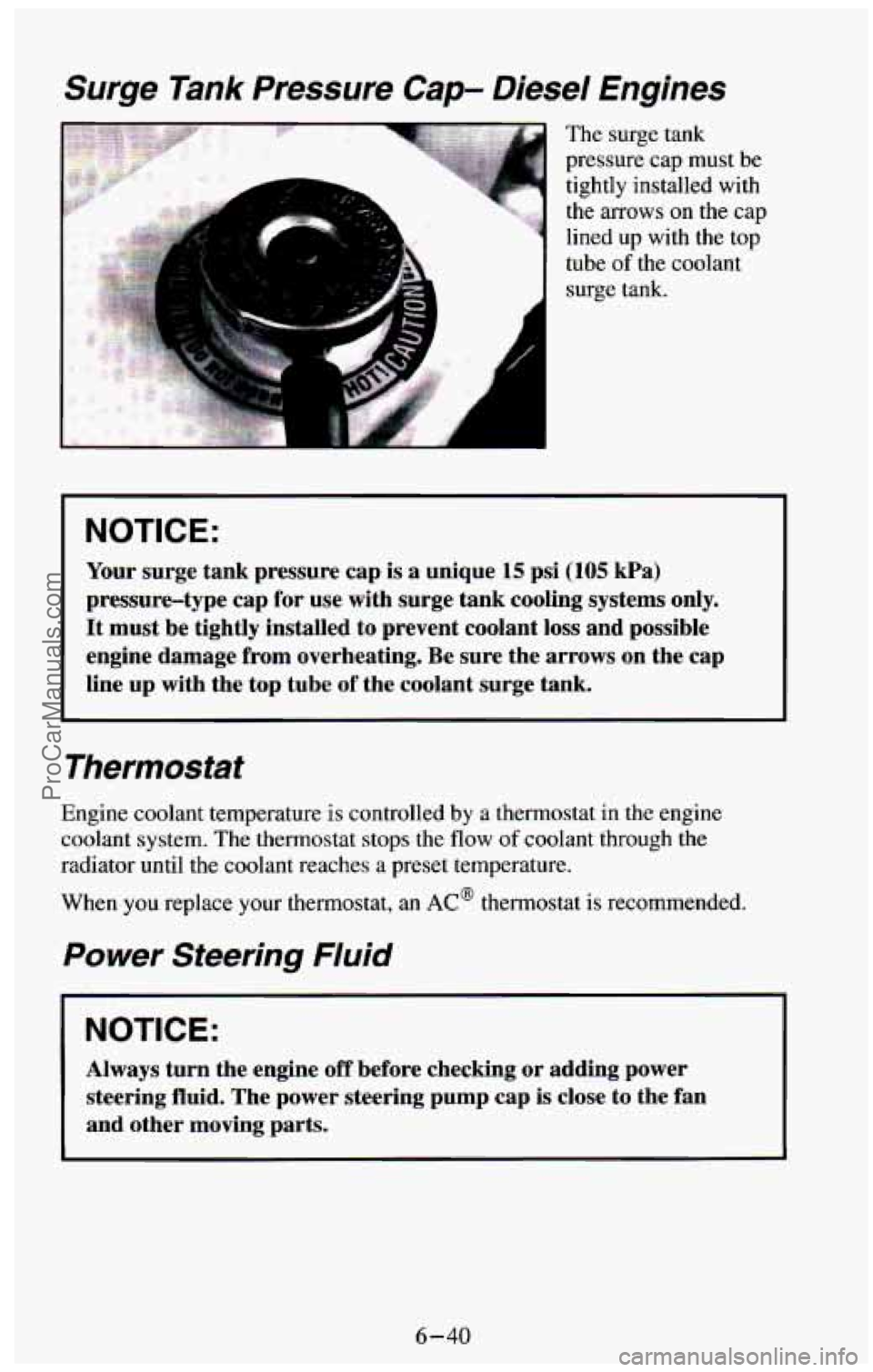
The surge tank
pressure cap must be
tightly installed with
the arrows
on the cap
lined up with the top
tube
of the coolant
surge tank.
NOTICE:
Your surge tank pressure cap 1s a unique 15 psi (105 kPa)
pressure-type cap for use with surge tank cooling systems only.
It must be tightly installed to prevent coolant loss and possible
engine damage from overheating. Be sure the arrows on the cap
line up with the top tube
of the coolant surge tank.
Thermostat
Engine coolant temperature is controlled by a thermostat in the engine
coolant system. The thermostat stops the flow
of coolant through the
radiator until the coolant reaches a preset temperature.
When you replace your thermostat, an
AC@ thermostat is recommended.
Power Steering Fluid
I NOTICE:
Always turn the engine off before checking or adding power
steering
fluid. The power steering pump cap is close to the fan
and other moving parts.
6-40
ProCarManuals.com
Page 286 of 385
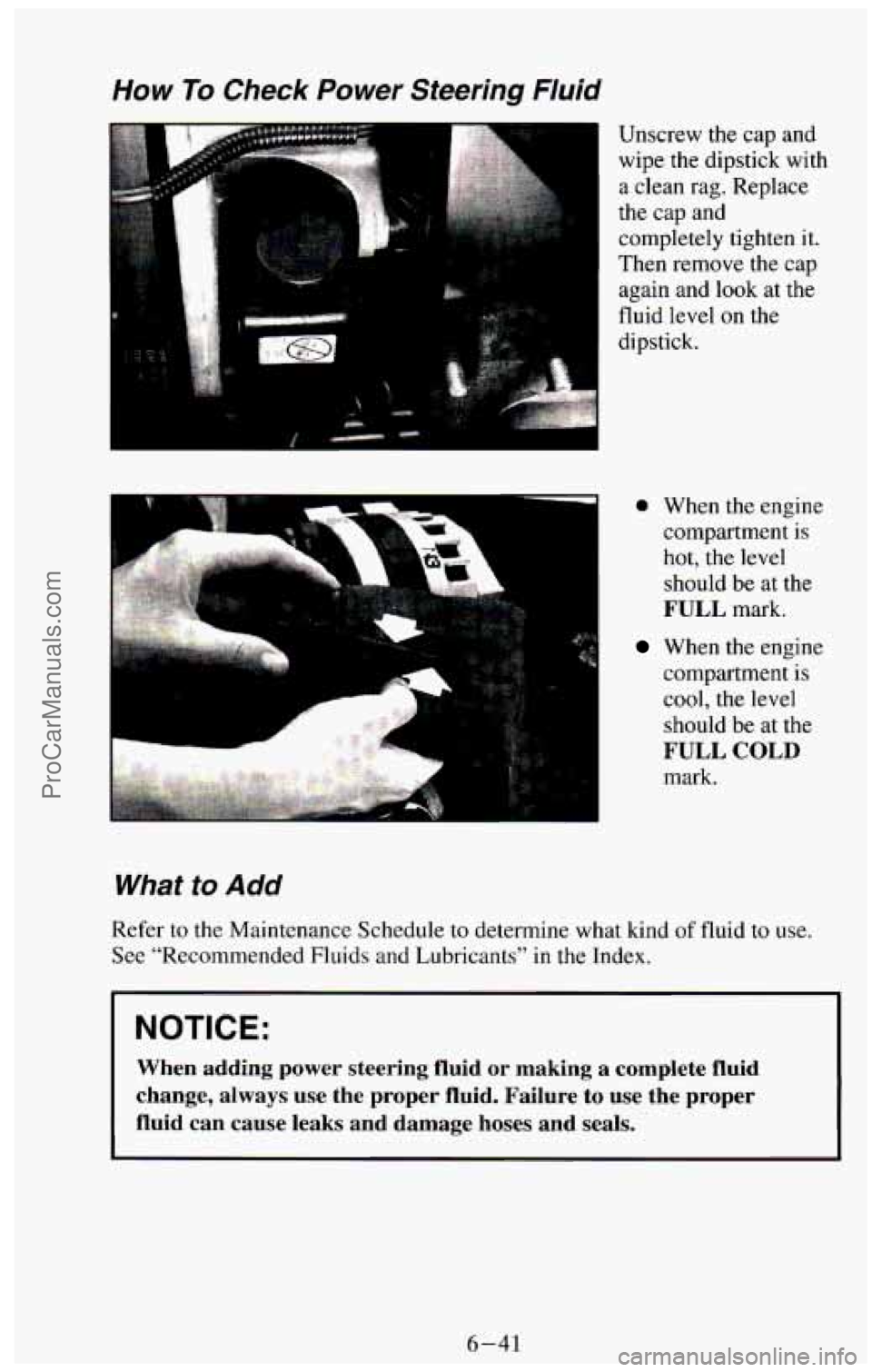
How To Check Power Steering Fluid
l
Unscrew the cap and
wipe the dipstick with
a clean rag. Replace
the cap and
completely tighten it.
Then remove the cap
again and look
at the
fluid level on the
dipstick.
0 When the engine
compartment is
hot, the level
should
be at the
FULL mark.
When the engine
compartment is
cool, the
level
should be at the
FULL COLD
mark.
Whaf fo Add
Refer to the Maintenance Schedule to determine what kind of fluid to use.
See “Recommended Fluids and Lubricants” in the Index.
NOTICE:
When adding power steering fluid or making a complete fluid
change, always
use the proper fluid. Failure to use the proper
fluid can cause leaks and damage hoses and
seals.
6-41
ProCarManuals.com
Page 289 of 385
To Check Brake Fluid
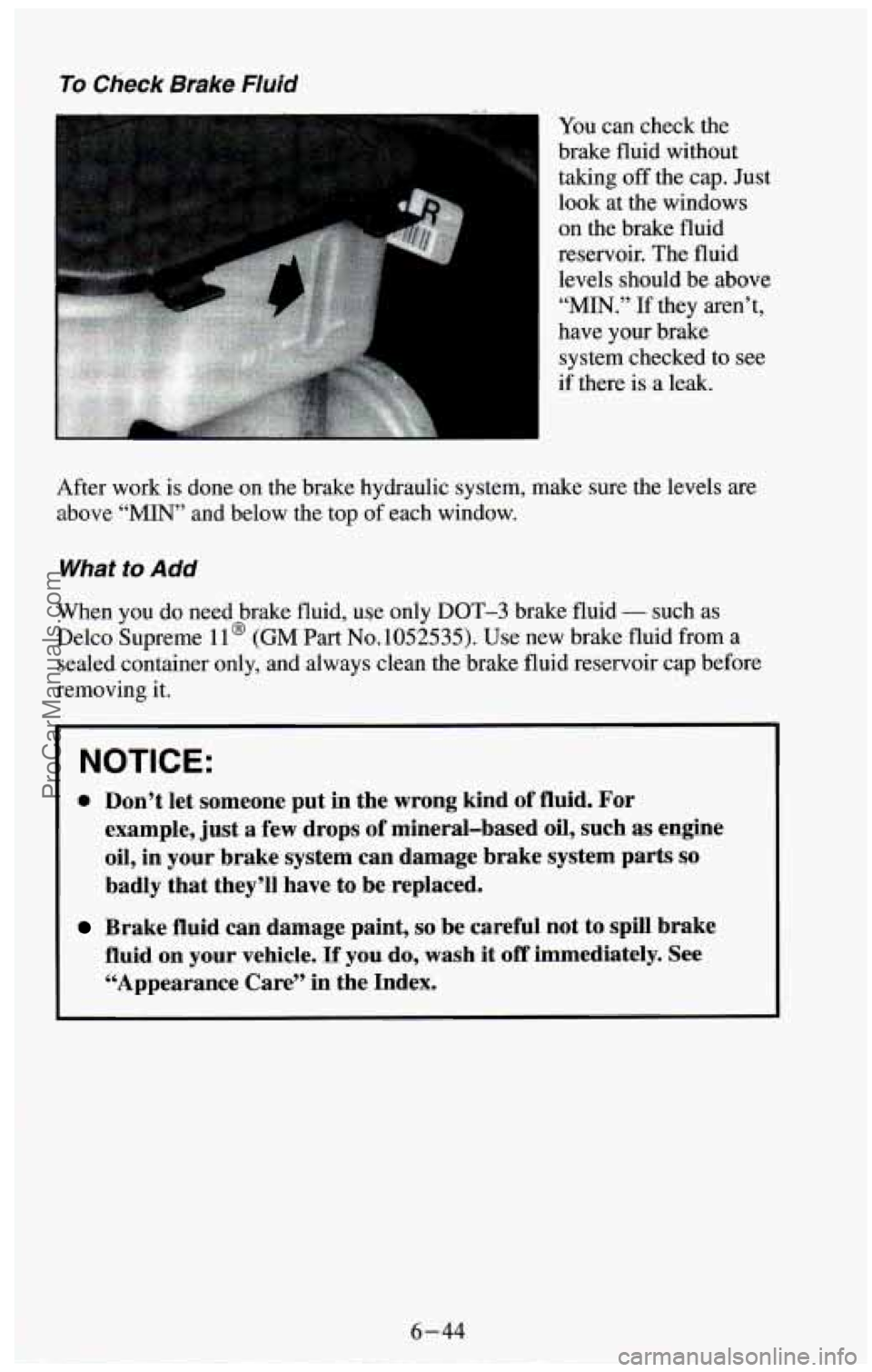
m You can check the
brake fluid without
taking off the cap. Just
look at the windows
on the brake fluid
reservoir. The fluid
levels should be above
“MIN.” If they aren’t,
have your brake
system checked to see
if there is a leak.
After work is done on the brake hydraulic system, make sure the levels are
above
‘“IN‘’ and below the top of each window.
What to Add
When you do need brake fluid, use only DOT-3 brake fluid - such as
Delco Supreme
ll@ (GM Part No.1052535). Use new brake fluid from a
sealed container only, and always clean the brake fluid reservoir cap before
removing it.
0 Don’t let someone put in the wrong kind of fluid. For
example, just
a few drops of mineral-based oil, such as engine
oil, in your brake system can damage brake system parts
so
badly that they’li have to be replaced.
Brake fluid can damage paint, so be careful not to spill brake
fluid
on your vehicle. If you do, wash it off immediately. See
“Appearance Care”
in the Index.
ProCarManuals.com