Page 269 of 340
Downloaded from www.Manualslib.com manuals search engine Tires
We don’t make tires. Your new vehicle comes with high quality \
tires made
by a leading tire manufacturer. These tires are warranted by the tire
manufacturers and their warranties are delivered with every new vehicle. If
your spare tire is a different brand than your road tires, you will have a tire \
warranty folder from each
of these manufacturers.
6-51
Page 270 of 340
Downloaded from www.Manualslib.com manuals search engine Inflation - Tire Pressure
The CertificatiodTire label which is on the driver’s door lock pillar, shows
the correct inflation pressures for your tires, when they’re cold. ‘‘C01d’~
means your vehicle has been sitting for at least three hours or driven no
more than a mile.
NOTICE:
Don’t let anyone tell you that underinflation or overinflation is
all right. It’s not. If your tires don’t have enough air
(underinflation) you can get:
0 Too much flexing
0 Too much heat
0 Tire overloading
Bad wear
Bad handling
Bad fuel economy.
If your tires have too much air (overinflation), you can get:
Unusual wear
0 Bad handling
Rough ride
0 Needless damage from road hazards.
Page 271 of 340
Downloaded from www.Manualslib.com manuals search engine When to Check
Check your ..’ :s once a month or more. Also, check the tire pressure of the
spare tire.
How to Check
Use a good quality pocket-type gage to check tire pressure. Si\
mply looking at the tires will
not tell you the pressure, especially if you have radial tires
- which may look properly inflated even if they’re underinflated.
If your tires have valve caps, be sure to put them back on. The\
y help prevent
leaks by keeping out
dirt and moisture.
Special Tire Inflation
If you have 31xlOSOR15LT/C tires on your vehicle, and:
- You’ll be driving for very long at speeds of 66 mph (105 km/h) to
75 mph (120 km/h) where legal, inflate tires to 10 psi (70 Wa) more
than the recornended cold inflation pressures.
- You’ll be driving for very long at speeds of 76 mph (120 km/h) to
85 mph (1 35 km/h) where legal, cold inflation pressures should be
increased by
10 psi (70 Wa) and you must also reduce axle load
capacity by
10%. Do not drive over 85 mph (135 km/h) even when
it’s legal.
Inflation pressures should never exceed 10 psi (70 Pa) above the
inflation specified for
the maximum load of the tire.
Page 272 of 340
Downloaded from www.Manualslib.com manuals search engine lire Inspection and Rotation
To make your tires last longer, have them inspected and rotated at the
mileages recommended in the Maintenance Schedule. See “Schedul\
ed
Maintenance Services” in the Index.
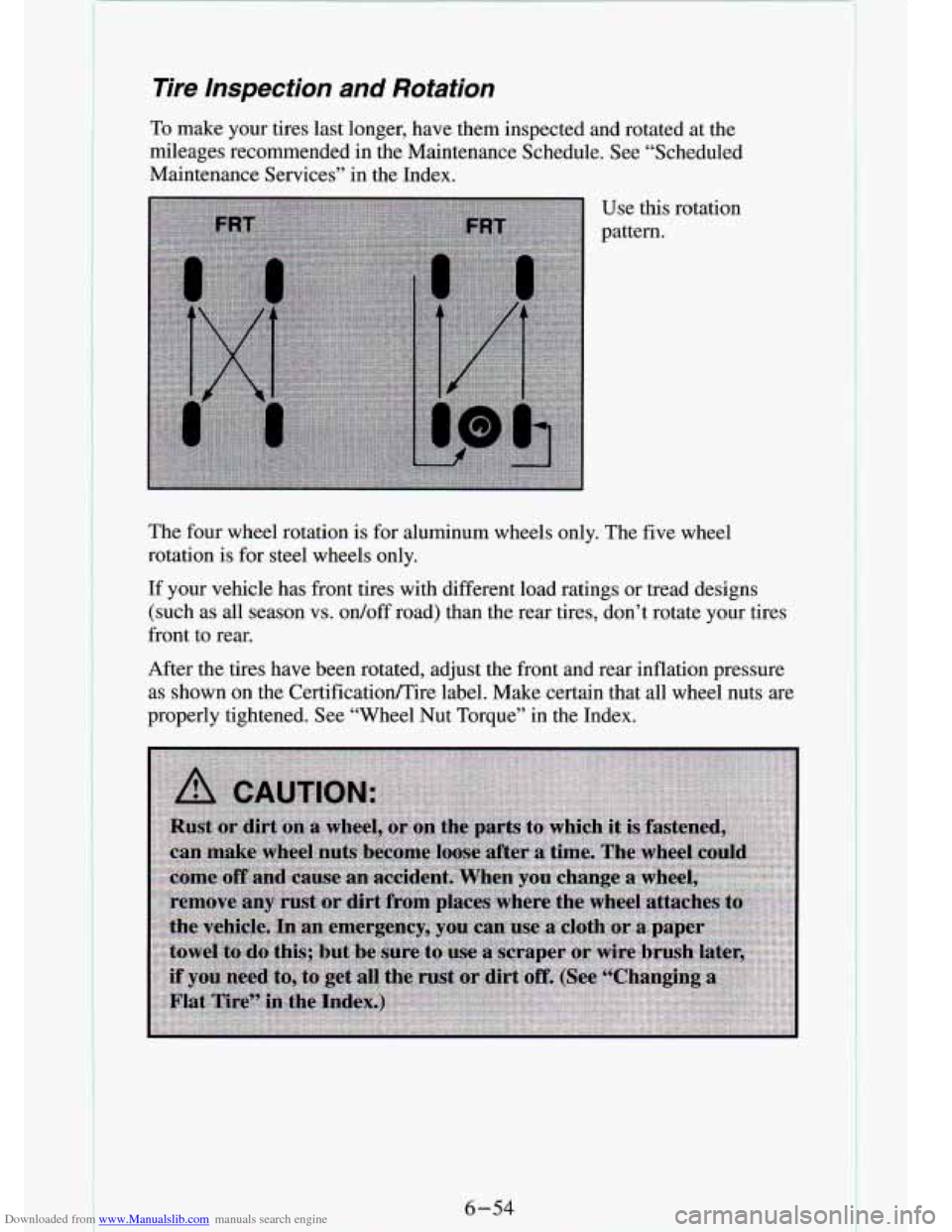
Use this rotation
pattern.
The four wheel rotation is for aluminum wheels only. The five wheel
rotation is for steel wheels only.
If your vehicle has front tires with different load ratings or tr\
ead designs
(such as all season vs. ordoff road) than the rear tires, d\
on’t rotate your tires
front to rear.
After the tires have been rotated, adjust the front and rear inflation pressure
as shown on the CertificatiodTire label. Make certain that all wheel nuts are
properly tightened. See “Wheel Nut Torque” in the Index.
6-54
Page 273 of 340
Downloaded from www.Manualslib.com manuals search engine When lt’s Time for New Tires
a
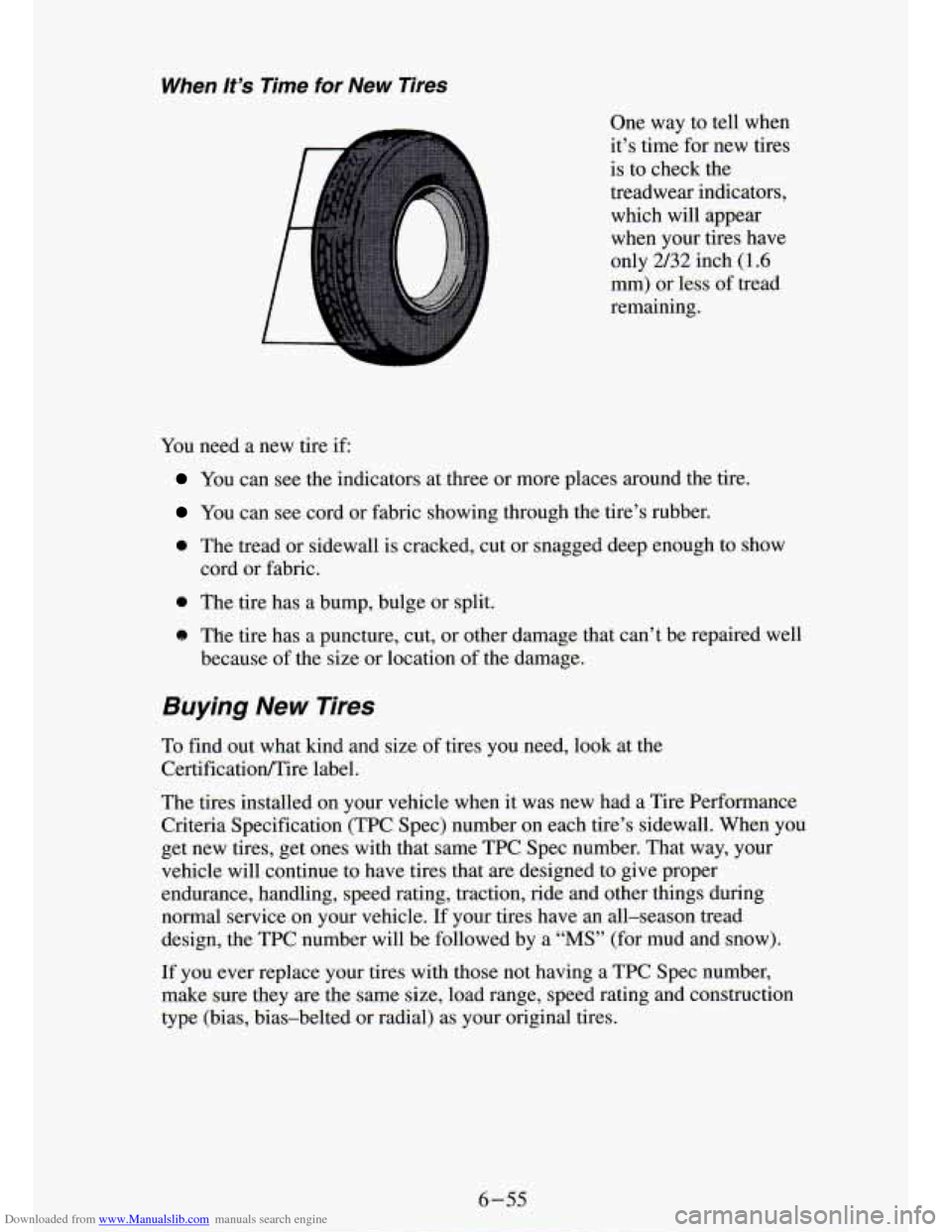
One way to tell when
it’s time for new tires
is to check the
treadwear indicators,
which will appear
when your tires have
only
2/32 inch (1.6
mm) or less of tread
remaining.
You need a new tire if
You can see the indicators at three or more places around the tire.
You can see cord or fabric showing through the tire’s rubber.
0 The tread or sidewall is cracked, cut or snagged deep enough to show
cord or fabric.
0 The tire has a bump, bulge or split.
The tire has a puncture, cut, or other damage that can’t be re\
paired well
because of the
size or location of the damage.
Buying New Tires
To find out what kmd and size of tires you need, look at the
Certificatioflire label.
The tires installed on your vehicle when it was new had a Tire Performance
Criteria Specification (PC Spec) number on each tire’s sidewall. When you
get new tires, get ones with that same TPC Spec number. That way, your
vehicle will continue to have tires that
are designed to give proper
endurance, handling, speed rating, traction, ride and other thin\
gs during
normal service on your vehicle.
If your tires have an all-season tread
design, the TPC number will be followed by a
“MS” (for mud and snow).
If you ever replace your tires with those not having a
TPC Spec number,
make sure they are the same size, load range, speed rating and construction
type (bias, bias-belted or radial) as your original tires.
Page 274 of 340

Downloaded from www.Manualslib.com manuals search engine Uniform Tire Quality Grading
The following information relates to the system developed by the Un\
ited
States National Highway Traffic Safety Administration which grade\
s tires
by treadwear, traction and temperature performance. (This applie\
s only
to
vehicles sold in the United States.)
Treadwear
The treadwear grade is a comparative rating based on the wear rate\
of the
tire when tested under controlled conditions on a specified gov\
ernment test
course. For example, a tire graded
150 would wear one and a half (1-1/2)
times as well on the government course as a tire graded 100. The relative
performance of tires depends upon the actual conditions
of their use,
however, and may depart significantly from the norm due to var\
iations
in
driving habits, service practices and differences in road charac\
teristics and
climate.
Tractlon - A, 9, C
The traction grades, from highest to lowest are: A, B, and C. They represent
the tire’s ability
to stop on wet pavement as measured under controlled
conditions on specified government test surfaces of asphalt and concrete.
A
tire marked C may have poor traction performance.
Warning: The traction grade assigned to this tire is based on braking
(straight-ahead) traction tests
and does not include cornering (turning)
traction.
6-56
Page 275 of 340
Downloaded from www.Manualslib.com manuals search engine Temperature -A, By C
The temperature grades are A (the highest), B, and C, representing the tire’s
resistance to the generation of heat and its ability
to dissipate heat when tested
under controlled conditions on a specified indoor laboratory tes\
t wheel.
Sustained high temperature can cause the material of the tire to degenerate
and reduce tire life, and excessive temperature can lead to su\
dden tire failure.
The grade
C corresponds to a level of performance which all passenger car
tires must meet under the Federal Motor Vehicle Safety Standard\
No. 109.
Grades B and A represent higher levels of performance on the laboratory test
wheel than the minimum required by law.
Warning: The temperature grade for
this tire is established for a tire that is
properly inflated and not overloaded. Excessive speed, underinfla\
tion, or
excessive loading, either separately or in combination, can cause heat
buildup and possible tire failure.
These grades are molded on
the sidewalls of passenger car tires.
While the tires available as standard or optional equipment on General
Motors vehicles may vary with respect to these grades, all such tires meet
General Motors performance standards and have been approved for use on
General Motors vehicles. All passenger type
(P Metric) tires must conform
to Federal safety requirements in addition to these grades.
Wheel Alignment and Tire Balance
The wheels on your vehicle were aligned and balanced carefully at the
factory to give you the longest tire life and best overall performance.
In most cases, you will not need to have your wheels aligned again.
However,
if you notice unusual tire wear or your vehicle pulling one way \
or
the other, the alignment may need to be reset. If you notice your vehicle
vibrating when driving
on a smooth road, your wheels may need to be
rebalanced.
Wheel Replacement
Replace any wheel that is bent, cracked or badly rusted. If wheel nuts keep
coming loose, the wheel, wheel bolts, and wheel nuts should be replaced.
If
the wheel leaks air, replace it (except some aluminum wheels, \
which can
sometimes be repaired). See your GM dealer if any of these conditions exist.
Your dealer will know the kind of wheel you need,
Each new wheel should have the same load carrying capacity, diameter,
width, offset, and be mounted the same way as the one it replaces.
6-57
Page 277 of 340
Downloaded from www.Manualslib.com manuals search engine Tire Chains
NOTICE:
If your vehicle has P235/75R15 or 31xlOSOR15LT/C size tires,
don’t use tire chains; they can damage your vehicle.
If you have other size tires, use tire chains only where legal and
only when you must. Use only SAE Class “S” type chains that
are the proper size for your tires. Install them on the drive axle
tires (four-wheel-drive vehicles can use chains on both axles)
and tighten them as tightly
as possible with the ends securely
fastened. Drive slowly and follow the chain manufacturer’s
instructions.
If you can hear the chains contacting your vehicle,
stop and retighten them.
If the contact continues, slow down
until
it stops. Driving too fast with chains on will damage your
vehicle.
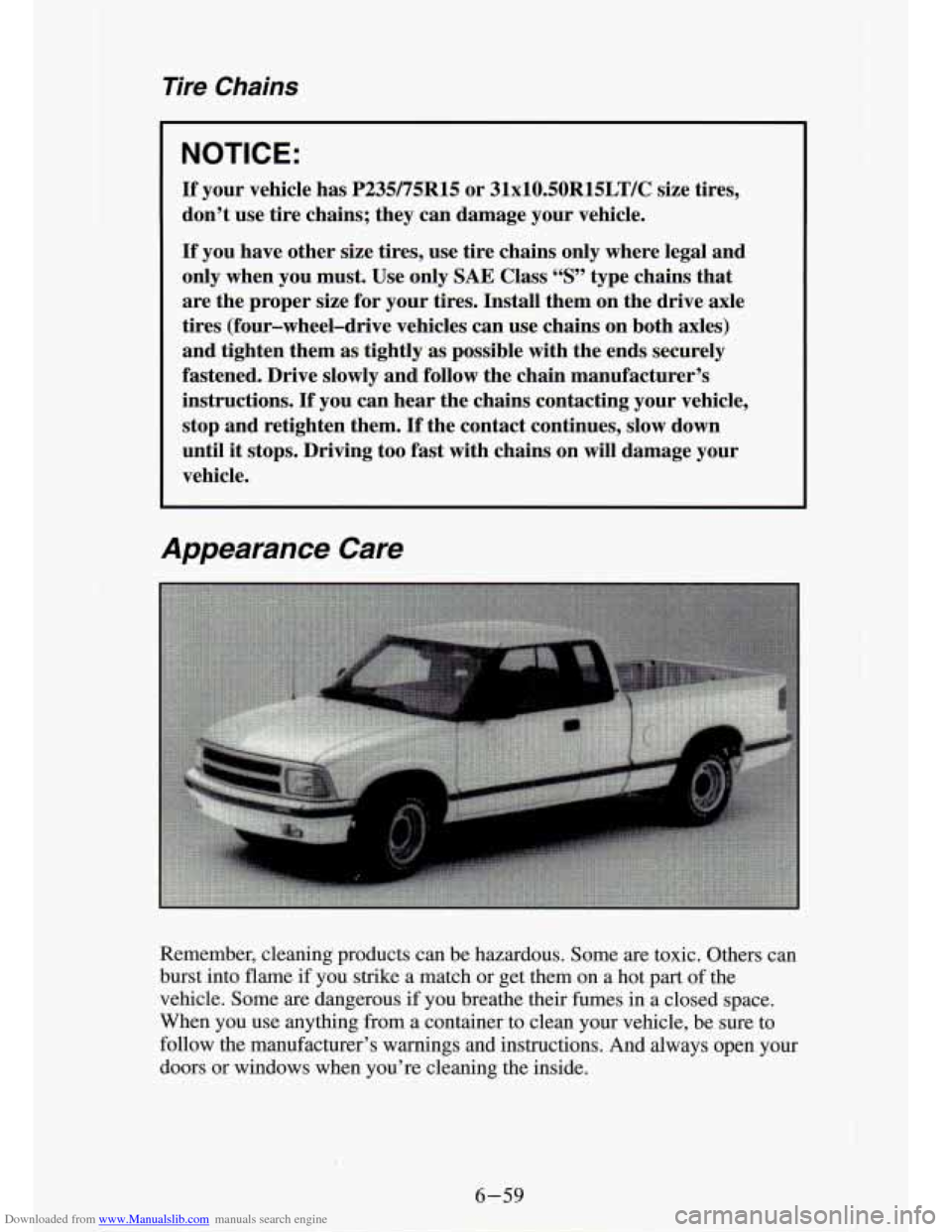
Appearance Care
Remember, cleaning’ products can be hazardous. Some are toxic\
. Others can
burst into flame
if you strike a match or get them on a hot part of the
vehicle. Some are dangerous
if you breathe their fumes in a closed space.
When you use anything from
a container to clean your vehicle, be sure to
follow the manufacturer’s warnings and instructions. And always open your\
doors or windows when you’re cleaning the inside.
6-59