1994 CHEVROLET CORVETTE stop start
[x] Cancel search: stop startPage 86 of 274

Downloaded from www.Manualslib.com manuals search engine I
1
E
E
1
S
t
r
r
’arking Brake Indicator Light
rhis light will come on when you set your
mking brake, and it will stay on if your
)arking brake doesn’t release fully.
rhis light should also come on as you
tart the.vehicle. If it doesn’t come on
hen, have it fixed
so it will be ready to
cmind you if the parking brake hasn’t
&eleased fully.
SERVICE
Anti-Lock Brake System Warning
Light
With anti-lock, this light will come on
when you start your engine and may stay
on for about two seconds. That’s normal.
If the light doesn’t come on, have it fixed
so it will be ready to warn you if there is i
problem.
If the light stays on, turn the ignition off.
Or, if the light comes on when you’re
driving, stop as soon as possible and turn
the ignition
off. Then start the engine
again to reset the system. If the light still
stays on, or comes on again while you’re
driving, your Corvette needs service. If
the regular brake system warning light
isn’t on, you still have brakes, but you
don’t have anti-lock brakes.
If the regular
brake system warning light is also on, you
don’t have anti-lock brakes and there’s a
problem with your regular brakes. See
“Brake System Warning Light” earlier in
this part.
85 ...
Page 87 of 274
Downloaded from www.Manualslib.com manuals search engine Features and Controls
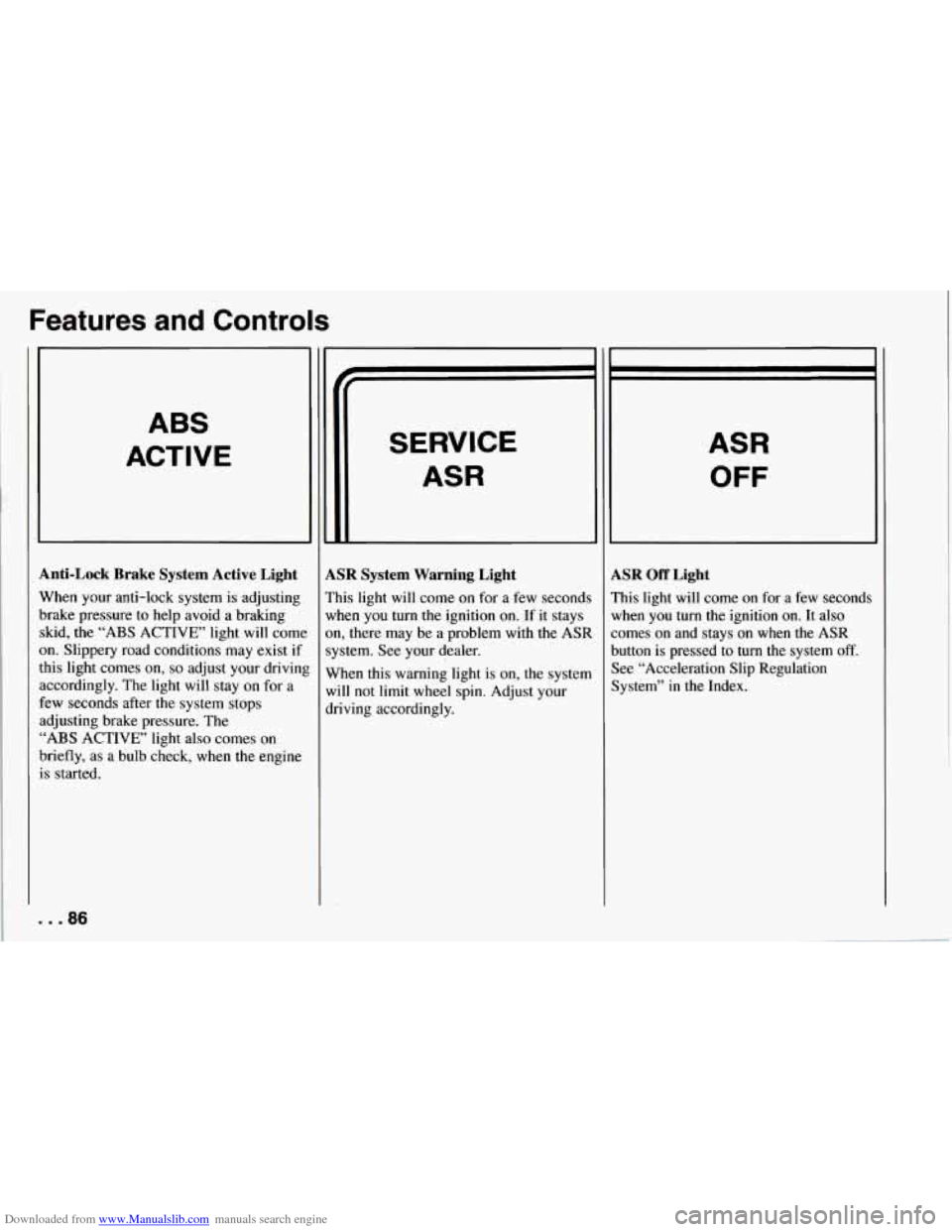
ABS
ACTIVE
Anti-Lock Brake System Active Light
When your anti-lock system is adjusting
brake pressure to help avoid a braking skid, the
“ABS ACTIVE’ light will come
on. Slippery road conditions may exist if
this light comes
on, so adjust your drivinl
accordingly. The light will stay on for a
few seconds after the system stops
adjusting brake pressure. The
“ABS ACTIVE’ light also comes on
briefly, as a bulb check, when the engine
is started.
. . .86
SERVICE
ASR
LSR System Warning Light
’his light will come on for a few seconds
vhen you turn the ignition on. If it stays
m, there may be a problem with
the ASR
ystem. See your dealer.
Vhen this warning light is on, the system
vi11 not limit
wheel spin. Adjust your
lriving accordingly.
ASR
OFF
LSR Off Light
’his light will come on for a few seconds
lrhen you turn the ignition
on. It also
omes on and stays on when the ASR
lutton is pressed to turn the system
off.
lee “Acceleration Slip Regulation
lystem” in the Index.
Page 88 of 274

Downloaded from www.Manualslib.com manuals search engine ASR
ACTIVE
ASR Active Light
When your ASR system is limiting wheel
spin, the “ASR ACTIVE’ light will come
on. Slippery road conditions may exist if
this light comes
on, so adjust your driving
accordingly. The light will stay on for a
few seconds after the ASR system stops
limiting wheel spin. The “ASR ACTIVE’
light also comes
on briefly, as a bulb
check, when the engine is started.
Low Tire Pressure Warning Light
(Option)
The LTPWS has a sensor on each road
wheel that transmits to a receiver
on the
instrument panel. The system operates on
a radio frequency subject to Federal
Communications Commission (FCC)
Rules.
This device complies with Part
15 of the
FCC Rules. Operation
is subject to the
following two conditions:
1. This device may not cause harmful
2. This device must accept any
interference,
and
interference received, including
interference that may cause undesired
operation.
Changes or modifications to this system
by other than an authorized service
facility could void authorization to use
this equipment.
LOWIFLAT
TIRE
..
The Low Tire Pressure Warning System
(LTPWS) monitors air pressure in each
road tire while you’re driving your
Corvette. The “LOW/FLAT TIRE” light
will come
on whenever tire pressure in
any road tire goes below
25 psi (175 kPa)
and it will stay
on until you turn off the
ignition. The light may come on if any
LTPWS parts aren’t working properly.
..
8
87 ...
Page 96 of 274

Downloaded from www.Manualslib.com manuals search engine 1. Turn the key to “Run,” but don’t start
2. Press “ENG MET” on the Trip the engine.
Monitor. Then, within five seconds,
press it again.
3. Within five seconds, press and hold
“GAUGES” on the Trip Monitor. The
“CHANGE
OIL” light should flash.
4. Hold the “GAUGES” button until the
“CHANGE
OIL” light stops flashing
and goes out. This should take about
ten seconds.
When the light goes out, the monitor is
reset. If the monitor doesn’t reset, turn the
ignition
off, then try again.
SERVICE
RIDE
CONTROL
Service Ride Control Light
This light should come on for a few
seconds when you start your vehicle. If
the light stays on or comes on while
you’re driving, there may be a problem
with your Selective Ride Control system.
You can still drive, but you should see
your dealer soon.
The Selective Ride Control system is
designed to sense vehicle speed in the
first minute after the vehicle is started.
If the vehicle is not moved
in that first
minute, the system records a fault. The
“SERVICE RIDE CONTROL” light
comes on after three faults are recorded.
If the light comes on for this reason, movc
your Corvette and the light should go out.
PASSIVE
KEYLESS
ENTRY
’assive Keyless Entry Light
’his light will come on for about two
econds when you turn the ignition
on,
Inless your keyless entry system is off.
:he light also comes on and flashes when
‘ou are programming transmitters. See
‘Passive Keyless Entry System” in the
ndex.
95 ...
Page 111 of 274
Downloaded from www.Manualslib.com manuals search engine Comfort Controls and Audio Systems
except ‘j and-; and at all
temperatures above freezing.
3. Press the arrows on the fan speed
switch if you don’t like the automatic
setting. In
“AUTO # ” on hot days,
the fan speed will be low at fist to
help get rid of the hot inside air..
When the air conditioner is on,
you may
notice slight changes
in your vehicle’s
engine speed and power. This is normal
because the system is designed to cycle
the compressor on and off to keep the
desired temperature and help fuel
economy.
Defogging and Defrosting
Windows
Your vehicle has several settings for
clearing your windows. The air
conditioner compressor will run to help
remove moisture from the air.
To defrost the windshield quickly:
1. Press the arrows on the “TEMP SET”
switch to set
a comfortable
temperature.
2. Press .
3. The fan will go to high speed. After
the windows are clear, you can lower
. . .I10
the speed using 7 or
“AUTO .”
To warm passengers while keeping the
windshield clear:
1. Press the arrows on the “TEMP SET”
switch
to set a comfortable
temperature.
2. Press -2 and at the same time.
3. Press the arrows on the fan speed
switch if you don’t like the automatic
setting.
To defrost
the side windows quickly:
1. Press the arrows on the “TEMP SET”
switch to set a‘comfortable
temperature.
2. Press c2 .
3. Press the arrows on the fan speed
switch if you don’t like the automatic
setting.
System Problems
If ,the light above a button flashes when
you turn on the ignition, your system may
have an electrical problem. The flashing
will continue for one minute, then stop.
The flashing light could also mean the
refrigerant level
is too low in your
system. The light will continue to flash, even
if refrigerant
is added, until the
system is reset. Have your system
checked and serviced
if needed.
To reset yoilr system:
1. Turn your ignition key to “Off’ or
2. Remove the courtesy lights and radio
fuses from the main fuse panel and
wait one minute. See “Fuses and
Circuit Breakers” in the Index.
3. Put the fuses back in and start your
The light shouldn’t come on and your
system should be working properly. If
you still have a problem, see your dealer.
“LOCK.”
vehicle.
Page 115 of 274
Downloaded from www.Manualslib.com manuals search engine Comfort Controls and Audio Systems
0 0
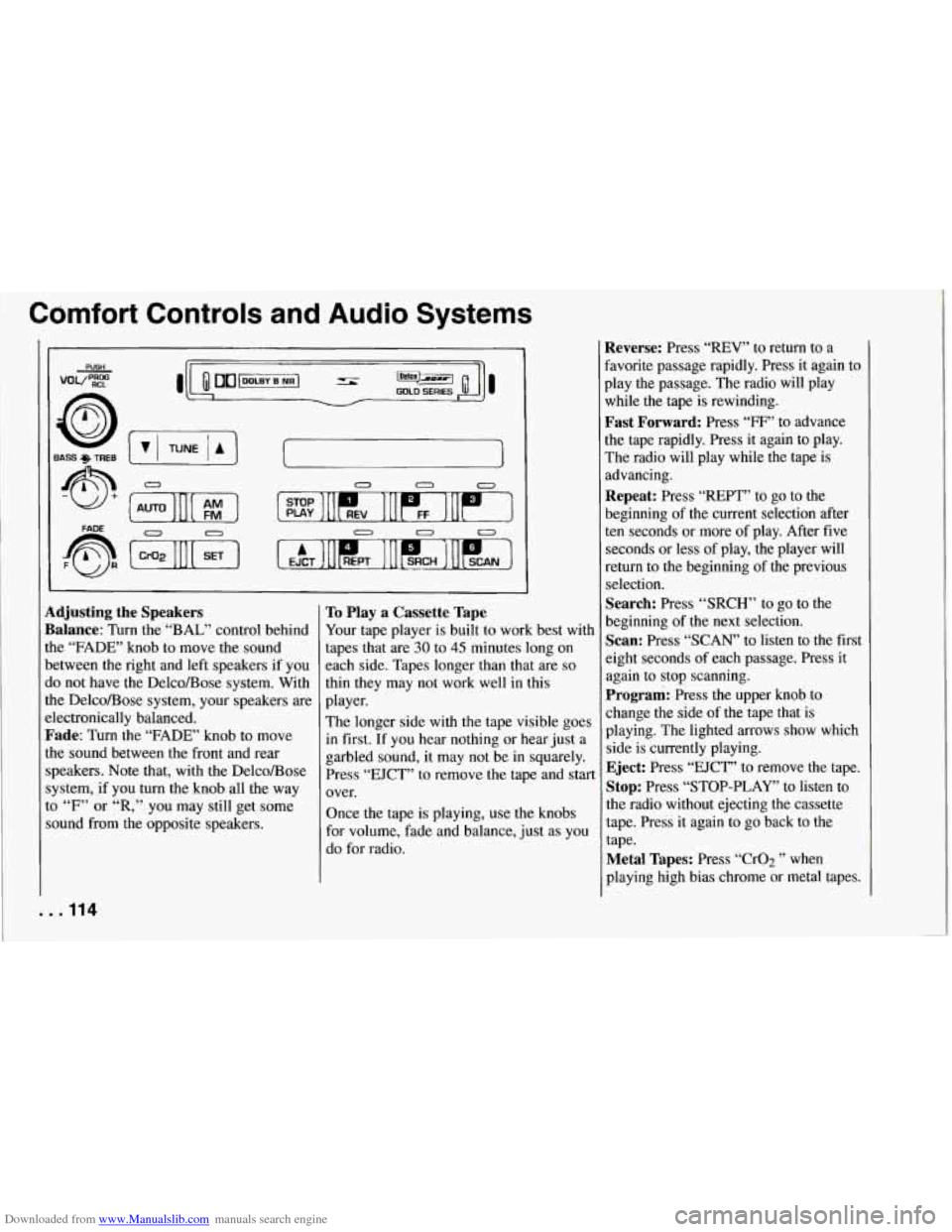
Adjusting the Speakers
Balance:
Turn the “BAL” control behind
the “FADE” knob to move the sound
between the right and left speakers if you
do not have the DelcoBose system. With
the DelcoBose system, your speakers are
zlectronically balanced.
Fade: Turn the “FADE’ knob to move
the sound between the front and rear
speakers. Note that, with the Delco/Bose
system, if you turn the knob all the way
to “F” or “R,” you may still get some
sound from the opposite speakers.
To Play a Cassette Tape
Your tape player is built to work best with
tapes that are
30 to 45 minutes long on
each side. Tapes longer than that are
so
thin they may not work well in this
player.
The longer side with the tape visible goes
in first.
If you hear nothing or hear just a
garbled sound, it may not be in squarely.
Press “EJCT” to remove the tape and start
over.
Once the tape is playing, use the knobs
for volume, fade and balance, just as you
do for radio.
Reverse: Press “REV” to return to a
favorite passage rapidly. Press it again to
play the passage. The radio will play while the tape is rewinding.
Fast Forward: Press “FF” to advance
the tape rapidly. Press it again to play.
The radio will play while the tape is
advancing.
Repeat: Press “REPT” to go to the
beginning of the current selection after
ten seconds or more of play. After five
seconds or less of play, the player will
return to the beginning of the previous
selection.
Search: Press “SRCH” to go to the
beginning of the next selection.
Scan: Press “SCAN” to listen to the first
eight seconds of each passage. Press it
again to stop scanning.
Program: Press the upper knob to
change the side
of the tape that is
playing. The lighted arrows show which
side is currently playing.
Eject: Press “EJCT” to remove the tape.
Stop: Press “STOP-PLAY” to listen to
the radio without ejecting the cassette
tape. Press it again to go back to the
tape.
Metal Tapes: Press ‘‘CrOz ” when
playing high bias chrome or metal tapes.
. . .I14
Page 117 of 274
Downloaded from www.Manualslib.com manuals search engine Comfort Controls and Audio Systems
Fade: Turn the “FADE” knob to move
the sound between the front and rear
speakers. Note that if you turn the knob
all the way to
“F” or “R,” you may still
get some sound from the opposite
speakers.
To Play a Cassette Tape
Your tape player is built to work best with
tapes that are
30 to 45 minutes long on
each side. Tapes longer than that are
so
thin they may not work well in this player.
The longer side with the tape visible goes
in first.
If you hear nothing or hear just a
garbled sound, it may not be in squarely.
Press “EJCT” to remove the tape and
start over.
Once the tape is playing, use the knobs
for volume and fade, just as you do for
radio. If both a tape and a compact disc
are loaded into
the system, press
“CNCD’ to select
the one you want.
Reverse: Press “REV” to return to a
favorite passage rapidly. Press it again to
play the passage. The radio will play
while the tape is rewinding.
Fast Forward: Press “FF” to advance
the tape rapidly. Press it again to play.
The radio will play while the tape is
advancing.
. . .I16
Repeat: Press “REPT” to go to the
beginning of
the current selection after
ten seconds or more of play. After five
seconds or less of play,
the player will
return to
the beginning of the previous
selection.
Search: Press “SRCH’ to go to the
beginning of the next selection.
Scan: Press “SCAN’ to listen to the first
eight seconds of each passage. Press it
again to stop scanning.
Program: Press the upper knob to change
the side of the tape that is playing. The
lighted arrows show which side is
currently playing.
Eject: Press “EJCT” to remove the tape.
Stop: Press “STOP-PLAY” to listen to the
radio without ejecting the cassette tape.
Press it again to go back to the tape.
Metal Tapes: Press “CrO;! ” when
playing high bias chrome or metal tapes.
To Play a Compact Disc
Don’t use the mini-discs (3” singles).
They will eject, but they won’t play. Use
only full-size compact discs. With
the audio system
on, insert a disc
into
the slot with the label side up. “CD”
will appear on the display and track
1 will
begin to play. If both
a tape and a
compact disc are loaded into the system,
press “CNCD’ to select the one you
want.
If the disc comes back out and “ERR”
appears on the display, it could be that:
The disc is upside down.
It is dirty, scratched, or wet.
0 There’s too much moisture in the air.
(Wait about an hour and try again.)
You are driving on a very rough road.
The temperature is too hot or too cold.
Recall: Press “RCL“’ to see what track is
playing. Press it again within five seconds
to see how long it has been playing, the
elapsed time (“EL TIME’).
Reverse: Press and hold “REV” to return
to a favorite passage rapidly. The
decreasing elapsed time will show on
the
display.
Fast Forward: Press and hold “FF” to
advance through passages. The increasing
elapsed time will show on the display.
Page 118 of 274

Downloaded from www.Manualslib.com manuals search engine Repeat: Press “REPT” to go to the
beginning of the current track after eight
seconds or more
of play. After eight
seconds or less of play, the player will
return to the beginning of the previous
track.
Search: Press “SRCH’ to go to the
beginning of the next track.
Scan: Press “SCAN” to listen to the first
eight seconds of each track. Press it again
to stop scanning.
Compression: Press “COMP” to make
loud and soft passages more nearly equal
in volume. Press
it again for normal play.
To Stop the Disc Player
0
0
0
Turn the power off or turn the ignition
key
off. The disc stays in the player
and will resume playing at the point
where it stopped.
Press “STOP-PLAY” to stop playing
the disc and switch to radio. Press it
again to restart the disc at the point
where it stopped.
Press “EJCT” to eject the disc and
switch to radio. If the ignition or audio
system is turned
off, the player will
pull the disc back in if you don’t
remove it from the opening within
30 seconds.
Understanding Radio Reception
FM Stereo
FM stereo will give you the best sound.
But FM signals will reach only about
10 to 40 miles (16 to 65 km). And, tall
buildings or hills can interfere with
FM signals, causing the sound to come
and go.
AM
The range for most AM stations is greater
than for
FM, especially at night. The
longer range, however, can cause stations
to interfere with each other. AM can pick
up noise from things like storms and
power lines. Try reducing the treble to
reduce this noise if you ever get it. Care of Your Cassette Tape
Player
A tape player that is not cleaned regularly
can cause reduced sound quality, ruined
cassettes, or a damaged mechanism.
Cassette tapes should be stored in their
cases away from contaminants, direct
sunlight, and extreme heat. If they aren’t,
they may not operate properly or cause
failure of the tape player.
Your tape player should be cleaned
regularly each month or after every 15
hours of use. If
you notice a reduction in
sound quality, try a known good cassette
to see if the tape or the tape player
is
at fault. If this other cassette has no
improvement in sound quality, clean the
tape player.
117.. .