1994 CHEVROLET CORVETTE stop start
[x] Cancel search: stop startPage 126 of 274
Downloaded from www.Manualslib.com manuals search engine This is a mistake. Your brakes may not
have time to cool between hard stops.
Your brakes will wear out much faster if
you do a lot
of heavy braking. If you keep
pace with the traffic and allow realistic
following distances, you will eliminate a
lot of unnecessary braking. That means
better braking and longer brake life.
If your engine ever stops while you’re
driving, brake normally but don’t pump
your brakes. If you do, the pedal may get
harder to push down. If your engine stops,
you will still have some power brake
assist. But you will use it
when you brake.
Once the power assist is used up, it may
take longer to stop and the brake pedal
will be harder to push.
SERVICE
I
Anti-Lock Brakes (ABS)
Your Corvette has an advanced electronic
braking system that will help prevent
skidding.
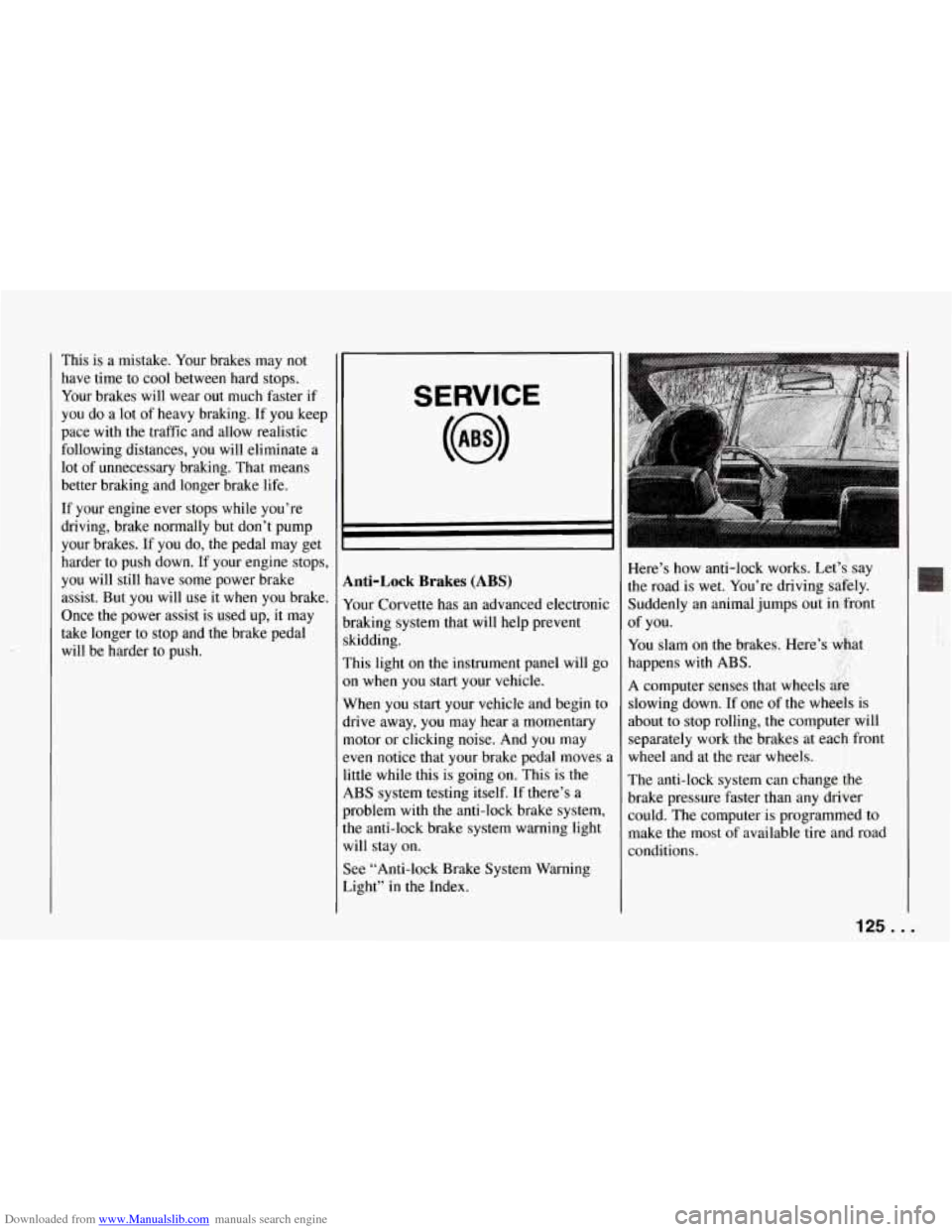
This light on the instrument panel will go
on when you start your vehicle.
When you start your vehicle and begin to
drive away, you may hear a momentary
motor or clicking noise. And you may
even notice that your brake pedal moves
,
little while this is going on. This is the
ABS system testing itself. If there’s a
problem with the anti-lock brake system,
the anti-lock brake system warning light
will stay on.
See “Anti-lock Brake System Warning
Light” in the Index. Here’s how anti-lock works. Let’s, say
the road
is wet. You’re driving safely.
Suddenly an animal jumps out in front
You slam on the brakes. Here’s &at
happens with
ABS. ..
A computer senses that wheels &g,
slowing down. If one of the wheels is
about to stop rolling, the computer will
separately work the brakes at each front
wheel and at the rear wheels.
The anti-lock system can change
the
brake pressure faster than any driver
could. The computer is programmed to
make the most of available tire and road
conditions. of
you.
125..,
Page 128 of 274
Downloaded from www.Manualslib.com manuals search engine The
comc
prob
Whe
will
drivi Systc
SERVICE
ASR
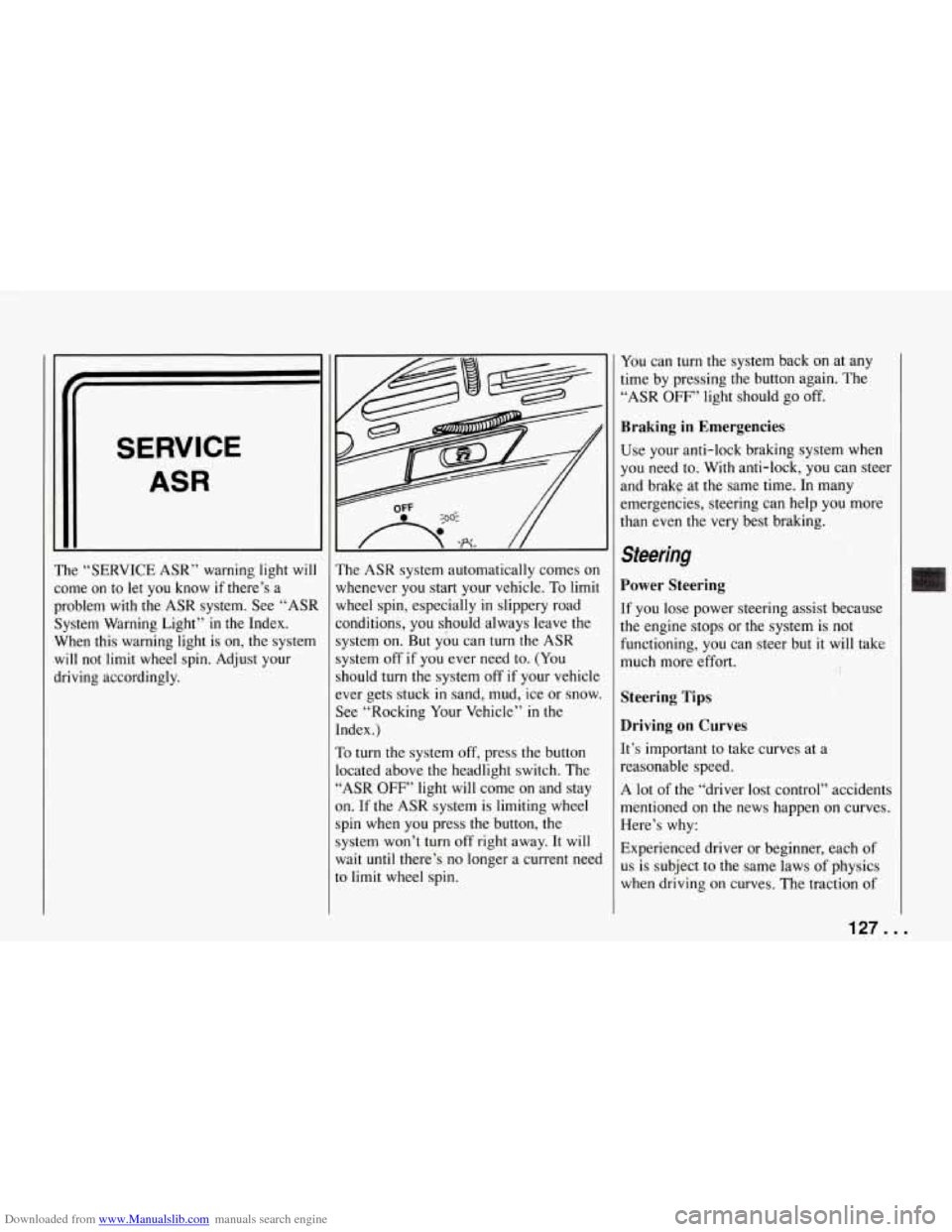
“SERVICE ASR“ warning light will
2 on
to let you know if there’s a
lem with the ASR system. See “ASR
:m Warning Light” in the Index.
n this warning light is on, the system
not limit wheel spin. Adjust your
ng accordingly. The
ASR system automatically comes on
whenever you start your vehicle. To limit
wheel spin, especially in slippery road
conditions, you should always leave the
system on. But you can turn the ASR
system off
if you ever need to. (You
should turn the system off if your vehicle
ever gets stuck
in sand, mud, ice or snow.
See “Rocking Your Vehicle” in the
Index.)
To
turn the system off, press the button
located above the headlight switch. The
“ASR
OFF’ light will come on and stay
on. If the ASR system is limiting wheel
spin when you press the button, the
system won’t turn off right away. It will
wait until there’s no longer a current
need
to limit wheel spin.
You can turn the system back on at any
time by pressing the button again. The
“ASR
OFF’ light should go off.
Braking in Emergencies
Use your anti-lock braking system when
you need to. With anti-lock, you can steer
and brakG at the same time. In many
emergencies, steering can help you more
than even the very best braking.
Steering
; .1
,.
Power Steering
If you lose power steering assist because
the engine stops or the system is not
functioning, you can steer but it will take
much more effort.
Steering Tips
Driving on Curves
It’s important to take curves at a
reasonable speed.
A lot
of the “driver lost control” accidents
mentioned
on the news happen on curves.
Here’s why:
Experienced driver or beginner, each
of
us is subject to the same laws of physics
when driving on curves. The traction of
127 ...
Page 130 of 274
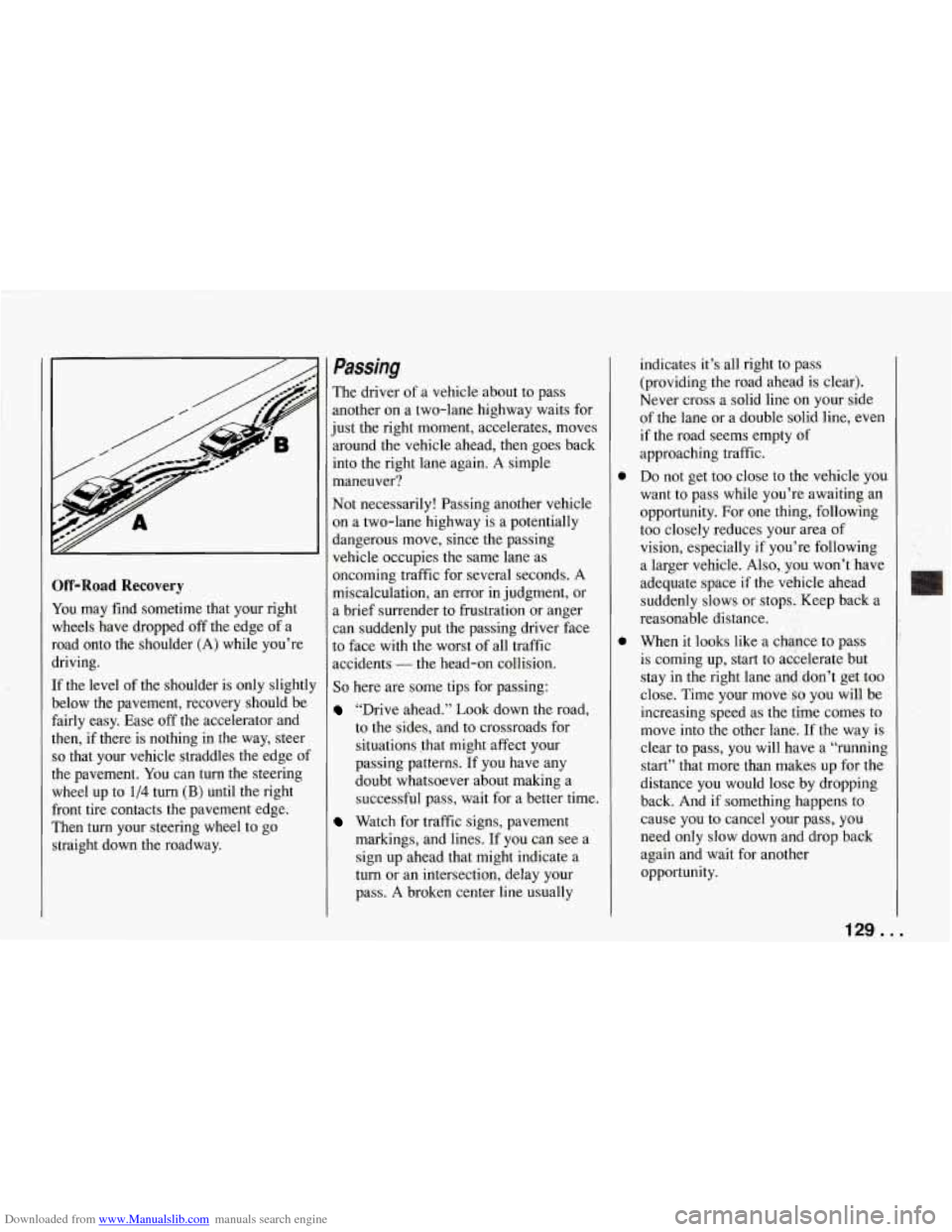
Downloaded from www.Manualslib.com manuals search engine Off-Road Recovery
You may find sometime that your right
wheels have dropped off the edge of a
road onto the shoulder (A) while you’re
driving.
If the level of the shoulder is only slight11
below the pavement, recovery should be
fairly easy. Ease off the accelerator and
then,
if there is nothing in the way, steer
so that your vehicle straddles the edge of
the pavement.
You can turn the steering
wheel up to
1/4 turn (B) until the right
front tire contacts the pavement edge.
Then turn your steering wheel to
go
straight down the roadway.
Passing
fhe driver of a vehicle about to pass
mother on a two-lane highway waits for
ust the right moment, accelerates, moves
tround the vehicle ahead, then goes back
.nto the right lane again.
A simple
naneuver?
Vot necessarily! Passing another vehicle
In a two-lane highway is a potentially
langerous move, since the passing
fehicle occupies the same lane as
Incoming traffic for several seconds. A
niscalculation, an error in judgment, or
brief surrender to frustration or anger
:an suddenly put the passing driver face
:o face with the worst of all traffic
lccidents
- the head-on collision.
So here are some tips for passing:
“Drive ahead.” Look down the road,
to the sides, and
to crossroads for
situations that might affect your
passing patterns. If you have any
doubt whatsoever about making a
successful pass, wait for a better time.
Watch for traffic signs, pavement
markings, and lines. If you can see a
sign up ahead that might indicate a
turn or an intersection, delay your
pass. A broken center line usually indicates
it’s all right to pass
(providing the road ahead
is clear).
Never cross a solid line on your side
of the lane or a double solid line, even
if the road seems empty of
approaching traffic.
Do not get too close to the vehicle you
want to pass while you’re awaiting an
opportunity. For one thing, following
too closely reduces your area of
vision, especially if you’re following
a larger vehicle. Also, you won’t have
adequate space if the vehicle ahead
suddenly slows or stops. Keep back a
reasonable distance.
When it looks like a chance to pass
is coming up, start to accelerate but
stay in the right lane and don’t get too
close. Time your move
so you will be
increasing speed as the time comes to
move into the other lane. If the way is
clear to pass, you will have a “running
start” that more than makes up for the
distance you would lose by dropping
back. And if something happens to
cause you to cancel your pass, you
need only slow down and drop back
again and wait for another
opportunity.
Page 131 of 274
Downloaded from www.Manualslib.com manuals search engine Your Driving and the Road
0
0
..
If other cars are lined up to pass a
slow vehicle, wait your turn. But take
care that someone isn’t trying to pass
you as you pull out to pass the slow
vehicle. Remember to glance over
your shoulder and check the blind
spot.
Check your mirrors, glance over your
shoulder, and start your left lane
change signal before moving out of
the right lane to pass. When you are
far enough ahead
of the passed vehicle
to see its front
in your inside mirror,
activate your right lane change signal
and move back into the right lane.
(Remember that your right outside
mirror is convex. The vehicle you just
passed may seem to be farther away
from you than it really is.)
Try not to pass more than one vehicle
at a time on two-lane roads.
Reconsider before passing the next vehicle.
Don’t overtake a slowly moving
vehicle too rapidly. Even though the
brake lights are not flashing, it may be
slowing down or starting
to turn.
If you’re being passed, make it easy
for the following driver to get ahead
of you. Perhaps you can ease a little
to the right.
,130
Loss of Control
Let’s review what driving experts say
about what happens when the three
control systems (brakes, steering and
acceleration) don’t have enough friction
where the tires meet the road to do what
the driver has asked.
In any emergency, don’t give up. Keep
trying to steer and constantly seek an
escape route or area of less danger.
Skidding
In a skid, a driver can lose control of the
vehicle. Defensive drivers avoid most
skids by taking reasonable care suited to
existing conditions, and by not
“overdriving” those conditions. But skids
are always possible.
The three types of skids correspond to
your Corvette’s three control systems.
In the braking skid your wheels aren’t
rolling. In the steering or cornering skid,
too much speed or steering in a curve
causes tires to slip and lose cornering
force. And in the acceleration skid too
much throttle causes the driving wheels
to spin.
A cornering skid
is best handled by
easing your foot
off the accelerator pedal. Remember: Any
ASR system helps avoid
only the acceleration skid. If your ASR
system is
off, then an acceleration skid is
also best handled by easing your foot off
the accelerator pedal.
If your vehicle starts to slide, ease your
foot
off the accelerator pedal and quickly
steer the way you want the vehicle to go.
If you start steering quickly enough, your
vehicle may straighten out. Always be
ready for a second skid if it occurs.
Of course, traction is reduced when water,
snow, ice, gravel, or other material is on
the road. For safety, you’ll want to slow
down and adjust your driving to these
conditions. It is important to slow down
on slippery surfaces because stopping
distance will be longer and vehicle
control more limited.
Page 133 of 274
Downloaded from www.Manualslib.com manuals search engine Your Driving and the Road
vehicle with misaimed headlights), slow
down a little. Avoid staring directly into
the approaching lights.
Keep your windshield and all the glass
on your vehicle clean
- inside and out.
Glare at night is made much worse by dirt
on the glass. Even the inside of the glass
can build up a film caused by dust. Dirty
glass makes lights dazzle and flash more
than clean glass would, making the pupils
of your eyes contract repeatedly.
Remember that your headlights light up
far less of a roadway when you are in a
turn
or curve. Keep your eyes moving;
that way, it’s easier to pick out dimly
lighted objects. Just as your headlights
should be checked regularly for proper
aim,
so should your eyes be examined
regularly. Some drivers suffer from night
blindness
- the inability to see in dim
light
- and aren’t even aware of it.
. . .I32
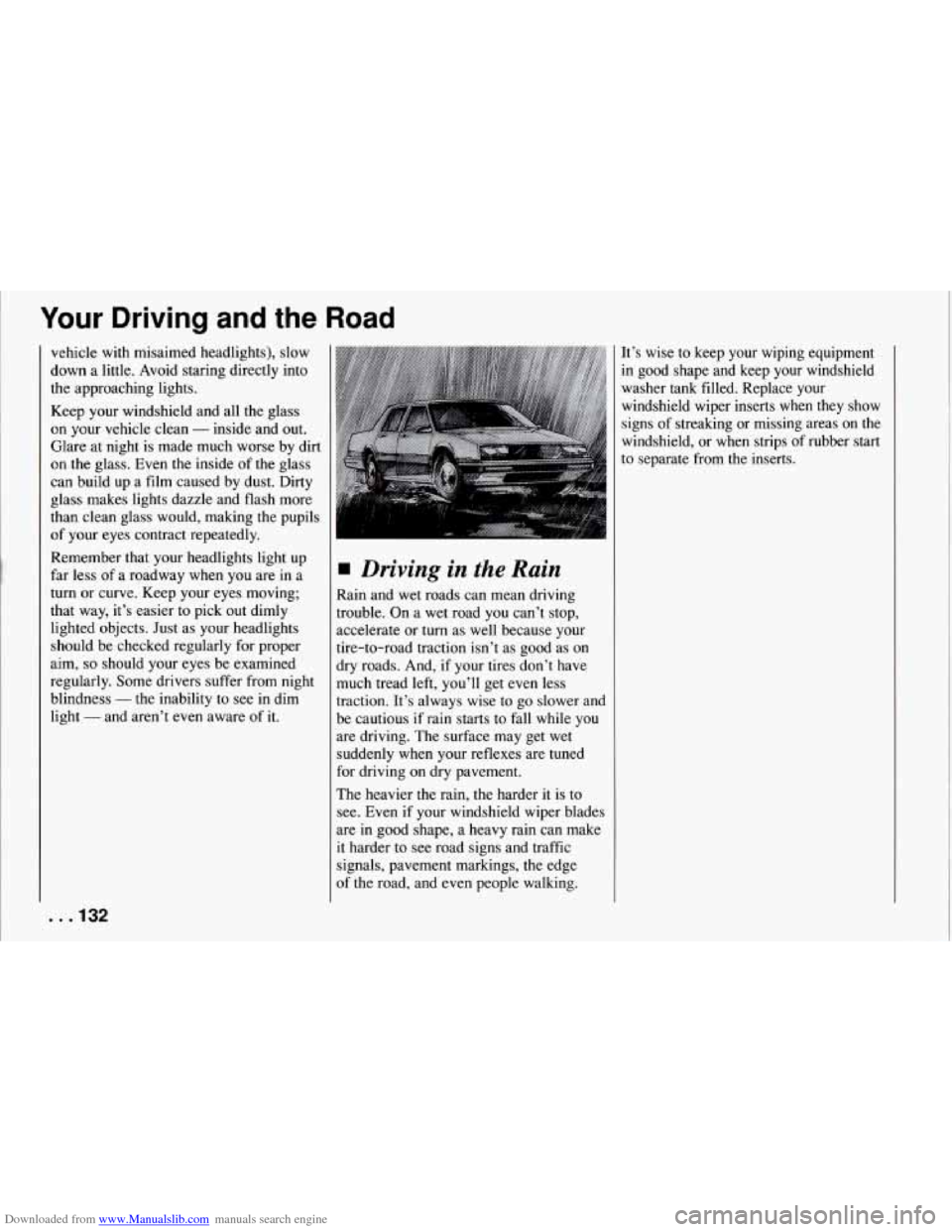
Driving in the Rain
Rain and wet roads can mean driving
trouble. On a wet road you can’t stop,
accelerate or turn as well because your
tire-to-road traction isn’t as good as on
dry roads. And, if your tires don’t have
much tread left, you’ll get even less
traction. It’s always wise to go slower and
be cautious
if rain starts to fall while you
are driving. The surface may get wet
suddenly when your reflexes are tuned
for driving on dry pavement.
The heavier the rain, the harder it is to
see. Even if your windshield wiper blades
are in good shape, a heavy rain can make
it harder to see road signs and traffic
signals, pavement markings, the edge
of the road, and even people walking. It’s wise
to keep your wiping equipment
in good shape and keep your windshield washer tank filled. Replace your
windshield wiper inserts
when they show
signs of streaking or missing areas on the
Windshield, or when strips of rubber start
to separate from the inserts.
Page 136 of 274
Downloaded from www.Manualslib.com manuals search engine begin to check traffic. Try to determine
where you expect to blend with the flow.
Try to merge into the gap
at close to the
prevailing speed. Switch on your turn
signal, check your mirrors and glance
over your shoulder as often as necessary.
Try to blend smoothly with the traffic
flow.
Once you are on the freeway, adjust your
speed to the posted limit or to the
prevailing rate if it’s slower. Stay in the
right lane unless you want to pass.
Before changing lanes, check your
mirrors. Then use your turn signal. Just
before you leave the lane, glance quickly
over your shoulder to make sure there
isn’t another vehicle in your “blind” spot.
Once you are moving on the freeway,
make certain you allow a reasonable
following distance. Expect to move
slightly slower at night.
When you want to leave the freeway,
move to the proper lane well
in advance.
If you miss your exit do not, under any
circumstances, stop and back up. Drive on
to the next exit.
The exit ramp can be curved, sometimes
quite sharply. The exit speed is usually
posted. Reduce your speed according to your speedometer, not
to your sense of
motion. After driving for any distance at
higher speeds, you may tend to think you
are going slower than you actually are.
Before Leaving on a Long Trip
Make sure you’re ready. Try to be well
rested. If you must start when you’re not
fresh
- such as after a day’s work -
don’t plan to ,make too many miles that
first part
of the journey. Wear comfortable
clothing and shoes you can easily drive
in.
Is your vehicle ready for a long trip? If
you keep it serviced and maintained, it’s
ready to go. If it needs service, have it
done before starting out. Of course, you’ll
find experienced and able service experts
in Chevrolet dealerships all across North
America. They’ll be ready and willing to
help if you need
it.
Here are some things you can check
before a trip:
Windshield Washer Fluid: Is the
reservoir full? Are all windows clean
inside and outside?
0 Wiper Blades: Are they in good
shape?
0
0
Fuel, Engine Oil, Other Fluids:
Have you checked all levels?
Lights: Are they all working? Are the
lenses clean?
Tires: They are vitally important to a
safe, trouble-free trip.
Is the wead
good enough for long-distance
driving? Are the tires all inflated to
the recommended pressure?
Weather Forecasts: What’s the
weather outlook along your route?
Should you delay your trip
a short
time to avoid a major storm system?
Maps: Do you have up-to-date maps?
Highway Hypnosis
Is there actually such a condition as
“highway hypnosis”? Or is it jugt plain
falling asleep at the wheel? Call it
highway hypnosis, lack of awareness, or
whatever.
There is something about an easy stretch
of road with the same scenery, along with
the hum of the tires on the road, the drone
of the engine, and the rush of the wind
against the vehicle that can make you
sleepy. Don’t let it happen to you! If it
does, your vehicle can leave the road in
less than a second, and you could crash
and be injured.
135