Page 65 of 274
Downloaded from www.Manualslib.com manuals search engine Features and Controls
NOTICE:
0
0
0
0
When using concentrated washer fluid, follow the
manufacturer’s instructions
for adding water.
Don’t mix water with
ready-to-use washer fluid.
Water can cause the solution to
freeze and damage your washer
fluid tank and other parts of the
washer system. Also, water
doesn’t clean as well as washer
fluid.
Fill your washer fluid tank only
314 full when it’s very cold.
This allows for expansion,
which could damage
the tank
if it is completely full.
Don’t use radiator antifreeze in
your windshield washer. It can
damage your washer system
and paint.
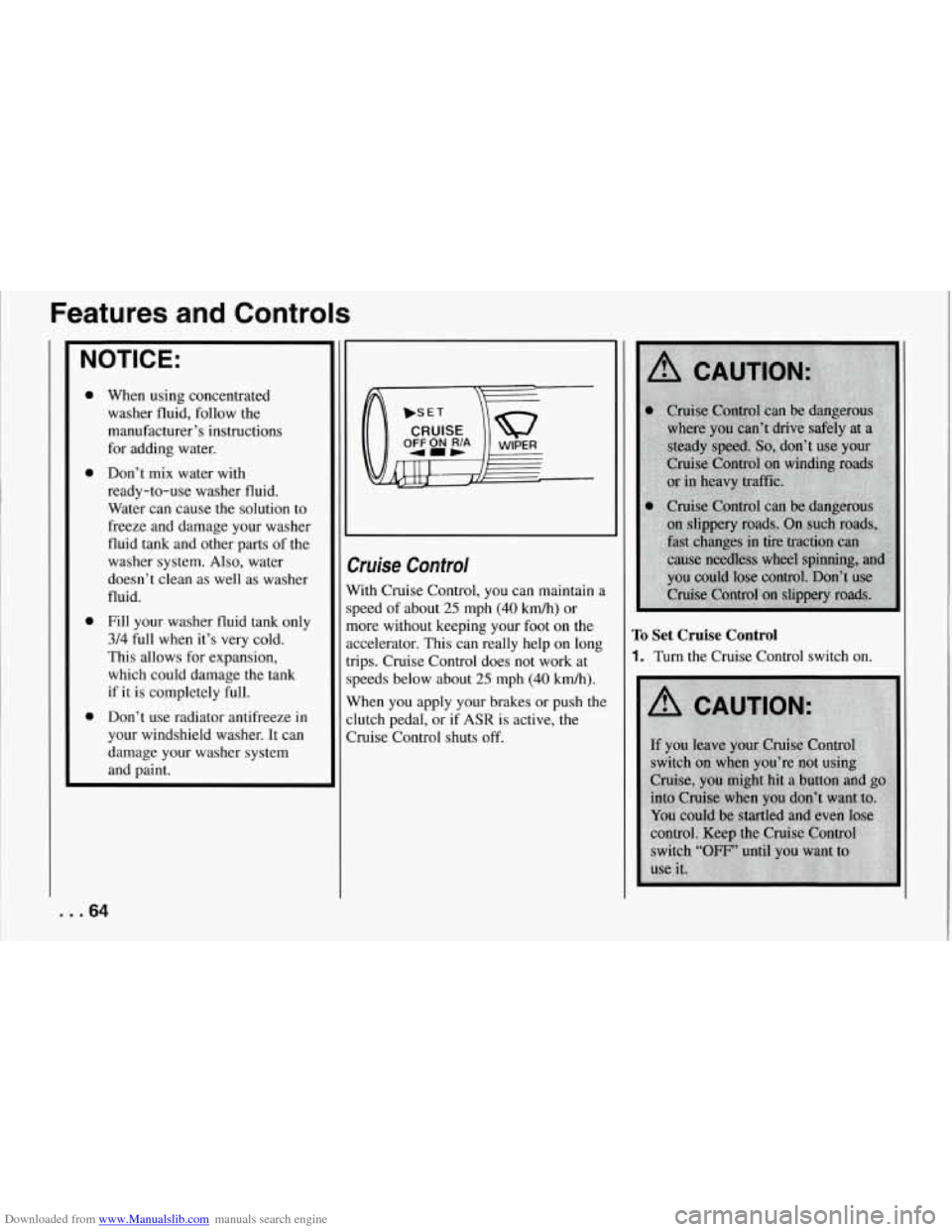
>wise Control
Vith Cruise Control, you can maintain a
peed of about 25 mph (40 km/h) or
nore without keeping your foot on the
ccelerator. This can really help on long
ips. Cruise Control does not work at
peeds below about
25 mph (40 kmh).
Vhen you apply your brakes or push the
lutch pedal, or if ASR is active, the
bise Control shuts off.
To Set Cruise Control
1. Turn the Cruise Control switch on.
... 64
Page 109 of 274
Downloaded from www.Manualslib.com manuals search engine Comfort Controls and Audio Systems
Automatic Electronic Climate Control
(OP~ON)
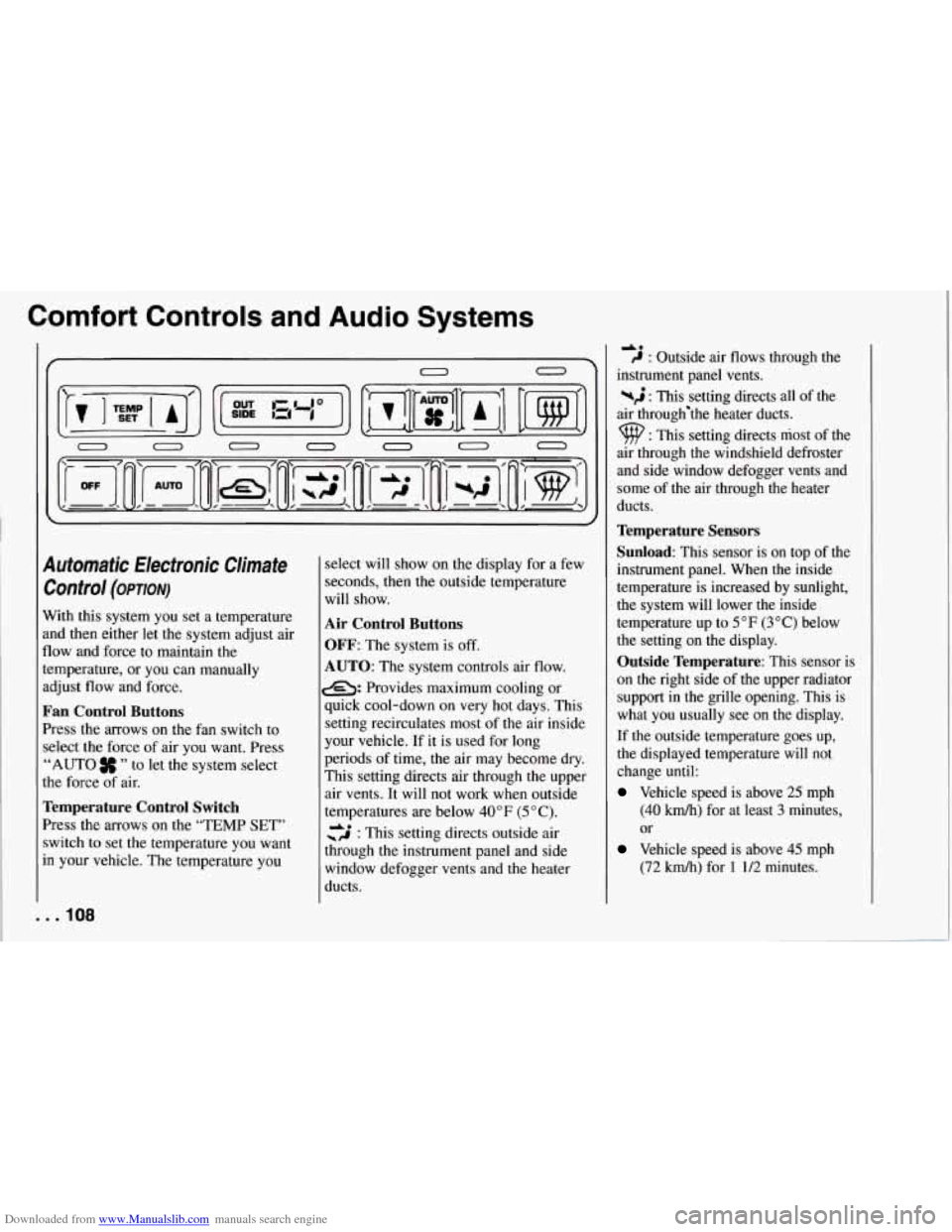
With this system you set a temperature
and then either let the system adjust air
flow and force to maintain
the
temperature, or you can manually
adjust flow and force.
Fan Control Buttons
Press the arrows on the fan switch to
select the force of air you want. Press
“AUTO
” to let the system select
the force of air.
Temperature Control Switch
Press the arrows on the “TEMP SET’’
switch to set the temperature you want
in your vehicle. The temperature you
. . .IO8
select will show on the display for a few
seconds, then the outside temperature
will show.
Air Control Buttons
OFF:
The system is off.
AUTO: The system controls air flow.
e: Provides maximum cooling or
quick cool-down on
very hot days. This
setting recirculates most of the air inside
your vehicle. If it is used for long
periods of time, the air may become dry.
This setting directs air through the upper
air vents. It will not work when outside
temperatures are below
40°F (5 “C).
cs : This setting directs outside air
through the instrument panel and side
window defogger vents and the heater
ducts.
40 C : Outside air flows through the
instrument panel vents.
%$ : This setting directs all of the
air through‘the heater ducts.
9 : This setting directs most of the
air through
the windshield defroster
and side window defogger vents and
some of the air through the heater
ducts.
Temperature Sensors
Sunload:
This sensor is on top of the
instrument panel. When the inside
temperature is increased by sunlight,
the system will lower the inside
temperature up to
5°F (3°C) below
the setting on the display.
Outside Temperature: This sensor is
on the right side of the upper radiator
support in the grille opening. This is
what you usually see on the display.
If the outside temperature goes up,
the displayed temperature will not
change until:
Vehicle speed is above 25 mph
(40 kmh) for at least 3 minutes,
or
Vehicle speed is above 45 mph
(72
km/h) for 1 1/2 minutes.
Page 153 of 274
Downloaded from www.Manualslib.com manuals search engine Problems on the Road
F
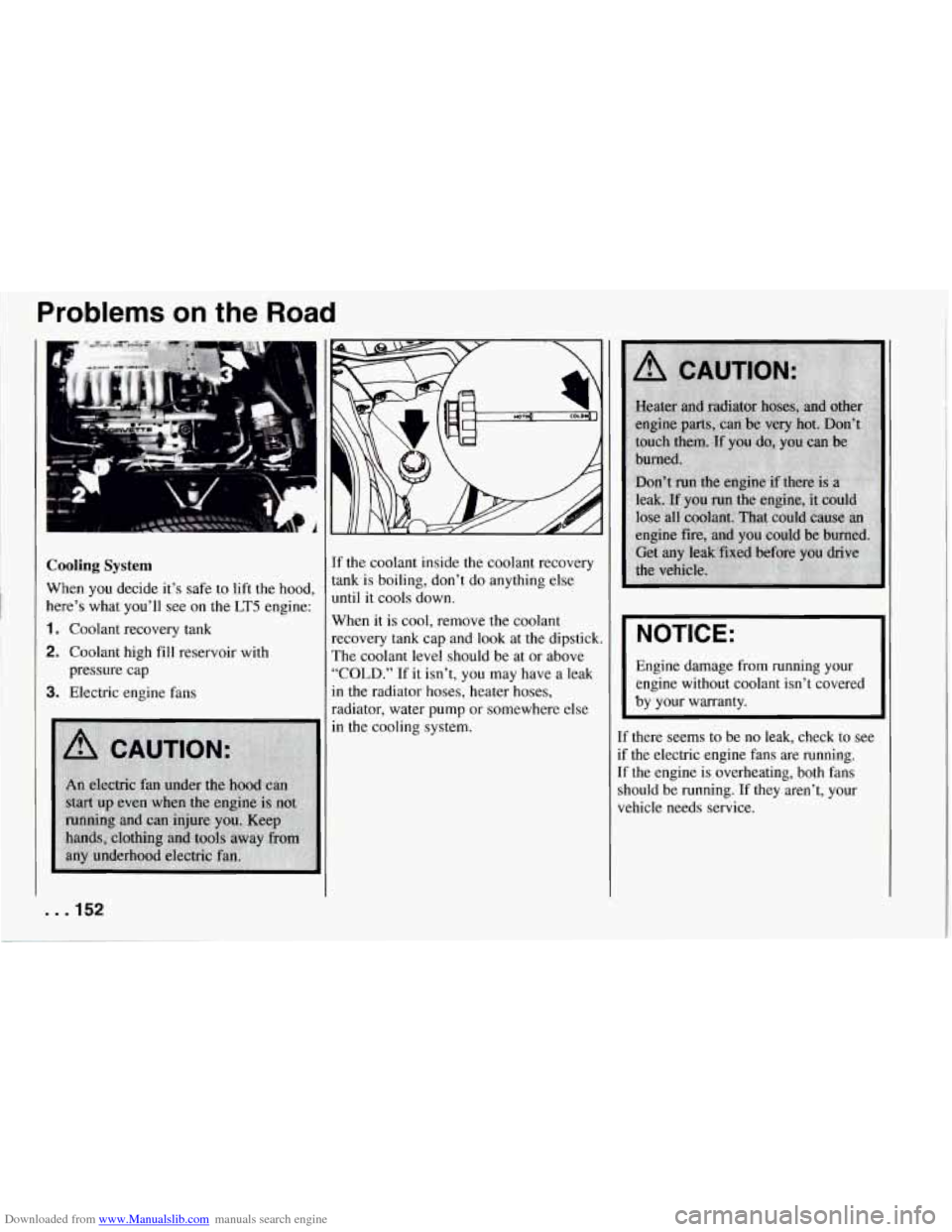
Cooling System
When you decide it’s safe to lift the hood,
here’s what you’ll see on the
LT5 engine:
1. Coolant recovery tank
2. Coolant high fill reservoir with
3. Electric engine fans
pressure cap
. . -152
If
the coolant inside the coolant recovery
tank is boiling, don’t do anything else
until it cools down.
When it is cool, remove the coolant
recovery tank cap and look at the dipstick.
The coolant level should be at or above
“COLD.” If it isn’t, you may have a leak
in the radiator hoses, heater hoses,
radiator, water pump or somewhere else
in the cooling system.
I NOTICE:
I
Engine damage from running your
engine without coolant isn’t covered
by your warranty.
If there seems to be no leak, check
to see
if the electric engine fans are running.
If the engine is overheating, both fans
should be running.
If they aren’t, your
vehicle needs service.
Page 154 of 274
Downloaded from www.Manualslib.com manuals search engine How to Add Coolant to the Coolant
Recovery Tank
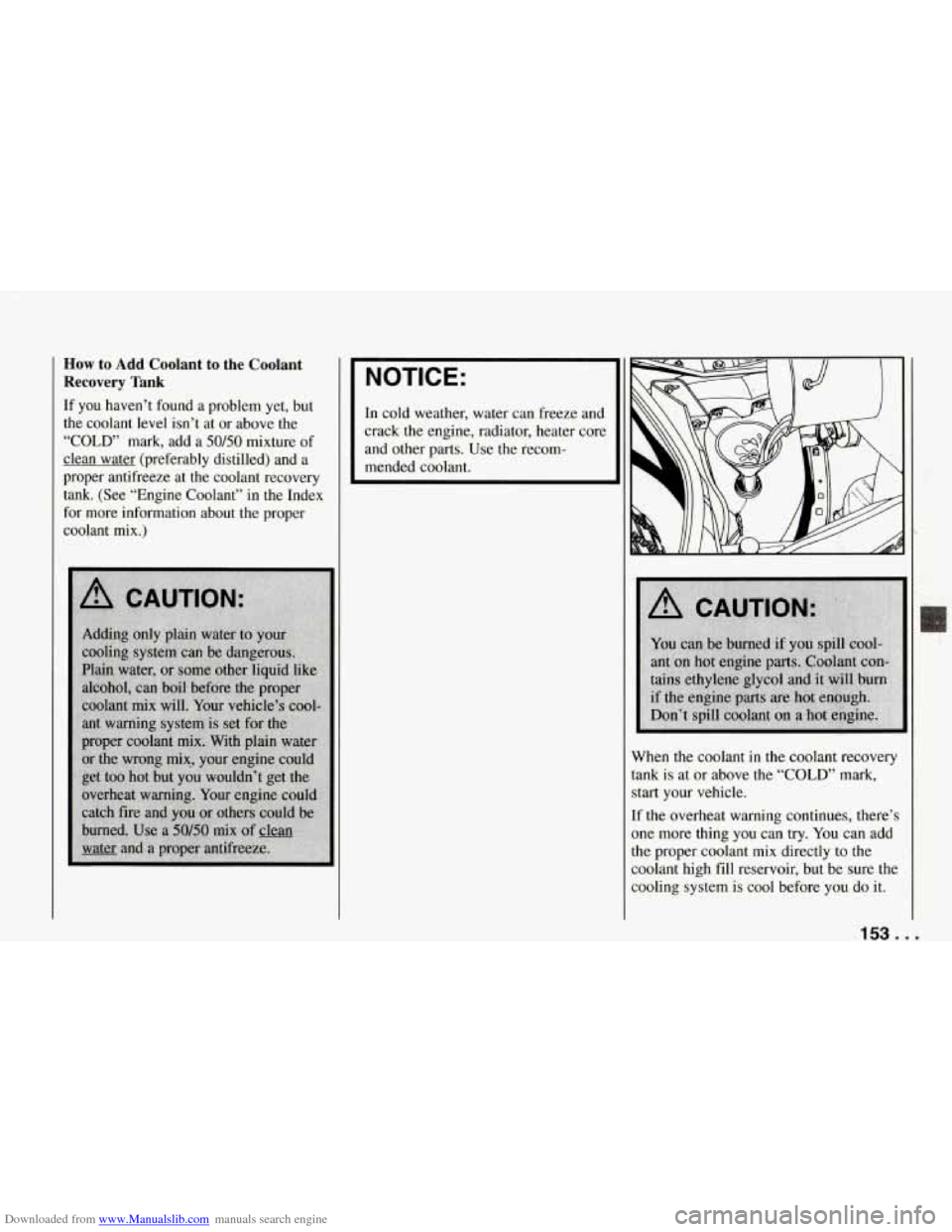
If you haven’t found a problem yet, but
the coolant level isn’t at or above the
“COLD, mark, add a
50150 mixture of
clean water (preferably distilled) and a
proper antifreeze at the coolant recovery
tank. (See “Engine Coolant” in the Index
for more information about the proper
coolant
mix.)
NOTICE:
I
In cold weather, water can freeze and
crack
the engine, radiator, heater core
and other parts. Use the recom-
mended coolant.
When the coolant in the coolant recovery
tank is at or above the
“COLD” mark,
start your vehicle.
If the overheat warning continues, there’s
one more thing you can try. You can add
the proper coolant mix directly to the
coolant high fill reservoir, but be sure the
cooling system is cool before you do it.
153 ...
Page 155 of 274
Downloaded from www.Manualslib.com manuals search engine Problems on the Road
How to Add Coolant to the Coolant
High
Fill Reservoir - LT1 Only
NOTICE:
I
The LT1 engine (Code P) has a
specific coolant high fill reservoir
fill procedure. Failure to follow this
procedure could cause your engine to
overheat and be severely damaged.
1. You can remove the coolant high fill
reservoir pressure cap when the
cooling system, including the coolant
high fill reservoir pressure cap and
upper radiator hose,
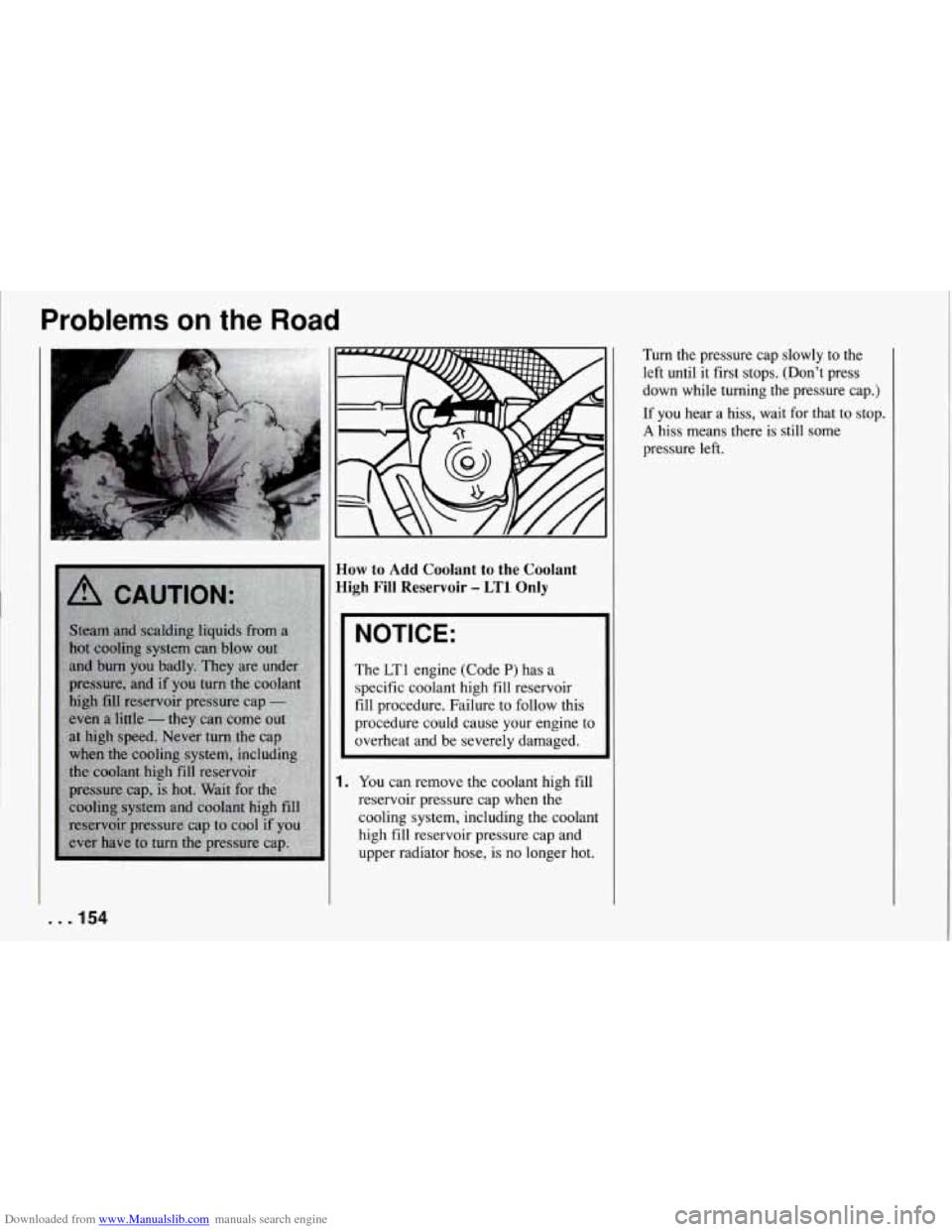
is no longer hot. Turn the pressure cap slowly to
the
left until
it first stops. (Don't press
down while turning the pressure cap.)
If
you hear a hiss, wait for that to stop.
A hiss means there is still some
pressure left.
. . .I54
Page 158 of 274
Downloaded from www.Manualslib.com manuals search engine How to Add Coolant to the Coolant
High Fill Reservoir
(5.7L LT5 (Code J)
Engine)
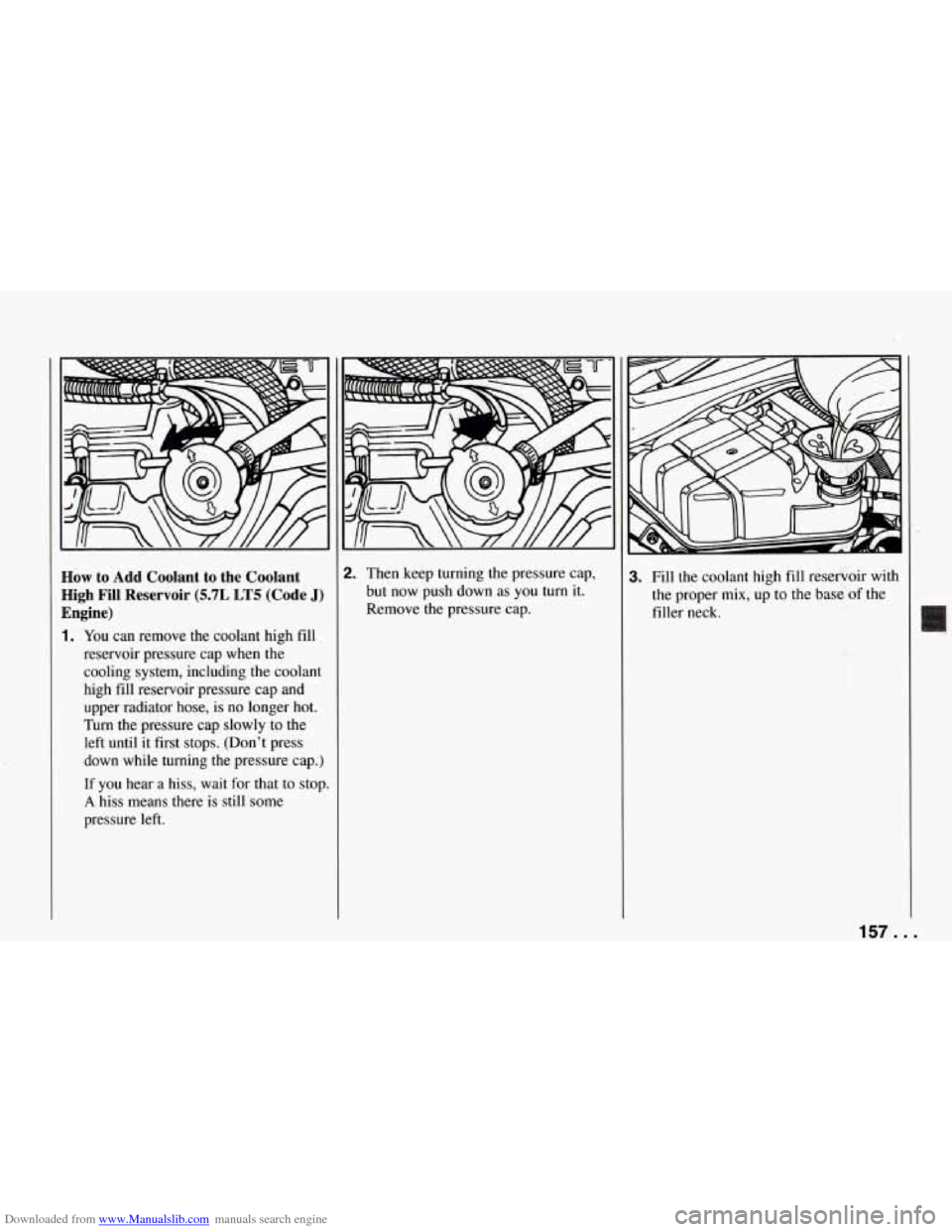
1. You can remove the coolant high fill
reservoir pressure cap when the
cooling system, including the coolant
high fill reservoir pressure cap
and
upper radiator hose, is no longer hot.
Turn the pressure cap slowly to the
left until it first stops. (Don’t press
down while turning the pressure cap.)
If you hear a hiss, wait for that to stop.
A hiss means there is still some
pressure left.
2. Then keep turning the pressure cap,
but now push down as you turn it.
Remove the pressure cap. 3. Fill the coolant high fill reservoir with
the proper mix, up to the base of the
filler neck.
157 ...
Page 159 of 274
Downloaded from www.Manualslib.com manuals search engine Problems on the Road
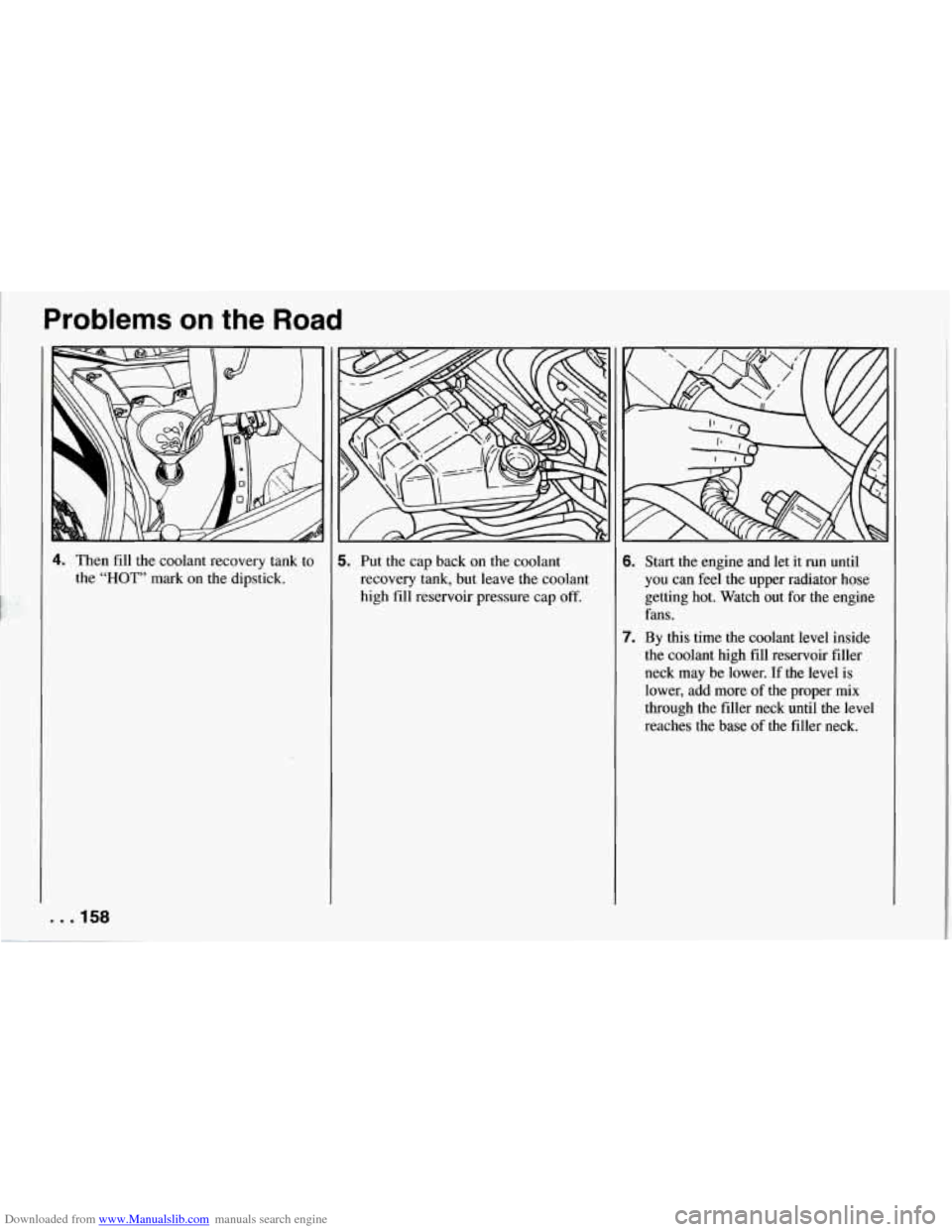
4. Then fill the coolant recovery tank to
the “HOT” mark
on the dipstick.
5. Put the cap back on the coolant
recovery tank, but leave
the coolant
high fill reservoir pressure cap
off.
6. Start the engine and let it run until
you can feel the upper radiator hose
getting hot. Watch out for the engine
fans.
7. By this time the coolant level inside
the coolant high fill reservoir filler
neck may be lower. If the level is
lower, add more of the proper
mix
through the filler neck until the level
reaches the base of the filler neck.
. . .158
Page 190 of 274
Downloaded from www.Manualslib.com manuals search engine What to Use:
Use a mixture of one-half clean water
(preferably distilled) and one-half
antifreeze that meets “GM Specification
1825-M,” which won’t damage aluminum
parts.
You can also use a recycled coolant
conforming to GM Specification 1825-M
with a complete coolant flush and refill.
If you use this mixture, you don’t need to
add anything else.
NOTICE:
If you use an improper coolant mix,
your engine could overheat and be
badly damaged. The repair cost wouldn’t be covered by your
warranty.
Too much water in the mix
can freeze and crack the engine,
radiator, heater core and other parts.
Adding Coolant
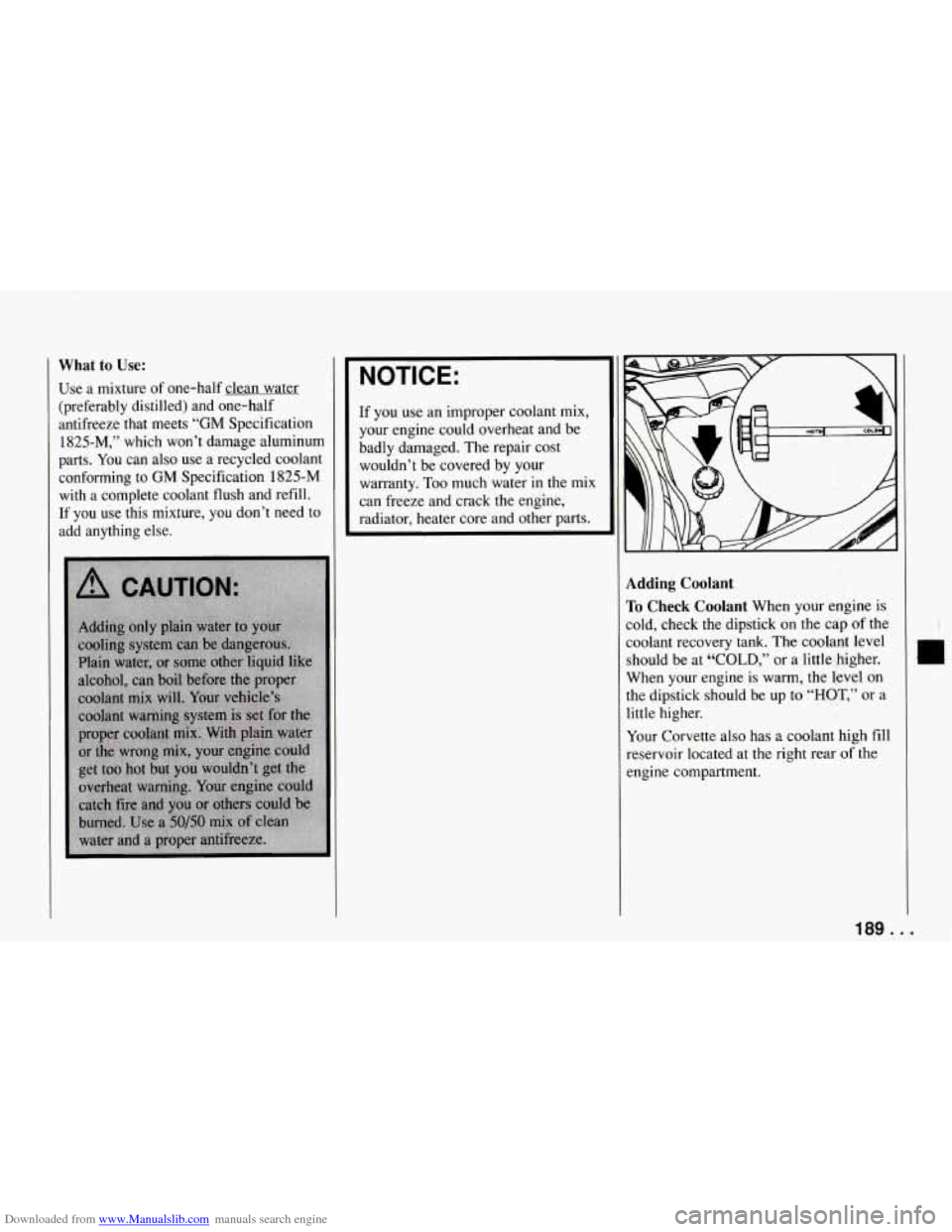
I’o Check Coolant When your engine is
;old, check the dipstick on the cap of the
;oolant recovery tank. The coolant level
should be at “COLD,” or a little higher.
When your engine is warm, the level on
the dipstick should be up to “HOT,” or a
little higher.
Your Corvette also has a coolant high fill
reservoir located at the right rear of the
engine compartment.
189 ...