1994 CHEVROLET CAVALIER light
[x] Cancel search: lightPage 175 of 243
Downloaded from www.Manualslib.com manuals search engine Service & Appearance Care
NOTICE:
When using concentrated washer
fluid, follow the manufacturer’s
instructions for adding water.
Don’t mix water with ready-to-
use washer fluid. Water can cause
the solution to freeze and damage
your washer fluid tank and other
parts of the washer system. Also,
water doesn’t clean as well
as
washer fluid.
Fill your washer fluid tank only %
full when it’s very cold. This
allows for expansion, which could
damage the tank if it is
completely full.
Don’t use radiator antifreeze in
your windshield washer. It can
damage your washer system and
paint.
I Brakes
Brake Master Cylinder
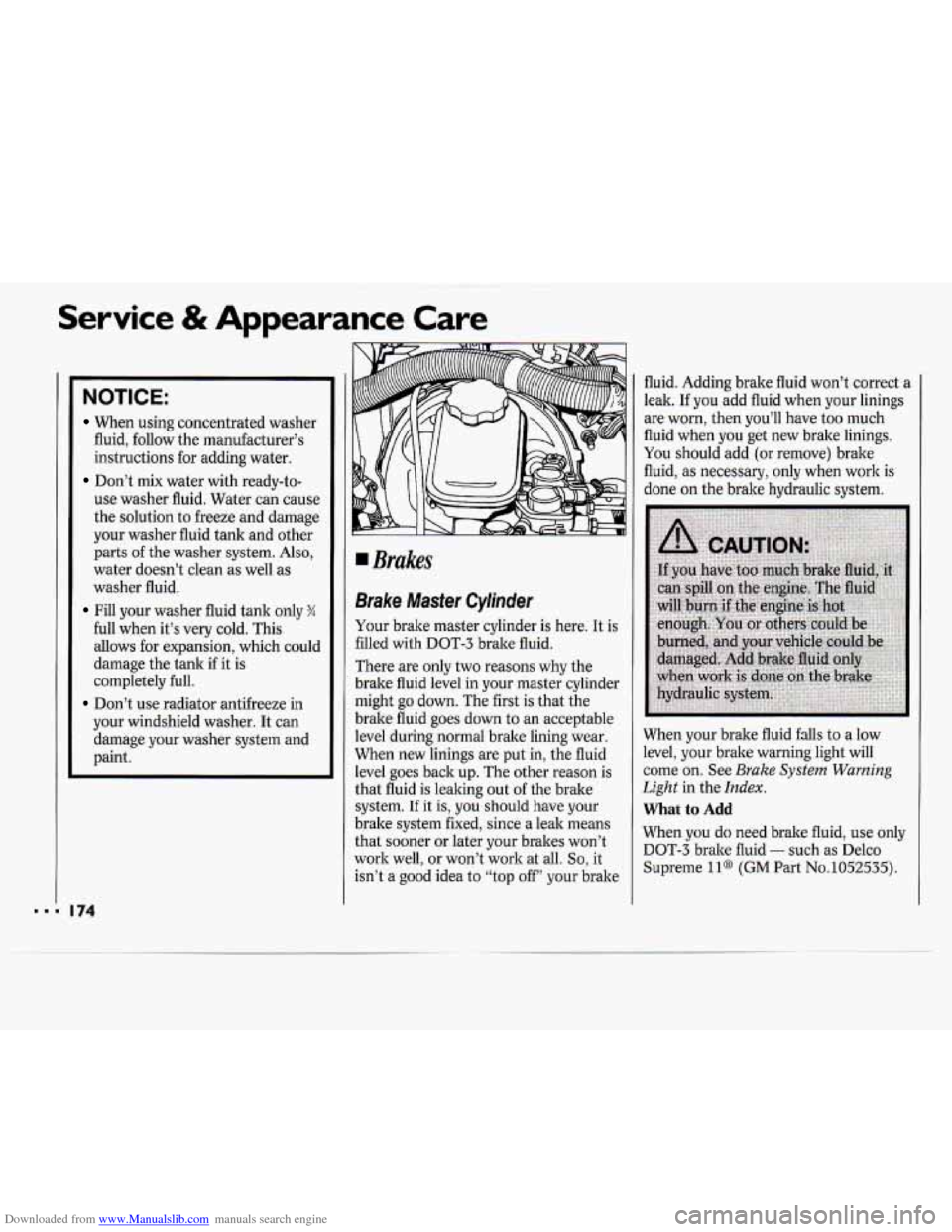
Your brake master cylinder is here. It is
filled with DOT-3 brake fluid.
There are only two reasons why the
brake fluid level in your master cylinder
might go down. The first is that the
brake fluid goes down to an acceptable
level during normal brake lining wear.
When new linings are put in, the fluid
level goes back up. The other reason is
that fluid is leaking out of the brake
system.
If it is, you should have your
brake system fixed, since a leak means
that sooner or later your brakes won’t
work well,
or won’t work at all. So, it
isn’t a good idea to “top off” your brake fluid. Adding brake fluid won’t correct a
leak.
If you add fluid when your linings
are worn, then you’ll have too much
fluid when
you get new brake linings.
You should add (or remove) brake
fluid, as necessary, only when work
is
done on the brake hydraulic system.
When your brake fluid falls
to a low
level, your brake warning light will
come on. See
Brake System Warning
Light in the Index.
What to Add
When you do need brake fluid, use only
DOT-3 brake fluid
- such as Delco
Supreme
11@ (GM Part No.1052535).
Page 176 of 243
Downloaded from www.Manualslib.com manuals search engine Use new brake fluid from a sealed container only, and always clean the
brake fluid reservoir cap before
removing it.
I
NOTICE:
DOT-5 silicone brake fluid can
Don’t let someone put in the
damage your vehicle. Don’t
use it.
wrong kind of fluid. For example,
just
a few drops of mineral-based
oil, such as engine
oil, in your
brake system can damage brake system parts
so badly that they’ll
have to be replaced.
Brake fluid can damage paint, so
be careful not to spill brake fluid
on your vehicle. If you do, wash it
OF immediately. See Appearance
Cave
in the Index.
II
Brake Wear
Your Chevrolet has front disc brakes
and rear drum brakes.
Disc brake pads have built-in wear
indicators that make a high-pitched warning sound when
~ the
b&e..p@dsa .ve,
worn and new‘
pads are needed: .The ‘
sound may come and go or be heard all
the time your vehicle is moving (except
when you are pushing on the brake
pedal firmly).
NOTICE:
Continuing to drive with worn-out
brake pads could result in costly
brake repair.
Some driving conditions or climates
may cause
a brake squeal when the
brakes are first applied or lightly
applied. This does not mean something
is wrong with your brakes. Your
rear drum brakes don’t have wear
indicators, but if you ever hear a rear
brake rubbing noise, have the rear brake
linings inspected.
Also, the rear brake
drums should be removed and
inspected each time the tires are
removed for rotation or changing. When
you have the front brakes replaced,
have the rear brakes inspected, too.
Brake linings should always be replaced
as complete axle sets.
Brake Pedal Travel
See your dealer if the brake pedal does
not return to normal height, or if there
is
a rapid increase in pedal travel. This
could be a sign of brake trouble.
Brake Adjustment
Every time you make a moderate brake
stop, your disc brakes adjust for wear. If
you rarely make a moderate or heavier stop, then your brakes might not adjust
correctly.
If you drive in that way, then
- very carefully - make a few
moderate brake stops about every
1,000
miles (1600 lun), so your brakes will
adjust properly.
Page 178 of 243
Downloaded from www.Manualslib.com manuals search engine Headlight Bulb Replacement
For the type of bulb, see the Index
under Replacement Bulbs.
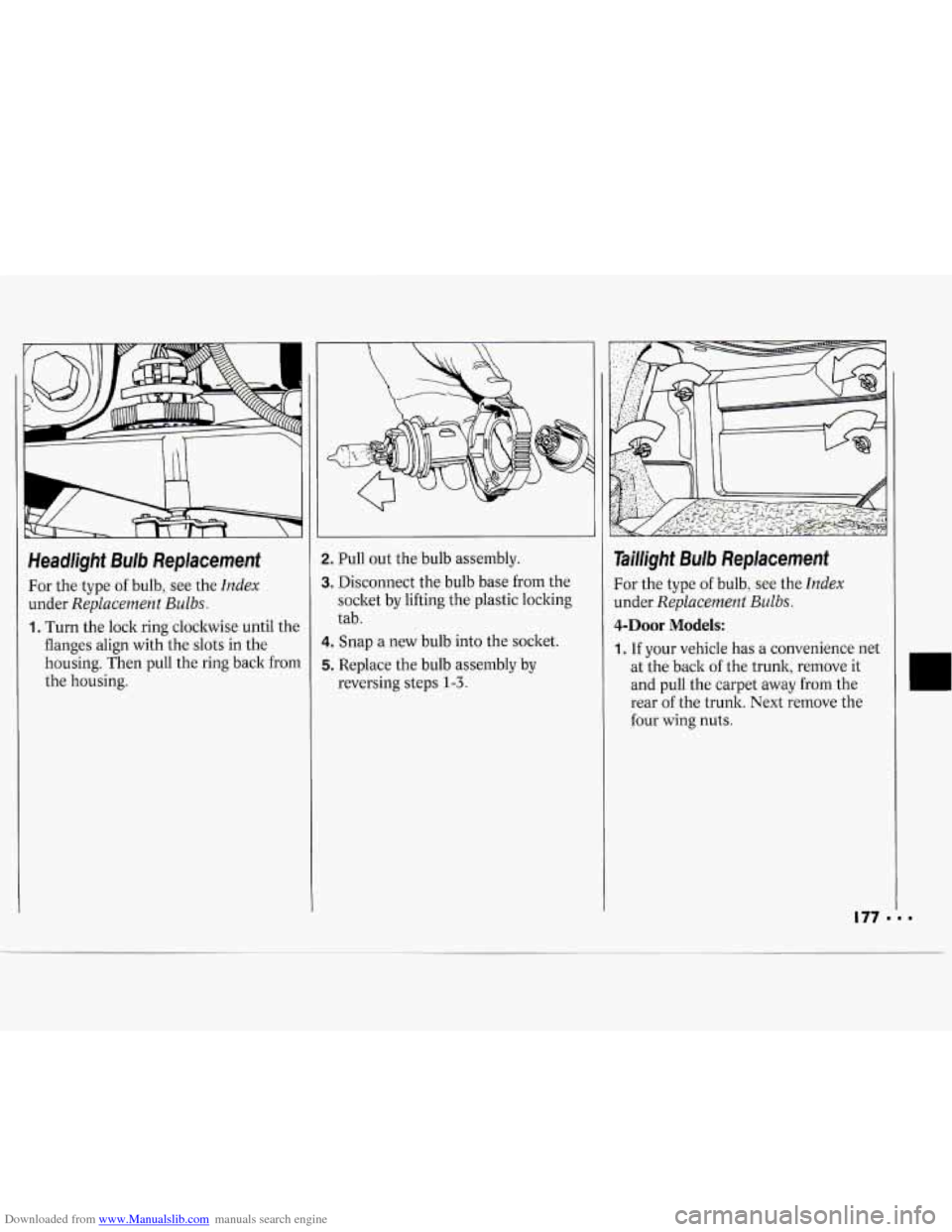
1. Turn the lock ring clockwise until the
flanges align with the slots in the
housing. Then pull the ring back from
the housing.
2. Pull out the bulb assembly.
3. Disconnect the bulb base from the
socket by lifting the plastic locking
tab.
4. Snap a new bulb into the socltet.
5. Replace the bulb assembly by
reversing steps
1-3.
Taillight Bulb Replacement
For the type of bulb, see the Index
under Replacement Bulbs.
4-Door Models:
1, If your vehicle has a convenience net
at the back of the trunk, remove it
and pull the carpet away from the
rear of the trunk. Next remove the
four wing nuts.
177 1
Page 179 of 243
Downloaded from www.Manualslib.com manuals search engine __~
Service & Appearance Care
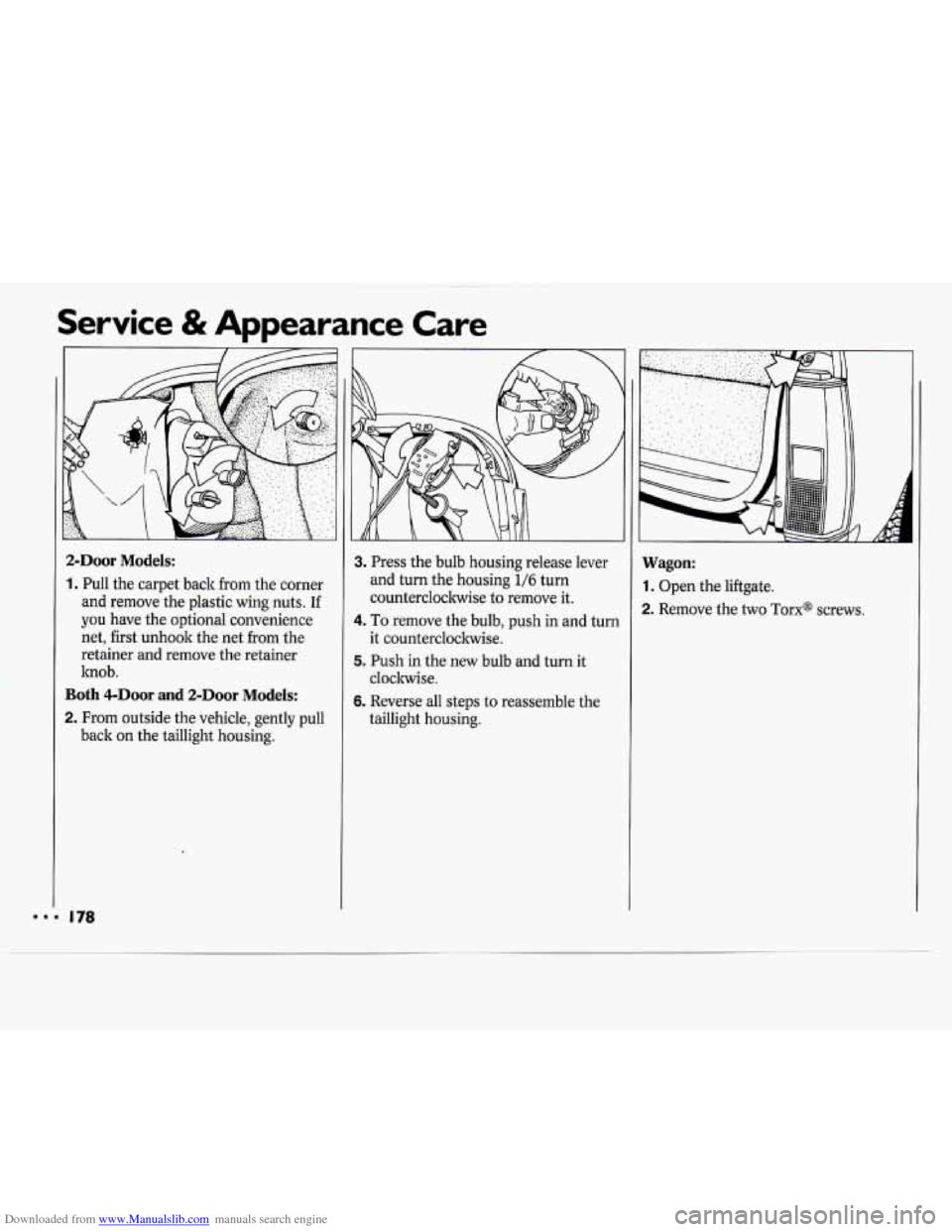
2-Door Models:
1. Pull the carpet back from the corner
and remove the plastic wing nuts.
If
you have the optional convenience
net, first unhook the net from the
retainer and remove the retainer
knob.
Both 4-DOOr and 2-Door Models:
2. From outside the vehicle, gently pull
back on the taillight housing.
3. Press the bulb housing release lever
and turn the housing
1/6 turn
countercloclnvise to remove it.
it countercloclnvise.
cloclnvise.
taillight housing.
4. To remove the bulb, push in and turn
5. Push in the new bulb and turn it
6. Reverse all steps to reassemble the
Wagon:
1. Open the liftgate.
2. Remove the two Torxs screws.
Page 180 of 243
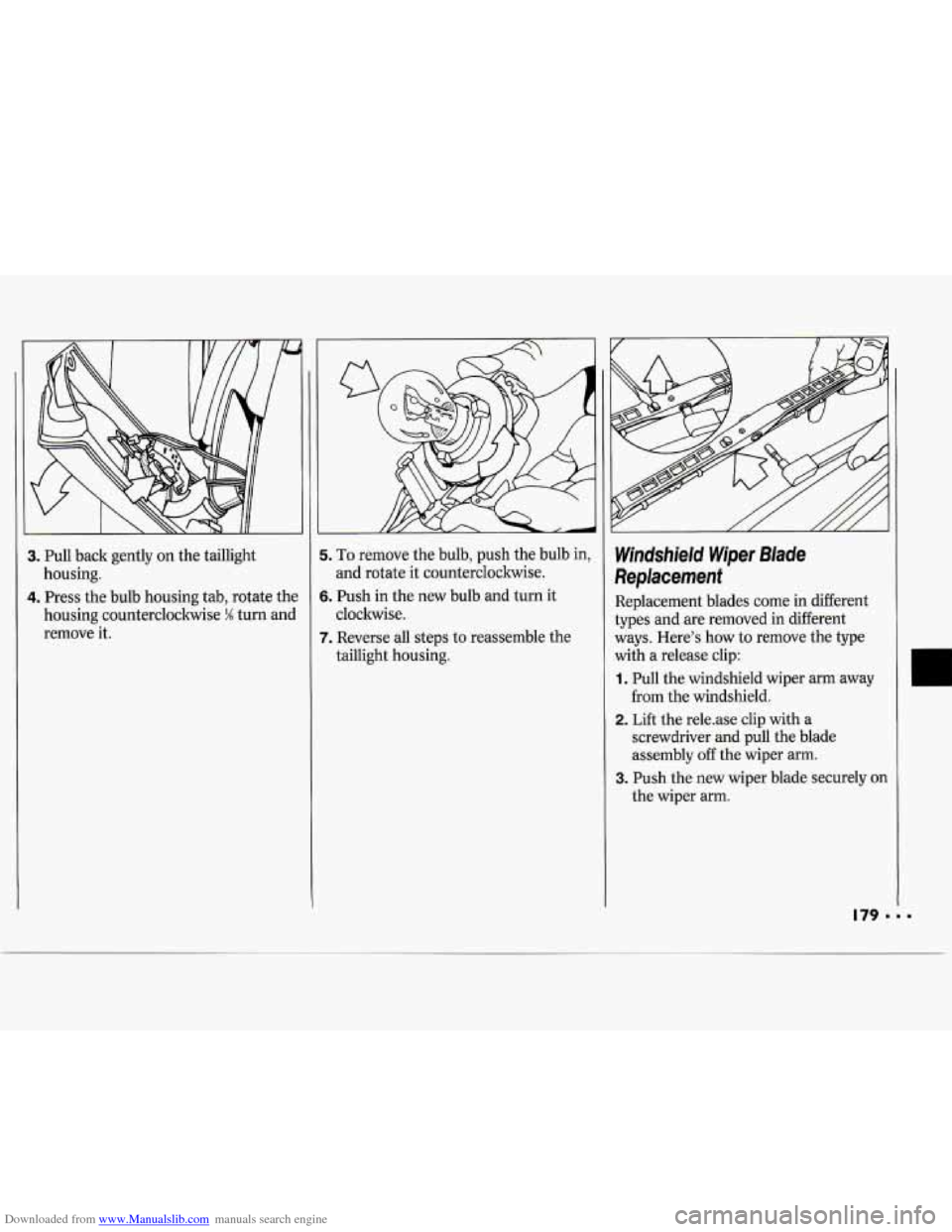
Downloaded from www.Manualslib.com manuals search engine 3. Pull back gently on the taillight
housing.
4. Press the bulb housing tab, rotate the
housing counterclockwise
% turn and
remove it.
i. To remove the bulb, push the bulb in,
and rotate it counterclockwise.
5. Push in the new bulb and turn it
cloclnvise.
7. Reverse all steps to reassemble the
taillight housing.
Windshield Wiper Blade
Replacement
Replacement blades come in different
types and are removed in different
ways. Here’s how to remove the type
with
a release clip:
1. Pull the windshield wiper arm away
from the windshield.
2. Lift the rele-ase clip with a
screwdriver and pull the blade
assembly off the wiper arm.
the wiper arm.
3. Push the new wiper blade securely on
Page 187 of 243
Downloaded from www.Manualslib.com manuals search engine Service & Appearance Care
Wheel Alignment and Tire Balance
The wheels on your vehicle were
aligned and balanced carefully at the
factory
to give you the longest tire life
and best overall performance.
In most cases, you will not need to have
your wheels aligned again. However, if
you notice unusual tire wear or your
vehicle pulling one way or the other, the
alignment may need
to be reset. If you
notice your vehicle vibrating when
driving on
a smooth road, your wheels
may need to be rebalanced.
Wheel Replacement
Replace any wheel that is bent, cracked
or badly rusted.
If wheel nuts keep
coming loose, the wheel, wheel bolts,
and wheel nuts should be replaced.
If
the wheel leaks air, replace it (except
some aluminum wheels, which can
sometimes be repaired). See your
Chevrolet dealer if any
of these
conditions exist.
Your dealer will know the kind of wheel
you need.
Each new wheel should have the same
load carrying capacity, diameter, width,
offset, and be mounted the same way as
the one it replaces.
If you need to replace any of your
wheels, wheel bolts, or wheel nuts,
replace them only with new
GM
original equipment parts. This way, you
will be sure
to have the right wheel,
wheel bolts, and wheel nuts for your
Chevrolet model.
I NOTICE:
The wrong wheel can also cause
problems with bearing life, brake
cooling, speedometer/odometer
calibration, headlight aim, bumper
height, vehicle ground clearance,
and tire or tire chain clearance to
the body and chassis.
Page 189 of 243
Downloaded from www.Manualslib.com manuals search engine Service & Appearance Care
Never use these to clean your vehicle:
Gasoline
Benzene
Naphtha
Carbon Tetrachloride
Acetone
Paint Thinner
Turpentine
Lacquer Thinner
Nail Polish Remover
They can all be hazardous
- some
more than others
- and they can all
damage your vehicle, too.
NOTICE:
Don’t use any of these unless this
manual says
you can. In many uses,
these will damage your vehicle:
Alcohol
Laundry Soap
Bleach
Reducing Agents
Cleaning the Inside of Your
Chevrolet
Use a vacuum cleaner often to get rid of
dust and loose dirt. Wipe vinyl or
leather with
a clean, damp cloth.
Your Chevrolet dealer has two GM
cleaners, a solvent-type spot lifter and a
foam-type powdered cleaner. They will
clean normal spots and stains very well.
Do not use them on vinyl or leather.
Here are some cleaning tips:
Always read the instructions on the
cleaner label.
Clean up stains as soon as you can -
before they set.
Use a clean cloth or sponge, and
change to a clean area often.
A soft
brush may be used
if stains are
stubborn.
ventilated area only. If you use them,
don’t saturate the stained area.
If a ring forms after spot cleaning,
clean the entire area immediately or it
will set.
Use solvent-type cleaners in a well-
Using Foam-Type Cleaner on
Fabric
Vacuum and brush the area to remove
Always clean a whole trim panel or
any
loose dirt.
section. Mask surrounding trim along
stitch or welt lines.
,
Mix Multi-Purpose Powdered Cleaner
following the directions on the
container label.
Use suds only and apply with a clean
Don’t saturate the material.
Don’t rub it roughly.
As soon as you’ve cleaned the section,
use a sponge to remove the suds.
Rinse the section with a clean, wet
sponge.
Wipe off what’s left with a slightly
damp paper towel or cloth.
Then dry it immediately with a blow
dryer or a heat lamp.
sponge.
Page 190 of 243
Downloaded from www.Manualslib.com manuals search engine NOTICE:
Be careful with a hair dryer or heat
lamp. You could scorch the fabric.
Wipe with a clean cloth.
Using Solvent-Type Cleaner on
Fabric
First, see if you have to use solvent-type
cleaner at all. Some spots and stains
will clean off better with just water and
mild soap.
If you need to use a solvent:
Gently scrape excess soil from the
trim material with a clean, dull knife
or scraper. Use very little cleaner,
light pressure and clean cloths
(preferably cheesecloth). Cleaning
should start at the outside of the
stain, “feathering” toward the center.
Keep changing to a clean section of
the cloth.
When you clean a stain from fabric,
immediately dry the area with an air
hose, hair dryer, or heat lamp to help
prevent a cleaning ring. (See the
previous NOTICE.)
Fabric hotection
Your Chevrolet has upholstery that has
been treated with Scotchgard’” Fabric
Protector, a 3M product. ScotchgardTM
protects fabrics by repelling oil and
water, which are the carriers of most
stains. Even with this protection, you
still need to clean your upholstery often
to keep it looking new.
Further information on cleaning is
available by calling 1-800-433-3296 (in
Minnesota, 1-800-642-6167).
Special Cleaning Problems
Greasy or Oily Stains
Such as grease, oil, butter, margarine,
shoe polish, coffee with cream, chewing
gum, cosmetic creams, vegetable oils,
wax crayon, tar and asphalt.
Carefully scrape off excess stain.
Follow the solvent-type instructions
Shoe polish, wax crayon, tar and
described earlier.
asphalt will stain if left on a vehicle
seat fabric. They should be removed
as soon as possible. Be careful,
because the cleaner will dissolve them
and may cause them to spread.
Non-Greasy Stains
Such as catsup, coffee (black), egg,
fruit,
fruit juice, milk, soft drinks, wine,
vomit, urine and blood.
Carefully scrape off excess stain, then
sponge the soiled area with cool
water.
If a stain remains, follow the foam-
type instructions described earlier.
If an odor lingers after cleaning vomit
or urine, treat the area with a
.
waterhaking soda solution: 1
teaspoon (5 ml) of baking soda to 1
cup (250 ml) of lukewarm water.
If needed, clean lightly with solvent-
type cleaner.
Combination Stains
Such as candy, ice cream, mayonnaise,
chili sauce and unknown stains.
Carefully scrape off excess stain, then
clean with cool water and allow to
dry-
If a stain remains, clean it with
solvent-type cleaner.
189 I