Page 219 of 398

Trailer Hitching Procedure Using A Weight
Distributing (Equalizing) Hitch
(Recommended for loaded trailers weighing 3,000 lbs. to 7,000 lbs.)
Your vehicle is equipped with an Electronic Level Control (ELC) feature.
When hooking up a trailer using a weight distributing hitch, always use
the following procedure:
0
0
0
0
0
Place the vehicle on a level surface without the trailer hitched. With
the ignition off, and all doors closed, allow the vehicle to level
automatically.
Disable the Electronic Level Control (ELC) by pulling
MAXI@
fuse #9 (30 AMP) from the underhood electrical center located on
the passenger side wheel housing in the engine compartment. Remove
the cover to gain access.
Attach the trailer to the vehicle. The trailer tongue should weight
12%
of the total loaded trailer weight.
Level the vehicle with the load leveling spring bars (equalizers).
Leave the fuse out while towing your trailer.
n It
I
I
E'
NOTICE:
Adjusting an equalizing hitch with the Electronic Level Control \
(ELC) system engaged will defeat the function of the load
equalizing hitch and may cause unsatisfactory handling.
Once you have completed towing your trailer, be sure to reinstall the
Electronic Level Control (ELC) fuse.
In Addition
Use two friction sway controls if your trailer is over 5,000 lbs. .(2270
kg) loaded weight, and/or is. over 24'. long..
0 Use at least one friction sway control if your trailer is over 2,000 lbs.
(908 kg) loaded weight, and consider using one for trailers under
2,000 lbs. (908 kg).
ill
i
3
206
Page 222 of 398
Passing
You’ll need more passing distance ahead when you’re towing a trailer.
Because you’re longer, you’ll need to go much farther beyond the passed
vehicle before you can return to your lane.
Backing Up
Hold the bottom of the steering wheel with one hand. Then, to move the
trailer to the left, just move that hand to the left.
To move the trailer to
the right, move your hand to the right. Always back up slowly and, if
possible, have someone guide you.
Making Turns
When you’re turning with a trailer, make wider turns than normal. Do
this so your trailer won’t strike soft shoulders, curbs, road signs, trees, or
other objects. Avoid jerky or sudden maneuvers. Signal well in advance.
Turn Signals When Towing a Trailer
When you tow a trailer, your vehicle has to have a different turn signal
flasher and extra wiring. The green arrows on your instrument panel will
flash whenever you signal a turn or lane change. Properly hooked up, the
trailer lights will also flash, telling other drivers you’re about to turn,
change lanes or stop.
When towing a trailer, the green arrows on your instrument panel will
flash for turns even if the bulbs on the trailer are burned out. Thus, you
may think drivers behind you are seeing your signal when they are not.
It’s important to check occasionally to be sure the trailer bulbs are still
working.
Driving On Grades
Reduce speed and shift to a lower gear before you start down a long or
steep downgrade.
If you don’t shift down, you might have to use your
brakes
so much that they get hot and no longer work well.
209
Page 223 of 398
On a long uphill grade, shift down to a lower gear and reduce your speed
and reduce your speed to around
45 mph (70 km/h) to reduce the
possibility of engine and transmission overheating.
If your trailer weighs more than
2,000 pounds (908 kg), you should drive
in “D or 3” instead of Overdrive. This allows the torque convertor clutch
to engage and allowing the transmission to run cooler.
Parking on Hills
You really should not park your vehicle, and trailer on a hill. If something
goes wrong your rig could start to move. People can be injured and both
I your vehicle and the trailer can be damaged.
If you eve1 have to park your rig on a hill, here’s how to do it:
Apply your regular brakes, but don’t shift into “P7, (Park) yet.
I Have someone place chocks (tapered triangular blocks) under the
downhill side the trailer wheels.
When the wheel chocks are in place, release the regular brakes until
Reapply the regular brakes. Then shift into “P” (Park) and apply the
Release the regular brakes.
the
chocks absorb the load.
parking brake.
When You Are Ready to Leave Afier Parking on a Hill
1. Apply your regular brakes and hold the pedal down while you:
Start your engine;
Shift into a gear; and
Be sure the parking brake has released.
2. Release the brake pedal.
3. Drive slowly until the trailer is clear of the chocks.
iI;
n
Gi
I B
h I1
-1
l
U1
a‘ I
210
4. Stop and have someone pick up and store the chocks.
Page 233 of 398
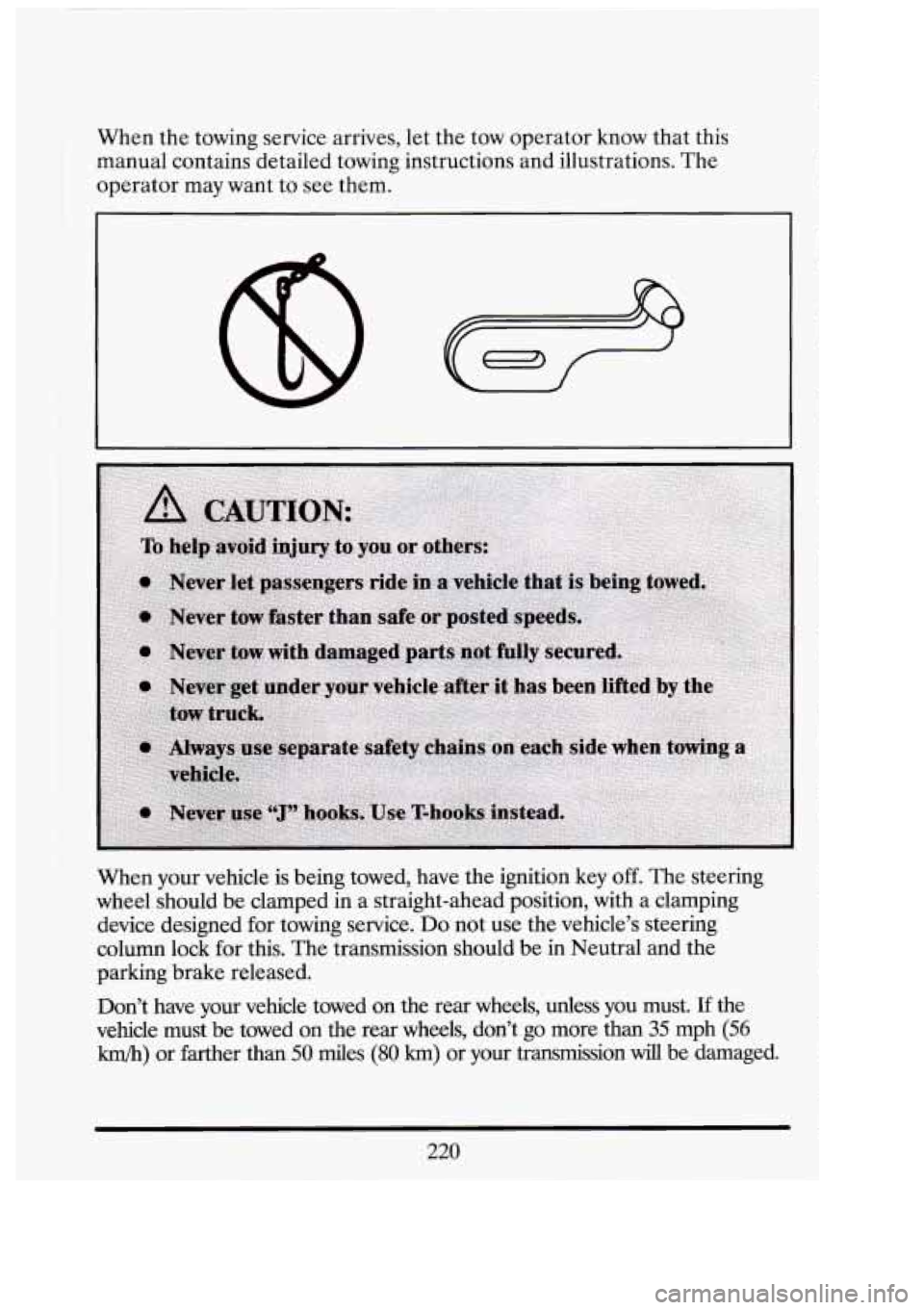
When the towing service arrives, let the tow operator know that this
manual contains detailed towing instructions and illustrations. The
operator may want to see them.
When your vehicle is being towed, have the ignition
key off. The steering
wheel should be clamped in a straight-ahead position, with a clamping
device designed for towing service.
Do not use the vehicle's steering
column lock
for this. The transmission should be in Neutral and the
parking brake released.
Don't have your vehicle towed on the rear wheels, unless you must. If the
vehicle must be towed
on the rear wheels, don't go more than 35 mph (56
km/h) or farther than 50 des (80 km) or your transmission will be damaged.
:!I
u 'I
f
220
Page 234 of 398
r
If these limits must be exceeded, then the rear wheels have to be supported
on
a dolly.
I
NOTICE:
Do not attach winch cables or J-hooks to suspension
components when using car carrier equipment. Always use
T-hooks inserted in the T-hook slots.
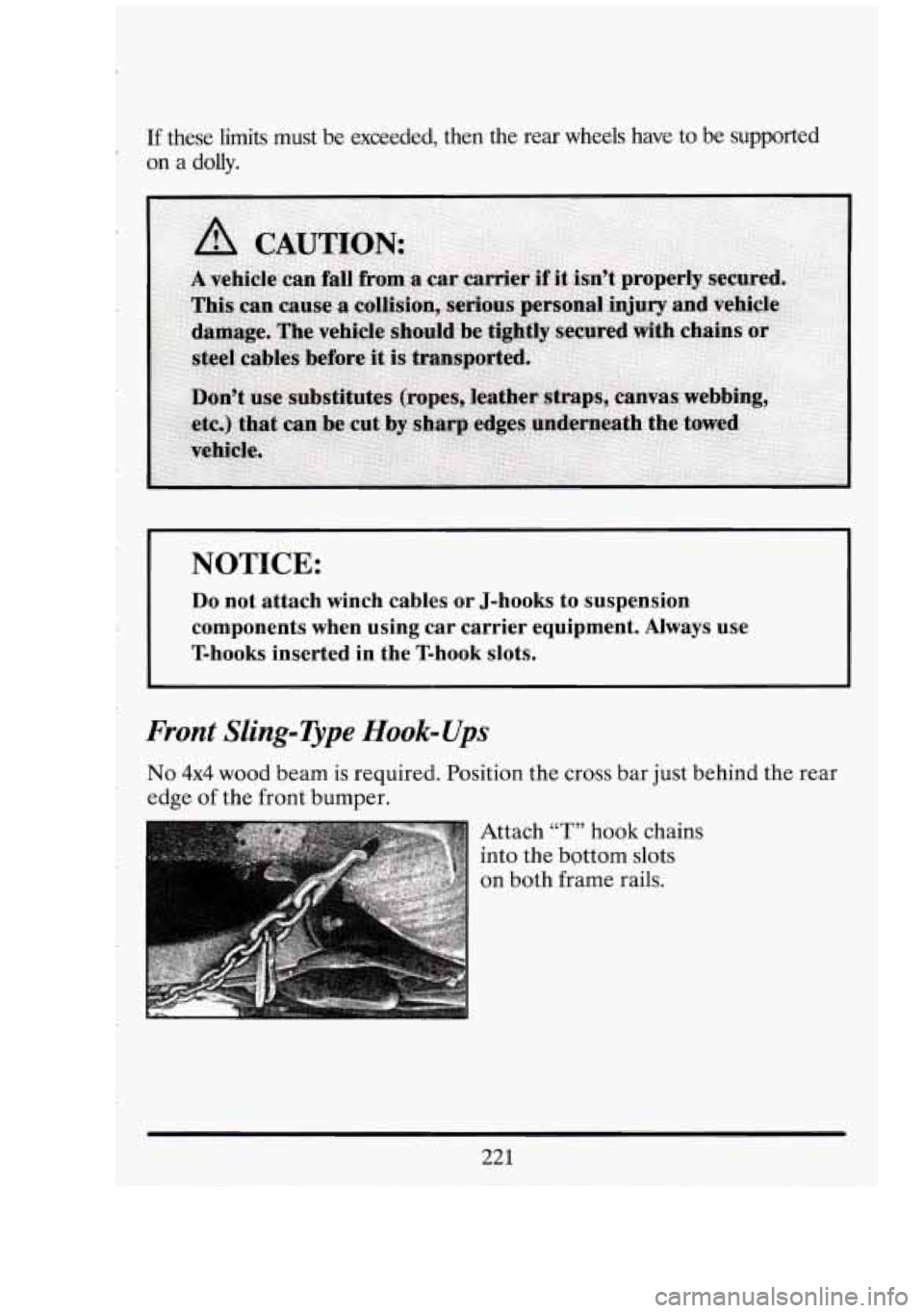
Front Sling-Type Hook-Ups
No 4x4 wood beam is required. Position the cross bar just behind the rear
edge of the front bumper.
, , ,, Attach “T” hook chains
into the bottom slots
on both frame rails.
221
Page 235 of 398
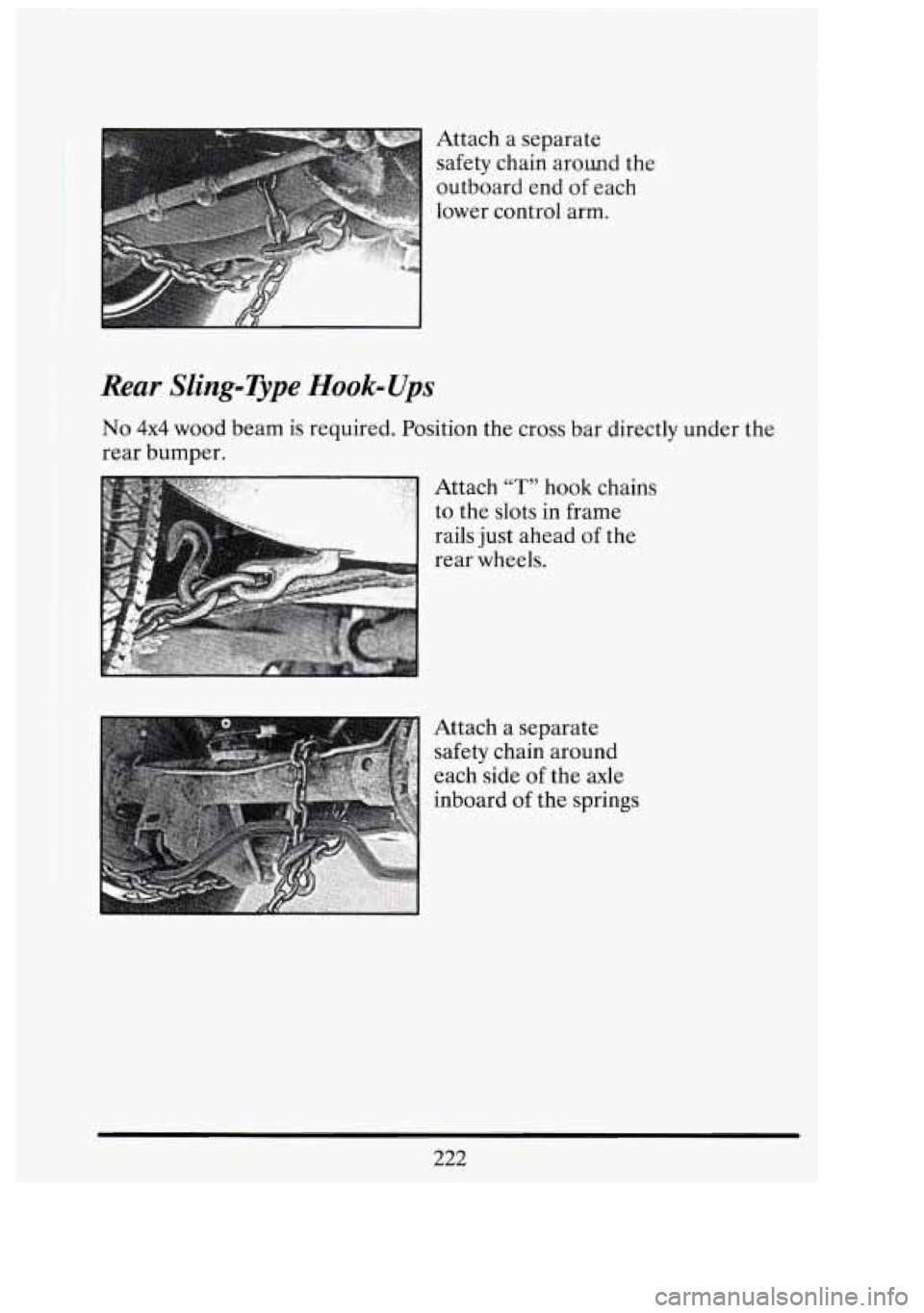
Attach a separate
safety chain around the
outboard end
of each
lower control arm.
Rear SliinpType Hook- Ups
No 4x4 wood beam is required. Position the cross bar directly under the
rear bumper.
Attach
“T” hook chains
to
the slots in frame
rails just ahead
of the
rear wheels.
Attach a separate
safety chain around
each side of the axle
inboard of the springs
01
nr
!j
L ..
222
Page 244 of 398
r IF A TIREGOES FLAT
It’s unusual for a tire to “blow out” while you’re driving, especially if you
maintain your tires properly. If air goes out of a tire, it’s much more likely
to leak out slowly. But
if you should ever have a “blowout,” here are a
few tips about what to expect and what to do:
If a front tire fails, the flat tire will create a drag that pulls the vehicle
toward that side. Take your foot off the accelerator pedal and grip the
steering wheel firmly. Steer to maintain lane position, then gently brake
to a stop well out of the traffic lane.
A rear blowout, particularly on a curve, acts much like a skid and may
require the same correction you’d use in a skid. In any rear blowout,
remove your foot from the accelerator pedal. Get the vehicle under
control by steering the way you want the vehicle to
go. It may be very
bumpy and noisy, but you can still steer. Gently brake to a stop, well off
the road
if possible.
If a tire goes flat, the next section shows how to use your jacking
equipment to change a flat tire safely.
231
Page 245 of 398
> 2 L- "- " -
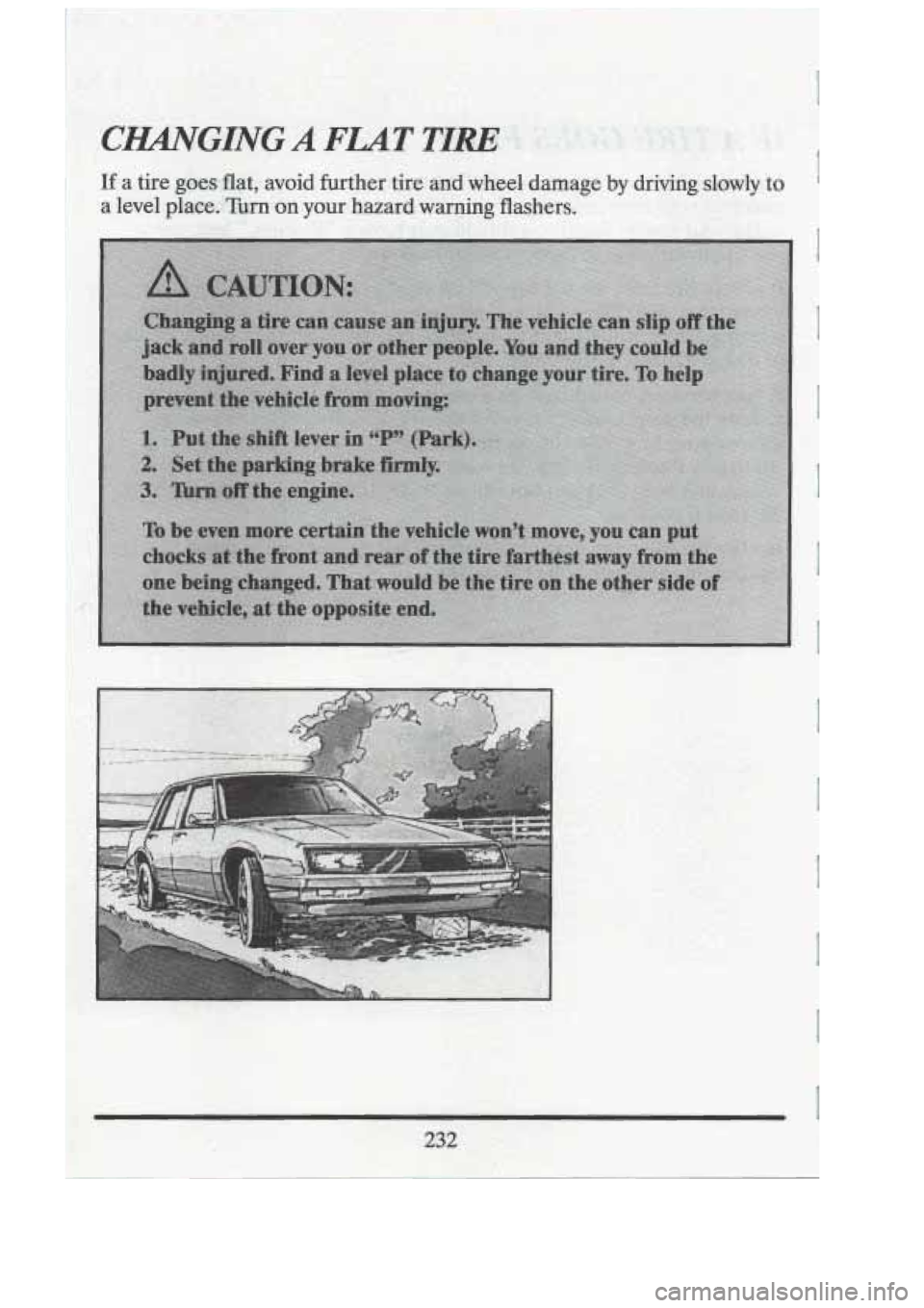
^', If a tire goes.flat, avoid farther tire and wheel damage bv driving slowly to
,' a level place. Turn on your hazard warning flashers.