Page 105 of 398
I
A
N (Neutral)
In this position, your engine doesn’t connect with the wheels. To
restart when you’re already moving, use “N” (Neutral) only. Also, use
“N” when your vehicle is being towed.
NOTICE:
Damage to your transmission caused by shifting out of “P”
(Park)
or “N” (Neutral) with the engine racing isn’t covered by
your warranty.
0 @ (Automatic Overdrive)
This position is for normal driving. If you need more power for
passing, and you’re:
- Going less than about 35 mph (60 km/h), push your accelerator
- Going about 35 mph (60 h/h) or more, push the accelerator all
pedal about
halfway down
the way down.
You’ll shift down to the next gear and have more power.
7’ P
I
1
92
Page 106 of 398
D or 3 (Third Gear)
This is like
@, but you never go into Overdrive.
Here are some times you might choose
“D” or “3” instead of “@”:
- When driving on hilly, winding roads
- When towing a trailer, so there is less shifting between gears
- When going down a steep hill
2 (Second Gear)
This position gives you more power but lower fuel economy.
You can
use
2 on hills. It can help control your speed as you go down steep
mountain roads, but then you would also want to use your brakes off
and on. (6 77
NOTICE:
Don’t drive in “2” (Second Gear) for more than 5 miles (8 km),
or at speeds over 55 mph (88 km/h), or you can damage your
transmission. Use
“D” or “3” as much as possible.
Don’t shift into
“2” unless you are going slower than 65 mph
(105 km/h), or you can damage your engine.
1 (First Gear)
This position gives you even more power (but lower fuel economy)
than
“2.” You can use it on very steep hills, or in deep snow or mud. If
the selector lever is put in “1,” the transmission won’t shift into first
gear until the vehicle is going slowly enough.
NOTICE:
If your rear wheels can’t rotate, don’t try to drive. This might
happen
if you were stuck in very deep sand or mud or were up
against
a solid object. You could damage your transmission.
Also, if you stop when going uphill, don’t hold your vehicle there
with only the accelerator pedal. This could overheat and
damage the transmission. Use your brakes to hold your vehicle
in position on
a hill.
93
Page 107 of 398
TMLER TOWING PACMGE (OPTION)
If your Fleetwood is equipped with either V92 or V4P package, you can
increase your vehicle's trailer towing capability to
5,000 pounds (2270 kg)
or 7000 lbs. (3178 kg). To determine which package you have, see the
Service Parts Label located on the underside
of the trunk lid. These
packages include a trailering harness located
in the trunk, heavy-duty
engine and transmission cooling.
Also included are heavy-duty front and
rear springs, 2.93:l rear axle ratio and Eagle
GA P235/70R15 tires.
3
a,
I
I
P-NG BRAKE
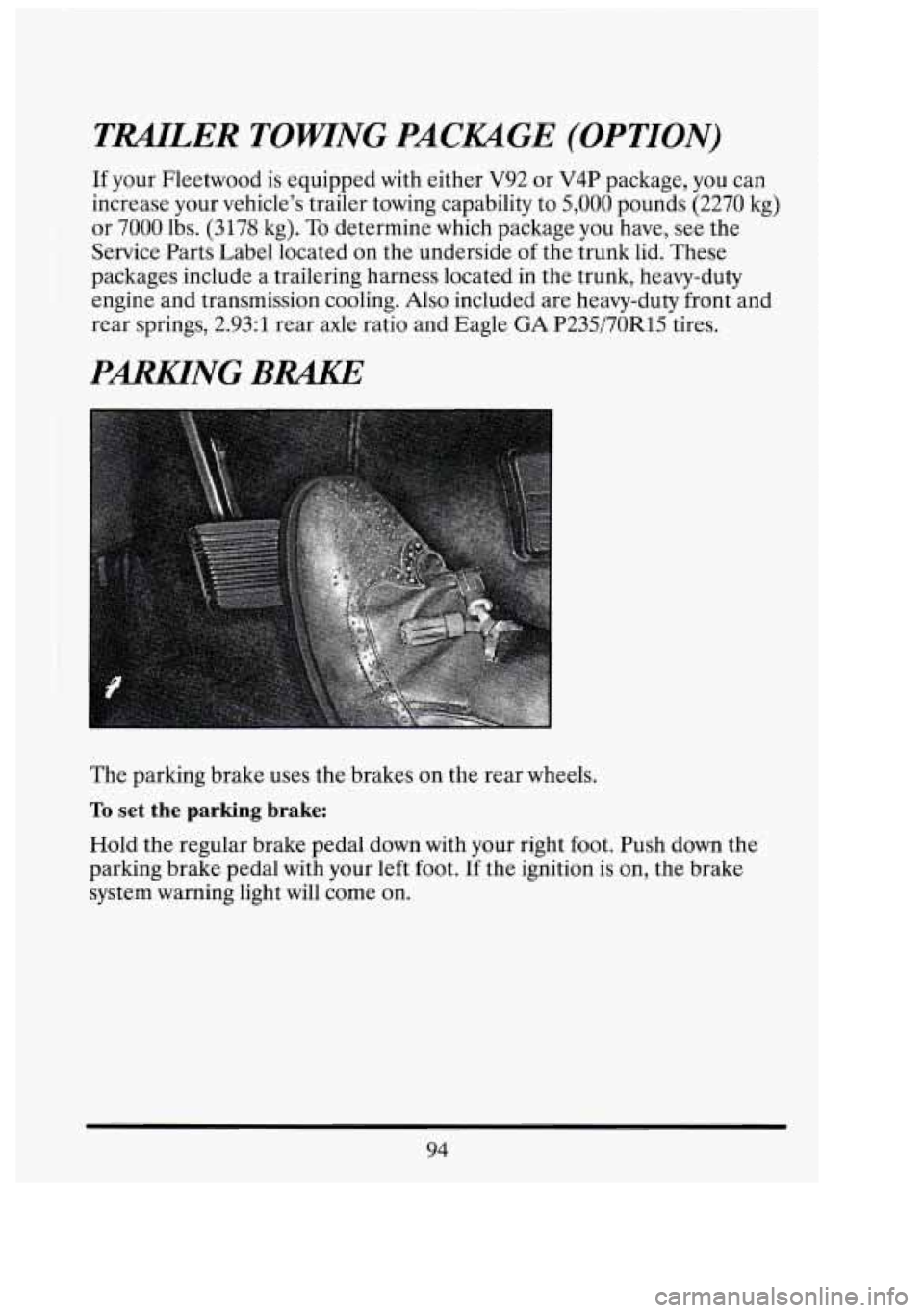
The parking brake uses the brakes on the rear wheels.
To set the parking brake:
Hold the regular brake pedal down with your right foot. Push down the
parking brake pedal with your left foot.
If the ignition is on, the brake
system warning light will come
on.
I
94
Page 109 of 398
If you are on a hill: See “Parking on Hills” in the Index. That section
shows how to turn your front wheels.
If you are towing a trailer and are parking on any hill: See “Towing a
Trailer” in the Index. That section shows what to do first to keep the
trailer from moving.
SHIFTING INTO 44P” (PARK)
Steering Column Shift Lever
1. Hold the brake pedal down with your right foot.
E
1
n !fl
I
96
..
Page 115 of 398
TILT WHEEL
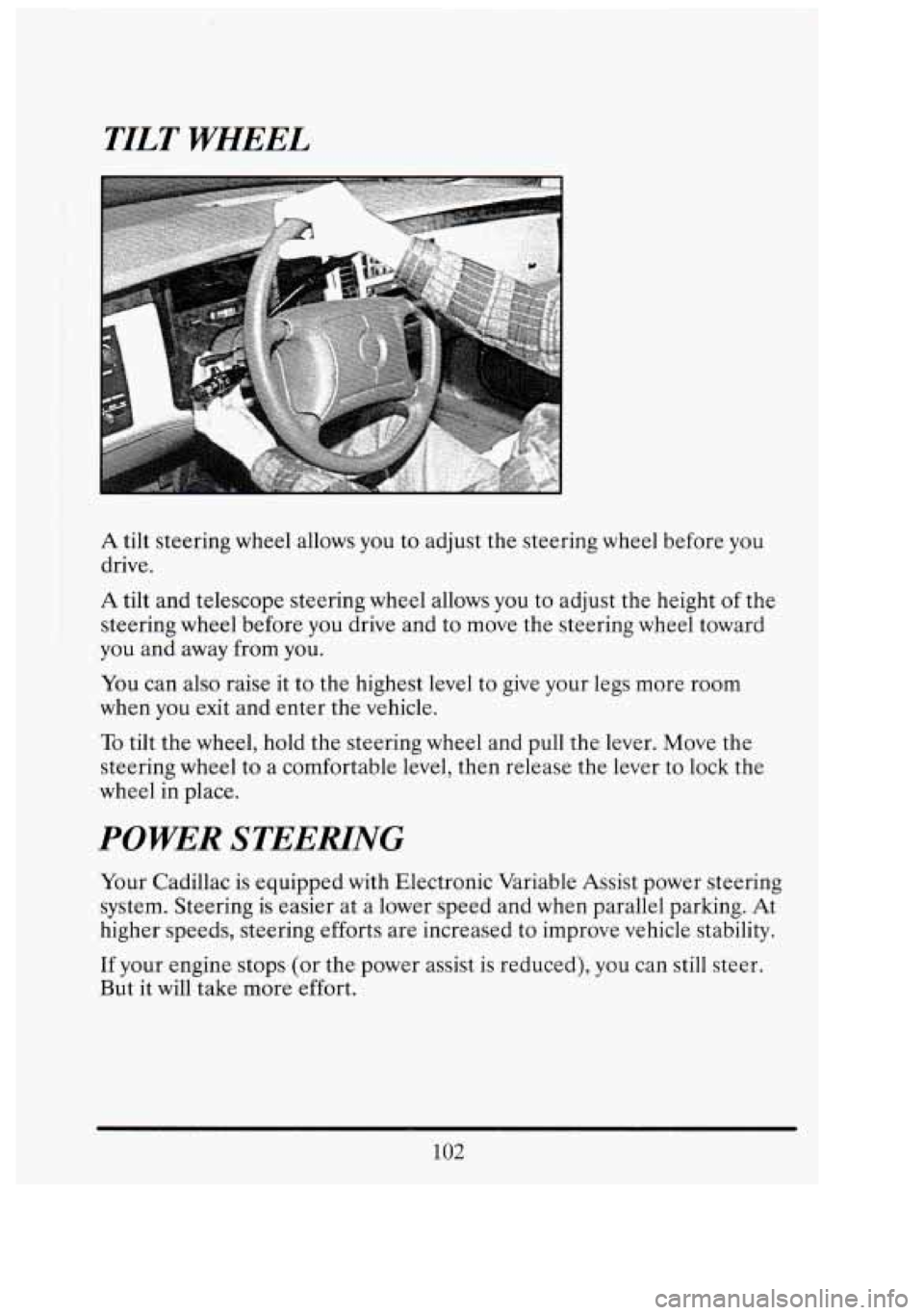
A tilt steering wheel allows you to adjust the steering wheel before you
drive.
A tilt and telescope steering wheel allows you to adjust the height of the
steering wheel before you drive and to move the steering wheel toward
you and away
from you.
You can also raise it to the highest level to give your legs more room
when you exit and enter the vehicle.
To tilt the wheel, hold the steering wheel and pull the lever. Move the
steering wheel to a comfortable level, then release the lever
to lock the
wheel
in place.
POWER STEERLNG
Your Cadillac is equipped with Electronic Variable Assist power steering
system. Steering is easier at a lower speed and when parallel parking. At
higher speeds, steering efforts are increased to improve vehicle stability.
If your engine stops (or the power assist is reduced),
you can still steer.
But it will take more effort.
102
GI
nr
Page 117 of 398
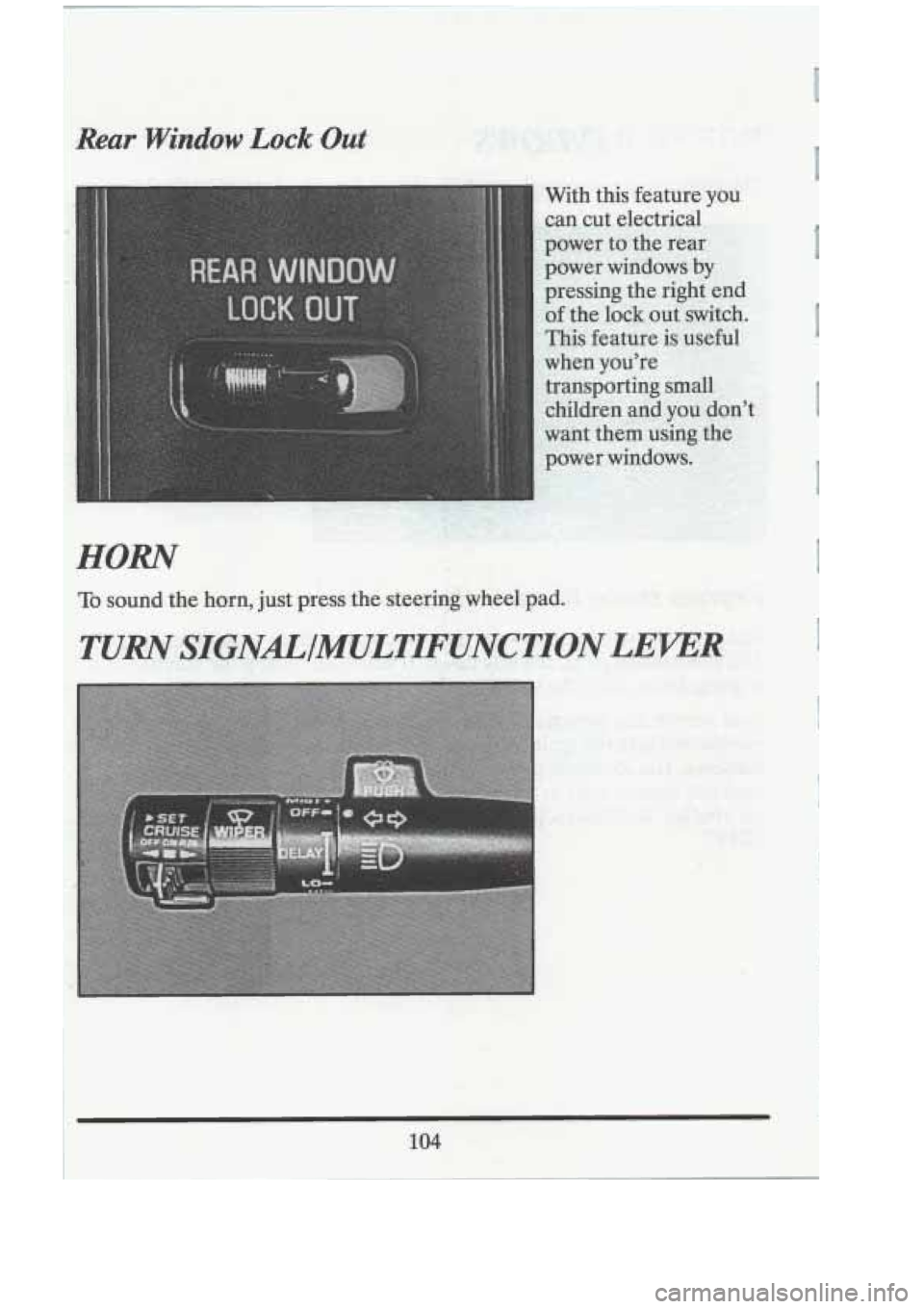
Rear .Window Lock.Out
.HORN
To sound the horn, just preiss the &ee$ingwheel pad..
104
Page 149 of 398
NOTICE:
Spinning your wheels when the “Tkaction Disabled” light comes
on can destroy parts of your vehicle .as well as the tires. If you
spin your .wheels
too fast while shifting your transmission back
and forth, you can destroy your transmission. When you’re
stuck., spin the wheels as little as possible.
Engine Coolant Temperature Warning’Light
This light tells you that
your engine coolant has
overheated.
If you have
been operating your
vehicle under normal
driving conditions, you
should pull
off the
road, stop your vehicle
and turn the engine
off
as soon as possible.
HOT COOLANT CAN BURN YOU BADLY!
In “Problems
on the Road,” this manual shows what to do. See “Engine
Overheating” in the Index.
136
3
n
u
n
141
i
Page 187 of 398
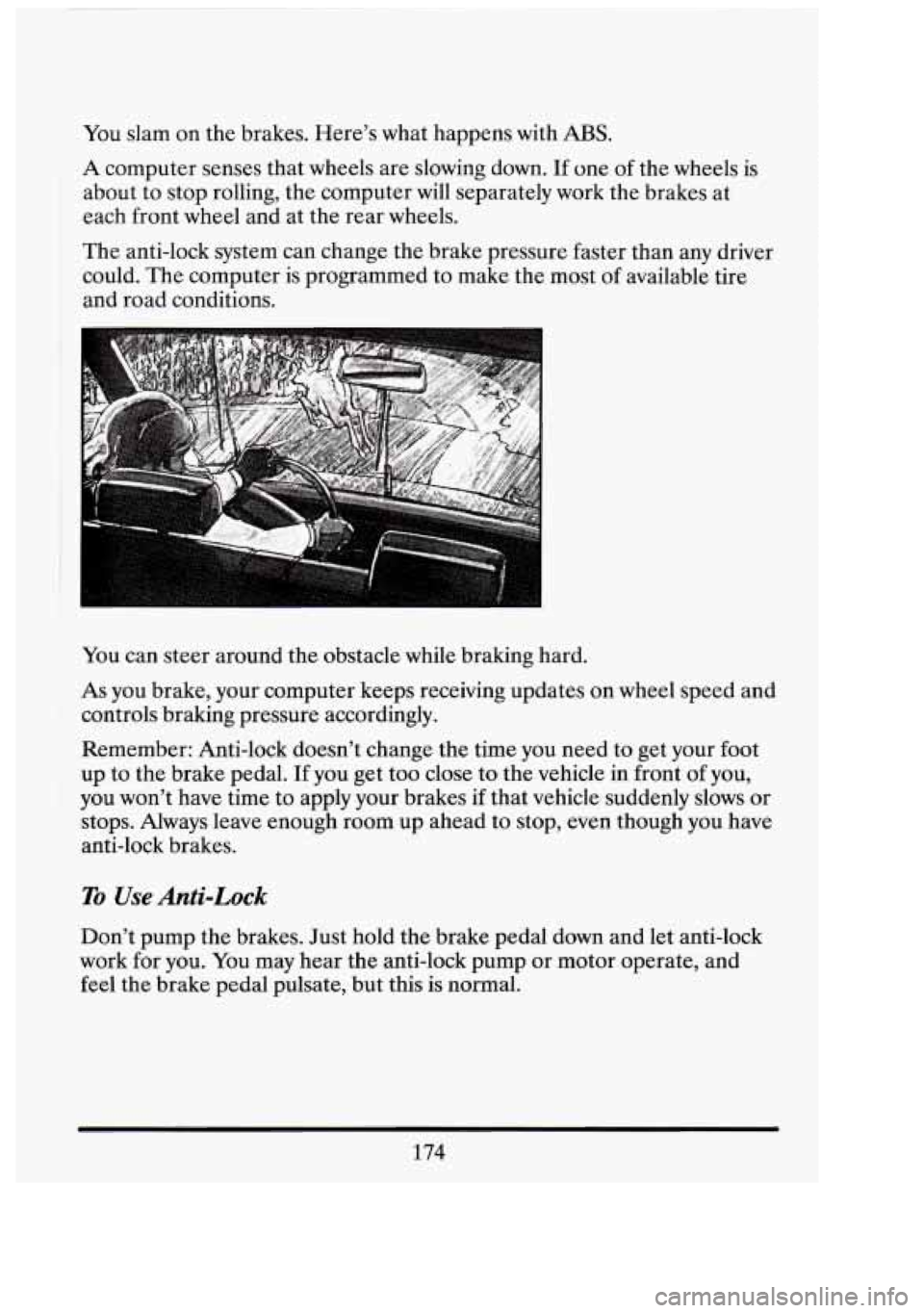
You slam on the brakes. Here's what happens with ABS.
A computer senses that wheels are slowing down. If one of the wheels is
about to stop rolling, the computer will separately work the brakes at
each front wheel and at the rear wheels.
The anti-lock system can change the brake pressure faster than any driver
could. The computer is programmed to make the most of available tire
and road conditions.
You can steer around the obstacle while braking hard.
As you brake, your computer keeps receiving updates on wheel speed and
controls braking pressure accordingly.
Remember: Anti-lock doesn't change the time you need to get your foot
up to the brake pedal. If you get too close to the vehicle in front of you,
you won't have time to apply your brakes if that vehicle suddenly slows or
stops. Always leave enough room up ahead to stop, even though you have
anti-lock brakes.
To Use Anti-Lock
Don't pump the brakes. Just hold the brake pedal down and let anti-lock
work for
you. You may hear the anti-lock pump or motor operate, and
feel the brake pedal pulsate, but this
is normal.
174
i
n!