1994 CADILLAC ELDORADO lock
[x] Cancel search: lockPage 179 of 398
Downloaded from www.Manualslib.com manuals search engine To Set the Minutes:
F 0 Press SET, and within 5 seconds, 1
Press and hold SCAN. When the clock gets& the correGt minute, Set j
Your clock is set.
go*
I I I
f
Care of Your Cassege .Tape Phyer
-2 , . . . -111.: ,, :
--,= ,: . . , .. . .,,&V?i'.,.r: m.. ... . - ., - c: ,I >$ -72 .. I . ,. .
A tape
player that is qot cl6aiied.r&gctlarly can cause reduad sound
quality, ruined cassettes,
or a..dam&$ed mechanism. Cassette tapes should .
be stored in their cases away ficmici&aninants, direct sunlight, and . '
failure of the tape player. I
,I
L extreme heat. If they aren?, they :may not operate properly or cause
- Your tape player should be cleaned regularly each month or after every
50 hours of use. If you notice a reduction in sound quality, try a known
good cassette to see
if the tape or the tape player is at fault. If this other
Cleaning may be done with a scrubbing action, non-abrasive cleaningi.
~
cassette. This system uses a cleaning cassette with pads which scrub the
tape head 'as the hubs of the cleaner cassette turn. It is-normal for. the
ensure thorough cleaning.
A scrubbing action cleaning cassette is
available through your Cadillac dealership.
-, cassette has no improvement in sound quality, clean the tape player.
.I
(, cartridge to eject while cleaning. Insert the cassette at least 3 times to
r
You may also choose a non-scrubbing action, wet-type cleaner which uses
a cassette with a fabric belt to clean the tape head. This
type of cleaning
cassette
will not eject. It -may not clean as thoroughly as the scrubbing
type cleaner.
Cassettes are subject to wear and the sound quality may degrade over
time. Always make sure that the cassette tape is in good condition before
you have your tape player serviced.
Care of Your Compact Discs
Handle discs carefully. Store them in their original cases or other
protective cases and away from direct sunlight and dust.
If the surface of
a disc
is soiled, dampen a clean, soft cloth in a mild, neutral detergent
solution and clean it, wiping from the center to the edge.
167
Page 189 of 398
Downloaded from www.Manualslib.com manuals search engine PI
Anti=Lock Brakes (ABS)
Your Cadillac has an advanced electronic braking system that will help
prevent skidding.
r
i
r
t
ANTI-
LOCK (@)
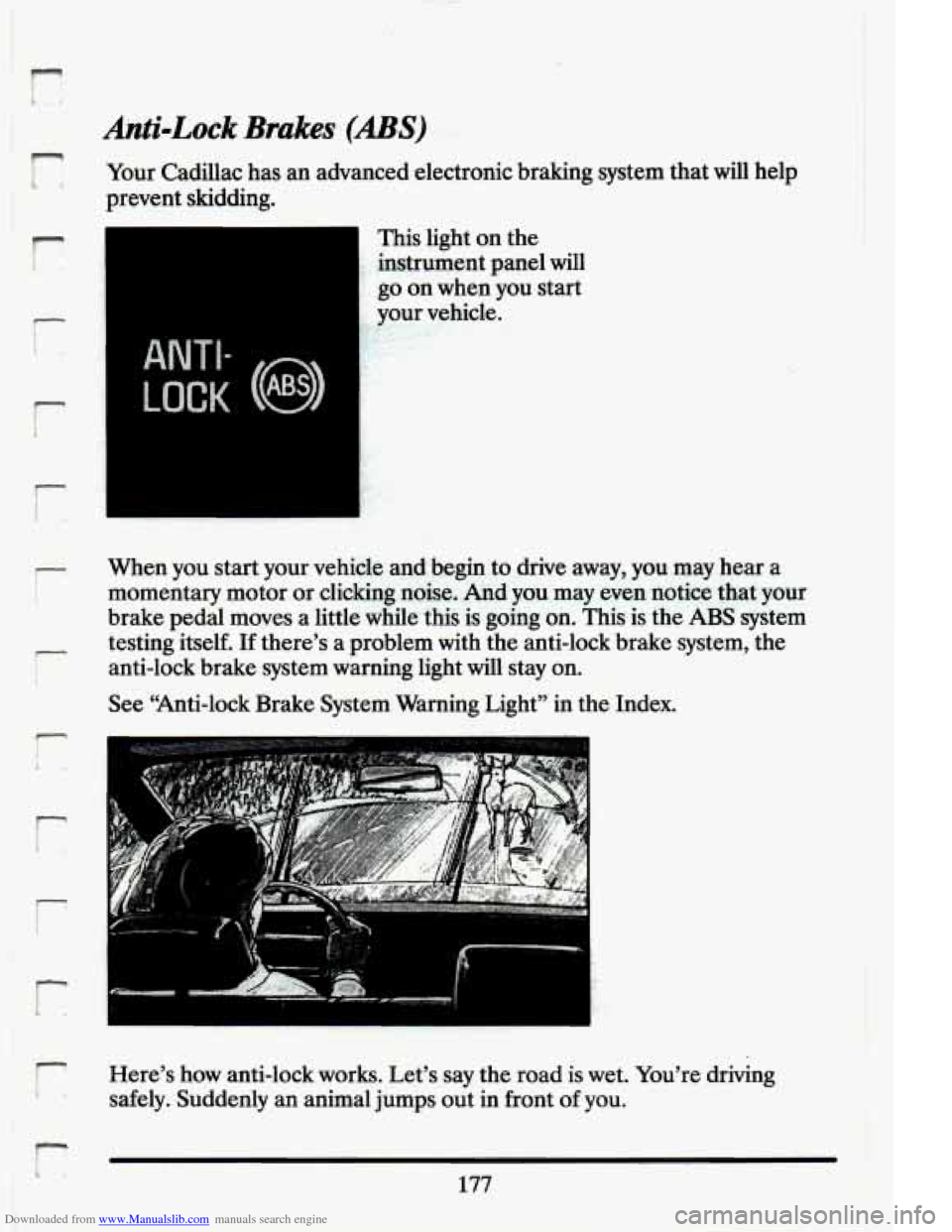
This light on the
instrument panel will
go on when you start
.. your vehicle. ,, .. v I- I‘ 1
?
When you start your vehicle and begin to drive away, you may hear a
momentary motor or clicking noise, And you may even notice that your
brake pedal moves a little while this is going on. This is the
ABS system
testing itself.
If there’s a problem with the anti-lock brake system, the
anti-lock brake system warning light
will stay on.
See “Anti-lock Brake System Warning Light” in the Index.
F;/ - ’r
Here’s how anti-lock works. Let’s say the road is wet. You’re driving
safely. Suddenly an animal jumps out in front
of you.
L 177
Page 190 of 398
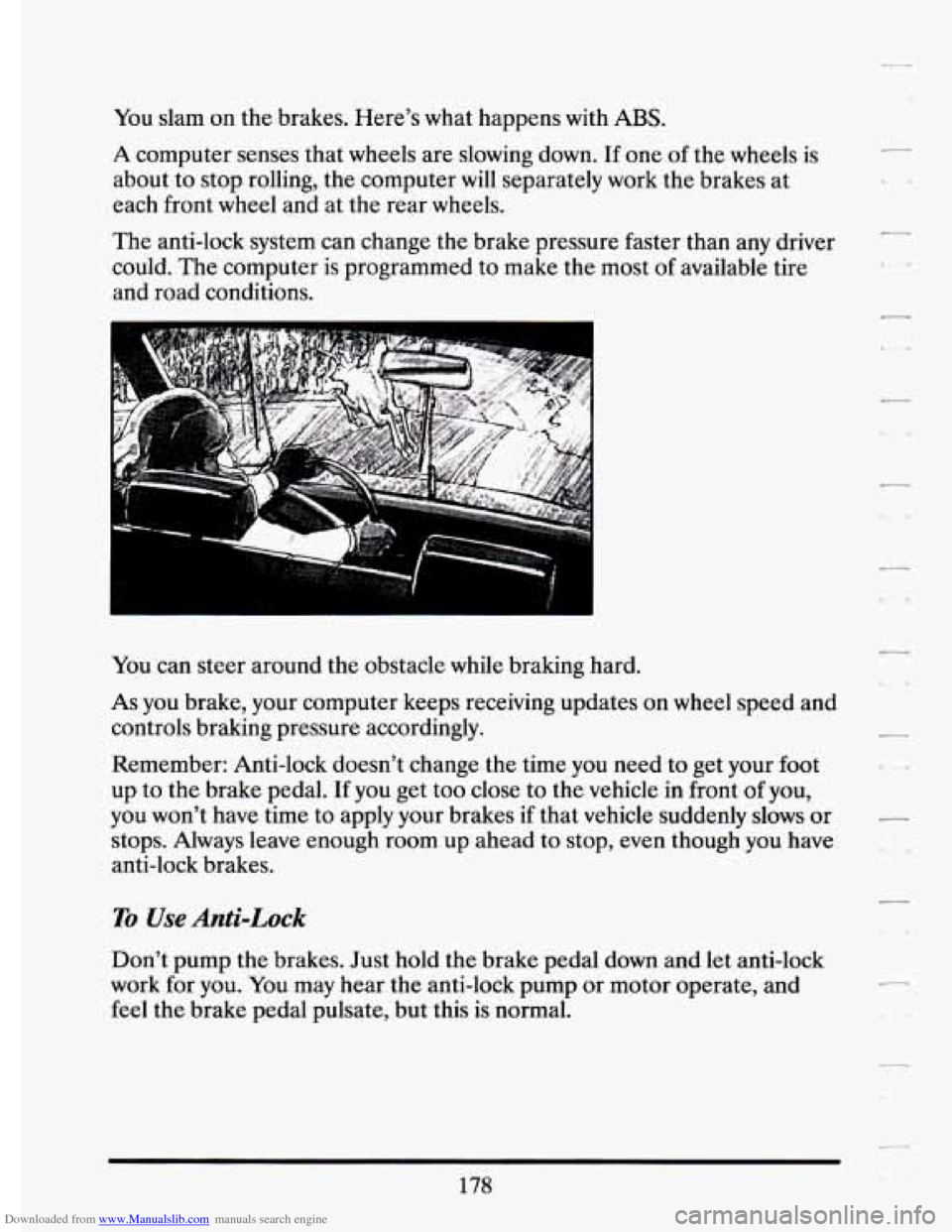
Downloaded from www.Manualslib.com manuals search engine You slam on the brakes. Here’s what happens with ABS.
A computer senses that wheels are slowing down. If one of the wheels is
about to stop rolling, the computer will separately work the brakes at
each front
wheel and at the rear wheels.
The anti-lock system can change the brake pressure faster than any driver
could.
The computer is programmed to make the most of available tire
and road conditions.
-
fou can steer around the obstacle while braking hard.
As you brake, your computer keeps receiving updates on wheel speed and
controls braking pressure accordingly.
Remember: Anti-lock doesn’t change the time you need to get your
foot
up to the brake pedal. If you get too close to the vehicle in front of you,
you won’t have time to apply your brakes
if that vehicle suddenly slows or
stops. Always leave enough room up ahead to stop, even though you have
anti-lock brakes.
1
To Use Anti-Lock
Don’t pump the brakes. Just hold the brake pedal down and let anti-lock
work for you. You may hear the anti-lock pump or motor operate, and
feel the brake pedal pulsate, but this
is normal.
c
..
178
Page 191 of 398
Downloaded from www.Manualslib.com manuals search engine I
r
i .’
r
r
L
r
i
r I
Your vehicle has traction control system that limits wheel spin. This is
especially useful in slippery road conditions. The system operates only
if
it senses that one or both of the front wheels are spinning or- beginning to
lose traction. When .this happens, the system works the front brakes and
reduces engine power (by shutting
off fuel injectors) to limit wheel spin.
The “TRACTION ACTIVE” message will display on the Driver
Information Center when the traction control system is limiting wheel
spin. See “Driver Information Center Messages” in the Index. You may
feel the system working, or you may notice some noise, but this
is nomal.
If your vehicle is in cruise control when the traction control system begins
to limit wheel spin, the cruise control will automatically disengage. When
road conditions allow you to safely use it again, you may
turn the cruise
control back on. (See “Cruise Control” in the Index.)
The “TRACTION DISABLED” message
will display on the Driver
Information Center
if there’s a problem with your traction control system.
See “D,river Information Center Messages” in the Index. When. this
message is displayed, the system will not limit wheel spin. Adjust your
driving accordingly.
Braking in Emergencies
Use your anti-lock braking system when you need to. With anti-lock, you
can steer and brake at the same time. In many emergencies, steering can
help you more than even the very best braking.
179
Page 193 of 398
Downloaded from www.Manualslib.com manuals search engine ‘I
r td
r
r
!
-
I- t>
Try to adjust your speed so you can ‘‘d&xCY through.thecurve. Maintain a
reasonable,. steady speed, Wait to .accelerate until you are out of the
curve,
and then accelerate-gently into the straightaway.
.. .:r 5.
Steering in Emergencies
There are times when steering canbe more effective.than braking. For
example, you. come over a hill and, find a truck stopped
in your lane, .or a
car suddenly pulls. out from nowhere, ox a child darts out €rm betwe
you. You can avoid these pxoblems
by braking.
-- if you can stop in time. But sometimes you can’t; there isn’t
room. That’s the time for evasive action
-- steering around the problem.
Your Cadillac can perform verywell
in. emergencies like these. First apply
your brakes. It
is better to remove as much speed as you can from a,
possible collision. Then steer around the problem, to the left orright
depending on the space available.
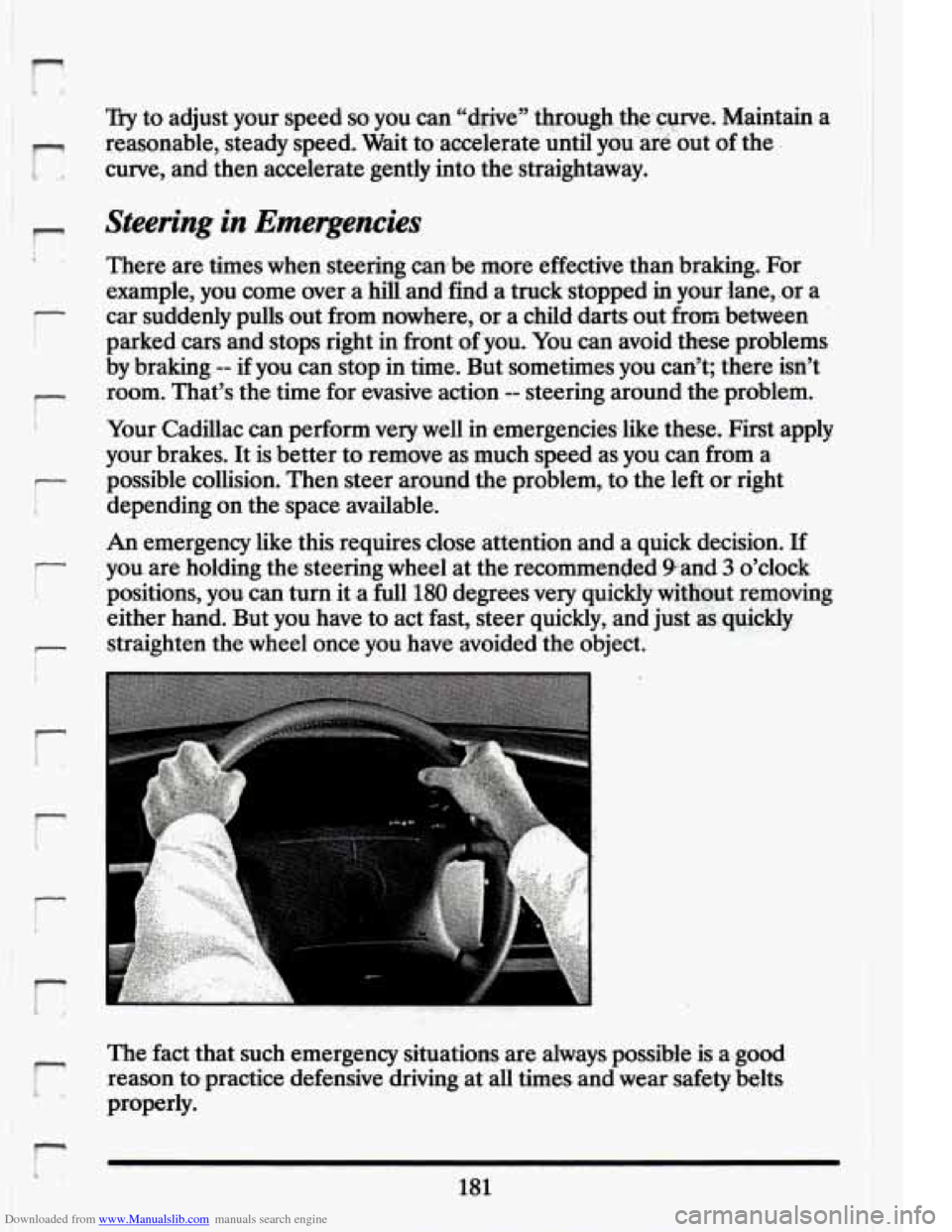
An emergency like this requires close attention and a quick decision. If
you. are holding the steering wheel’ at the recommended Pand-3’o’clock
positions, you can turn
it a full 180 degrees very quickly without removing
either hand. But you have to act fast, steer quickly, and just aslquickly
straighten the wheel once
you have avoided-:the object.
The fact that such emergency situations are always possible
is a.good
reason to practice defensive driving at all times. and wear safety belts
properly.
r c
181.
Page 197 of 398
Downloaded from www.Manualslib.com manuals search engine i"
r
I
i
r
r
r
i
L
r
r
I
While driving on a surface with redueed tractio.n, try your. best to avoid
sudden steering, acceleration, or braking (hciuding engine braking by
shifting to a lower gear). Any sudden changes could cause
the tires to
slide.
You may not realize the surface is slippery until your vehicle is
skidding. Learn to recognize warning clues
-- such as enough water, ice or
packed snow on the road to make a "mirrored surface"
-- and slow down
when you have any doubt.
Remember: Any anti-lock braking system
(ABS) helps avoid only the
braking skid.
DMNG ATNIGHT
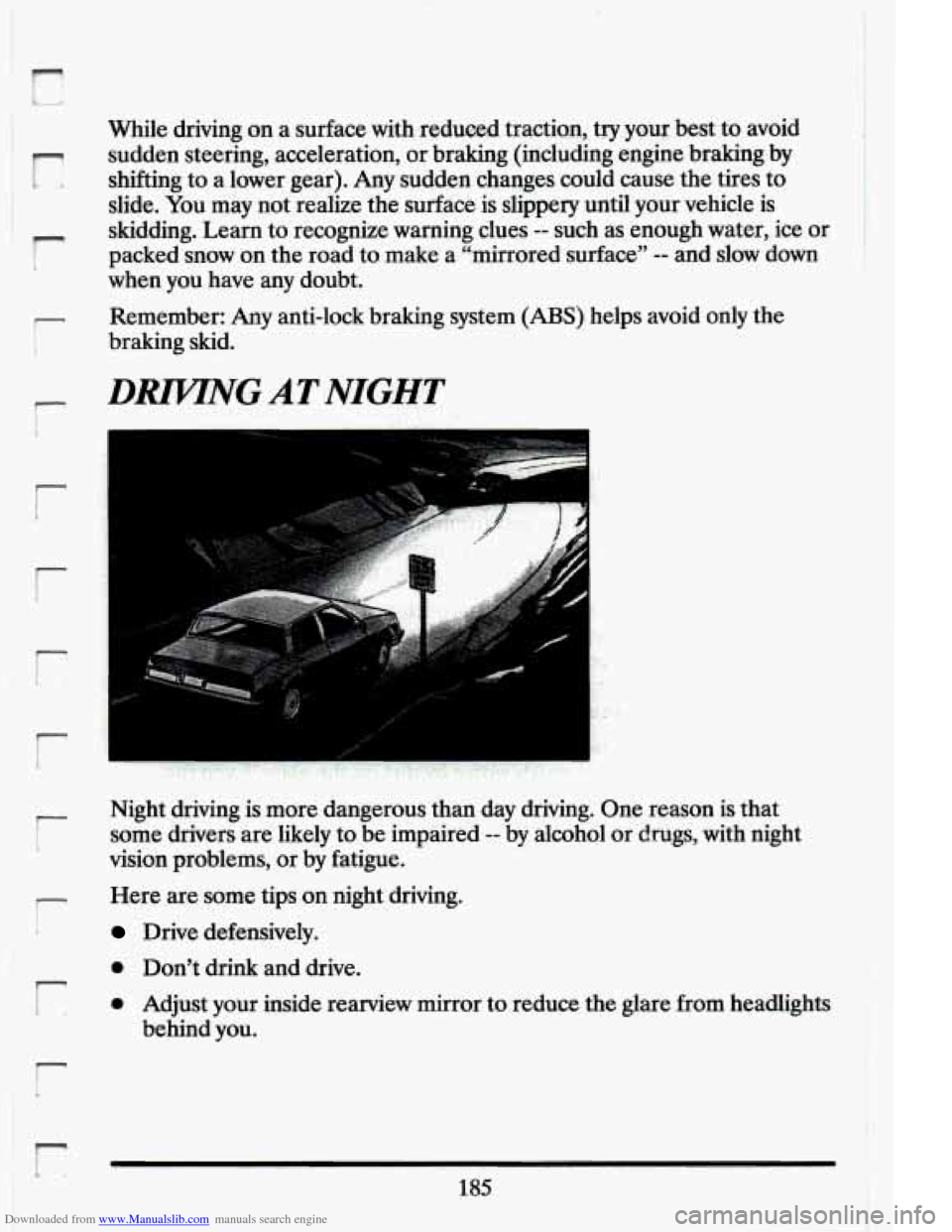
Night driving is more dangerous than day driving. One reason is that
some drivers are likely to be impaired
-- by alcohol or drugs, with night
vision problems, or by fatigue.
Here are some tips on night driving.
Drive defensively.
0 Don't drink and drive.
0 Adjust your inside reamew mirror to reduce the glare from headlights
behind you.
r
185
Page 210 of 398
Downloaded from www.Manualslib.com manuals search engine Most of the time, those places where your tires meet the:roaa probably
have good traction.
However,
if there is snow or ice between your tires and the road, you can
have
a very slippery situation. You’ll have a lot less traction or “grip” and
will need to be
very careful.
What’s the worst time for this? “Wet ice.” Very cold snow or ice can be
slick and hard to drive on. But wet ice can be even more trouble because
it may offer the least traction of all. You can get “wet
ice” when it’s about
freezing
(32 F; 0 C) and freezing rain begins to fall. Try to avoid driving
on wet ice untihalt and sand crews can get there.
Whatever the condition -=smooth ice, packed, blowing or loose snow
--
drive with caution.
If you have the traction control system, it will improve your ability to
accelerate when driving on a slippery road. Even though your vehicle has
a traction control system, you’ll want to slow down and adjust your
driving to the road conditions. See “Traction Control System” in the
Index.
Your anti-lock brakes improve your ability to make a hard stop on a
slippery road. Even though you have the anti-lock braking system, you’ll
want
to begin stopping sooner than you would on dry pavement. See
“Anti-lock” in the Index.
Allow greater following distance on any slippery road.
Watch for slippery spots. The road might be fine until you hit a spot
that’s covered with ice. Oman otherwise clear road, ice patc\
hes may appear in shaded areas where the sun can’t reach: around clumps
of
trees, behind buildings, or under bridges. Sometimes the surface of a
curve or an overpass may remain icy when the surrounding roads are
clear.
If you see a patch of ice ahead of you, brake before you are on
it.
Try not to brake while you’re actually on the ice, and avoid sudden
steering maneuvers.
198
Page 230 of 398
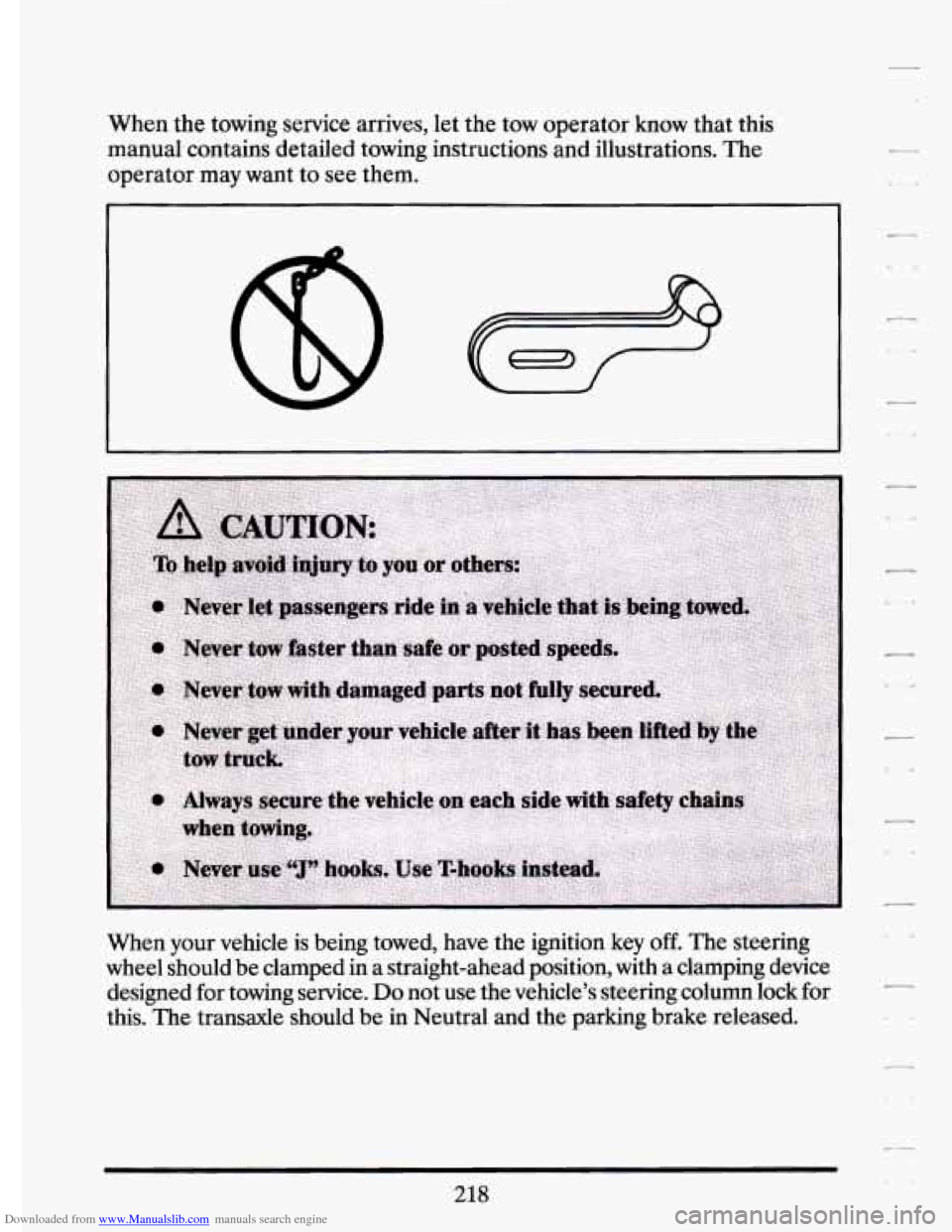
Downloaded from www.Manualslib.com manuals search engine When the towing service arrives, let the tow operator know that this
manual-contains detailed towing instructions and illustrations. The
operator may want to see them.
When your vehicle
is being towed, have the ignition key off. The steering
wheel should be clamped in a straight-ahead position, with
a clamping device
designed for towing service.
Do not use the vehicle’s steering column lock for
this. The transaxle should be in Neutral and the parking brake relea\
sed.
218
-.