1994 CADILLAC ELDORADO tow
[x] Cancel search: towPage 214 of 398
Downloaded from www.Manualslib.com manuals search engine If You Do Decide To Pull A Trailer
If you do, here are some important points.
0
0
0
e
0
0
0
There are many different laws having to do with trailering. Make sure your
rig will be legal, not
only where you live but also where you’ll be driving. A
good source for this information can be state or provincial police.
Consider using
a sway control.
You can ask a hitch dealer about sway controls.
Don’t tow a trailer at all during the first
500 miles (800 km) your new
vehicle is driven. Your engine, axle or other parts could be damaged.
Then, during the first
500 miles (800 km) that you tow a trailer, don’t drive
over
50 mph (80 km/h) and don’t make starts at full throttle. This helps your
engine and other parts of your vehicle wear in at the heavier loads.
When towing a trailer, close all windows and set the Electronic
Climate Control System to
“ECON”, “AUTO”, “DEFOG” or
Defroster to assure that the fan is running.
Three important considerations have to do with weight:
1. Weight of the nailer
How heavy can a trailer safely be?
It should never weigh more than 1,000 pounds
(450 kg).
It depends on how you plan
to use your rig. For example, speed,
altitude, road grades, outside temperature and how much your
vehicle is used to pull
a trailer are all important. And, it can also
depend on any special equipment that you have on your vehicle.
You can ask your dealer
for our trailering information or advice, or
you can write
us at Cadillac.
r
r.
In Canada, write to General Motors of Canada Limited, Customer L .
Assistance Center, 1908 Colonel Sam Drive, Oshawa, Ontario L1H 8P7.
2. Weight of the nailer Tongue
When a trailer is connected to your vehicle, the trailer tongue adds
to the weight your vehicle is carrying.
So, remember to subtract the
weight
of the trailer tongue from your vehicle’s capacity weight.
202
--
Page 216 of 398
Downloaded from www.Manualslib.com manuals search engine NOTICE:
The bumpers on your vehicle are not intended for hitches. Do
not attach rental hitches or other bumper-type hitches to them.\
-
Safety Chains
You should always attach chains between your vehicle and your trailer.
Cross the safety chains under the tongue of the trailer
so that the tongue
will not drop to the road
if it becomes separated from the hitch. Follow
the manufacturer’s recommendation for attaching safety chains. Alwa\
ys
leave
just enough slack so you can turn with your rig. And, never allow
safety chains to drag on
the ground.
Trailer Brakes
Be sure to read and follow the instructions for the trailer brakes so you’ll -
be able to install, adjust and maintain them properly. L:
Driving with a Trailer
Towing a trailer requires a certain amount of experience. Before setting
out for the open road, you’ll want to get to know your rig. Acquaint
yourself with the feel of handling and braking with the added weight of
the trailer. And always keep in mind that the vehicle you are driving is
now a good deal longer and not nearly
so responsive as your vehicle is by
itself.
Before you start, check the trailer hitch and platform, safety chains,
electrical connector, lights, tires and mirror adjustment. If the trailer has
electric brakes, start your vehicle and trailer moving and then apply the
trailer brake controller by hand to be sure the brakes are working. This
lets you check your electrical connection at the same time.
During your trip, check occasionally to be sure that the load is secure,
and that the lights and any trailer brakes are still working.
204
Page 217 of 398
Downloaded from www.Manualslib.com manuals search engine n
F- I
r
r i
I r’ j’ IL i
Folbwing Distance ~ ..
Stay at Least ,twice as far behind the vehicle ahead as you would when
driving your vehicie without a trailer.
This can help you.avoid situations
that require heavy braking and sudden turns.
,Passing
You’ll need more passing distance up ahead-.when you’re towing a. trailer.
And, because y0u’re.a good deal longer, you’ll need to go much farther
beyond the passed vehicle before you .can return to
your lane.
Backing Up
Hold the bottom of the steering wheel with one hand. Then, to move the
trailer ‘to .the- left, just move that hand
to the left. To move the trailer to
the right, .move -your hand
‘to the right. Always back up. slowly and, if
possible, have someone guide you.
Making nrns
When you’re turning with a trailer, make wider turns than normal. Do
.this so your trailer won? strike soft shoulders, curbs, road signs, trees, or
other .objects. Avoid jerky.or sudden maneuvers. Signal well
in advance.
Turn sigreals When Towing a Trailer
When you tow a trailer, your vehicle has to have a different turn signal
.= flasher and extra wiring. The green arrows on your instrument panel will f
J I flash, whenever you signal a turn or lane change. Properly hooked. up, the
trailer
l&hts will also flash, telling other drivers you’re about to turn,
change lanes or stop.
flash for turns even’if the.bulbs on the trailer are burned out. .Thus, you
may think drivers behind
you are seeing your- signal when they are not.
’ Et’s important to check occasionally to be sure the trailer. bulbs are still
r
i When towing a trailer; the green arrows on your instrument panel will
t! working.
205
Page 219 of 398
Downloaded from www.Manualslib.com manuals search engine r
F, 4. Stop and have someone pick up .and store the chocks.
Engine Cooling When Tru.ilering
r
I ? Your cooling system may temporarily overheat during severe operating
conditions such as;
Climbing grades steeper than 4% at ambient temperatures above
90” Fahrenheit (32O Celsius) with a loaded vehicle and trailer.
Stopping after high-speed driving.
I
r Idling for long periods in stop and go traffic. I
If ,“ENGINE HOT A/C COMPRESSOR OFF” message appears on. the
Driver Information Center, do.not be alarmed.
This is. a normal function
continue to drive’your vehicle.
the -Driver Information Center, pull
,off to the side of the road as, soon as
it is safe to do
so. When the vehicle is at a complete stop, shift the
transaxle selector to
P (Park) and allow the engine to idle.:Do not turn off
three minutes the system should cool sufficiently to allow A/C operation
to resume. At that time resume driving at a reduced speed. Return to
normal driving after
10 minutes if the “ENGINE COOLANT HOT
- designed. to reduce the load on the.engine and cooling system. You can
- If “ENGINE COOLANT HOT IDLE ENGINE” message.appears on
c
I the engine or increase engine speed.above a normalidle. Wit-hin two or
b- IDLE ENGINE” message is not displayed.
Maintenance When Trailer Towing
i L.
Your vehicle will need service more often when you’re pulling a trailer.
See the Maintenance Schedule for more on this. Things that are
(don’t overfill), engine oil,
axle lubricant, belts, cooling system, and brake
adjustment. Each
of these is covered in this manual, and the Index will
these sections before you start your trip.
i especially important in trailer operation are, automatic transaxle fluid
7 help you find them quickly. If you’re trailering, it’s a good idea to review
I
‘F
Check periodically to see that all hitch nuts and bolts are tight.
r 207
Page 229 of 398
Downloaded from www.Manualslib.com manuals search engine TOWING YOUR VEHICLE
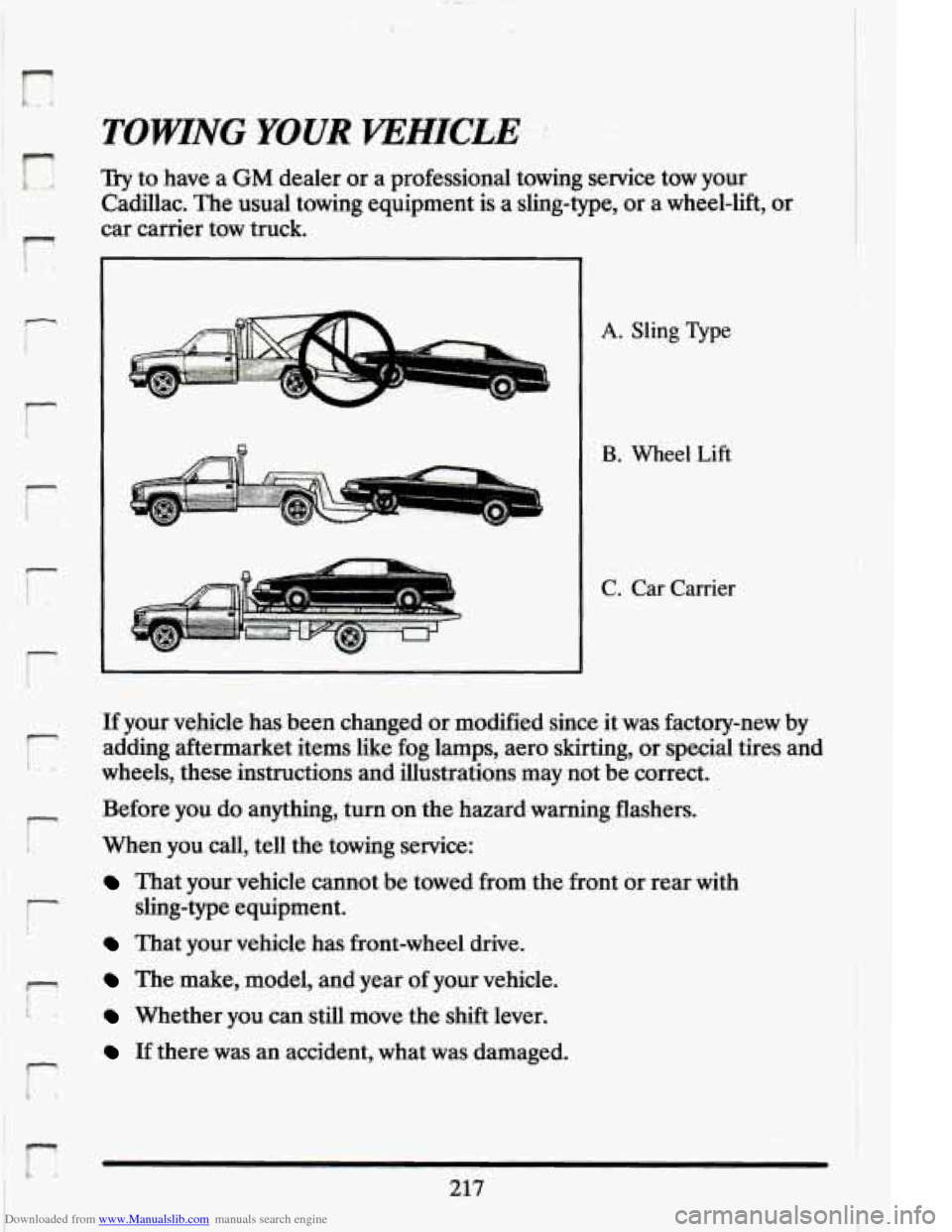
r, Try to have a GM dealer or a professional towing service tow your
Cadillac. The usual towing equipment is a sling-type, or a wheel-lift, or
car carrier tow truck.
r
r
V
I n
t
ir
I 'r:
F-
i
17
r
A. Sling Type
B. Wheel Lift
C. Car Carrier
If your vehicle has been changed or modified since it was factory-new by
adding aftermarket items like fog lamps, aero skirting, or special tires and
wheels, these instructions and illustrations may not be correct.
Before you do anything, turn on the hazard warning flashers.
When you call, tell the towing service:
That your vehicle cannot be towed from the front or rear with
That your vehicle has front-wheel drive.
The make, model, and year of your vehicle.
Whether you can still move the shift lever.
If there was an accident, what was damaged.
sling-type
equipment.
217
Page 230 of 398
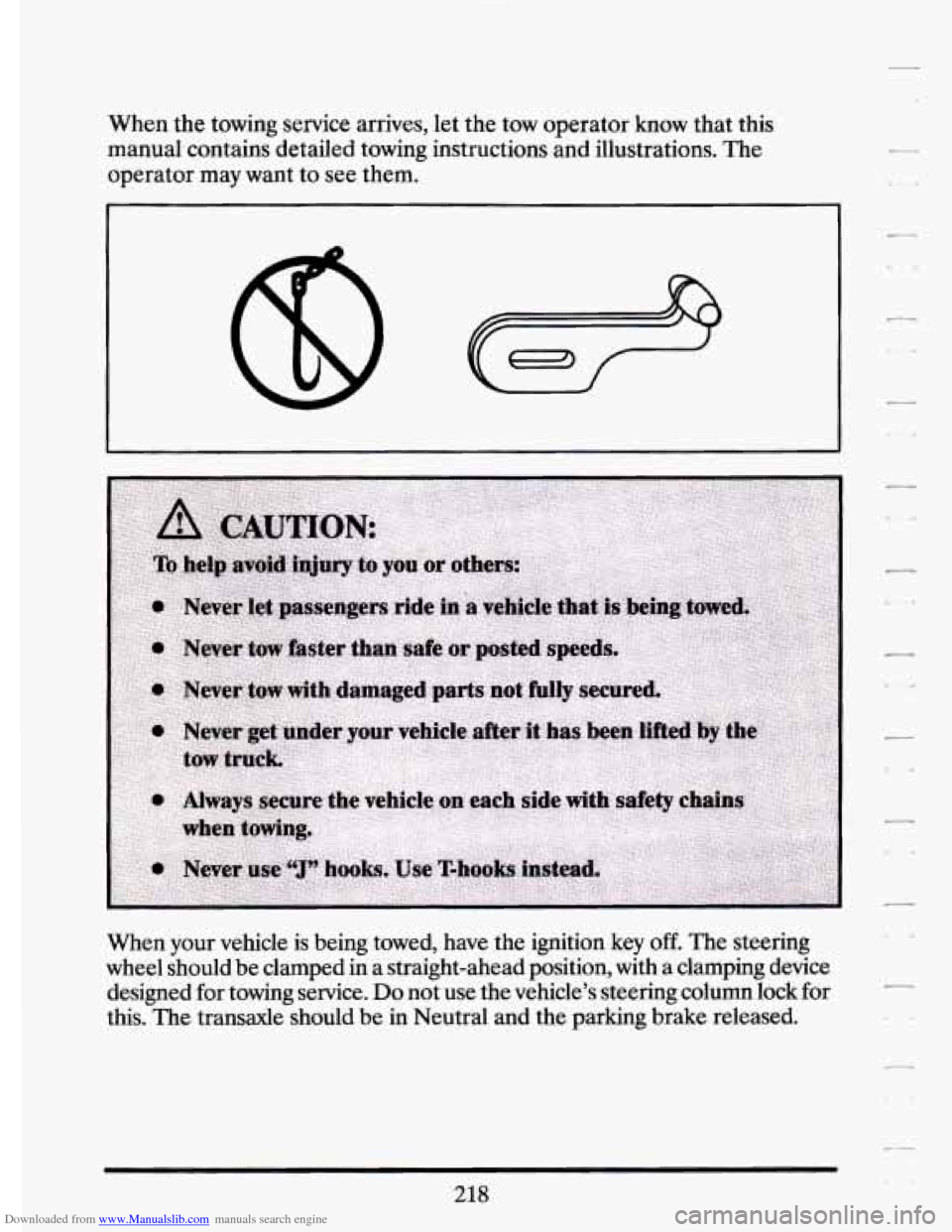
Downloaded from www.Manualslib.com manuals search engine When the towing service arrives, let the tow operator know that this
manual-contains detailed towing instructions and illustrations. The
operator may want to see them.
When your vehicle
is being towed, have the ignition key off. The steering
wheel should be clamped in a straight-ahead position, with
a clamping device
designed for towing service.
Do not use the vehicle’s steering column lock for
this. The transaxle should be in Neutral and the parking brake relea\
sed.
218
-.
Page 231 of 398
Downloaded from www.Manualslib.com manuals search engine r
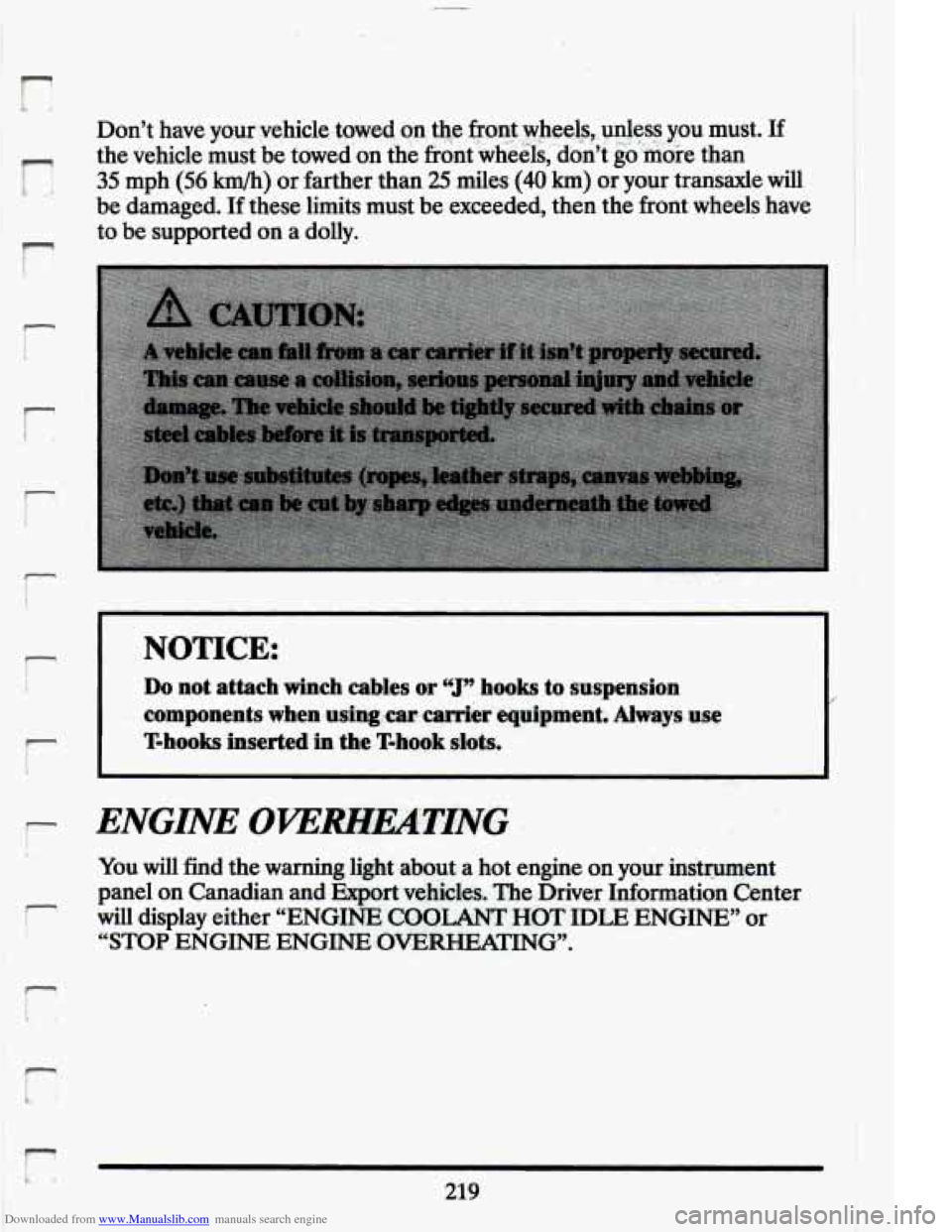
Don’t have your.yehicle. towd. on $9 front.,wheelsy,unless you must. If
the vehicle must be towed’on the frontwheels,’don’t go’.moie than
35 mph (56 km/h) or farther than 25 miles (40 km) or your transaxle will
be damaged. If these limits must be exceeded, then the front wheels have
to be supported on a dolly.
I- I Do not attach winch cables or ‘1” hooks to suspension
NOTICE:
components when usingxar carrier equipment. Always use
T-hooks inserted in the T-hook slots.
/
i- L
r
f-
r
ENGINE OVlWHEATING
You will find the warning light about a hot engine on your instmment
panel on Canadian and
Export vehicles. The Driver Information Center
will display either “ENGINE COOLANT HOT IDLE ENGINE” or
“STOP ENGINE ENGINE OVERHEMTING.
219
Page 232 of 398
Downloaded from www.Manualslib.com manuals search engine Overheated Engine Protection Operating Mode
Should a low coolant condition exist and the stop “STOP ENGINE
ENGINE OVERHEATING” message is displayed, an overheat
protection mode which alternates firing groups
of four cylinders helps
prevent engine damage. This operating mode allows your vehicle
to be
driven to a safe place in an emergency. You may drive up to 50 miles (80
km). Towing a trailer in the overheat protection mode should be avoided.
NOTICE:
After driving in the “Overheated Engine Protection Operating
Mode”, to avoid engine damage allow the engine to cool befo\
re
attempting any repair.
The engine oil may be severely degraded. Change the oil and
reset the oil life indicator. (See “Engine Oil, When to Change”
in the Index.
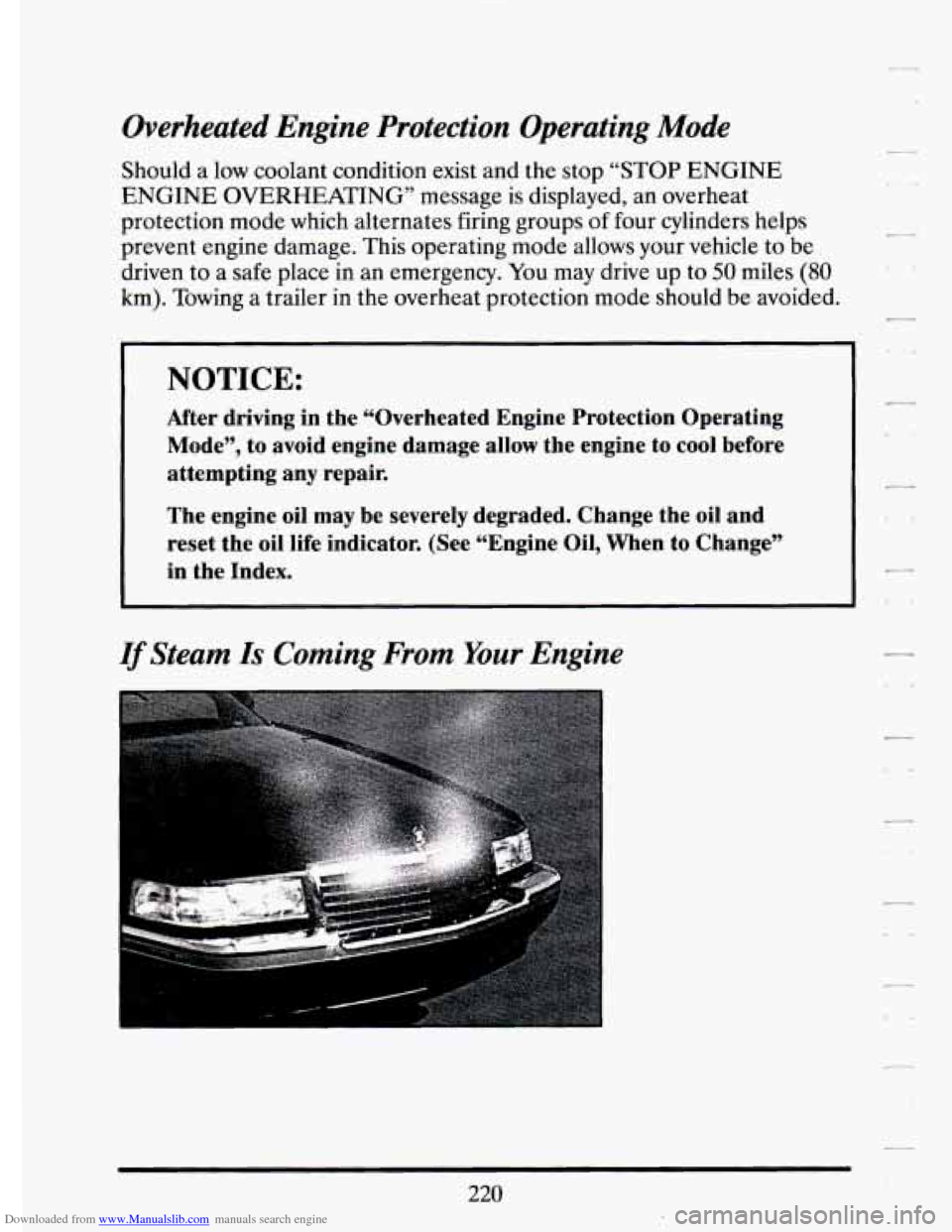
If Steam Is Coming From Your Engine
220