Page 7 of 398
Downloaded from www.Manualslib.com manuals search engine r
r
r
r
r
I r
r
,r
r
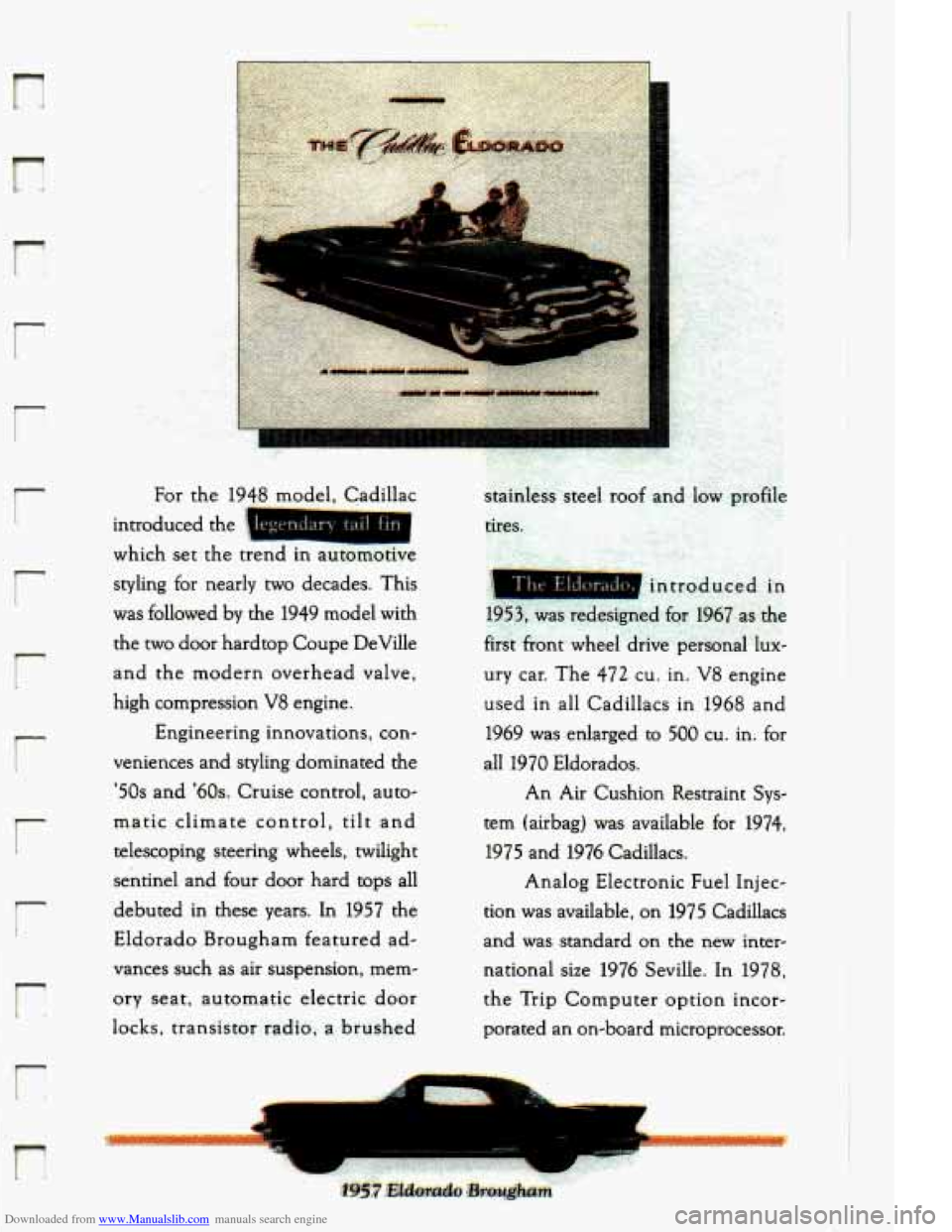
introduced the
which set the trend in automotive
styling for nearly two decades. This
was followed
by the 1949 model with
the two door hardtop Coupe DeVille
and the modern overhead valve,
high compression
V8 engine.
Engineering innovations, con-
veniences and styling dominated the
'50s and '60s. Cruise control, auto-
matic climate control,
tilt and
telescoping steering wheels, twilight
sentinel and four door hard tops all
debuted in these years. In
1957 the
Eldorado Brougham featured ad-
vances such as air suspension, mem-
ory seat, automatic electric door
locks, transistor radio, a. brushed
L.
c .,
Page 28 of 398
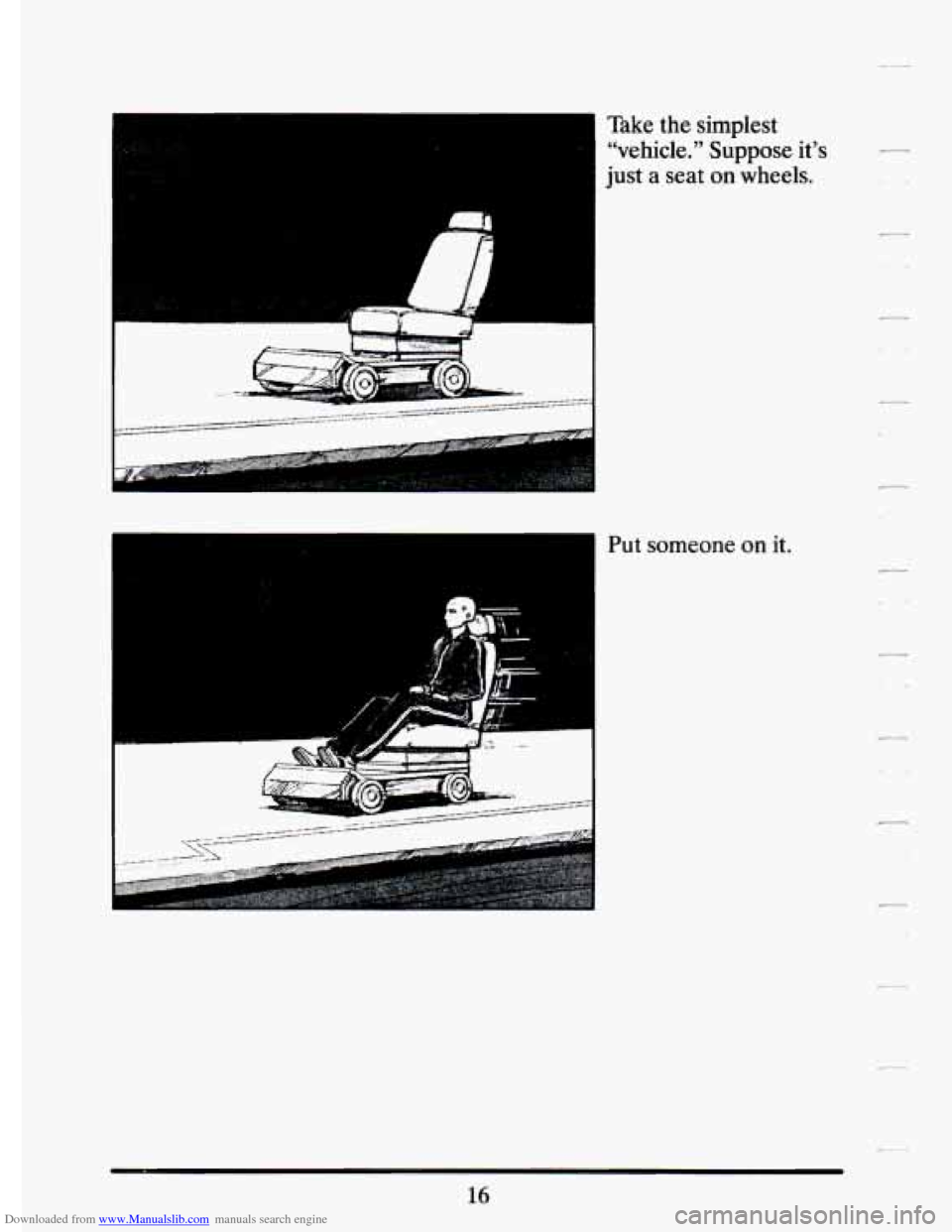
Downloaded from www.Manualslib.com manuals search engine Take the simplest
“vehicle.” Suppose it’s
just a seat
on wheels.
.-
Put someone on it.
16
Page 46 of 398
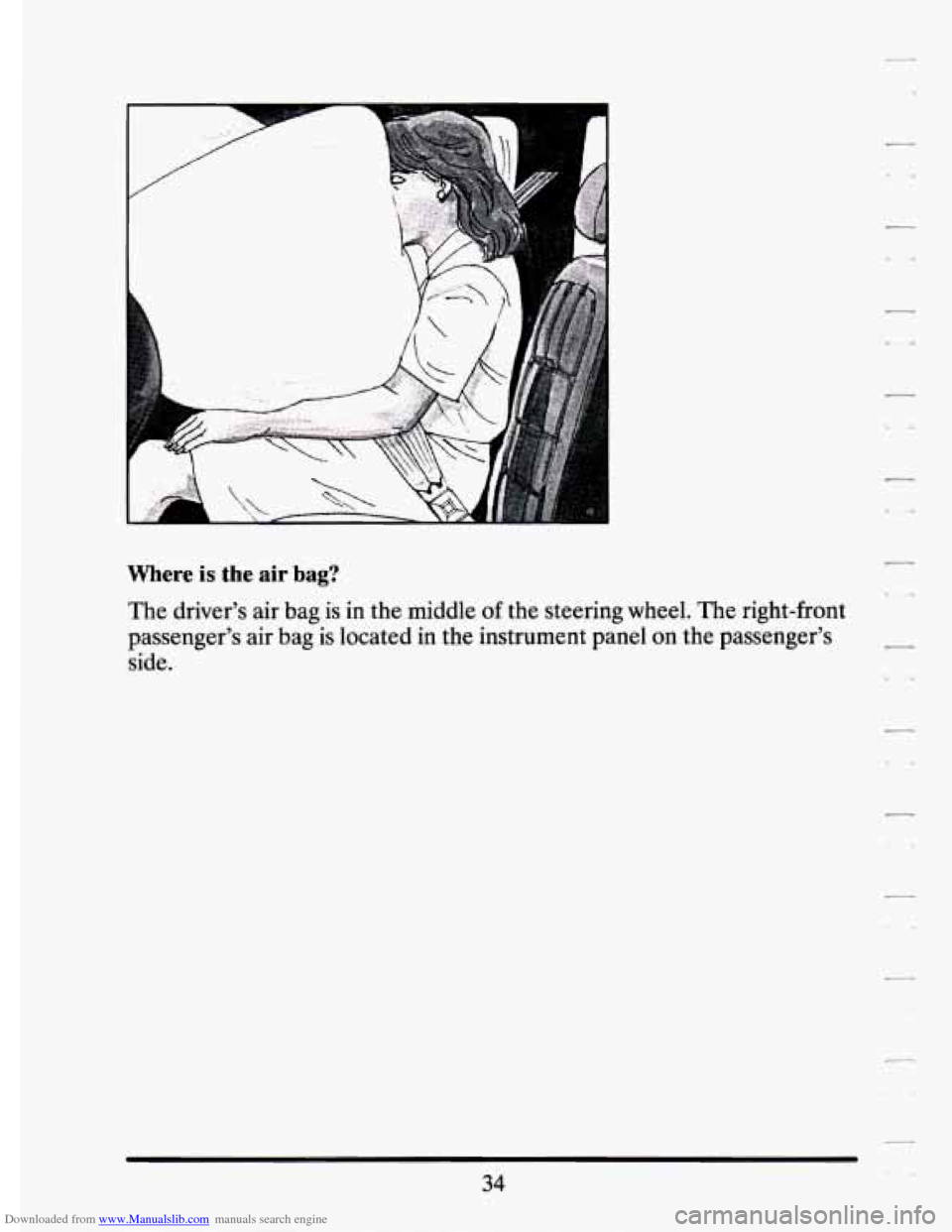
Downloaded from www.Manualslib.com manuals search engine Where is the air bag?
The driver’s air bag is in the middle of the steering wheel. The right-front
passenger’s air bag
is located in the instrument panel on the passenger’s
side.
Page 48 of 398
Downloaded from www.Manualslib.com manuals search engine What makes an air bag inflate?
In a frontal or near-frontal impact of sufficient severity, the air bag
sensing system detects that the vehicle is suddenly stopping as\
a result of
a crash. The sensing system triggers a chemical reaction of the sodium
azide sealed
in the inflator. The reaction produces nitrogen gas, which
inflates a cloth bag. The inflator, cloth bag, and related hardware are all
part
of the air bag inflator modules packed inside the steering wheel and
in the instrument panel in front of the passenger.
How does an air bag restrain?
In moderate to severe frontal or near-frontal collisions, even belted
occupants can contact the steering wheel or the instrument panel. The air
bag supplements the protection provided by safety belts. Air bags
distribute the force of the impact more evenly over the occupant’s upper
body, stopping the occupant more gradually. But air bags would not
provide protection in many types
of collisions, including rollovers and
rear and side impacts, primarily because an occupant’s motion is \
not
toward the air bag. Air bags should never be regarded as anything more
than a supplement to safety belt protection
in moderate to severe frontal
and near-frontal collisions.
What will you see after an air bag inflation?
After the air bag has inflated, it will then quickly deflate. This occur\
s so
quickly that some people may not even realize that the air bag inflated.
Some components of the air bag module
in the steering wheel hub for the
driver’s air bag or the instrument panel for the passenger’s bag may be
hot for a short time, but the portion of the bag that comes into contact
with you will not be hot to the touch. There will be small amounts of
smoke and dust coming from vents in the
deflated air bags. The air bag
will
not impede the driver’s vision or ability to steer the vehicle, nor will it
hinder the occupants from exiting the vehicle.
36
Page 92 of 398
Downloaded from www.Manualslib.com manuals search engine When you park your Cadillac and open the driver’s door, you’ll hear a
chime reminding you to remove your key from the ignition and take it
with you. Always
do this. Your steering wheel will be locked, and so will
your ignition and transaxle. And remember to lock the doors.
Parking at Night
Park in a lighted spot, close all windows and lock your vehic\
le. Remember
to keep your valuables out
of sight. Put them in a storage area, or take
them with you.
Parking Lots
If you park in a lot where someone will be watching your vehicle, it’s best
to lock it up and take your keys. But what
if you have to leave your
ignition key? What
if you have to leave something valuable in your
vehicle?
a Put your valuables in a storage area, like your trunk or glove box.
Lock the glove box.
0 Lock all the doors except the driver’s.
Then take the door key with you.
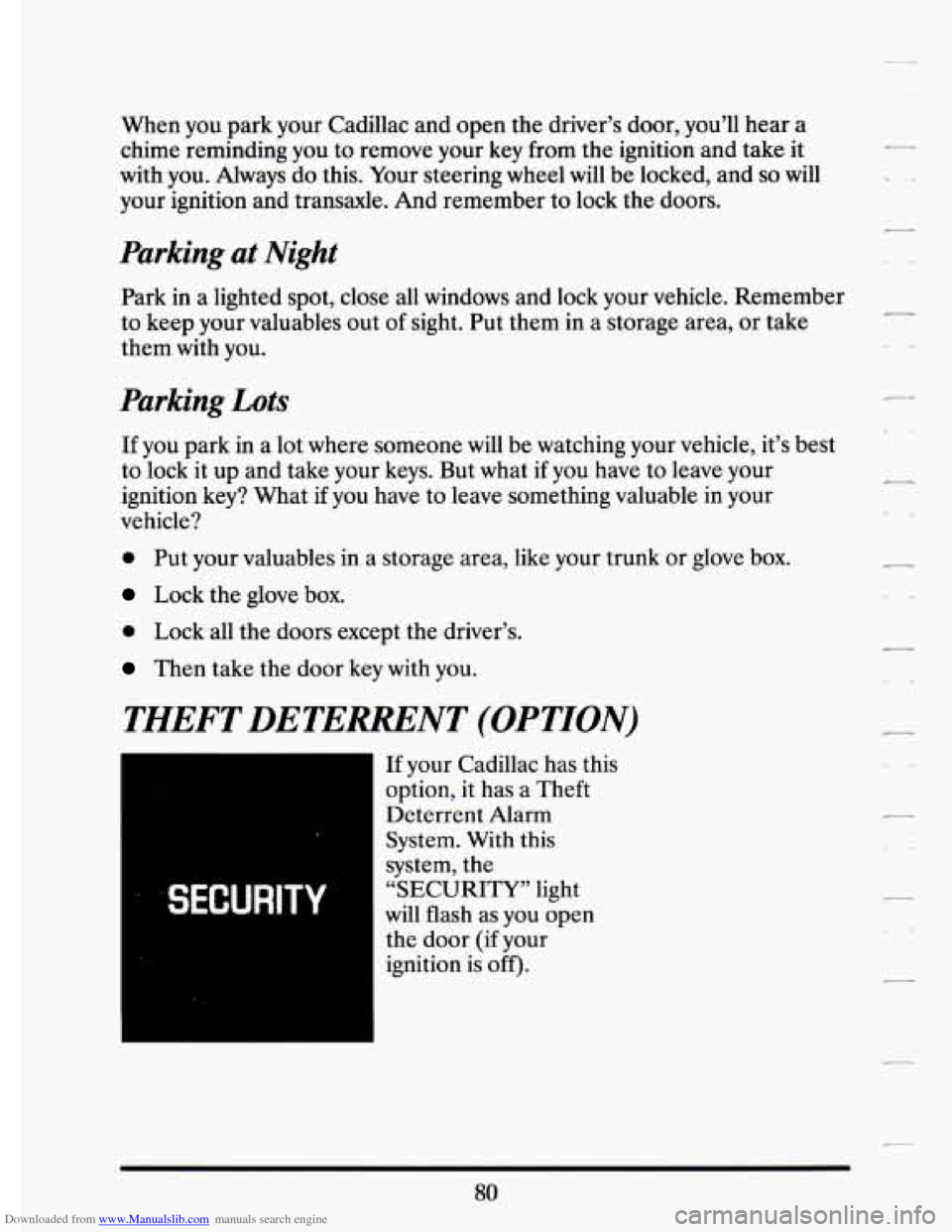
THEFT DETERRENT (OPTION)
I ,SECURITY
If your Cadillac has this
option, it has a Theft
Deterrent Alarm
System. With
this
system, the
“SECURITY” light
will flash as you open
the door
(if your
80
Page 96 of 398
Downloaded from www.Manualslib.com manuals search engine Before you put the key In, your ignition will be in the “LOCK” position.
This position locks your ignition, steering
wheel and transaxle. It’s an
anti-theft feature.
The other positions let
you perform these functions:
ACC: Accessory lets you use things like the radio and the windshield
wipers when the engine is off. To get into “ACC”, push
in the key and turn
it toward you. Your steering wheel
will remain locked, just as it was-
before you inserted the key.
OFF: This position lets you turn off the engine but still turn the steering
wheel. It doesn’t lock the steering wheel like “Lock.” Use “Off”
if you
must have your car in motion while the engine is off (for example, if your
car is being pushed).
RUN This is the position for driving.
STARR This starts your engine.
NOTICE:
If your key seems stuck in “Lock” and you can’t turn it, be sure it
is
all the way in. If it is, then turn the steering wheel left and
right while you turn the key hard. But turn the key only with your
hand. Using
a tool to force it could break the key or the ignition
switch. If none of this works, then your vehicle needs service.
STARTING YOUR ENGINE
Move your shift lever to “P” (Park) or “N” (Neutral). Your engine won’t
start in any other position
-- that’s a safety feature. To restart when you’re
already moving, use
“N” (Neutral) only.
.-
,.
NOTICE: -
Don’t try to shift to “P” (Park) if your Cadillac is moving. If you
I
do, you could damage the transaxle. Shift to “P” (Park) only
when your vehicle
is stopped.
84
Page 100 of 398
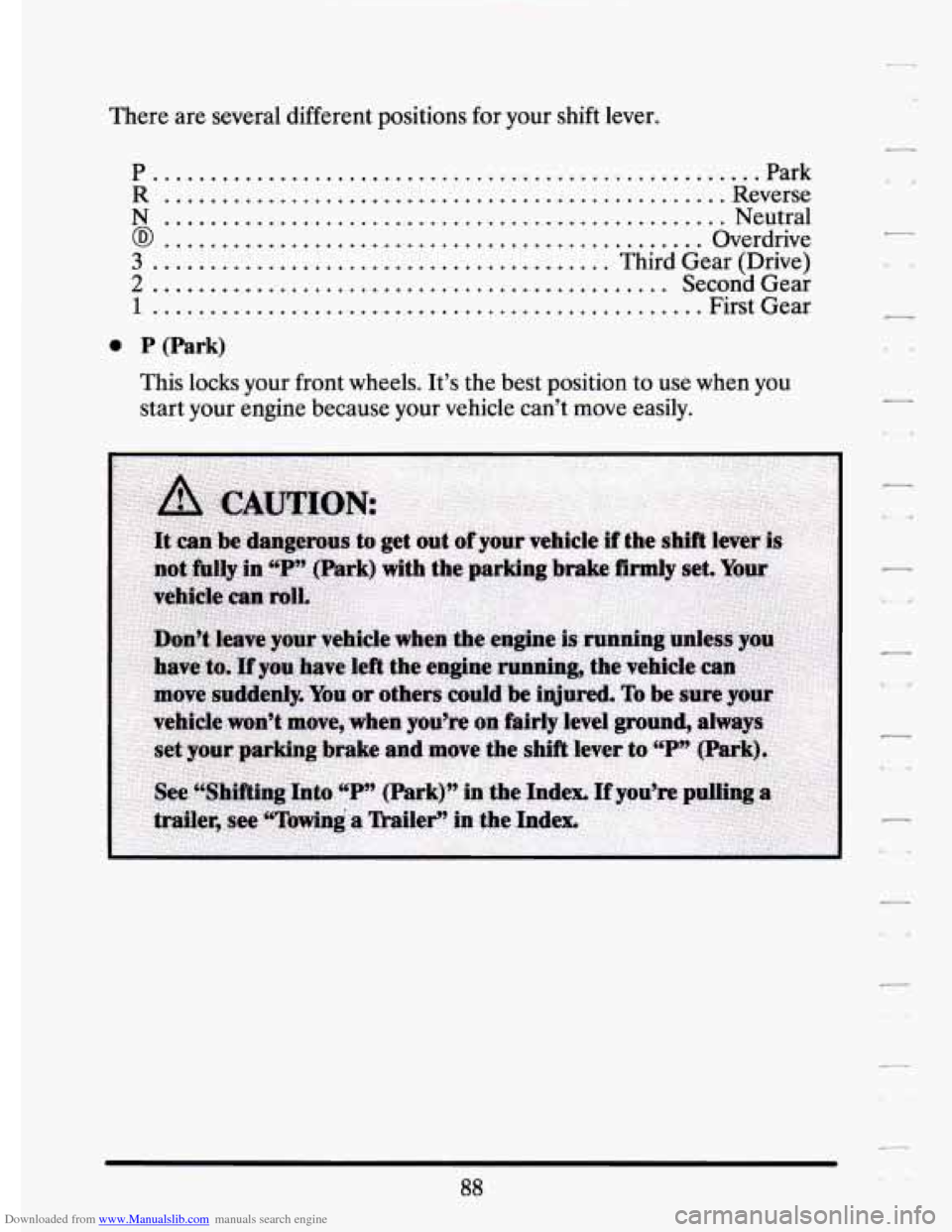
Downloaded from www.Manualslib.com manuals search engine There are
0
P.....
R ....
8 ::::
3 .....
2 .....
1 .....
several different positions for your shift lever.
................................................ Park
............................................. Reverse
............................................. Neutral
........................................... Overdrive
........................................ SecondGear
........................................... FirstGear
................................... Third Gear (Drive)
P (Park)
This locks your front wheels. It’s the best position to use when you
start your engine because your vehicle can’t move easily.
88
Page 102 of 398
Downloaded from www.Manualslib.com manuals search engine N (Neutral)
In this position, your engine doesn’t connect with the wheels. To
restart when you’re already moving, use “N” (Neutral) only. Also, use
“N” when your vehicle is being towed.
NOTICE:
Damage to your transaxle caused by shifting out of “P” (Park)
or “N” (Neutral) with the engine racing isn’t covered\
by your
warranty.
0 @ Automatic Overdrive
This position is for normal driving. If you need more power for
passing, and you’re:
- Going less than about 35 mph (56 kmh), push your accelerator
- Going about 35 mph (56 km/h) or more, push the accelerator all
pedal about
halfway down.
the way down.
You’ll shift
down to the next gear and have more power.
90