Page 107 of 398
Downloaded from www.Manualslib.com manuals search engine r:
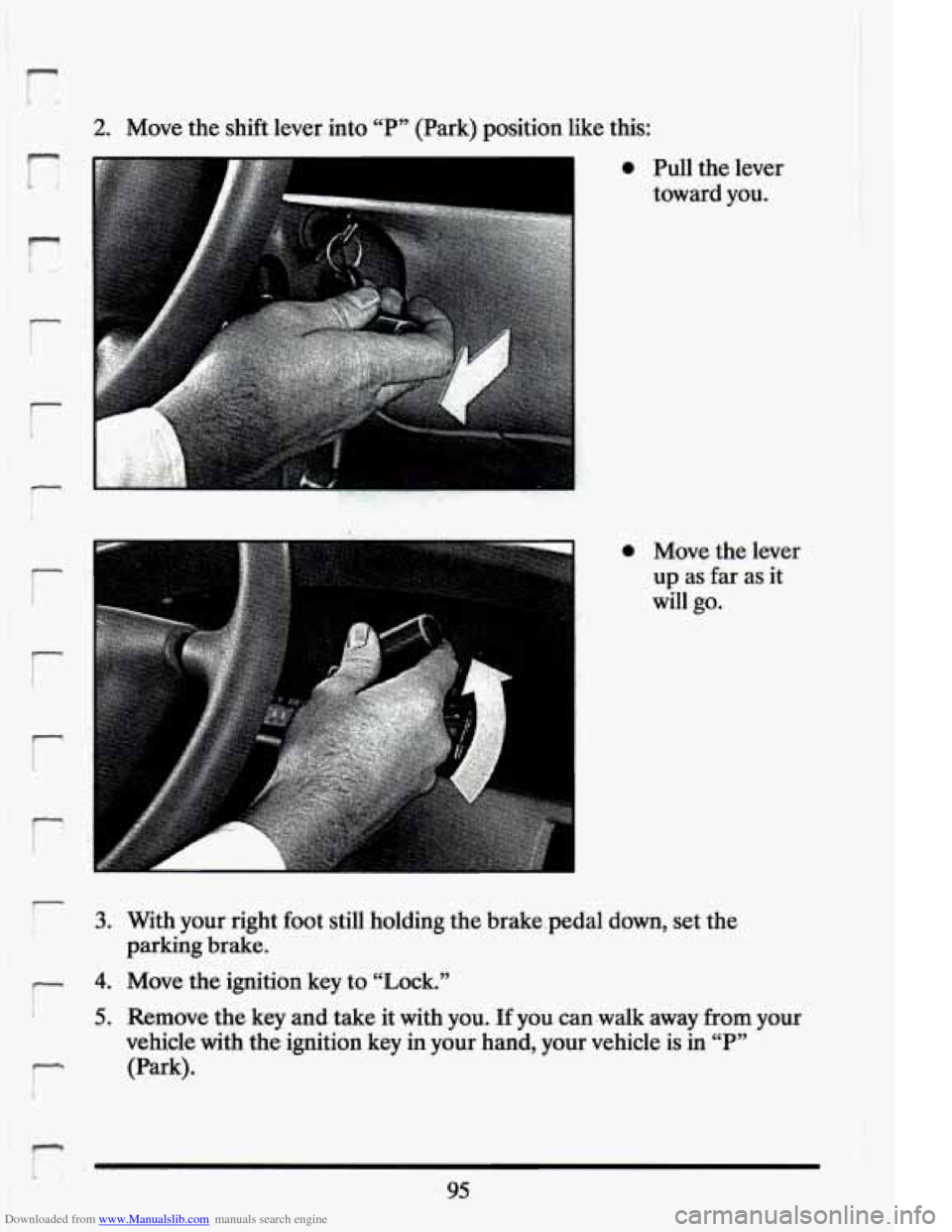
2. Move the shift lever into “P” (Park) position like this:
r.
r
0 Move the lever
up as far as it
will go.
0 Pull the lever
toward
you.
r--- 1 3. With your right foot still holding the brake.peda1 down, set the
parking brake.
4. Move the ignition key to “Lock.”
.5. Remove -the key and take it with you. If you camwalk away from your
vehicle with the-ignition key in your hand, your vehicle is in “P”
1 (Park).
i
-
95
Page 108 of 398
Downloaded from www.Manualslib.com manuals search engine Lonsole Shift Lever
1. Hold the brake pedal down with your right foot.
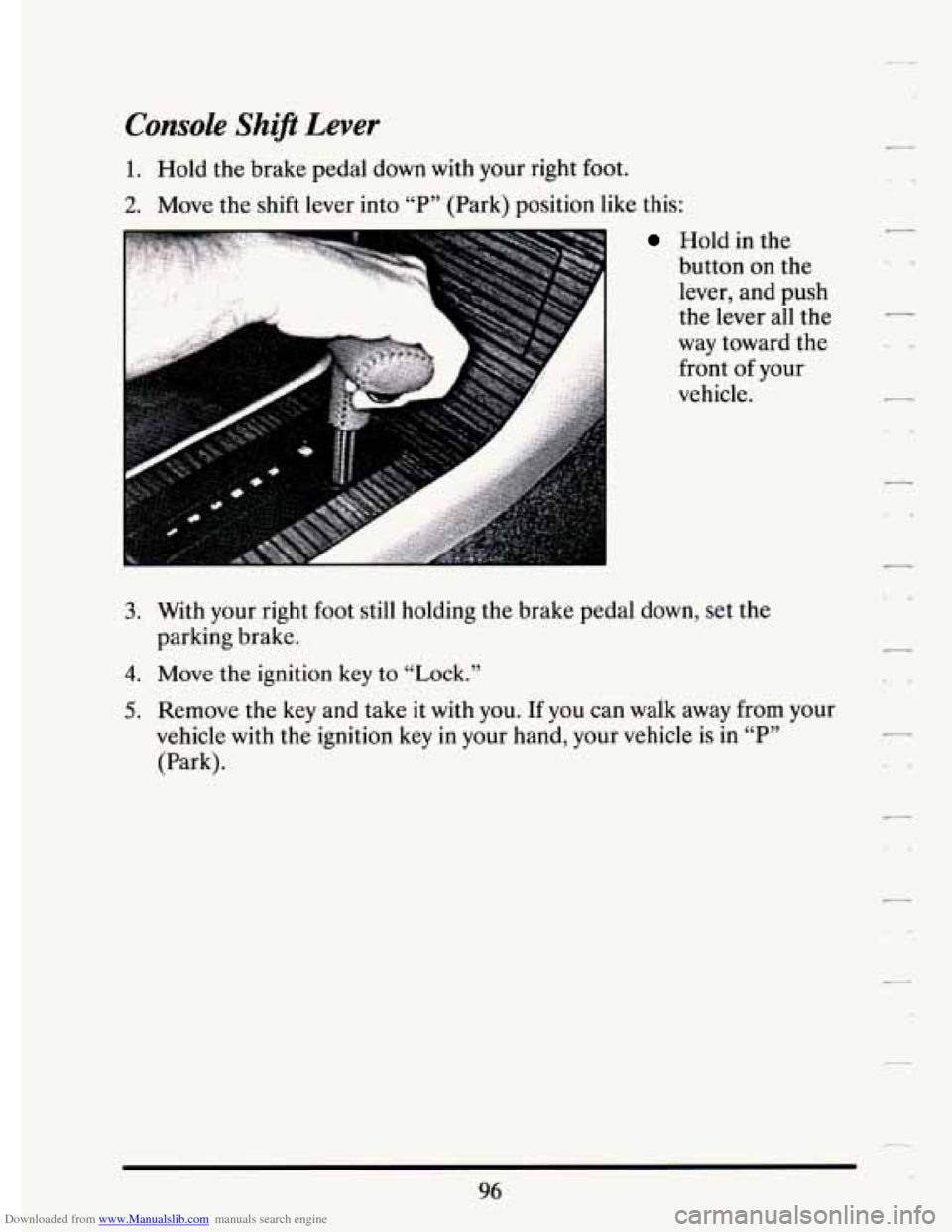
2. Move the shift lever into “P” (Park) position like this:
Hold in the
button on the
lever, and push
the lever all the
way toward the
front
of your
vehicle.
3. With your right foot still holding the brake pedal down, set the
parking brake.
4. Move the ignition key to “Lock.”
5. Remove the key and take it with you. If you can walk away from your
vehicle with the ignition key in your hand, your vehicle is in “P”
(Park).
-
L-
96
Page 109 of 398
Downloaded from www.Manualslib.com manuals search engine r
i-
P
i 1
P
r
i
I?
P I i. 1
_... *- .*
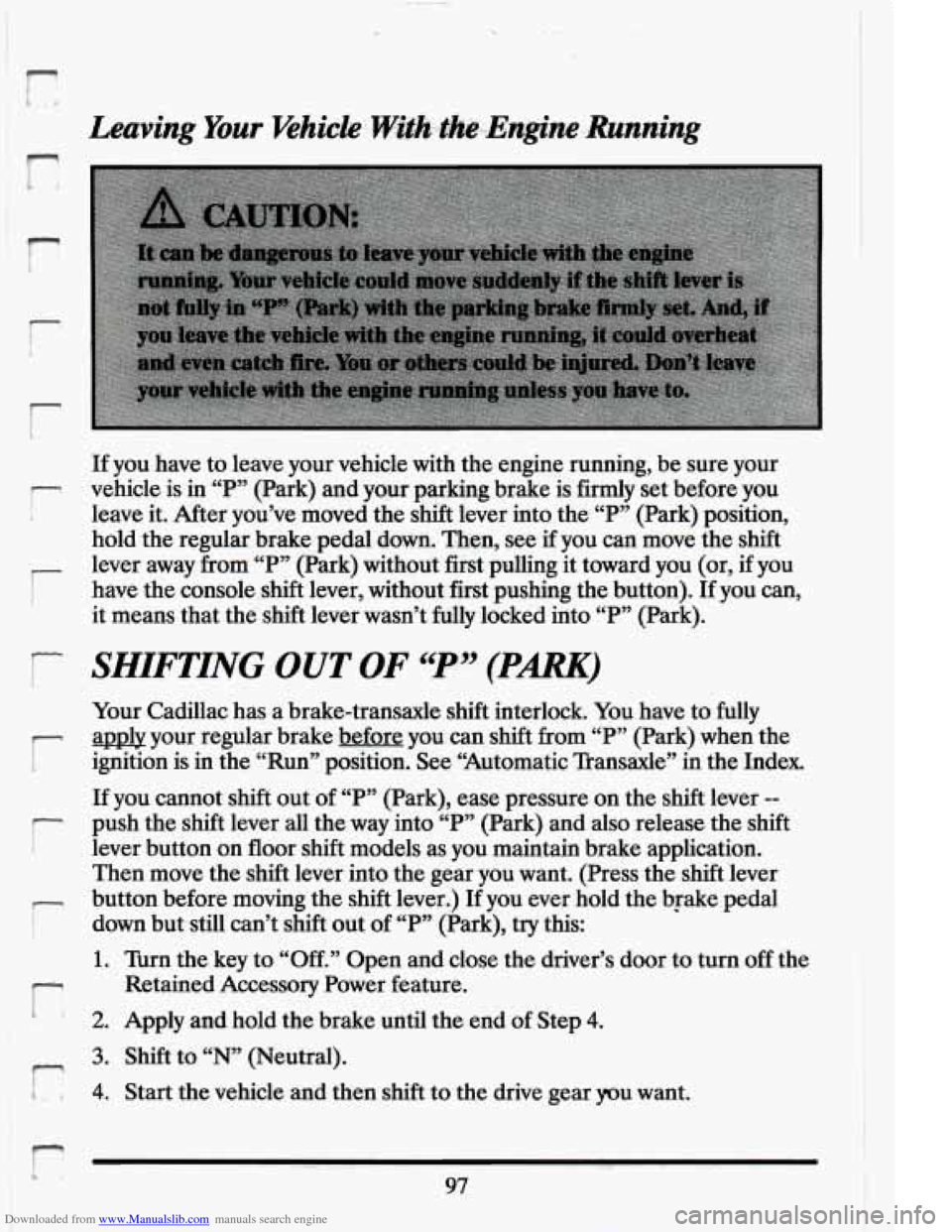
If you have to leave your vehicle with the engine running, be sure your
vehicle is in “PYy (Park) and your parking brake is firmly set before you
leave it. After you’ve moved the shift lever into the “P” (Park) position,
hold the regular brake pedal down. Then, see if you can move the shift
lever away
from “P” (Park) without first pulling it toward you (or, if you
have the console shift
lever, without first pushing the button). If you can,
it means that the shift lever wasn’t fully locked into “P” (Park).
SHIFTING OUT OF “P” (PARK)
Your Cadillac has a brake-transaxle shift interlock. You have to fully
& your regular brake before you can shift from “P” (Park) when the
ignition is in the “Run” position. See “Automatic Transaxle” in the Index.
If you cannot shift out of “P” (Park), ease pressure on the shift lever --
push the shift lever all the way into “P” (Park) and also release the shift
lever button on floor shift models as you maintain brake application.
Then move the shift lever into the gear you want. (Press the shift lever
button before moving the shift lever.)
If you ever hold the brake pedal
down but still can’t shift out of “PYy (Park), try this:
1.
2.
3.
4.
Turn the key to “Off.” Open and close the driver’s door to turn off the
Retained Accessory Power feature.
Apply and hold the brake until the end of Step
4.
Shift to “N” (Neutral).
Start the vehicle and then shift to the drive gear you want.
i
Page 112 of 398
Downloaded from www.Manualslib.com manuals search engine RUNNING YOUR ENGINE WHILE YOU’RE
PARKED
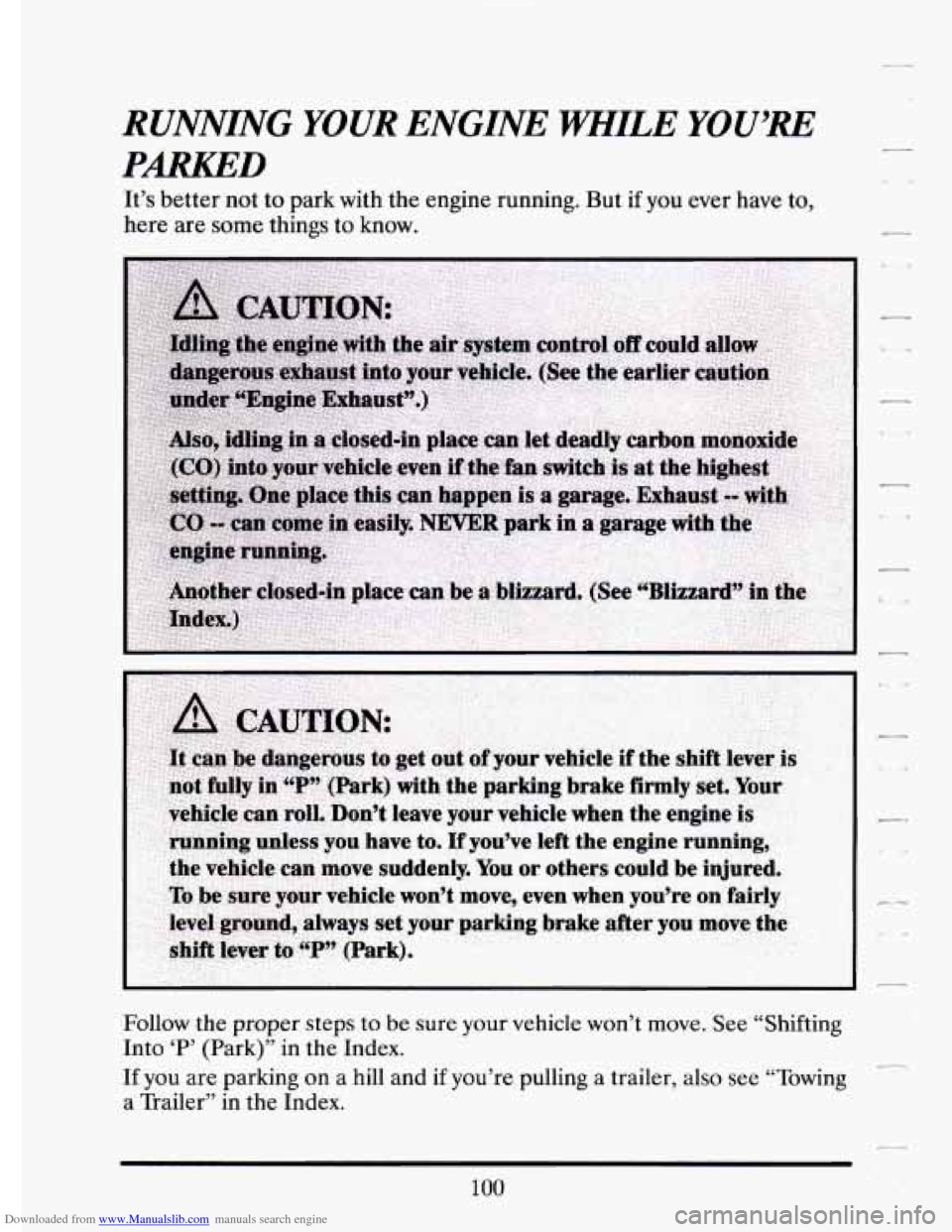
It’s better not to park with the engine running. But if you ever have to,
here are some things to know.
Follow the proper steps to be sure your vehicle won’t
move. See “Shifting
Into
‘P’ (Park)” in the Index.
If you are parking on a hill and if you’re pulling a trailer, also see “Towing
a Trailer” in the Index.
100
Page 117 of 398
Downloaded from www.Manualslib.com manuals search engine r
r
!-
r
r
lr
If a bulb is burned out, ~~p~a~~~,~~.~~~.h~~~~a~~~~-an ,?wide$. If the green
arrows don’t
go on at all when you signal-a turn, check the fuse (see
“Fuses” in the Index) and for burned-out bulbs.
Operation of Lights
Although your vehicle’s lighting system (headlights, parking \
lights, fog
lamps, side marker lights and taillights) meets all applicable federal
lighting requirements, certain states and provinces may apply their
own
lighting regulations that may require special attention before you operate
these lights.
For example, some jurisdictions may require that you operate your lower
beam lights with fog lamps at all times, or that headlights be turned on
whenever you must use your windshield wipers. In addition, most
jurisdictions prohibit driving solely with parking lights, especially at dawn
or dusk. It is recommended that you check with your
own state or
provincial highway authoritfi for applicable lighting regulations.
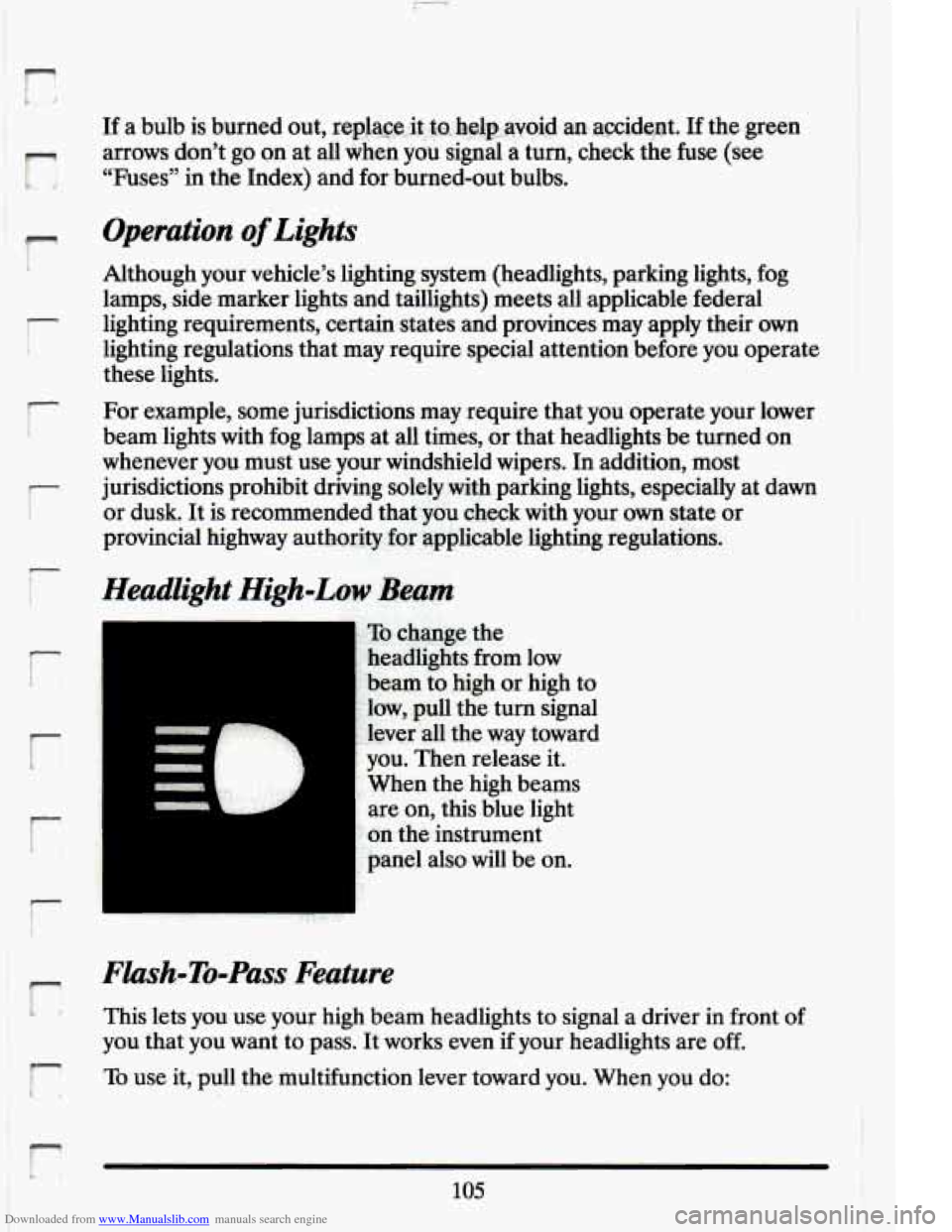
Headlight High-Low Beam
To change the
headlights from low
‘beam to high or high to
low,
pull the turn signal
lever all the way toward
you. Then release it.
When the high beams
are on, this blue light
on the instrument
panel also will be on.
Flash-To-Pass Feature
This lets you use your high beam headlights to signal a driver in front of
you that you want to pass. It works even if your headlights are off.
To use it, pull the multifunction lever toward you. When you do:
105
Page 118 of 398
Downloaded from www.Manualslib.com manuals search engine If your headliEhts are off: Your high beam headlights will turn on. They’ll
stay on as long as you hold the lever there. Release the lever to turn
them
off.
If your headliEhts are on. but on low beam: The system works normally.
Just pull the lever. Your headlights
will shift to high beam and stay there.
To return to low beam, just pull the lever toward you.
If vour headlights are
on. and on high beam: Your headlights will switch
to low beam. To get back to high beam, pull the lever toward you.
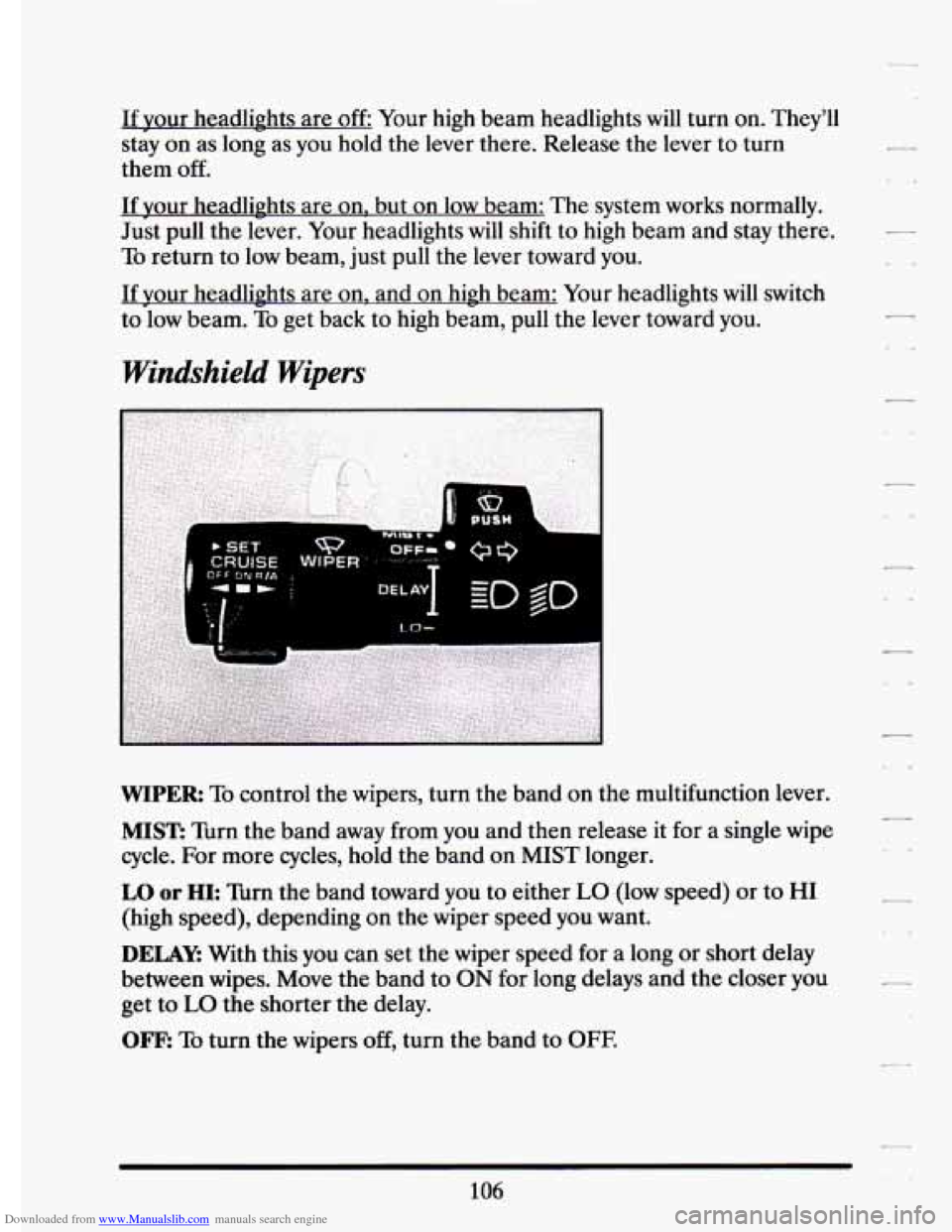
Windshield Wipers
1.0-
1.0- I
WIPER: To control the wipers, turn the band on the multifunction lever.
MIST: Turn the band away from you and then release it for a single wipe
cycle. For more cycles, hold the band on MIST longer.
7
LO or HI: Turn the band toward you to either LO (low speed) or to HI
(high speed), depending on the wiper speed you want.
DELAY: With this you can set the wiper speed for a long or short delay
between wipes. Move the band to
ON for long delays and the closer you
get to
LO the shorter the delay.
OFF: To turn the wipers off, turn the band to OFE
106
Page 144 of 398
Downloaded from www.Manualslib.com manuals search engine the manual’s advice. Waiting to do repairs can be costly -- and even
dangerous.
So please get to know your warning lights. They’re a big help.
Your vehicle may also have a driver information system that works along
with the warning lights. See “Driver Information System”
in the Index.
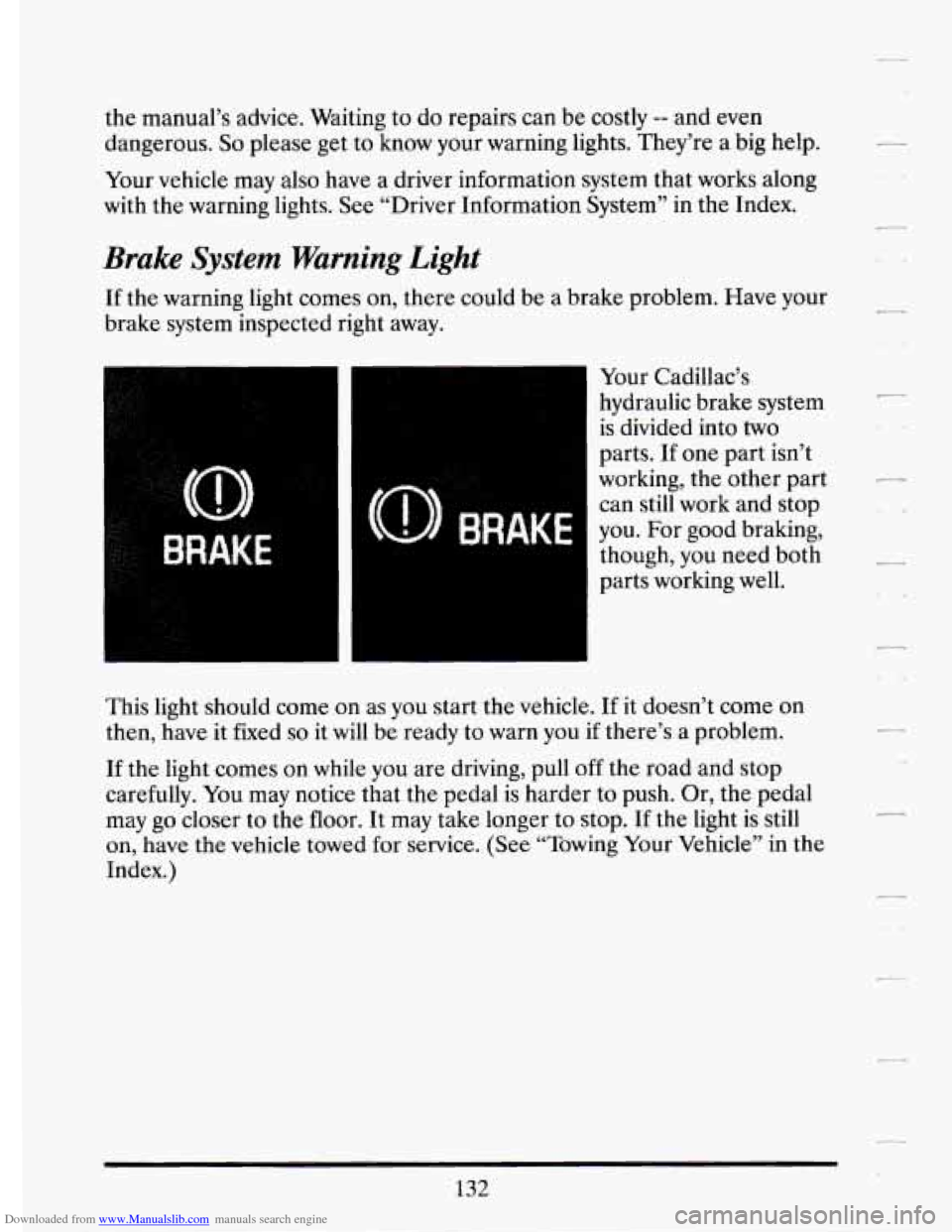
Brake System Warning Light
If the warning light comes on, there could be a brake problem. Have your
brake system inspected right away.
Your Cadillac’s
hydraulic brake system
is divided into two
parts. If one part isn’t
working, the other part
can still work and stop
you. For good braking,
though, you need both
parts working well.
This light should come
on as you start the vehicle. If it doesn’t come on
then, have it fixed
so it will be ready to warn you if there’s a problem.
If the light comes on while you are driving, pull off the road and stop
carefully.
You may notice that the pedal is harder to push. Or, the pedal
may go closer to the floor. It may take longer to stop. If the light
is still
on, have the vehicle towed for service. (See “Towing Your Vehicle” in the
Index.)
132
Page 213 of 398
Downloaded from www.Manualslib.com manuals search engine r
r
r
P
r
!
r I
r
r-
NOTICE:
Pulling a trailer improperly can damage your vehicle and result
in costly repairs not covered by your warranty. To pull a trailer
correctly, follow the advice
in this section.
Your Cadillac is a passenger vehicle. It was not designed for many of the
demands that trailer towing can add.. Trailer towing can change the way
your vehicle performs on the road. It brings new forces into play and can
add plenty
of strain and stress to your vehicle.
Load pulling components such as the engine, transaxle, wheel assemblies,
and tires are forced to work harder against the drag
of the added weight.
The engine is required to operate at relatively higher speeds and under
greater loads, generating extra heat. Trailer towing adds considerably to
wind resistance increasing the pulling requirements.
All
of that means changes in:
Handling
Durability
Fuel Economy
You may decide not to pull a trailer but meet your load carrying needs in
some other way.
201 I
I