1994 CADILLAC ELDORADO brakes
[x] Cancel search: brakesPage 216 of 398
Downloaded from www.Manualslib.com manuals search engine NOTICE:
The bumpers on your vehicle are not intended for hitches. Do
not attach rental hitches or other bumper-type hitches to them.\
-
Safety Chains
You should always attach chains between your vehicle and your trailer.
Cross the safety chains under the tongue of the trailer
so that the tongue
will not drop to the road
if it becomes separated from the hitch. Follow
the manufacturer’s recommendation for attaching safety chains. Alwa\
ys
leave
just enough slack so you can turn with your rig. And, never allow
safety chains to drag on
the ground.
Trailer Brakes
Be sure to read and follow the instructions for the trailer brakes so you’ll -
be able to install, adjust and maintain them properly. L:
Driving with a Trailer
Towing a trailer requires a certain amount of experience. Before setting
out for the open road, you’ll want to get to know your rig. Acquaint
yourself with the feel of handling and braking with the added weight of
the trailer. And always keep in mind that the vehicle you are driving is
now a good deal longer and not nearly
so responsive as your vehicle is by
itself.
Before you start, check the trailer hitch and platform, safety chains,
electrical connector, lights, tires and mirror adjustment. If the trailer has
electric brakes, start your vehicle and trailer moving and then apply the
trailer brake controller by hand to be sure the brakes are working. This
lets you check your electrical connection at the same time.
During your trip, check occasionally to be sure that the load is secure,
and that the lights and any trailer brakes are still working.
204
Page 218 of 398
Downloaded from www.Manualslib.com manuals search engine Driving On Grades
Reduce speed and shift to a lower gear before you start down a long or
steep downgrade.
If you don’t shift down, you might have to use your
brakes
so much that they would get hot and no longer work well.
On a long uphill grade, shift down and reduce your speed to around
45 mph (70 km/h) or less to reduce the possibility of engine and transaxle
overheating.
If your trailer weighs more than 1,000 pounds (450 Kg) and you have an
automatic transaxle with Overdrive, you may want
to drive in “3” instead
of Overdrive
Parking on Hills
You really should not park your vehicle, with a trailer attached, \
on a hill.
If something goes wrong, your rig could start to move. People can be
injured, and both your vehicle and the trailer can be damaged.\
But
if you ever have to park your rig on a hill, here’s how to do it:
Apply your regular brakes, but do not shift into “P’, (Park).
Have someone place chocks-under the- trailer wheels.
When. the wheel chocks are in place, release the regular brakes until
the chocks absorb the load.
Reapply the regular brakes. THen shift into “P7, (Park) firmly and
apply your parking brake.
Release the regular brakes.
When You Are Ready to Leave Afler Parking on a Hill
1. Apply your regular brakes and hold the pedal down while you:
Start your engine;
Shift into a gear; and
0 Be sure the parking brake has released.
2. Let up on the brake pedal.
L
c
206
i
Page 282 of 398
Downloaded from www.Manualslib.com manuals search engine Brake Master Cylinder
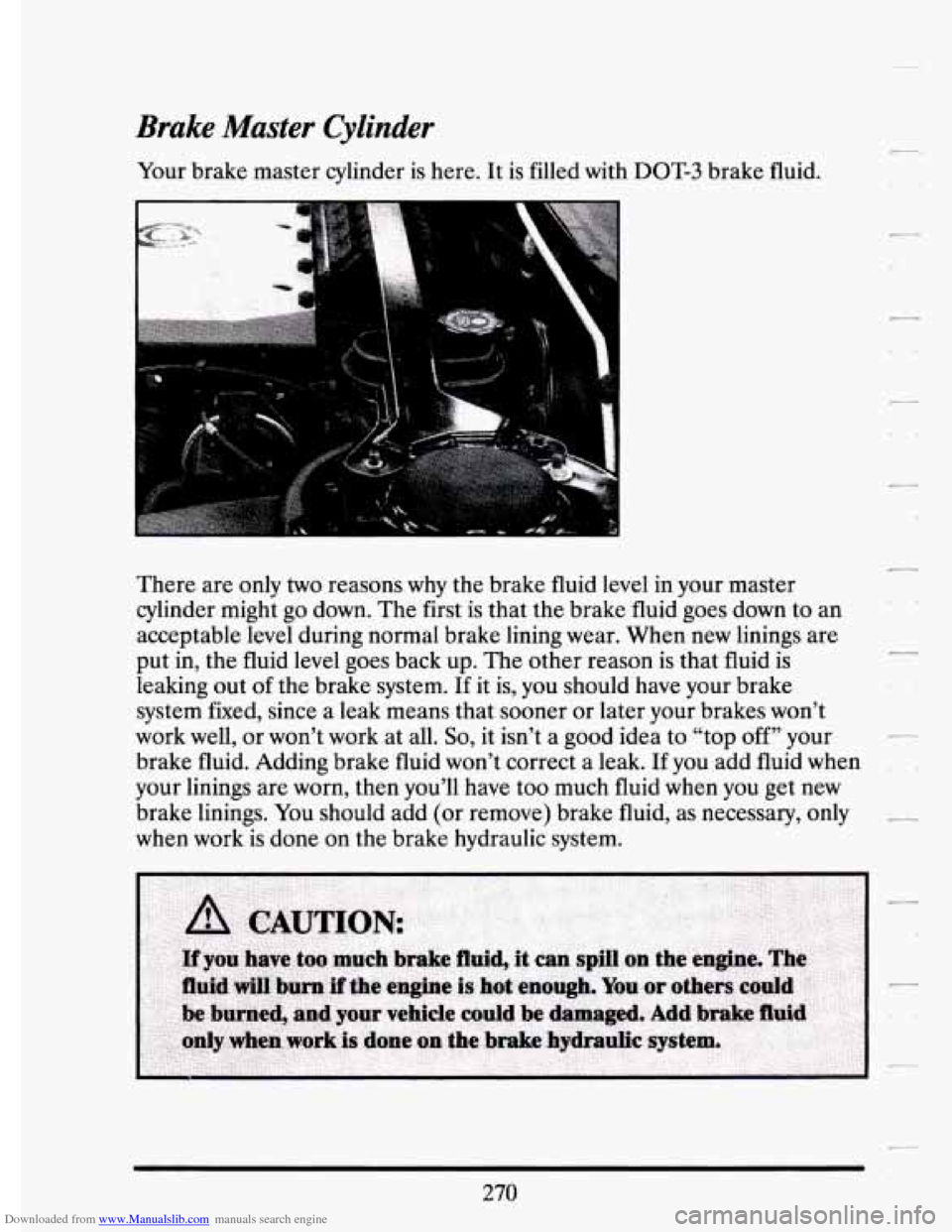
Your brake master cylinder is here. It is filled with DOT-3 brake fluid.
There are only
two reasons why the brake fluid level in your master
cylinder might go down. The first is that the brake fluid goes down to an
acceptable level during normal brake lining wear. When new linings are
put in, the fluid level goes back up. The other reason is that fluid is
leaking out
of the brake system. If it is, you should have your brake
system fixed, since
a leak means that sooner or later your brakes won’t
work well, or won’t work at all.
So, it isn’t a good idea to “top off” your -
brake fluid. Adding brake fluid won’t correct a leak. If you add fluid when
your linings are worn, then you’ll have too much fluid when you get new
brake linings.
You should add (or remove) brake fluid, as necessary, only
when work is done on the brake hydraulic system.
270
Page 284 of 398
Downloaded from www.Manualslib.com manuals search engine ?%at to Add
When you do need brake fluid, use only DOT-3 brake fluid -- such as
Delco Supreme
1 l@ (GM Part No.1052535). Use new brake fluid from a
sealed container only, and always clean the brake fluid reservoir cap
before removing it.
NOTICE:
Don’t let someone put in the wrong kind of fluid. For
example, just
a few drops of mineral-based oil, such as
engine oil, in your brake system can damage brake system
parts
so badly that they’ll have to be replaced.
Brake fluid can damage paint, so be careful not to spill brake
fluid on your vehicle.
If you do, wash it off immediately. See
“Appearance Care” in the Index.
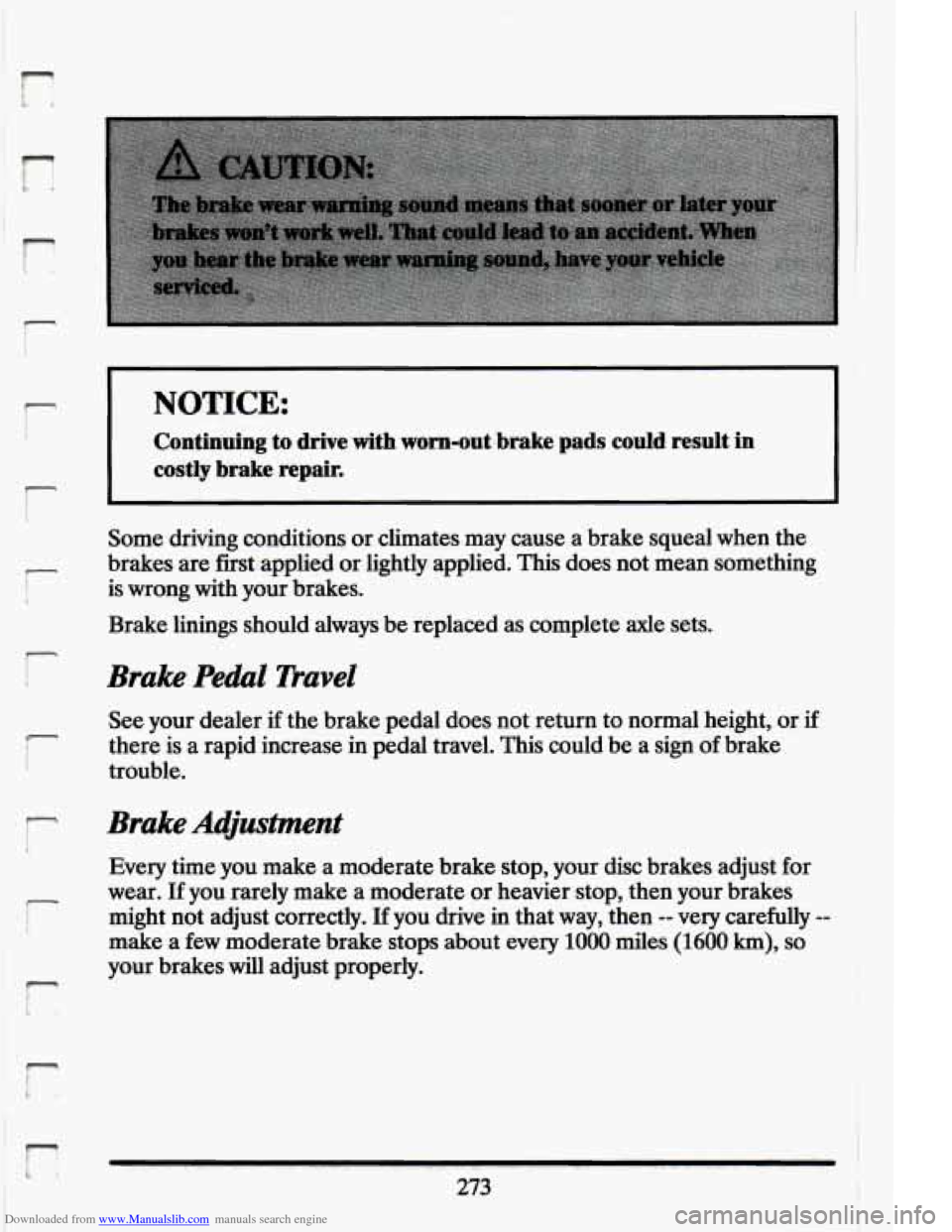
Brake Wear
Your Cadillac has four-wheel disc brakes.
Disc brake pads have built-in wear indicators that make a high-pitched
warning sound when the brake pads are worn and new pads are needed.
The sound may come and
go or be heard all the time your vehicle is
moving (except when
you are pushing on the brake pedal firmly).
272
Page 285 of 398
Downloaded from www.Manualslib.com manuals search engine r
r
r
NOTICE:
Continuing to drive with worn-out.brake pads could result in
costly brake repair.
Some driving conditions or climates may cause a brake squeal when the
brakes are first applied or lightly applied. This does not mean something
is wrong with your brakes.
Brake linings should always be replaced as complete axle sets. \
Brake Pedal Travel
See your dealer if the brake pedal does not return to normal height, or if
trouble.
F I L there is a rapid increase in pedal travel. This could be a sign of brake
r
Brake Adjustment
Every time you make a moderate brake stop, your disc brakes adjust for
wear.
If you rarely make a moderate or heavier stop, then your brakes
might not adjust correctly.
If you drive in that way, then -- very carefully --
make a few moderate brake stops about every 1000 miles (1600 km), so
your brakes will adjust properly.
273
Page 286 of 398

Downloaded from www.Manualslib.com manuals search engine Every time you make a brake stop, your disc brakes adjust for\
wear.
Every time you apply the brakes moderately, with
or without the vehicle
moving, your brakes adjust for wear.
As you make brake stops, your disc brakes automatically adjust for\
wear.
If your brake pedal goes down farther than normal, your rear drum
brakes may need adjustment. Adjust them by backing up and firmly
applying the brakes a
few times.
Replacing Brake System Parts
The braking system on a modern vehicle is complex. Its many parts have
to be of top quality and work well together if the vehicle is to have really
good braking. Vehicles we design and test have top-quality GM brake
parts
in them, as your Cadillac does when it is new. When you replace
parts of your braking system
-- for example, when your brake linings wear
down and
you have to have new ones put in -- be sure you get new
genuine GM replacement parts. If you don’t, your brakes may no longer
work properly. For example,
if someone puts in brake linings that are
wrong for your vehicle, the balance between your front and rear brakes
can change, for the worse. The braking performance you’ve come to
expect can change in many other ways
if someone puts in the wrong
replacement brake parts.
BATTERY
Every new Cadillac has a Delco Freedom@ battery. You never have to
add water to one of these. When it’s time for a
new battery, we
recommend a Delco Freedom@ battery. Get one that has the catalog
number shown on the original battery’s label.
274
Page 325 of 398

Downloaded from www.Manualslib.com manuals search engine Y
r
r I
i
r
!r:
i E
,r
i 'E
L HDLP LO R HDLP LO L HDLP HI R HDLP HI ION 3 COOL'FAN TRANS
I FUSE CENTER IDENTIFICATION I
ENGINE COMPARTMENT FUSE BLOCK
DlSTR 20A
SIR 20A - IGNITION CONTROL MODULE
- DIAGNOSTIC/ENERGY RESERVE
MODULE (DERM)
- DUAL POLE ARMING SENSOR PCM (ION 1OA
- PASS-Key@ DECODER MODULE INJ 10A
- POWERTRAIN CONTROL MODULE (PCM)
- 1,4,6, AND 7 FUEL INJECTORS
- 2.3.5. AND 8 FUEL INJECTORS INJ 1OA
ION
1 iOA - A/C REFRIGERANT PRESSURE SWITCH - TRANSAXLE RANGE SWITCH - STOP/BTSI/CRUISE BRAKE SWITCH - INSTRUMENT PANEL'CLUSTER - KEYLESS ENTRY MODULE - DIAGNOSTlCfENERGY RESERVE MODULE
- PERM2 ORN RING LIGHTS - TURN/HAZARD SWITCH ASSY. - CHIME MODULE - HEADLIGHT SWITCH - TWILIGHT SENTINEUDRL MODULE
- FUELPUMP - OIL PRESSURE SWITCH - POWERTRAIN CONTROL MODULE IPCMI
FUEL PUMP 20A
PCM (BAT) 1OA
RTD
, AT) 20A - RgAD SENSING SUSPENSION (RSS) MODUL A/C COMP 1OA
- POWERTRAIN CONTROL MODULE (PCM)
- A/C COMPRESSOR CLUTCH HDLPS 3OA
.~
- HEADLIGHT DIMMER SWITCH - HEADLIGHT RELAY "D (ENGINE COMF!
- DRL HEADLIGHT RELAY "E" (WITH DAYTIME
- POWERS C13 MICRO RELAY CENTER)
RUNNING LIGHTS)
E
STOP LP 2OA - STOP/BTSI/CRUISE SWITCH - STOPUGHT SWITCH CAPACITOR TURNIHAZ 20A - HAZARD FLASHER - TURN FLASHER RELAY - TURN FLASHER MODULE DRL 1 OA (CANADA) - DAV~ME RUNNI'NG LIGHTS (CANADA) ~ ~~
DRL 1 OA (CANADA)
HTD
W/S 1OA
L HDLP LO 1OA
- LEFT AND RIGHT LO BEAM HEADLAMP
- HEATED WINDSHIELD CONTROL MODULE
- LEFT LO BEAM HEADLAMP R HDLP LO 10A
L HDLP HI 1OA - RIGHT LO BEAM HEADLAMP
- LEFT HI BEAM HEADLAMP R HDLP HI 1OA
IGN
3 10A - RIGHT HI BEAM HEADLAMP
- REAR DEFOGGERRELAY - ELECTRONIC LEVEL CONTROL IELCI - HEATED WINDSHIELD - HEATER AND A/C PROGRAMMER - CRUISE CONTROL
..
COOLING FAN 1OA - MENDED TRAVEL BRAKE SWITCH - POWERTRAIN CONTROL MO'DULE (PCM) - COOLING FAN RELAYS 1,2, AND 3 - FRONT AND REAR HEATED OXYGEN SENSOR TRANSIECS 1 OA - OVERSPEED ALERT MODULE (=PORT) - POWER STEERING PRESSURE SWITCH - EXHAUST GAS REClRCULAilON (EGR) VALVE - TRANSAXLE SHIFT SOLENOIDS A & B - EVAPORATIVE EMISSION CONTROL
SOLENOID ~~
- POWERTRAIN CONTROL MODULE (PCM) - TORQUE CONVERTER CLUTCH SOLENOID - TCC BRAKESWlTCH
313
Page 326 of 398
Downloaded from www.Manualslib.com manuals search engine I 30AC.B. I
A
I I 60A
E
I 60A I
I I 50A
4
I 40A 1
n
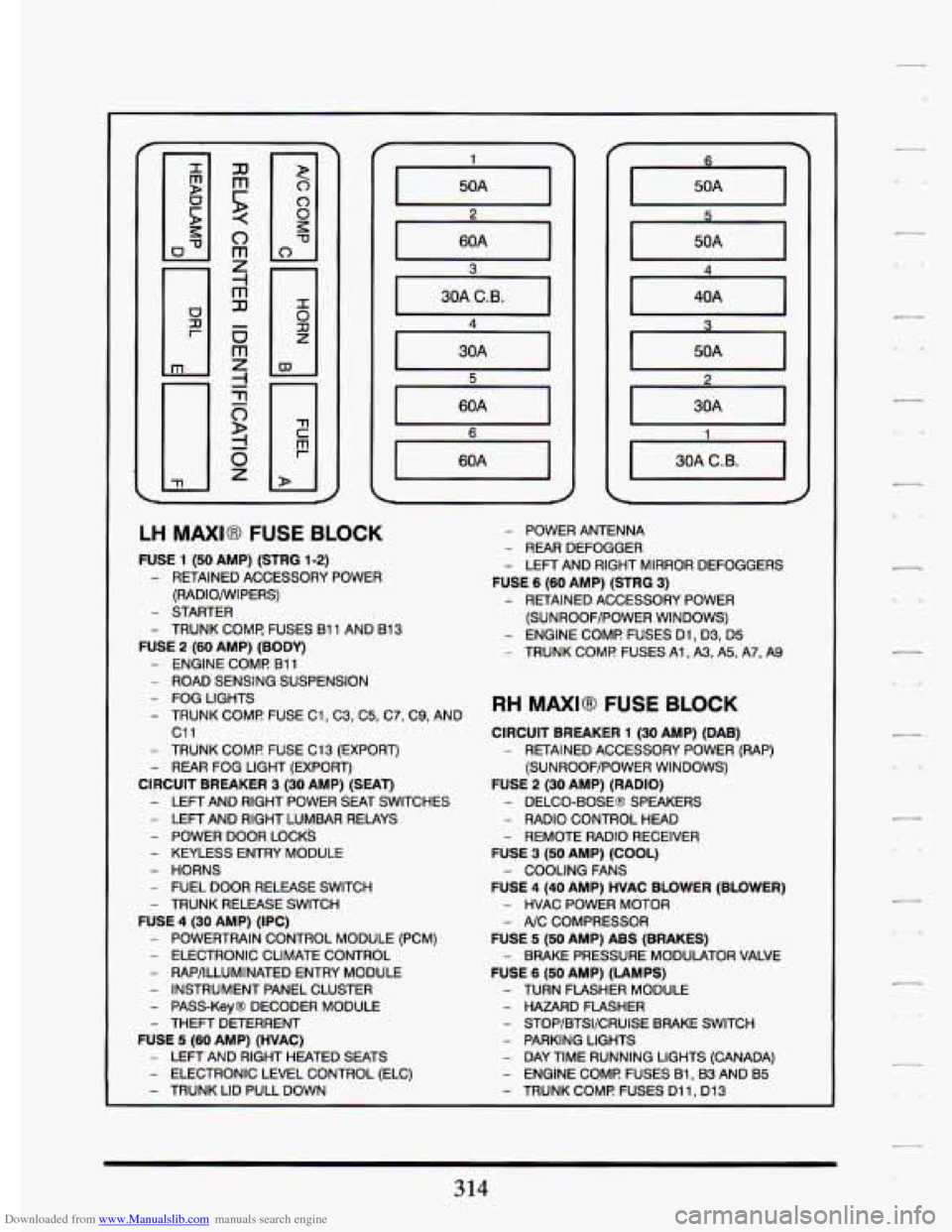
LH MAXI8 FUSE BLOCK
FUSE 1 (50 AMP) (STRG 1-2)
- RETAINED ACCESSORY POWER (RADIO/WIPERS)
- STARTER
- TRUNK COMF FUSES 81 1 AND 813
FUSE 2 (60 AMP) (BODY)
- ENGINE COMI? B11
- ROAD SENSING SUSPENSION
- FOG LIGHTS
- TRUNK COMF! FUSE C1, C3, C5, C7, C9, AND
c11
- TRUNK COMF! FUSE C13 (EXPORT)
- REAR FOG LIGHT (EXPORT)
CIRCUIT BREAKER 3 (30 AMP) (SEAT)
- LEFT AND RIGHT POWER SEAT SWITCHES
- LEFT AND RIGHT LUMBAR RELAYS
- POWER DOOR LOCKS
- KEYLESS ENTRY MODULE
- HORNS
- FUEL DOOR RELEASE SWITCH - TRUNK RELEASE SWITCH
FUSE 4 (30 AMP) (IPC)
- POWERTRAIN CONTROL MODULE (PCM)
- ELECTRONIC CLIMATE CONTROL
- RAP/ILLUMINATED ENTRY MODULE
- INSTRUMENT PANEL CLUSTER
- PASS-Key@ DECODER MODULE
- THEFT DETERRENT
FUSE 5 (SO AMP) (HVAC)
- LEFT AND RIGHT HEATED SEATS
- ELECTRONIC LEVEL CONTROL (ELC)
- TRUNK LID PULL DOWN
- POWER ANTENNA
- REAR DEFOGGER
- LEFT AND RIGHT MIRROR DEFOGGERS
FUSE 6 (60 AMP) (STRG 3)
- RETAINED ACCESSORY POWER
(SUNROOF/POWER WINDOWS)
- ENGINE COMF! FUSES Dl, D3, D5
- TRUNK COMF! FUSES Al, A3, A5, Ai', A9
RH MAXI8 FUSE BLOCK
CIRCUIT BREAKER 1 (30 AMP) (DAB)
- RETAINED ACCESSORY POWER (RAP)
(SUNROOF/POWER WINDOWS)
FUSE 2 (30 AMP) (RADIO)
- DELCO-BOSE@ SPEAKERS
- RADIO CONTROL HEAD
- REMOTE RADIO RECEIVER
FUSE 3 (50 AMP) (COOL)
FUSE
4 (40 AMP) HVAC BLOWER (BLOWER)
- COOLING FANS
- HVAC POWER MOTOR
- A/C COMPRESSOR
FUSE 5 (50 AMP) ABS (BRAKES)
FUSE
6 (50 AMP) (LAMPS)
- BRAKE PRESSURE MODULATOR VALVE
- TURN FLASHER MODULE
- HAZARD FLASHER
- STOP/BTSI/CRUISE BRAKE SWITCH
- PARKING LIGHTS
- DAY TIME RUNNING LIGHTS (CANADA)
- ENGINE COME FUSES B1,W AND B5
- TRUNK COMF! FUSES Dl 1, Dl3
314