1994 BUICK REGAL trailer
[x] Cancel search: trailerPage 170 of 308

Following Distance
Stay at least twice as far behind the vehicle ahead as you
would when driving your vehicle without a trailer. This
can help you avoid situations that require heavy braking
and sudden turns.
Passing
You’ll need more passing distance up ahead when
you’re towing a trailer. And, because you’re a good deal
longer, you’ll need
to go much farther beyond the
passed vehicle before
you can return to your lane.
Backing Up
Hold the bottom of the steering wheel with one hand.
Then,
to move the trailer to the left, just move that hand
to the left.
To move the trailer to the right, move your
hand
to the right. Always back up slowly and, if
possible, have someone guide you.
Making Turns
When you’re turning with a trailer, make wider turns
than normal.
Do this so your trailer won’t strike soft
shoulders, curbs, road signs, trees, or other objects.
Avoid jerky or sudden maneuvers. Signal well
in
advance.
Turn Signals When Towing a Trailer
When you tow a trailer, your vehicle has to have a
different turn signal flasher and extra wiring. The green
arrows
on your instrument panel will flash whenever
you signal a turn or lane change. Properly hooked up,
the trailer lights will also flash, telling other drivers
you’re about to turn, change lanes or stop.
When towing a trailer,
the green arrows on your
instrument panel will flash for turns even
if the bulbs on
the trailer are burned out. Thus, you may think drivers
behind you are seeing your signal when they are
not. It’s
important to check occasionally to be sure the trailer
bulbs are still working.
Driving On Grades
Reduce speed and shift to a lower gear before you start
down a long or steep downgrade. If you don’t shift
down,
you might have to use your brakes so much that
they would get hot and no longer work
well.
On a long uphill grade, shift down and reduce your
speed to around
45 mph (70 km/h) to reduce the
possibility
of engine and transaxle overheating.
If you are towing a trailer that weighs more than
1,000
pounds (450 kg), you may prefer to drive in “D” instead
of Overdrive (or, as you need to, a lower gear).
168
ProCarManuals.com
Page 171 of 308
Parking on Hills
You really should not park your vehicle, with a trailer
attached,
on a hill. If something goes wrong, your rig
could start to move. People can be injured, and both
your vehicle and the trailer can be damaged.
But
if you ever have to park your rig on a hill, here’s
how
to do it:
0 Shift into a gear; and
2. Have someone place chocks under the trailer wheels,
3. When the wheel chocks are in place, release the
regular brakes until the chocks absorb the load.
4. Reapply the regular brakes. Then apply your parking
brake, and
then shift to “P” (Park).
5. Release the regular brakes.
When You Are Ready to Leave After
Parking
on a Hill
0 Release the parking brake.
2. Let up on the brake pedal.
3. Drive slowly until the trailer is clear of the chocks.
4. Stop and have someone pick up and store the chocks.
Maintenance When Trailer Towing
Your vehicle will need service more often when you’re
pulling a trailer. See the Maintenance Schedule for more
on this. Things that are especially important
in trailer
operation are automatic transaxle fluid (don’t overfill),
engine oil, belt, cooling system, and brake adjustment.
Each of these is covered
in this manual, and the Index
will help you find them quickly. If you’re trailering, it’s
a good idea to review these sections before you start
your trip.
Check periodically to see that all hitch nuts and bolts are
tight.
1. Apply your regular brakes and hold the pedal down
while you:
0 Start your engine;
169
ProCarManuals.com
Page 189 of 308
Engine Overheating
You will find the coolant temperature gage on your
instrument panel.
You may also find a low coolant
warning light.
If Steam Is Coming From Your Engine
I NOTICE:
If your engine catches fire because you keep
driving with no coolant, your vehicle can be
badly damaged. The costly repairs would not be
covered by your warranty.
If No Steam Is Coming From Your Engine
If you get the overheat warning but see or hear no
steam, the problem may not be too serious. Sometimes
the engine can get a little too hot when you:
Climb a long hill on a hot day.
Stop after high speed driving.
Idle for long periods in traffic.
0 Tow a trailer.
187
ProCarManuals.com
Page 220 of 308
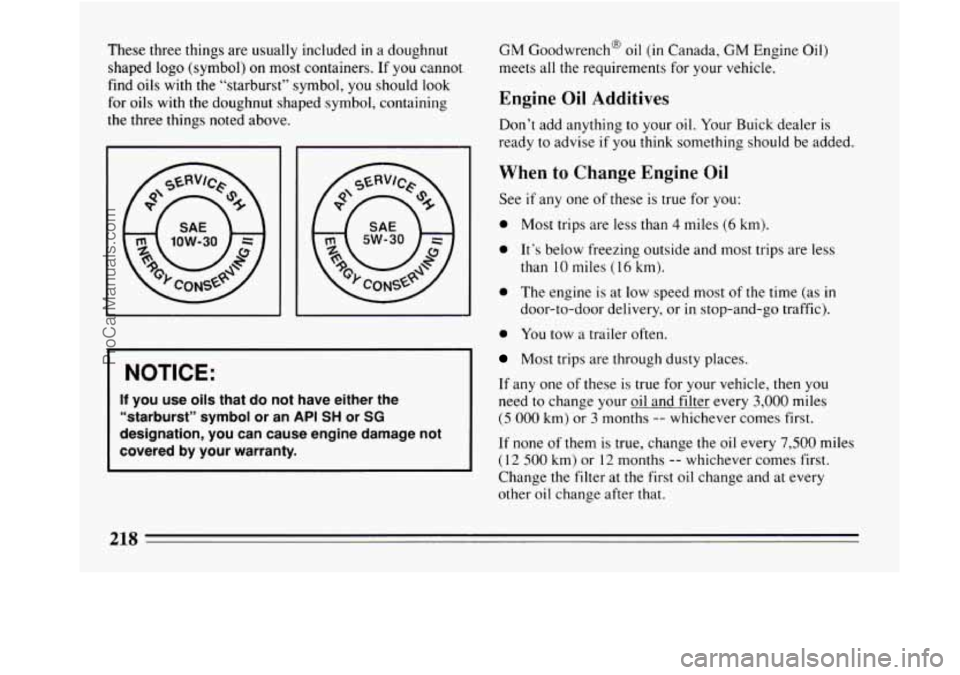
These three things are usually included in a doughnut
shaped logo (symbol)
on most containers. If you cannot
find
oils with the “starburst” symbol, you should look
for oils with the doughnut shaped symbol, containing
the three things noted above.
I NOTICE:
If you use oils that do not have either the
“starburst” symbol or an
API SH or SG
designation, you can cause engine damage not
covered by your warranty.
GM Goodwrench@ oil (in Canada, GM Engine Oil)
meets all the requirements for your vehicle.
Engine Oil Additives
Don’t add anything to your oil. Your Buick dealer is
ready to advise
if you think something should be added.
When to Change Engine Qil
See if any one of these is true for you:
0 Most trips are less than 4 miles (6 km).
0 It’s below freezing outside and most trips are less
than
10 miles ( 16 km).
0 The engine is at low speed most of the time (as in
door-to-door delivery, or in stop-and-go traffic).
0 You tow a trailer often.
Most trips are through dusty places.
If any one of these is true for your vehicle, then you
need to change your oil and filter every
3,000 miles
(5 000 km) or 3 months -- whichever comes first.
If none of them is true, change the oil every 7,500 miles
(12 500 km) or 12 months -- whichever comes first.
Change the filter at the first oil change and at every
other
oil change after that.
218
ProCarManuals.com
Page 223 of 308
Wait at least 30 minutes before checking the transaxle
fluid level if you have been driving:
0 When outside temperatures are above 90°F (32°C).
0 At high speed for quite a while.
In heavy traffic -- especially in hot weather.
0 While pulling a trailer.
To get the right reading, the fluid should be at normal
operating temperature, which is
180°F to 200°F (82°C
to 93°C).
Get the vehicle warmed up by driving about 15 miles
(24 km) when outside temperatures are above 50°F
(10°C).
If it’s colder than 50°F (lO”C), you may have
to drive longer.
To check the fluid level
Park your vehicle on a level place.
0 With the parking brake applied, place the shift lever
0 With your foot on the brake pedal, move the shift
in “P” (Park).
lever through each gear range, pausing for about three seconds
in each range. Then, position the shift
lever
in “P” (Park).
0 Let the engine run at idle for three to five minutes.
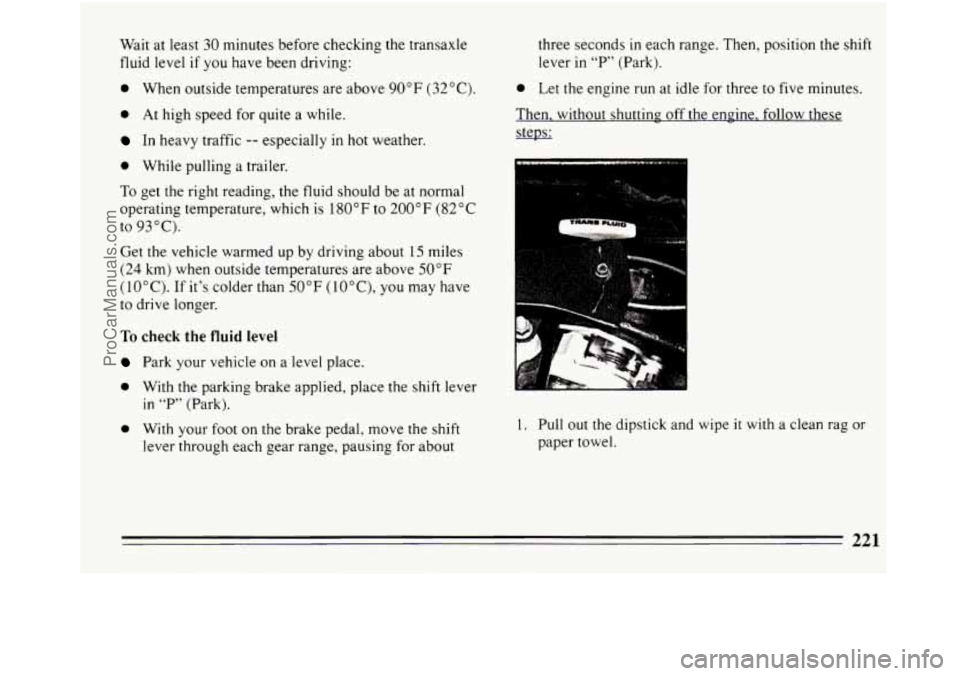
Then, without shutting off the engine. follow these
steps:
1. Pull out the dipstick and wipe it with a clean rag or
paper towel.
ProCarManuals.com
Page 269 of 308
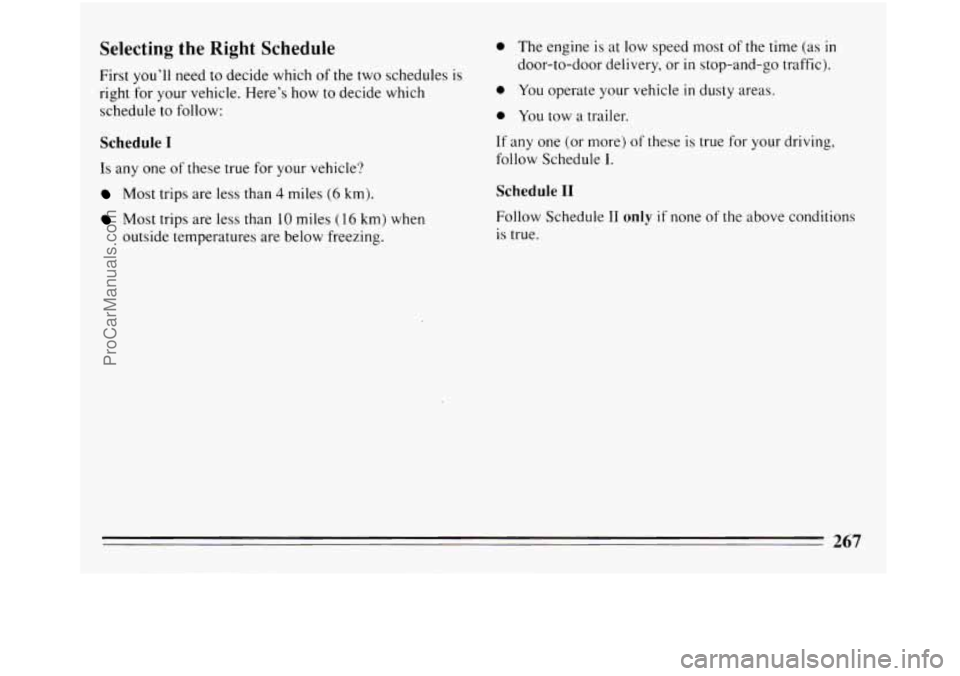
Selecting the Right Schedule
First you’ll need to decide which of the two schedules is
right for your vehicle. Here’s how to decide which
schedule to follow:
Schedule I
Is any one of these true for your vehicle?
Most trips are less than 4 miles (6 km).
Most trips are less than 10 miles (16 km) when
outside temperatures are below freezing.
0 The engine is at low speed most of the time (as in
0 You operate your vehicle in dusty areas.
door-to-door delivery,
or in stop-and-go traffic).
0 You tow a trailer.
If any one (or more) of these is true for your driving,
follow Schedule
I.
Schedule I1
Follow Schedule I1 only if none of the above conditions
is true.
267
ProCarManuals.com
Page 270 of 308
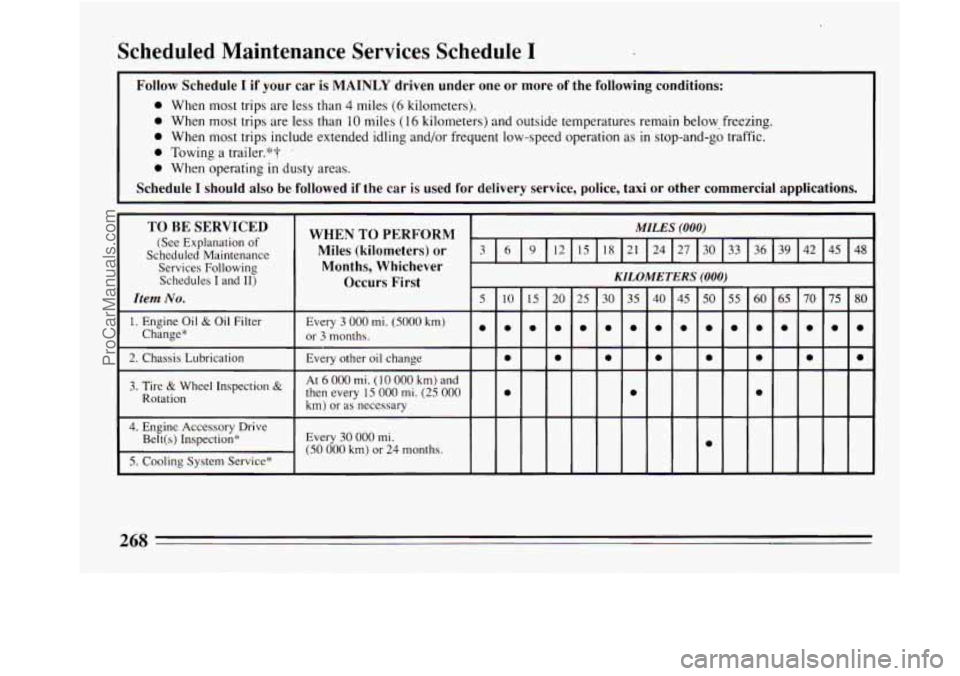
Scheduled Maintenance Services Schedule I
Follow Schedule I if your car is MAINLY driven under one or more of the following conditions:
0 When most trips are less than 4 miles (6 kilometers).
0 When most trips are less than 10 miles (16 kilometers) and outside temperatures remain below freezing.
0 When most trips include extended idling and/or frequent low-speed operation as in stop-and-go traffic.
0 Towing a trailer."? '
0 When operating in dusty areas.
I
Schedule I should also be followed if the car is used for delivery service, police, taxi or other commercial applications.
TO BE SERVICED
(See Explanation of
Scheduled Maintenance
Services Following Schedules
I and 11)
Item No.
1. Engine Oil & Oil Filter
Change"
2. Chassis Lubrication
3. Tire & Wheel Inspection &
Rotation
4. Engine Accessory Drive
Belt(s) Inspection*
5. Cooling System Service*
268
ProCarManuals.com
Page 275 of 308

To help ensure proper operation, we recommend a
pressure test of both the cooling system and the
pressure cap.
6. Transaxle Service -- Change both the fluid and filter
every
15,000 miles (25 000 km) if the vehicle is
mainly driven under one or more
of these conditions:
In heavy city traffic where the outside
temperature regularly reaches
90 F (32 C) or
higher.
In hilly or mountainous terrain.
When doing frequent trailer towing.
Uses such as found in taxi, police car or delivery
service.
If you do not use your vehicle under any of these
conditions, change both the fluid and filter every
100,000 miles (1 60 000 km).
7.
8.
9.
Spark Plug Replacement* -- Replace spark plugs
with the proper type. See “Specifications Chart” in
the Index.
Spark Plug Wire Inspection*? -- Inspect for burns,
cracks
or other damage. Check the boot fit at the
distributor and at the spark plugs. Replace wires as
needed.
Air Cleaner Filter Replacement* -- Replace every
30,000 miles (50 000 km) or more often under dusty
conditions. Ask your dealer for the proper
replacement intervals for your driving conditions.
10. Fuel Tank, Cap and Lines Inspection*? -- Inspect
fuel tank, cap and lines (including fuel rails and
injection assembly,
if equipped) for damage or leaks.
Inspect fuel cap gasket for an even filler neck
imprint or any damage. Replace parts as needed.
Periodic replacement of the fuel filter is not required.
* An Emission Control Service.
The
U.S. Environmental Protection Agency or the California Air Resources Board has determined that the failure to perform this maintenance item will not nullify the
emission warranty or limit recall liability prior to the completion of vehicle useful life. General Motors, however, urges that all recommended maintenance services be
performed at the indicated intervals and the maintenance be recorded in “Section E:Maintenance Record”. s
ProCarManuals.com