1994 BUICK REGAL overheating
[x] Cancel search: overheatingPage 11 of 308
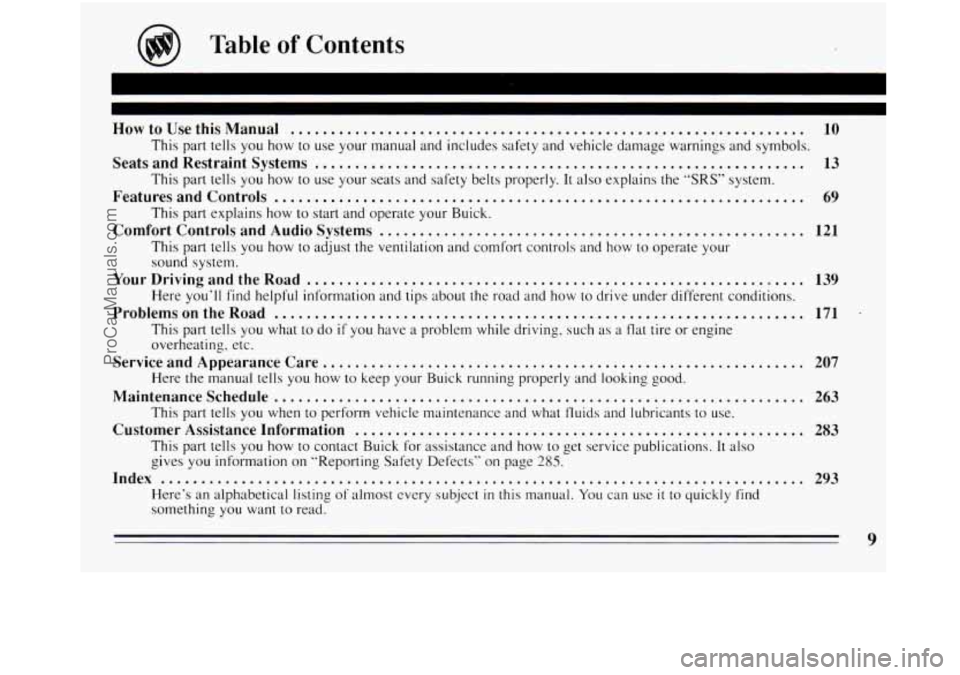
Table of Contents
HowtoUsethisManual ................................................................ 10
This part tells you how to use your manual and includes safety and vehicle damage warnings and symbols.
Seats and Restraint Systems .............................................................
This part tells you how to use your seats and safety belts properly. It also explains the ”SRS” system.
Featuresandcontrols ..................................................................
This part explains how to start and operate your Buick.
Comfort Controls and Audio Systems .....................................................
This part tells you how to adjust the ventilation and comfort controls and how to operate your
sound system.
Here you’ll
find helpful information and tips about the road and how to drive under different conditions.
This part tells you what to do
il‘ you have a problem while driving, such as a flat tire or engine
overheating. etc.
Service and Appearance Care.. ..........................................................
Here the manual tells you how to keep your Buick running properly and looking good.
Maintenanceschedule ..................................................................
This part tells you when to perform vehicle maintenance and what Iluids and lubricants to use.
Customer Assistance Information ........................................................
This part tells you how to contact Buick for assistance and how to get service publications. It also
gives you information on “Reporting Safety Defects” on page 285.
Index ........................................................................\
........
Here’s an alphabetical listing of almost every subject in this manual. You can use it to quickly find
something you want
to read.
YourDrivingandtheRoad ..............................................................
ProblemsontheRoad ..................................................................
13
69
121
139
171
207
263
283
293
9
ProCarManuals.com
Page 118 of 308
go closer to the floor. It may take longer to stop. Have
the vehicle towed for service. (See “Towing Your Car”
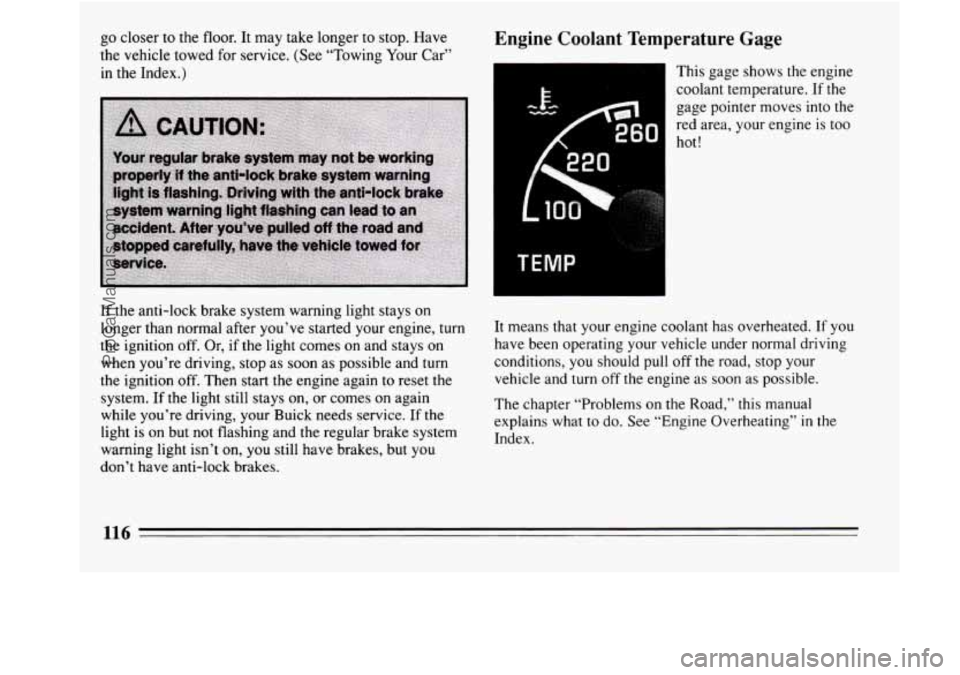
in the Index.) Engine Coolant Temperature Gage
This gage shows the engine
coolant temperature. If the
gage pointer moves into the
red area, your engine
is too
hot!
If the anti-lock brake system warning light stays on
longer than normal after you’ve started your engine, turn
the ignition off. Or,
if the light comes on and stays on
when you’re driving, stop as soon as possible and turn
the ignition off. Then start the engine again to reset the
system. If the light still stays on, or comes on again
while you’re driving, your Buick needs service. If the
light is on but not flashing and the regular brake system
warning light isn’t on,
you still have brakes, but you
don’t have anti-lock brakes. It means
that your engine coolant has overheated. If you
have been operating your vehicle under normal driving
conditions,
you should pull off the road, stop your
vehicle and turn off the engine as soon as possible.
The chapter “Problems on the Road,” this manual
explains what to do. See “Engine Overheating”
in the
Index.
116
ProCarManuals.com
Page 170 of 308

Following Distance
Stay at least twice as far behind the vehicle ahead as you
would when driving your vehicle without a trailer. This
can help you avoid situations that require heavy braking
and sudden turns.
Passing
You’ll need more passing distance up ahead when
you’re towing a trailer. And, because you’re a good deal
longer, you’ll need
to go much farther beyond the
passed vehicle before
you can return to your lane.
Backing Up
Hold the bottom of the steering wheel with one hand.
Then,
to move the trailer to the left, just move that hand
to the left.
To move the trailer to the right, move your
hand
to the right. Always back up slowly and, if
possible, have someone guide you.
Making Turns
When you’re turning with a trailer, make wider turns
than normal.
Do this so your trailer won’t strike soft
shoulders, curbs, road signs, trees, or other objects.
Avoid jerky or sudden maneuvers. Signal well
in
advance.
Turn Signals When Towing a Trailer
When you tow a trailer, your vehicle has to have a
different turn signal flasher and extra wiring. The green
arrows
on your instrument panel will flash whenever
you signal a turn or lane change. Properly hooked up,
the trailer lights will also flash, telling other drivers
you’re about to turn, change lanes or stop.
When towing a trailer,
the green arrows on your
instrument panel will flash for turns even
if the bulbs on
the trailer are burned out. Thus, you may think drivers
behind you are seeing your signal when they are
not. It’s
important to check occasionally to be sure the trailer
bulbs are still working.
Driving On Grades
Reduce speed and shift to a lower gear before you start
down a long or steep downgrade. If you don’t shift
down,
you might have to use your brakes so much that
they would get hot and no longer work
well.
On a long uphill grade, shift down and reduce your
speed to around
45 mph (70 km/h) to reduce the
possibility
of engine and transaxle overheating.
If you are towing a trailer that weighs more than
1,000
pounds (450 kg), you may prefer to drive in “D” instead
of Overdrive (or, as you need to, a lower gear).
168
ProCarManuals.com
Page 173 of 308
Part 5 Problems on the Road
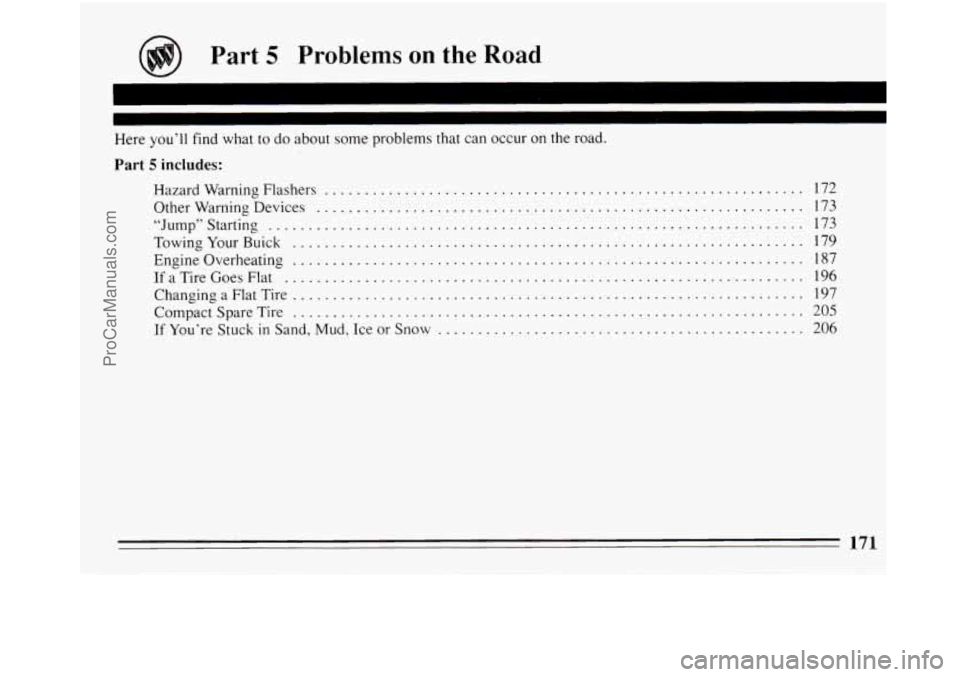
Here you’ll find what to do about some problems that can occur on the road .
Part 5 includes:
Hazard Warning Flashers ............................................................
OtherWarningDevices .............................................................
“Jump”Starting ...................................................................
TowingYourBuick ................................................................
Engineoverheating ................................................................
IfaTireGoesFlat .................................................................
ChangingaFlatTire ................................................................
CompactSpareTire ................................................................
If You’re Stuck in Sand, Mud, Ice or Snow ..............................................
172
173
173
179
187
196 197
205
206
171
ProCarManuals.com
Page 189 of 308
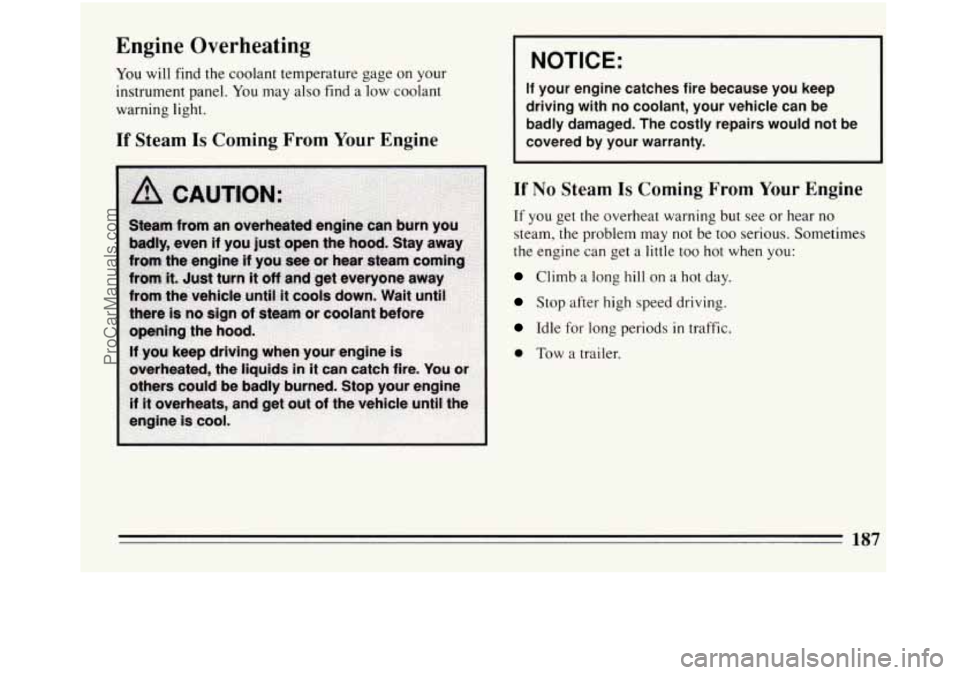
Engine Overheating
You will find the coolant temperature gage on your
instrument panel.
You may also find a low coolant
warning light.
If Steam Is Coming From Your Engine
I NOTICE:
If your engine catches fire because you keep
driving with no coolant, your vehicle can be
badly damaged. The costly repairs would not be
covered by your warranty.
If No Steam Is Coming From Your Engine
If you get the overheat warning but see or hear no
steam, the problem may not be too serious. Sometimes
the engine can get a little too hot when you:
Climb a long hill on a hot day.
Stop after high speed driving.
Idle for long periods in traffic.
0 Tow a trailer.
187
ProCarManuals.com
Page 191 of 308
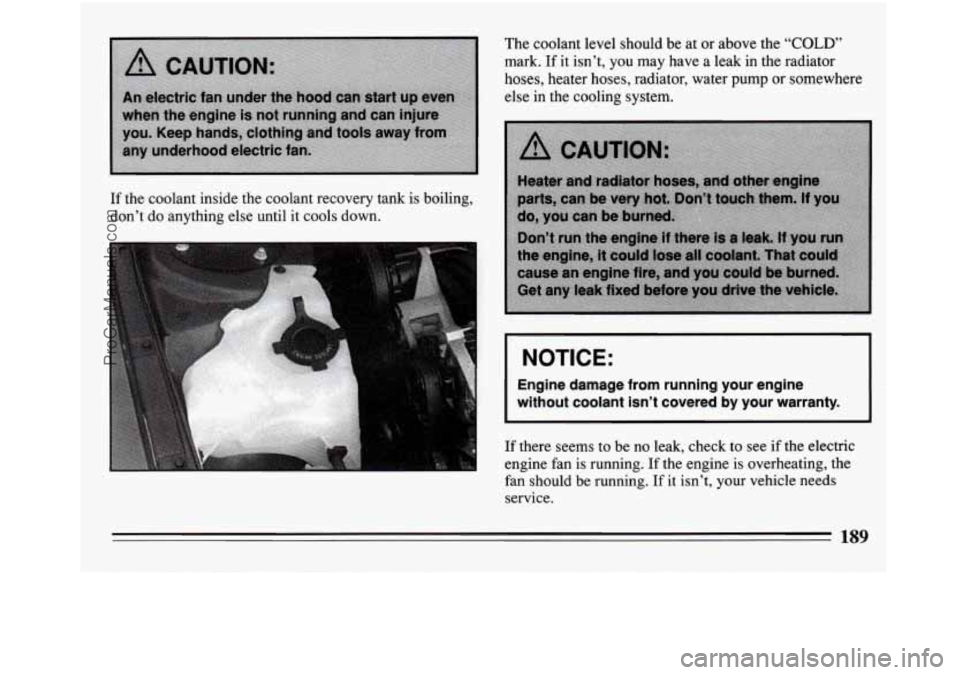
If the coolant inside the coolant recovery tank is boiling,
don’t do anything else until it cools down. The coolant level should be
at or above the
“COLD’
mark. If it isn’t, you may have a leak in the radiator
hoses, heater hoses, radiator, water pump or somewhere
else in the cooling system.
I NOTICE:
I
Engine damage from running your engine
without
coolant isn’t covered by your warranty. I
If there seems to be no leak, check to see if the electric
engine fan is running.
If the engine is overheating, the
fan should be running.
If it isn’t, your vehicle needs
service.
ProCarManuals.com
Page 225 of 308
Engine Coolant
The following explains your cooling system and how to
add coolant when it is low. If you have a problem with
engine overheating or if you need to add coolant to your
radiator, see “Engine Overheating” in the Index.
The proper coolant for your Buick will:
0 Give freezing protection down to -34°F (-37°C).
0 Give boiling protection up to 262°F (128°C).
Protect against rust and corrosion.
0 Help keep the proper engine temperature.
Let the warning lights work as they should.
What to Use
Use a mixture of one-half clean water (preferably
distilled) and one-half antifreeze that meets “GM Specification
1825-M,” which won’t damage aluminum
parts. You can also use a recycled coolant conforming to
GM Specification 1825-M with a complete coolant flush
and refill.
If you use this mixture, you don’t need to add
anything else.
NOTICE:
If you use an improper coolant mix, your engine
could overheat and be badly damaged. The repair cost wouldn’t be covered by your
warranty. Too much water in the mix can freeze
‘and crack the engine, radiator, heater core and other parts.
223
ProCarManuals.com
Page 226 of 308
Adding Coolant
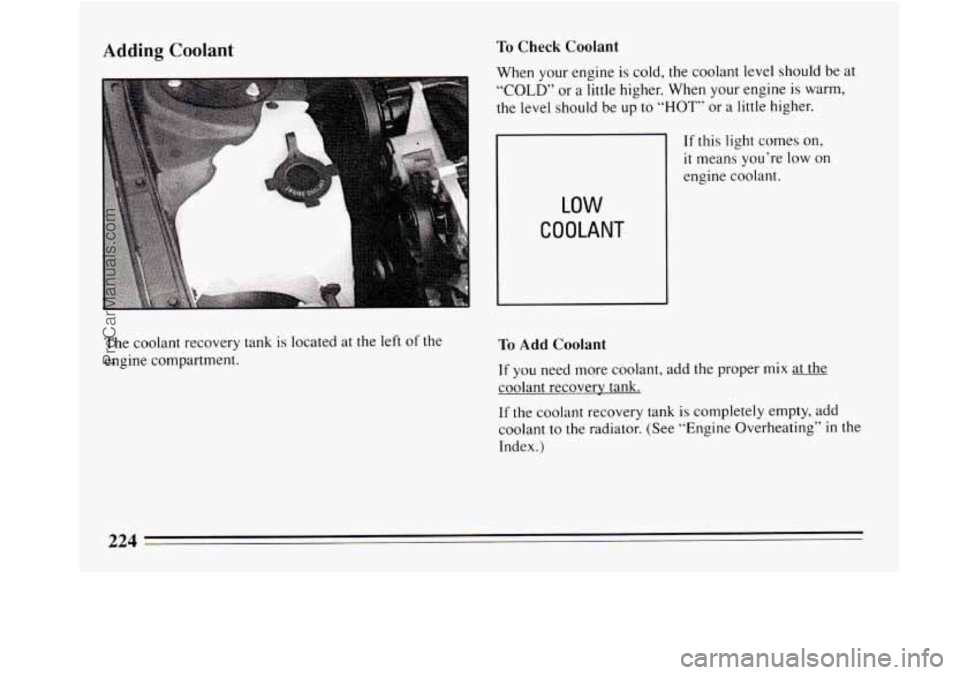
The coolant recovery tank is located at the left of the
engine compartment.
To Check Coolant
When your engine is cold, the coolant level should be at
“COLD” or a little higher. When your engine is warm,
the level should be up to
“HOT” or a little higher.
LOW
COOLANT
If this light comes on,
it means you’re low on
engine coolant.
To Add Coolant
If you need more coolant, add the proper mix at the
coolant recovery tank.
If the coolant recovery tank is completely empty, add
coolant to the radiator. (See “Engine Overheating” in the
Index.)
224
ProCarManuals.com