1993 VOLKSWAGEN GOLF check engine
[x] Cancel search: check enginePage 92 of 156
Downloaded from www.Manualslib.com manuals search engine GENERAL MAINTENANCE
Bonnet
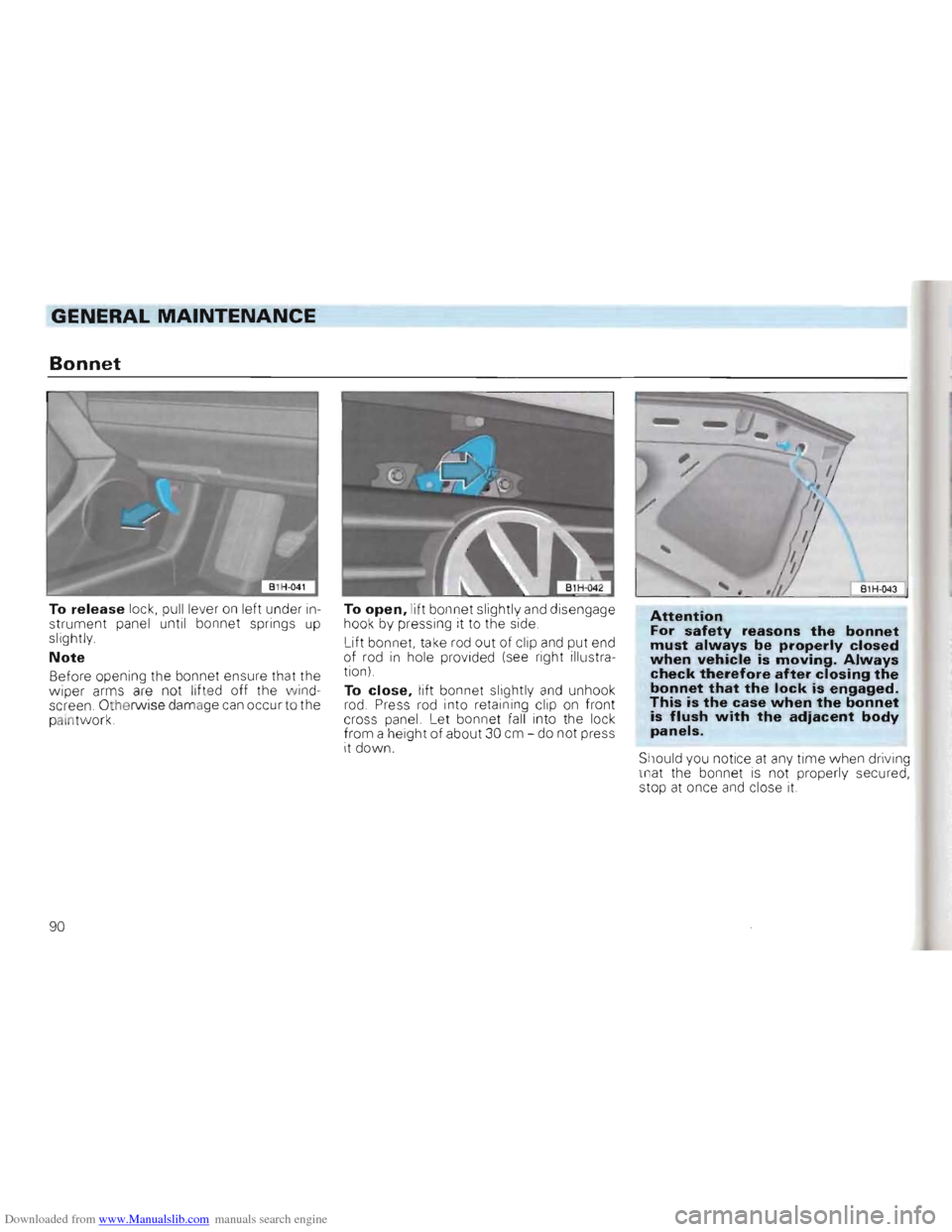
To release lock, pull lever on left under in
strument panel until bonnet springs up slightly.
Note
Before opening the bo nnet ensure that the
wiper arms are not lifted off the wind
screen. Othe rwise damage can occur to the
palntwork. To
open, lift
bonnet slightly and disengage
hook by pressing it to the side.
Lift bonnet, take rod out of
clip
and put end
of rod in hole provided (see right illustra
tion)
To
close, lift bonnet slightly and unhoo k
rod. Press rod into retaining cl ip on front
cross panel. Let bonnet fall into the lock
from a height of about 30 cm -do not press
it down.
B1H -043
Attention For safety reasons the bonnet must always be properly closed when vehicle is moving. Always check therefore after closing the bonnet that the lock is engaged. This is the case when the bonnet is flush with the adiacent body panels.
Should you notice at any time when driving
that the bonnet is not properly secured,
stop at once and close it.
90
Page 93 of 156
Downloaded from www.Manualslib.com manuals search engine GENERAL MAINTE NA NCE
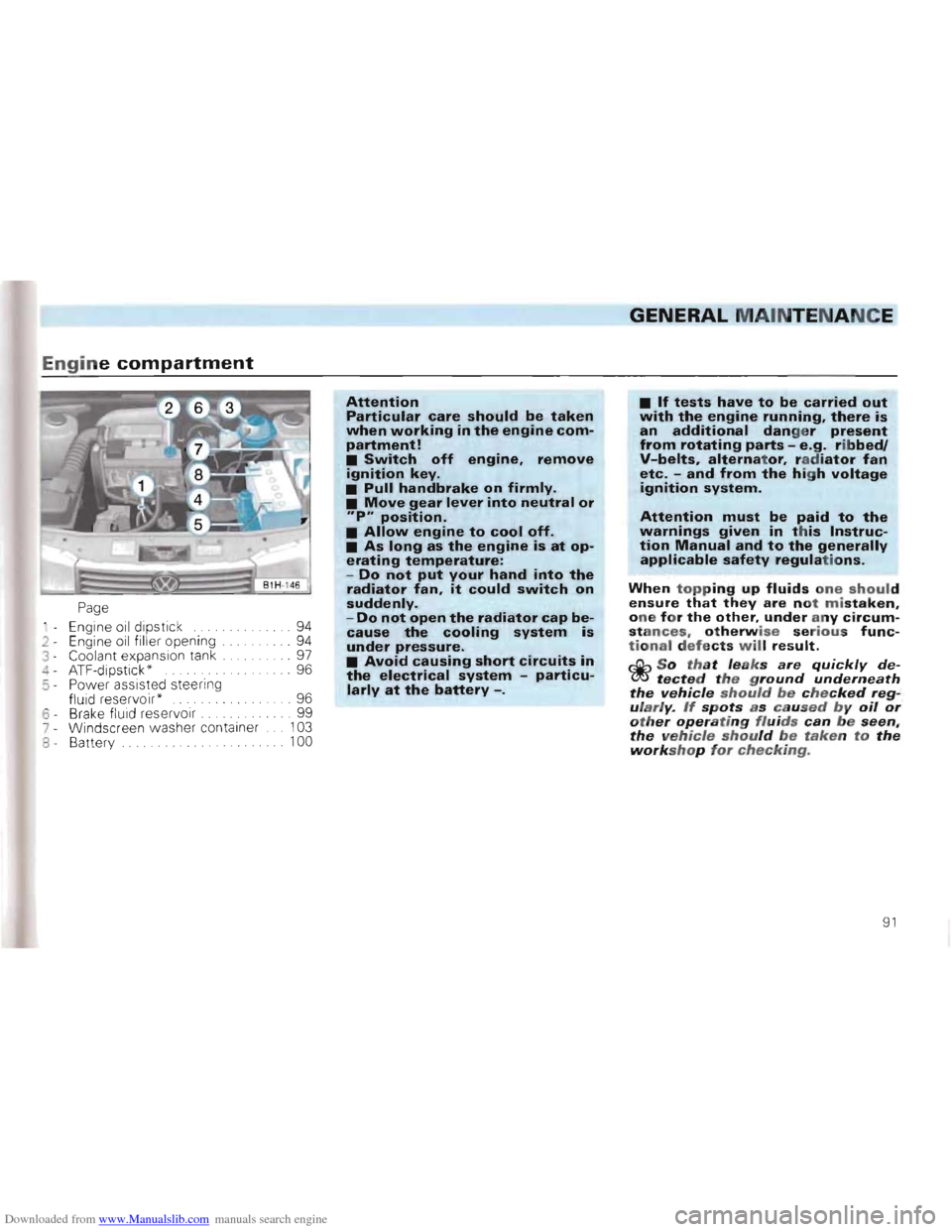
Engine c ompartmen t
Page
Engine oil dip sti ck . . 94
2 - Eng ine o
il filler openi ng ... ...... . 94
3 - Coolant exp ansion ta nk .. 97
4 -ATF-dip sti ck " . . . . . . . . . . . .. . 96
5 - Power assist ed steering flu id r eservoir '
6 Brak e fl uid re se rvo ir .
7 - Wi nd sc reen w ash er c on tainer
8 Battery .
Attention
Particular care should be taken
when working in the engine com
partment!
• Switch off engine. remove ignition key_
•
Pull handbrake on firmly.
• Move gear lever into neutral or
"P" position.
• Allow engine to cool off.
• As long as the engine is at op
erating temperature:
-Do not put your hand into the
radiator fan. it could switch on
suddenly.
-Do not open the radiator cap be
cause the cooling system is
under pressure.
• Avoid causing short circuits in
the electrical system -particu
larly at the battery -.
. .. 96
. .. 99
10 3
100
• If tests have to be ca rried o ut with the engine running. there is an additional dang e r present from rotating parts - e.g . ribbedl V-belts, alternator, ra d iator fan etc. -and fro m the high voltage ignition system.
Attention m ust be paid to the w arn ings given in this Instruction Manual and to the generally ap plicable safety regulations.
When topp ing up fluids one should ensure that they are not mistaken. one for the other, under any circum stances. otherwise serious fu nctional defects will result.
rJjh So that leaks are quickly de(!J!J tected the ground underneath the vehicle should be checked regularly. If spots as caused by oil or other operating fluids can be seen, the vehicle should be taken to the workshop for checking.
91
Page 96 of 156
Downloaded from www.Manualslib.com manuals search engine GENERAL MAINTENANCE
Checking oil level
Every eng ine uses a certain amount of oil. The oil consumption can be up to 1.0
litr es per 1000 km -see also page 73. The
engine oil l eve l must therefore be ch ecke d
a t regula r int ervals, preferab ly w hen fillin g
the tank and before a long Journey.
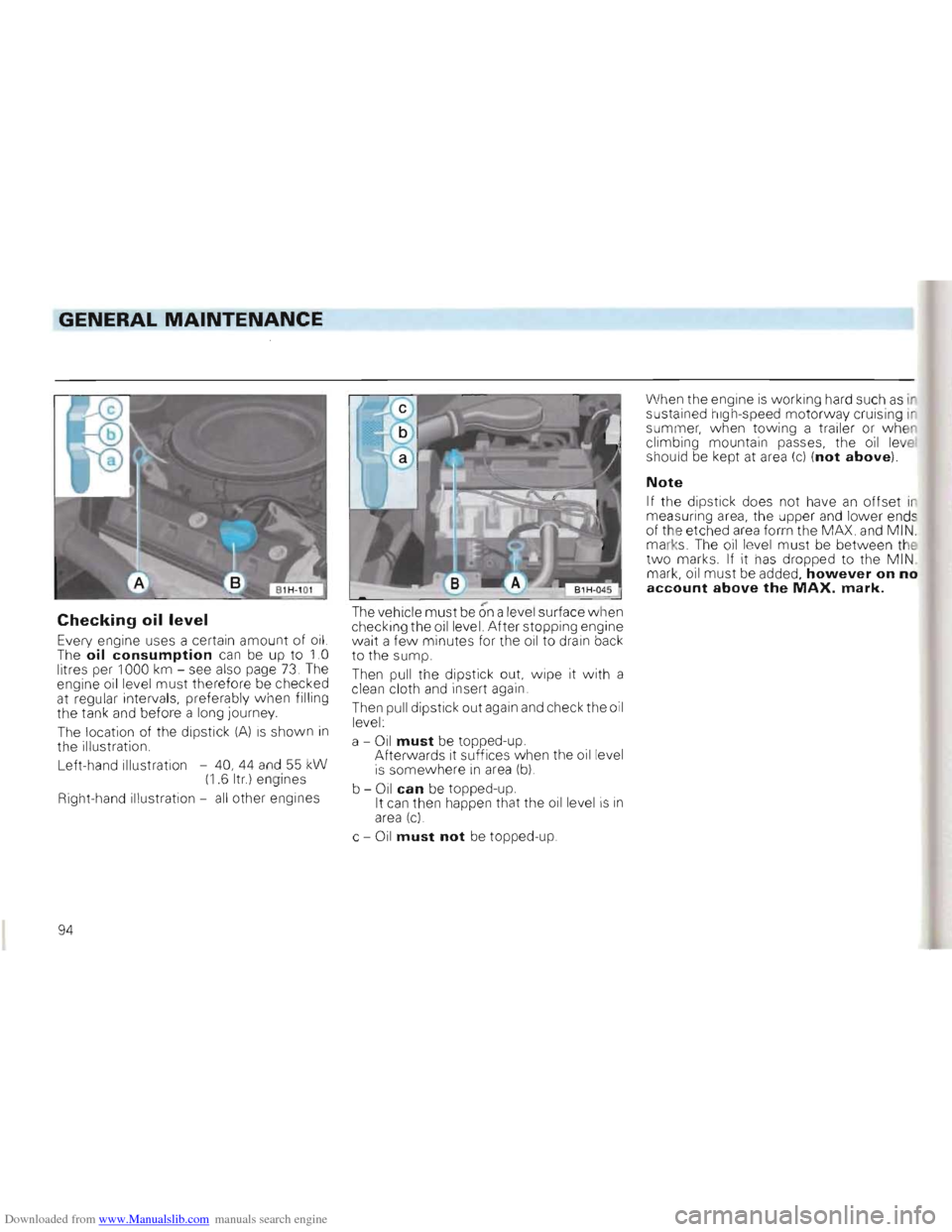
The locat ion of the dipst ick (A) IS shown in th e illustration.
Left-hand illustration -40 , 44 an d
55 kW (1 .6 Itr) en gi nes
Right-hand illustration -
all other engines
The ve hicle must be on a leve l surface when checking the oil level. A fter stopping engine
wa it a fe w minutes for the oil to drain back
to the sum p.
T hen pu ll the dipstick out, wipe it with a
clean cloth and insert again
Then pull dipstick out again
and check th e oi l
level :
a -
Oil must be topped-up.
Afterwards it suffices when the oil level
is somewhere in area (b)
b -Oil can be topped-up.
I t can then happen that the oil level is in area (c)
c -Oil must not be topped-up. When
the engine
is working hard such as ir
sustained high-speed motorway cruisin g in
summer, when towing a trailer or w he n
c limbing mountain passes , the o
il lev e! should be kept at area (c) (not above).
Note
If t he dipstick does not have an offset in
meas uring area, the upper and lower ends
of the etched area forrn the MAX. and MIN .
marks. The oil level must be between the two marks. If it has dropped to the M I N . mark, oil mu st be added, however on no account above the MAX. mark.
94
Page 97 of 156
Downloaded from www.Manualslib.com manuals search engine GENERAL MAINTENANCE
Topping up engine oil
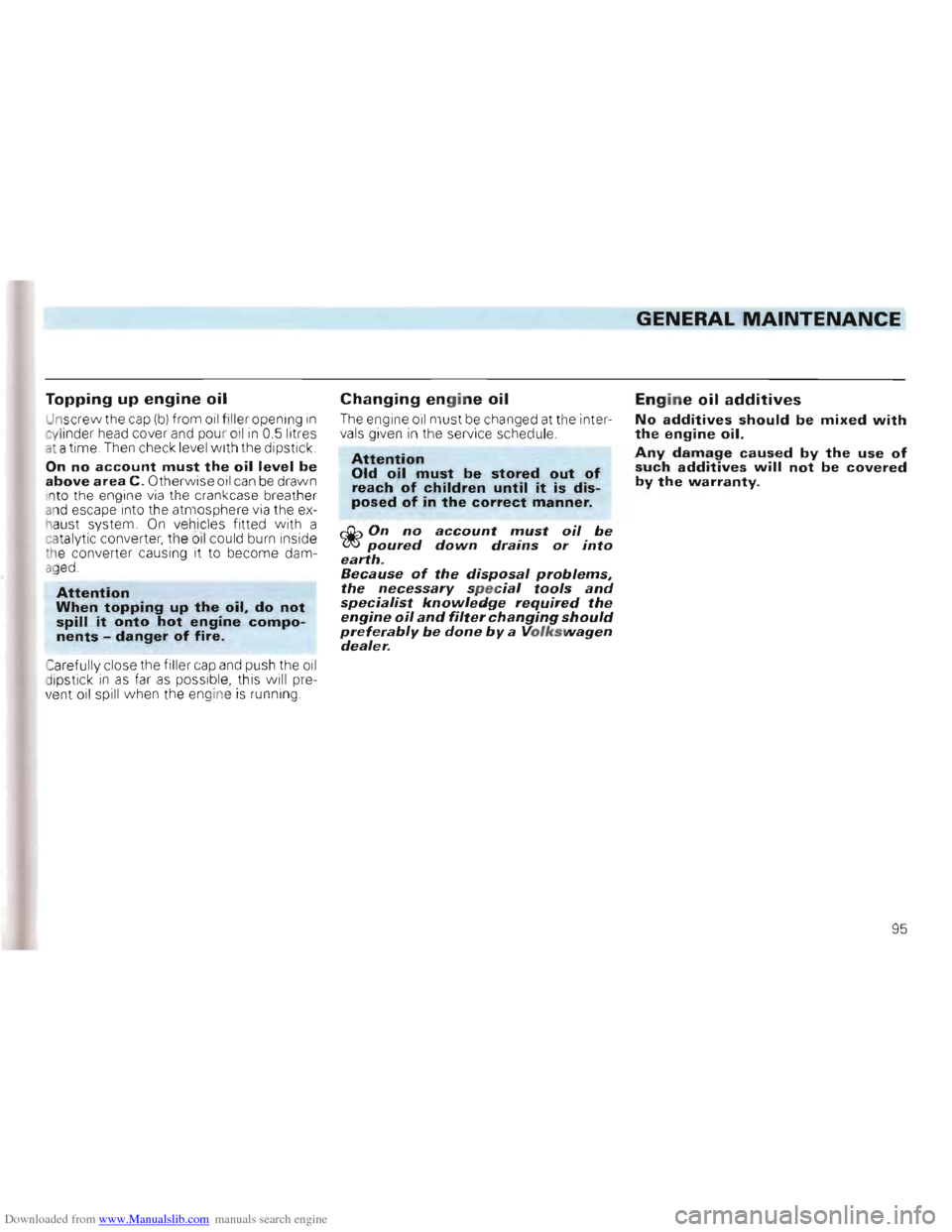
Unscrew the cap (b) from oil filler ope ning in cylinder head cover an d po ur 0 11 in 0 .5 litr es
at a time. Then check le ve l with th e dipst ic k .
On no account must the oil level be above area C . Otherwise oil can b e drawn
n to the engine via the crankcase breathe r
a n d escape into the atm osphere via th e ex·
h aust system. On ve hicl es fitted with a catalytic conve rte r, t he oil could burn inside the conve rter causing it to become dam·
a ged
Attention When topping up the oil. do not spill it onto hot engine components -danger of fire.
C arefully close the filler cap a n d push the oil ipsti ck in as far as possible, this w ill pre
vent oil spill when the engine is running .
Changing engine oil
The engine oil must be changed at the inter
v a ls g iven in the ser v ice sch e d ule .
Attention Old oil must be stored out of reach of children until it is disposed of in the correct manner,
r1Ib On no account must oil be ~poured down d,'ain s or into earth. Because of the disposal problems, the necessary special tools and specialist knowledge required the engine oiland filter ch anging should preferably be done by a Volkswagen dealer.
En gin e oil additives
No additives should be mixed with
the engine oil.
A ny damage caused by the use of
su ch additives will not be covered
by the warranty.
95
Page 98 of 156
Downloaded from www.Manualslib.com manuals search engine GENERAL MAINTENANCE
Automatic transmission fluid (ATF)*
The ATF' ) level must however be
checked between the interva ls given in the
Service Schedule. To do this the vehicle
must be standing on a level surface. The level must only be checked when the ATF is warm ( approximate ly 10 km afte r starting
from cold the ATF will reach the required
temperature). If ATF is cold or too hot the
reading w ill be incorrect.
The engine must be running at idling speed,
the handbrake must be appl ied and the se
lector lever at "N ".
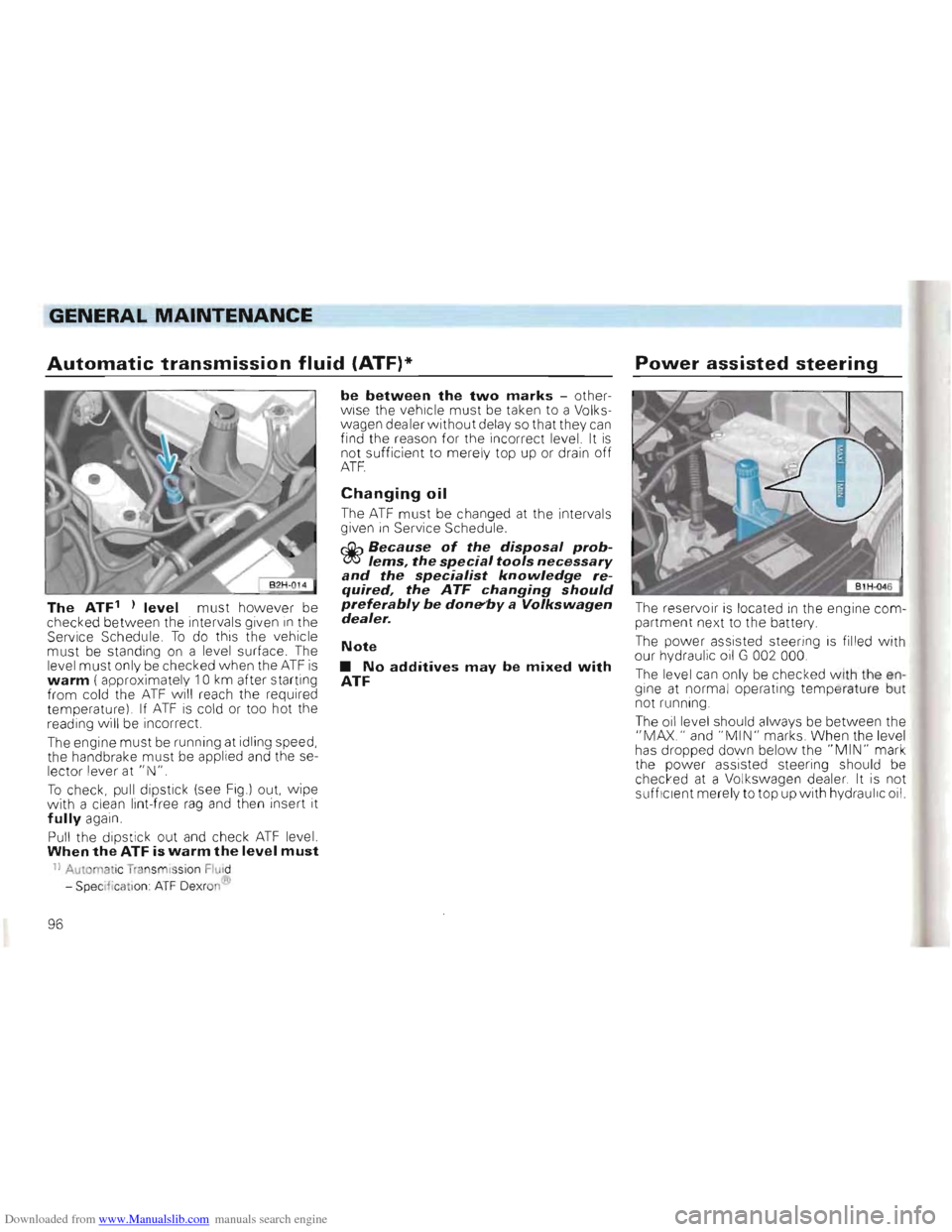
To check, pull dipstick (see Fig .) out. wipe
w ith a clea n lint -free rag and then insert it fully again.
Pull the dipstick out and check ATF level. When the ATF is warm the level must
11 Automat ic Transm is sion Fluid
- Spe cif ic ati on ATF Dexr on®
be between the two marks -other
w ise the vehicle must be taken to a Volks
wagen dealer without delay so that they can find the reason for the incorrect level. It is not sufficient to merely top up or drain off ATF.
Changing oil
The ATF must be changed at the intervals
given in Service Schedule .
r£il:-, Because of the disposal prob~lems, the special tools necessary and the specialist knowledge required, the ATF changing should preferably be donfY'by a Volkswagen dealer.
Note
• No additives may be mixed with ATF
Power assisted steering
The reservoir is located in the engine com
partment nex t to the battery.
The power assisted steering is fil led with
our hydraulic oil G 002 000.
The leve l can only be checked With the en
gine at normal operating temperature but
not running .
The oil level should always be between the
"MAX." and "MIN" m arks. When the leve l
has dropped down below the "MIN" mark
the power assisted steering should be
ched:ed at a Volkswagen dealer. It is not
suff iCient merely to top up with hy draulic oil.
96
Page 99 of 156
Downloaded from www.Manualslib.com manuals search engine GENERAL MAINTENANCE
Cooling system
The cooling system is filled at the factory with a perman ent coolant whic h is not
changed . The coo lant consists of w ater and a 40 % concent ration of our coolant additive
G 11 V8B (anti-f reeze on glycol basi s with
anti-corrosion additives). Thi s mi xture not
only gives the necessary frost prot ection
down to -25°C but also pro te cts the allo y
parts in the cooling system against cor
rosion. In add it ion it pr event s scal ing and raises the boiling point of the coo lant
The concentr atio n of the co olant therefore
must not be reduce d in the summer or in
wa rm countries, by tOPPing up with plain
w ater. The coolant additive proportion must be at least 40 %.
If greater protection against frost is re
qu ired, th e propor tion of G 11 V8B additive
c a n be increased, but onl y up to 60 % (Irost
prot ection to appr ox. -40 Cl. oth erwise the
a n ti-freeze prot ection is red uced and fur
t h ermore the cool ing effec t is im paired .
Vehicles for expor t to cold cou ntries usually
h ave frost protection down to -35°C.
Only our G 11 V8B or an addi tive with the specification TL-VW 774 B (ma rked on container ) should be added to the coolant.
The ad dit ive s can be obtained from Volks
w ag
en dealer s.
Other additives c a n b e very detrimental to the anti·corrosion effect in particular.
The subsequent corro sion damage can lead to coolant loss resulting in major engine damage.
Checking coolant level
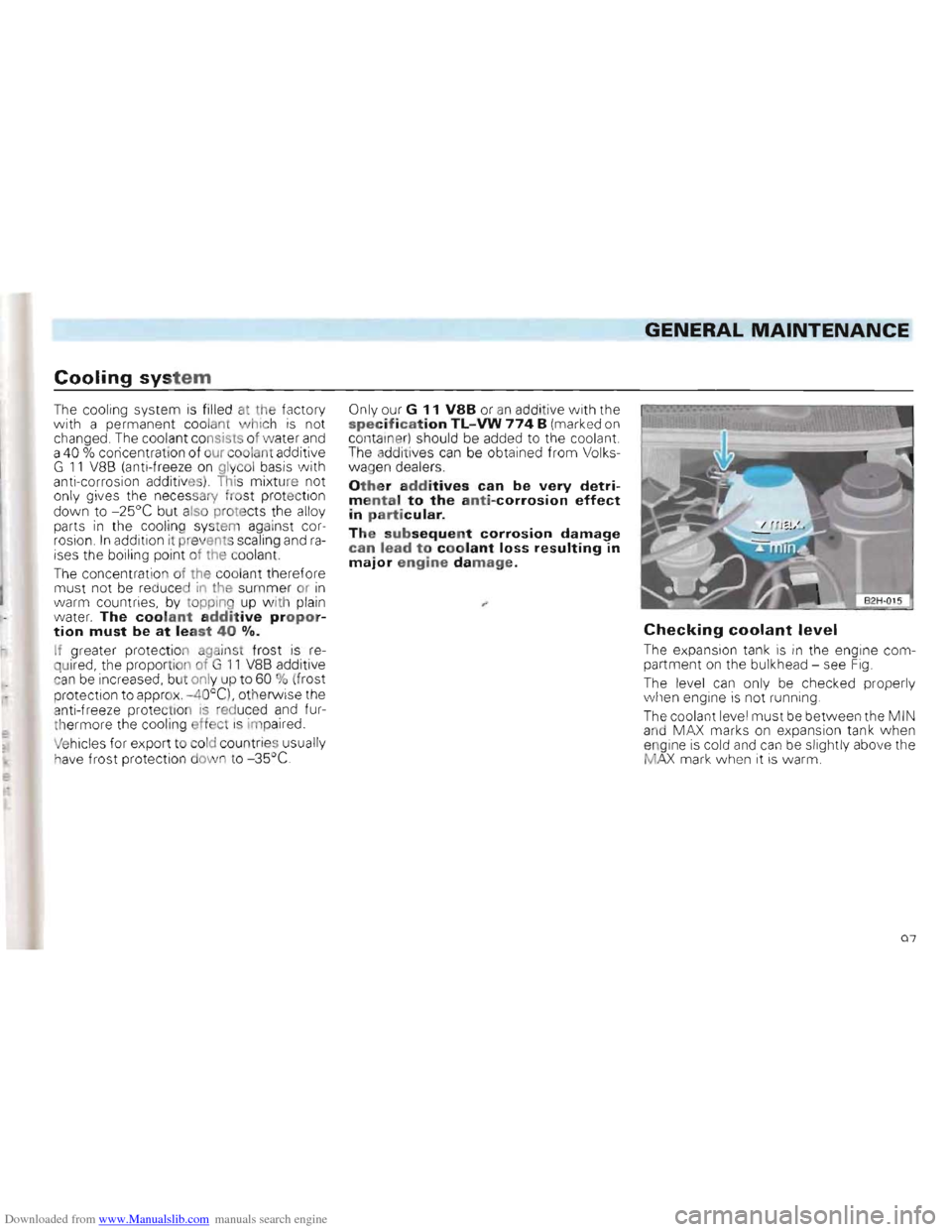
The expansion tank is in the engine com
p artm ent on the bulkhead -see Fig
The level can o nly be checked properly
w he n engin e is not running .
The coo lant level must be bet ween the MIN
and Mt>,X marks on e xpansion tank when
engine is cold and can be slightly above the
MAX mark when it is warm .
07
Page 100 of 156
Downloaded from www.Manualslib.com manuals search engine GENERAL MAINTENANCE
Coolant losses
Coolant loss normally indicates leaks in the
system . In this case the cooling system
should be checked by a Volkswagen dealer
w it h out delay . It is not sufficient merely to
add coolant.
Ii'! ~ ~MI~d ~v~t~m IMMS canonly occur if the boiling point of the coolant is exceeded as a result of overheating, and coolant is forced out of the system.
Topping up coolant
Switch engine off and let it cool down . Then
cover expansion tank cap with a cloth and
turn cap carefully
to the left
and remove.
Attention Do not remove expansion tank cap when engine is hot -Danger of scalding. System is under pressure.
If, in an emergency only water can be added the correct mixture concentration
must be restored with the specified coolant
additive (see previous page) as soon as possible. If
a lot of coolant has been lost.
on l y add cold
coolant after the engine has cooled down.
This will prevent engine damage.
Do not fill above the MAX. mark.
The excess coolant will be forced out
through the pressure rel ief valve in the cap
when engine becomes hot.
Screw cap on again tightly.
Attention The coolant additive and the coolant are a danger to health. The additive must therefore only be stored in the original container well out of reach of children. If the coolant has to be drained at any time it must be caught and also stored in a safe place.
dih Drained coolant should not nor~mally be reused, it must be disposed of, bearing in mind environmental protection regulations.
Fan
The radiator fan is driven electrically and controlled by a thermoswitch from the cool
ant temperature (also from the engine com
partment temperature
on some models).
Attention After the engine has been stopped the fan can continue running for a while -even with the engine switched off -(up to about 10 minutes). It can also start to run again suddenly after a short time if -the coolant temperature increases due to heat build-up
when engine is hot and the engine compartment is heated additionally by strong sunlight.
Special care must therefore be taken when working in the engine compartment.
98
Page 101 of 156
Downloaded from www.Manualslib.com manuals search engine GENERAL MAINTENANCE
Brake fluid
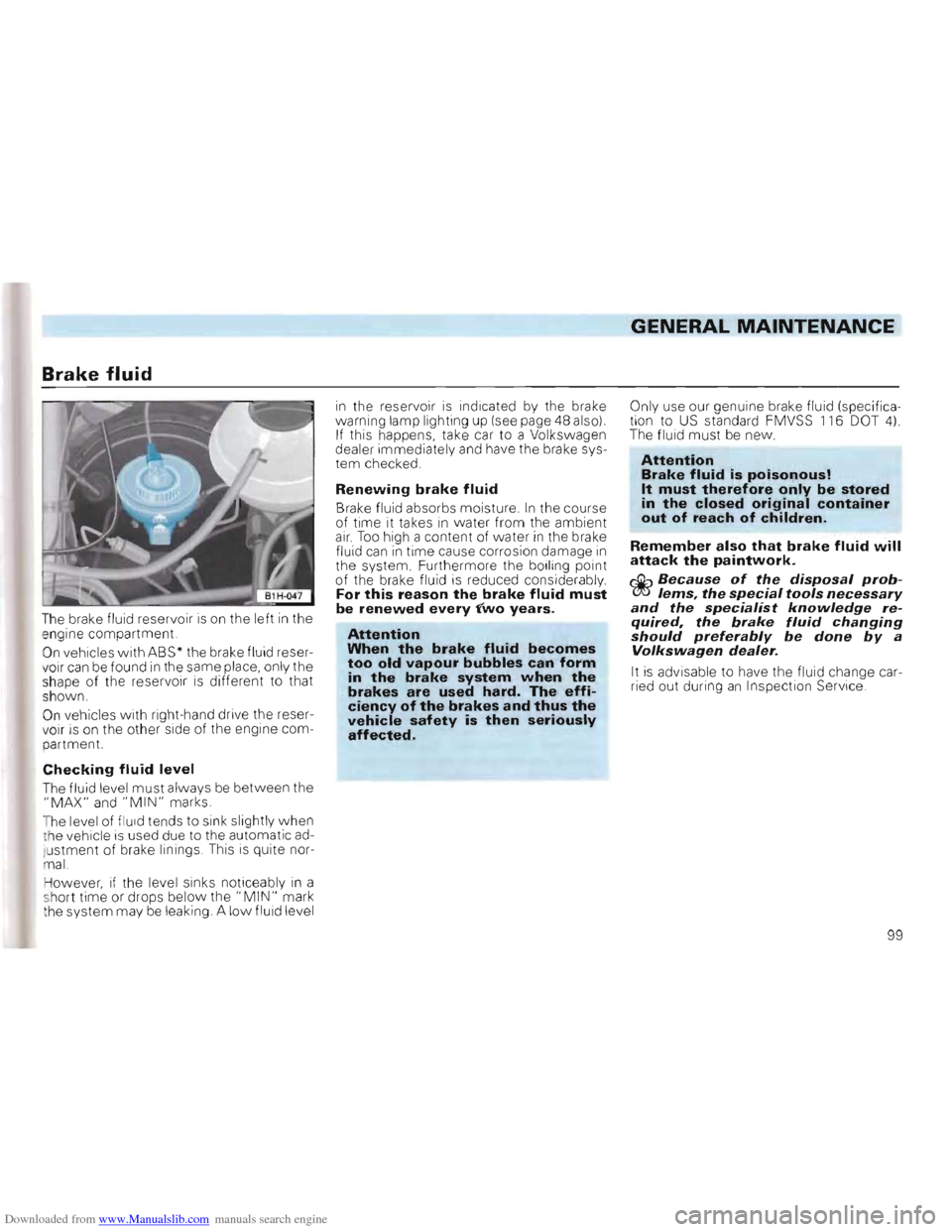
The brake fluid reservoir is on the left in the
e ngine compartment.
O n vehicles with ABS* the brake fluid reser
voir
can be found in the same place, only the
s hape of the reserv oir is different to that
s hown .
O n
vehicles with right-hand drive the reser
voir is on the other side of the engine com
p artment.
Checking fluid level
T he fluid level must always be between the
" MAX" and "MIN" marks.
T he
level of flu id tends to sin k slightly when the vehicle is used due to the automatic adJu stment of brake linings . This IS quite nor
mal.
H owever, if the level sinks noticeably in a
s h ort time or drops below the" MIN" mark
t h e system may be leaking. A low fluid level
in the reservoir is indicated by the brake
wa rning lamp lighting up (see page 48 also)
If this happens, take car to a Volkswagen
dealer immediately and have the brake sys
tem checked.
Renewing brake fluid
Brake fluid absorbs moisture. In the course
of time it takes in water from the ambient air. Too high a content of wa ter in the brake
fluid can In time cause corrosion damage in the system Furthermore the boiling point
of the brake fluid IS reduced considerably. For this reason the brake fluid must be renewed every f'wo years.
Attention When the brake fluid becomes too old vapour bubbles can form in the brake system when the brakes are used hard. The efficiency of the brakes and thus the vehicle safety is then seriously affected.
Only use our genuine brake fluid (spec ifica
tion to US standard FMVSS 116 DOT 4). The fluid must be new.
Attention Brake fluid is poisonous! It must therefore only be stored in the closed original container out of reach of children.
Remember also that brake fluid will attack the paintwork.
,.Q,., Because of the disposal prob
~lems, the special tools necessary
and the specialist knowledge re
quired, the brake fluid changing should preferably be done by a Vo/kswagen dealer.
It is advisable to have the fluid change car
ried out during an Inspection Service.
99