1993 VOLKSWAGEN GOLF check engine
[x] Cancel search: check enginePage 103 of 156
Downloaded from www.Manualslib.com manuals search engine GENERAL MAINTENANCE
• When disconnecting the bat
tery from th e vehic le e lectrical
system first disconnect the nega
tive cable and then the positive
cable.
The battery must not b e discon
nected with th e engine ru nning,
as this will damage t he e lectrica l
system (e lectro n ic components).
• When reconnecting t h e bat
tery connect the positive cable
first and then the negative cable.
The connect ing cables must on
no account interchang ed -can
cause wiring to burn out.
In order to protect the c asing from UV radiation, do not expose battery to direct sunlight.
Checking acid level
In norma l operating conditions the ba ttery re quires hardly any maintenance . At 111(;)11 am bient tem peratu res Ilowever It I S advIs
a b le to check th e acid le ve l a t r egula r inter als. It shou ld always be between the M IN
a nd MAX marks on th e batter y I
f th e ac
id leve l drops below the MIN mark, the aff ecte d c ells must be topped -up to the
MAX mark W ith dis tille d wa ter.
It
is recommen ded that the acid level is checked and correcte d by a Volkswag en dea ler.
Winter driving
W inte r wea ther is part icu larly hard on the
battery. Furt h er more at low temperatures it has only a par t of th e capacity it has at nor
ma l temperatures . We reco mmend there
for e th at
the bat te ry sho uld be c h ecked pre
f erably by a Volkswage1l dea le r before the onset of cold weat her an d charge d if
necessary
I f the vehicle is not driven for seve ral weeks when te m peratures are very low, the battery should be taken out and stored in a frost-free room, s o tha t it cannot freeze up and become damaged.
To ake battery out, first d isconnect the two cables an d th en remov e retainer.
Charging battery
W hen charg ing with a lo w curren t (e.g. with a smal l char ger) the battery cables need not
no rmally b e taken off. The instructions from the charger manufactu re r must however be
noted.
Bef ore
Quick charging, that is charging
wi th a high current, both battery cables
must b e disconnec ted .
T
he f o llowin g inf ormation must be noted:
• Whe n charging the
battery do not re
move caps.
• A discha rged battery
can freeze at -10°e. It is essential to thaw out a frozen battery before it is given a quick charge otherwise it may explode!
• The mains cable of the charger should
n ot be connec ted unti l afte r the clips of the charger have been prop erly secured to th e
battery terminals Red =pos itive
Black = negative
•
Recon nect cables correct ly after ch arging battery.
101
Page 104 of 156
Downloaded from www.Manualslib.com manuals search engine GENERAL MAINTENANCE
Spark plugs V-belts
Renewing a battery
If the battery has to be renewed , the new battery must have the same capacity, volt
age (12 V olts). current strength and shape
and a cap sealing arrangement. Volkswagen
dealers have a range of suitable batteries .
&-. Because of the problem of dis~posing of the old battery the renewal ofa battery should preferably be done by a Vo/kswagen dealer. Batteries contain, amongst other things, sulphuric acid and lead and must on no account be put with normal household waste.
The spark plugs are rene w ed during the
Volkswagen Inspection Service
If the spark plugs have to be rene w
ed be
t w een the Inspection Services, the fOllow
ing should be noted :
• Spark plugs and ignition system are
matched to the engine and
as such contrib
ute to reducing the levels of exhaust pollu
tants. To avoid faulty operation, engine
damage and even the w ithdrawal of the
type approval due
to ex cessive emissions
v alues or non -suppressed spark plugs, only
the Genuine Volks wagen spark plugs for the
engine concerned should be used. Import
ant, am ong other
thing
'S, are the number of
electrodes , the heat value and if necessary
the radio suppression .
• The plugs may
be, for technical reasons,
changed at short notice. It is therefore advisable to obtain plugs only from Volks
w agen dealers -they have the latest in
formation •
The V-belts are among the most s
everely stressed parts of a vehicle. The belts
must therefore be subjected to very high
quality requirements.
• When renewing a belt it
is not sufficient to use just any belt of the same size. For
safety reasons only the special Genuine
V olkswagen belt for the vehicle concerned
should be used .
• The V-belts may
be, for technical rea
sons, changed at short notice . It is therefore
advisable to obtain V-belts only from Volks
wagen dealers and to
hav e them changed
there -they have the latest information .
•
On some engines durable ribbed belts are used, which are checked and if necess
ary tensioned during an Inspection Service
(every 60, 000 km/40,OOO miles).
102
Page 107 of 156
Downloaded from www.Manualslib.com manuals search engine GENERAL MAINTENANCE
Wheels
General notes
• New tyres do not give maximum grip
str aight away and should therefore be run in
a moderate speeds and a careful style of
driving for about the first 100 km . This will
"Ielp to make the tyres last longer.
• The tread depth of
new tyres can vary
du e to constructi on and design features,
and depending on version and manufac
:u res.
• Check tyres for damage from
time to
-lin e (cuts, splits, cracks and lumps) and re
m ove any foreign bodies embedded in the
- r eads.
•
To a v oid damage to tyres and wheels
drive over curbs and similar obst acles very
slowly and as nearly at right angles as poss
Ible .
Damage to w he els and tyres is not always
e asy to see, so if you think that a wheel is
d a maged, It must be checked by a Volks
w agen dealer.
• Keep grease,
011 and fuel off the tyres.
• Replace missing dust caps as soon as possib le.
• Mark wheels before taking them off so
that they rotate in the same direction when put back on again
•
When taken off, the tyres should be
stored in a cool, dry and preferably dark
place
T y res
which are not on wheels shou ld be
stored In a vertical position.
Tyre life
Tyre life depends to a considerable extent
on the following factors:
Inflation pressure ..-
Tyre pressures can be found on page 141
and on a sticker on the inside of of the tank
filler flap -see page 81.
The inflation pressure
is very important par
ticularly at high speeds . Therefore, the pres
sures should be che cked at least once a
month and before every long Journey.
At this opportunity do not
forget the spare
w heel
• On the temporary spare the pressure is shown on the side wall.
• The spare
wheel w ith normal tyre shou ld alw ays be inflated to the highest pressure required on the veh icle. •
Always check the pressures
when the
ty res are cold. When warm, the pressure is higher but do not reduce. If the load changes a great deal the pressure must be altered to suit.
Pressures
which are too high or too low short en tyre life -quite apart from the detrimental influence on vehicle handling .
Attention
At continuous high speeds a tyre
in which the pressure is too low
flexes more and heats up excess
ively. This can cause tread separ
ation and tyre blowout.
dit-. A pressure which is too low in~creases the fuel consumption and this burdens the environment unnecessarily.
Mode of driving
Fast cornering, hard acceleration and Viol
ent braking also increase tyre wear.
105
Page 117 of 156
Downloaded from www.Manualslib.com manuals search engine DO-lT-YOURSELF
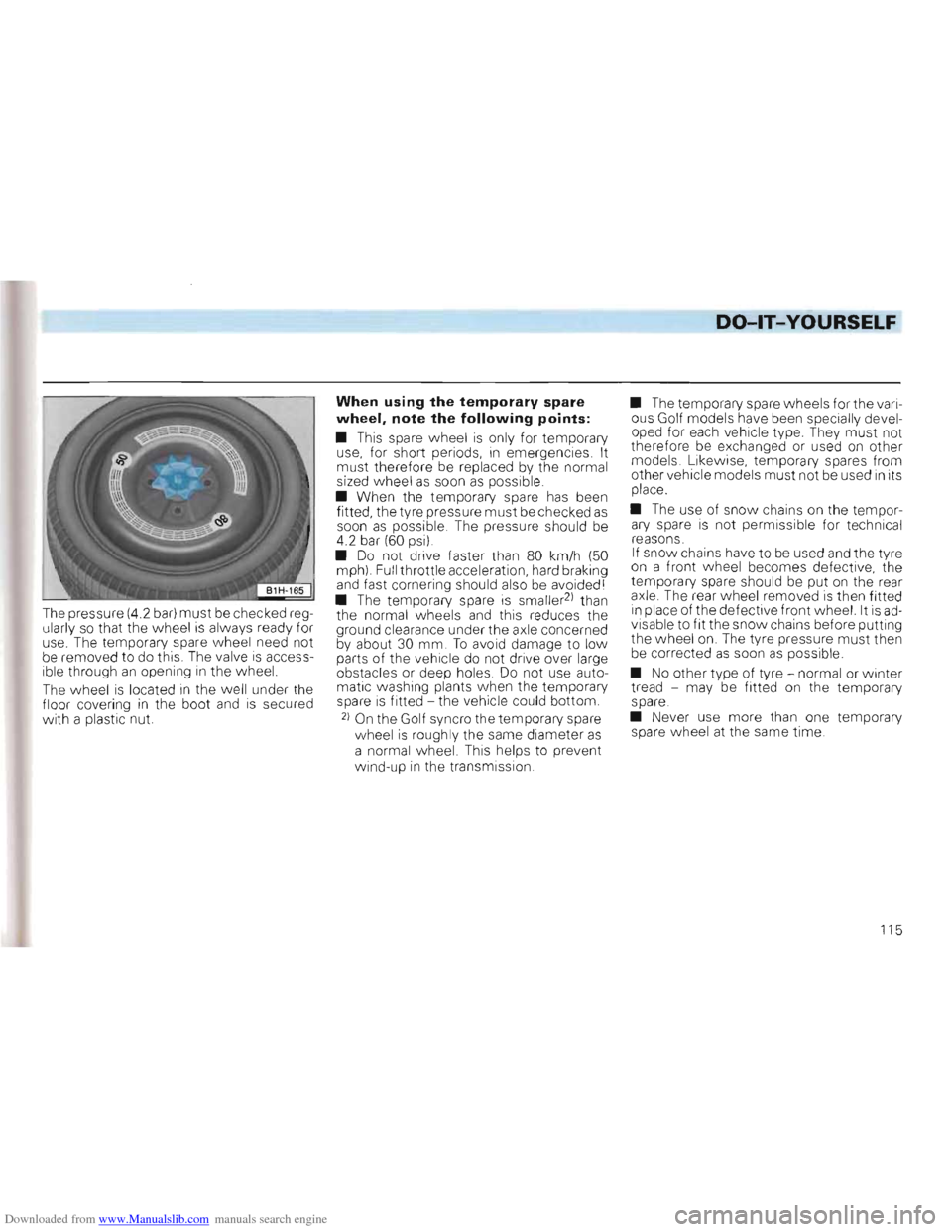
The pressure (4.2 bar) must be checked reg
u larly so that the wheel is always ready for
use. The temporary spare w heel need not
be removed to do this. The valve is access
ible through an opening in the wheel.
The w heel
is located in the well under the
floor covering in the boot and is secured
with a plastic nut
When using the temporary spare
wheel. note the following points:
• This spare wheel is only for temporary
use, for short periods, in emergencies. It
must therefore be replaced by the normal
sized wheel as soon as possible .
• When the temporary spare
has been
fitted , the tyre pressure must be checked as soon as possible. The pressure should be
4.2 bar (60 psi) .
•
Do not drive faster than 80 km/h (50 mph). Full throttle acceleration, hard braking and fast cornering should also be avoided I
• The temporary spare is smaller2
) than
the normal w heels and this reduces the
ground clearance under the axle concerned
by about 30 mm.
To avoid damage to low
parts of the vehicle do not drive over large
obstacles or deep holes. Do not use auto
matic washing plants when the temporary
spare
is fitted -the vehicle could bottom.
2) On the Golf syncro the temporary spare
vvheel is roughly the same diameter as a normal wheel. This helps to prevent
wind-up in the transmission . •
The temporary spare
wheels for the vari
ous Golf models have been specially devel
oped for each vehicle type. They must not
therefore be exchanged or used on other
models. Likewise, temporary spares from
other vehicle models must not
be used in its
place
• The use of
snow chains on the temporary spare is not permissible for technical
reasons. If snow chains have to be used
and the tyre on a front wheel becomes defective, the
temporary spare should be put on the rear
axle. The rear wheel removed is then fitted in place of the defecti ve front wheel. It is advisable to fit the snow chains before putting
the wheel on. The tyre pressure must then be corrected as soon as possible .
•
No other type of tyre - normal or winter
tread -may be fitted on the temporary
spare.
• Never use more than one temporary
spare wheel
at the same time.
115
Page 120 of 156
Downloaded from www.Manualslib.com manuals search engine DO-lT-YOURSELF
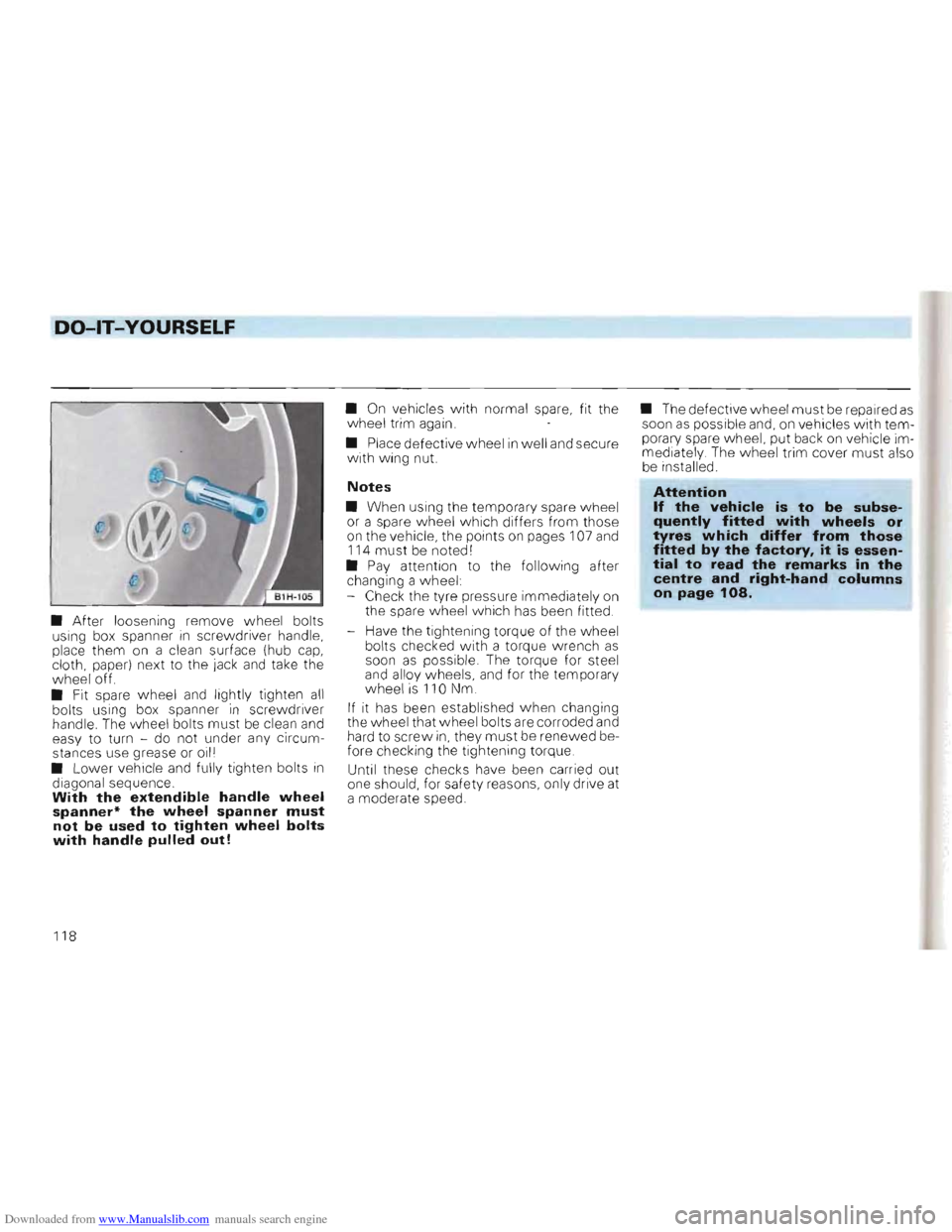
• After loosening remove wheel bolts
using box spanner in screwdriver handle,
place them on a clean surface (hub cap, cloth, paper) next to the jack and take the
wheel off.
• Fit spare w heel
and lightly tighten all bolts using box spanner in screwdriver
handle. The wheel bolts must be clean and
easy to turn -do not under any circum
stances use grease or oill
• L o
wer vehicle and fully tighten bolts in diagonal sequence. With the extendible handle wheel spanner* the wheel spanner must not be used to tighten wheel bolts with handle pulled out!
• On vehicles w ith normal spare, fit the
wheel trim again.
• Place defective wheel
in well and secure
with wing nut.
Notes
• When using the temporary spare wheel
or a spare wheel wh ich differs from those
on the vehicle, the points on pages 107 and
114 must be noted I
• Pay attention to the following after
changing a wheel:
- Check the tyre pressure immediatel y on
the spare wheel which has been fitted .
-
Have the tightening torque of the wheel
bolts checked with a torque wrench as soon as possible. The torque for steel and alloy wheels, and for the temporary
wheel is 110 Nm .
If it has been established when changing
the wheel that wheel bolts are corroded and
hard to screw
in, they must be renewed be
fore checking the tightening torque.
Until these checks have been carried out
one should, for safe ty reasons, only drive at
a moderate speed. •
The defective wheel
must be repaired as soon as possible and, on vehicles with tem
porary spare wheel, put back on vehicle im
mediately. The wheel trim cover must also be installed.
Attention If the vehicle is to be subsequently fitted with wheels or tyres which differ from those fitted by the factory. it is essential to read the remarks in the centre and right-hand columns on page 108.
118
Page 121 of 156
Downloaded from www.Manualslib.com manuals search engine ________~D=O~-~IT-VOURSELF
Fuses
The individual current circuits are protected
b y fuses .
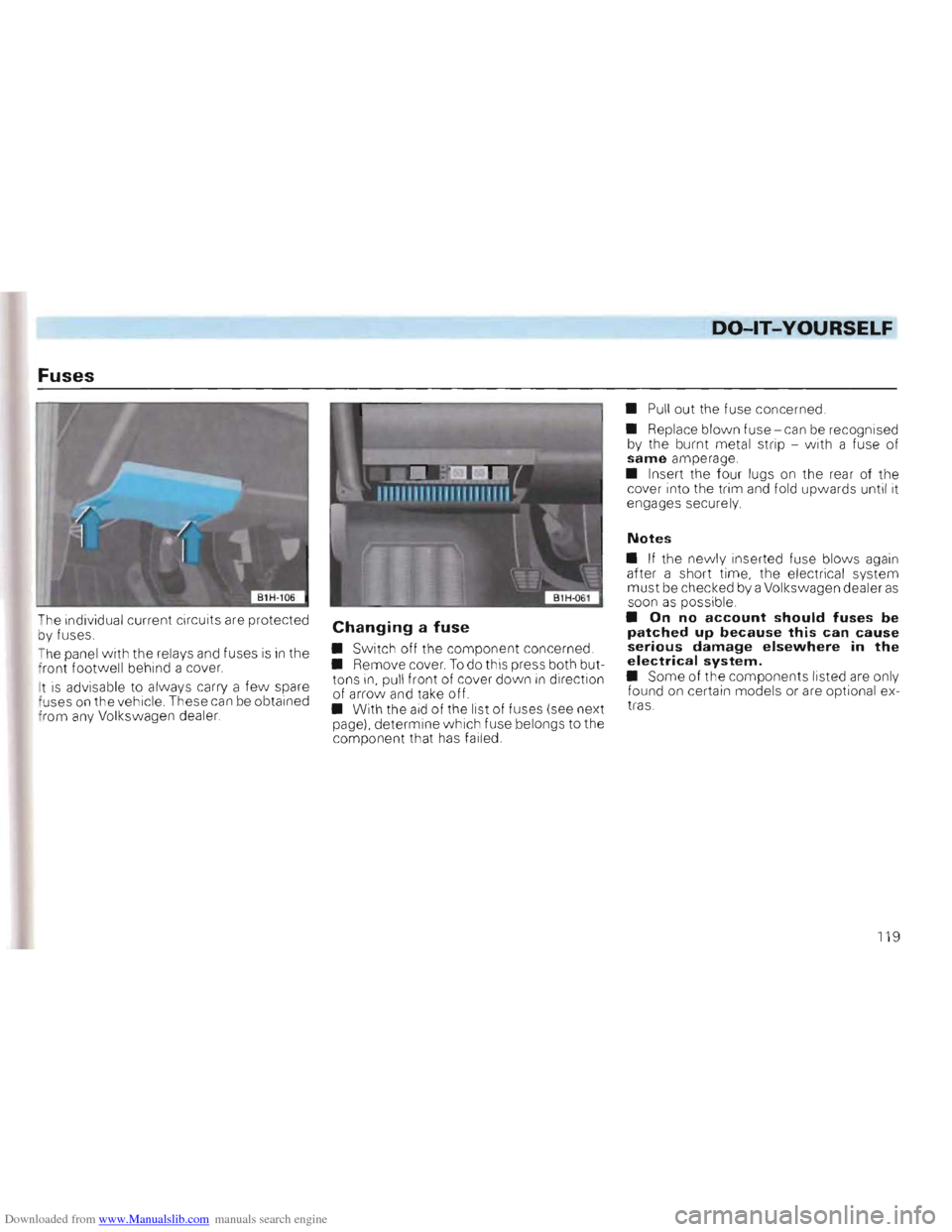
T he panel w ith
the relays and fuses is in the
front footwell behind a cover.
I t
is advisable to always carry a few spare
fuses on the vehicle . These can be obtained
f rom any Volkswagen dealer.
Changing a fuse
• Switch off the component concerned.
• Remove cover. To do this press both but
tons in, pull front of cover down in direction
of arrow and take off.
•
With the aid of the list of fuses (see next
page). determine w hich fuse belongs to the component that has failed. •
Pull out the fuse concerned.
• Replace
blown fuse -can be recognised
by the burnt metal strip -w ith a fuse of same amperage .
• Insert the four lugs on
the rear of the cover into the trim and fold upwards until it
engages securely.
Notes
• If the newly inserted fuse blows again after a short time, the electrical system must be checked by a Volkswagen dealer as soon as possible.
• On no account should fuses be patched up because this can cause serious damage elsewhere in the electrical system.
• Some of the components listed are only
found on certain models or are optional ex
tras.
119
Page 125 of 156
Downloaded from www.Manualslib.com manuals search engine DO-lT-YOURSELF
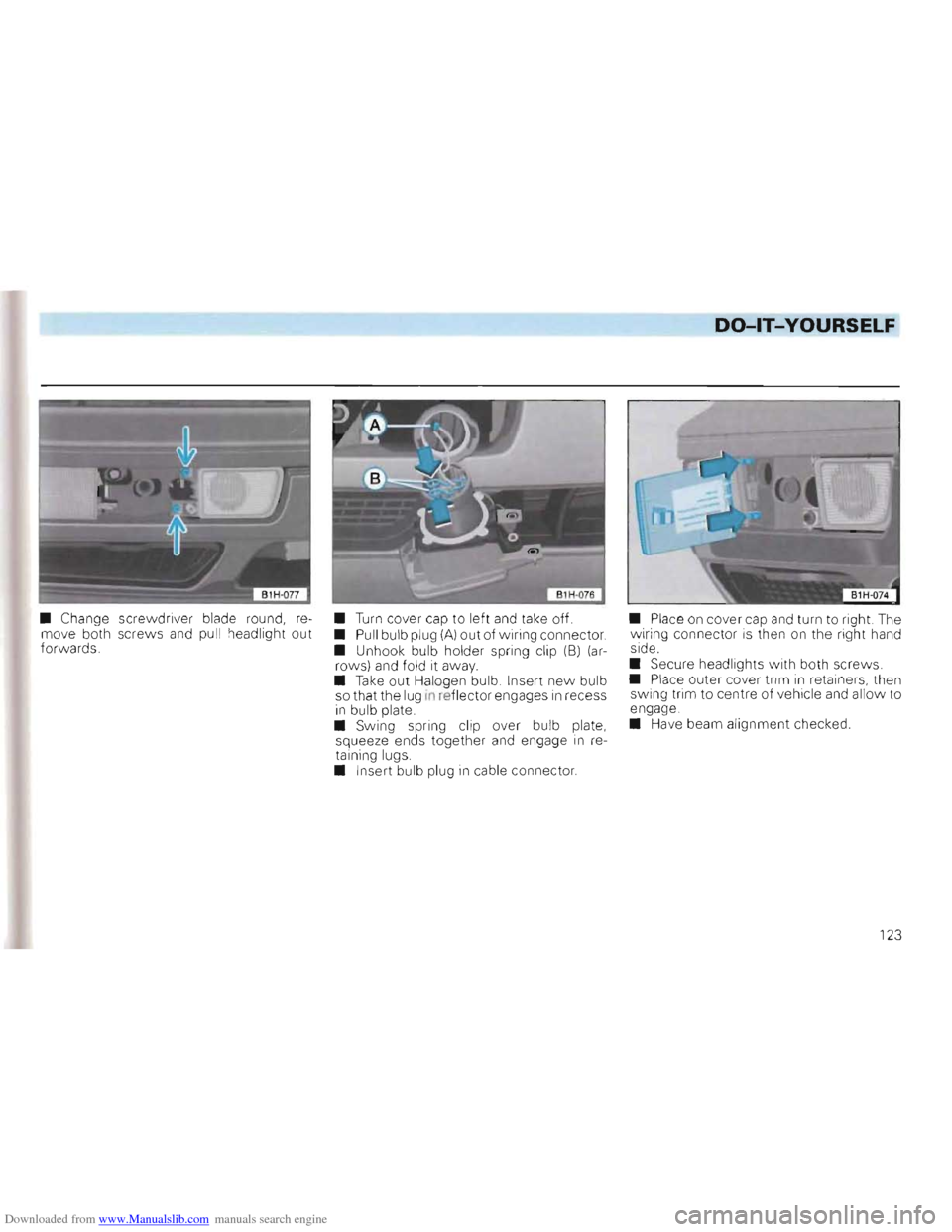
• Change screwdriver blade round, re
move both screws and pull headlight out forw ards. •
Turn cover
cap to left and take off.
• Pull bulb plug (A) out of wiring connector.
• Unhook bulb holder spring clip (8) (arrows) and fold it away.
•
Take out Halogen bulb. Insert new bulb
so that the lug in reflector engages in recess in bulb plate.
• Sw ing spring clip over bulb plate,
squeeze ends together and engage in
re
taining lugs.
• Inse rt bulb plug
in cable connector. •
Plac e
on cover cap and turn to right. The wiring connector is then on the right hand
side.
• Sec ure headlights
with both screws.
• Place outer cover trim in retainers, then
swing trim to centre of vehicle and allow to
engage.
• Have beam alignment checked .
123
Page 131 of 156
Downloaded from www.Manualslib.com manuals search engine DO-lT-YOURSELF
Tow startingfTowing
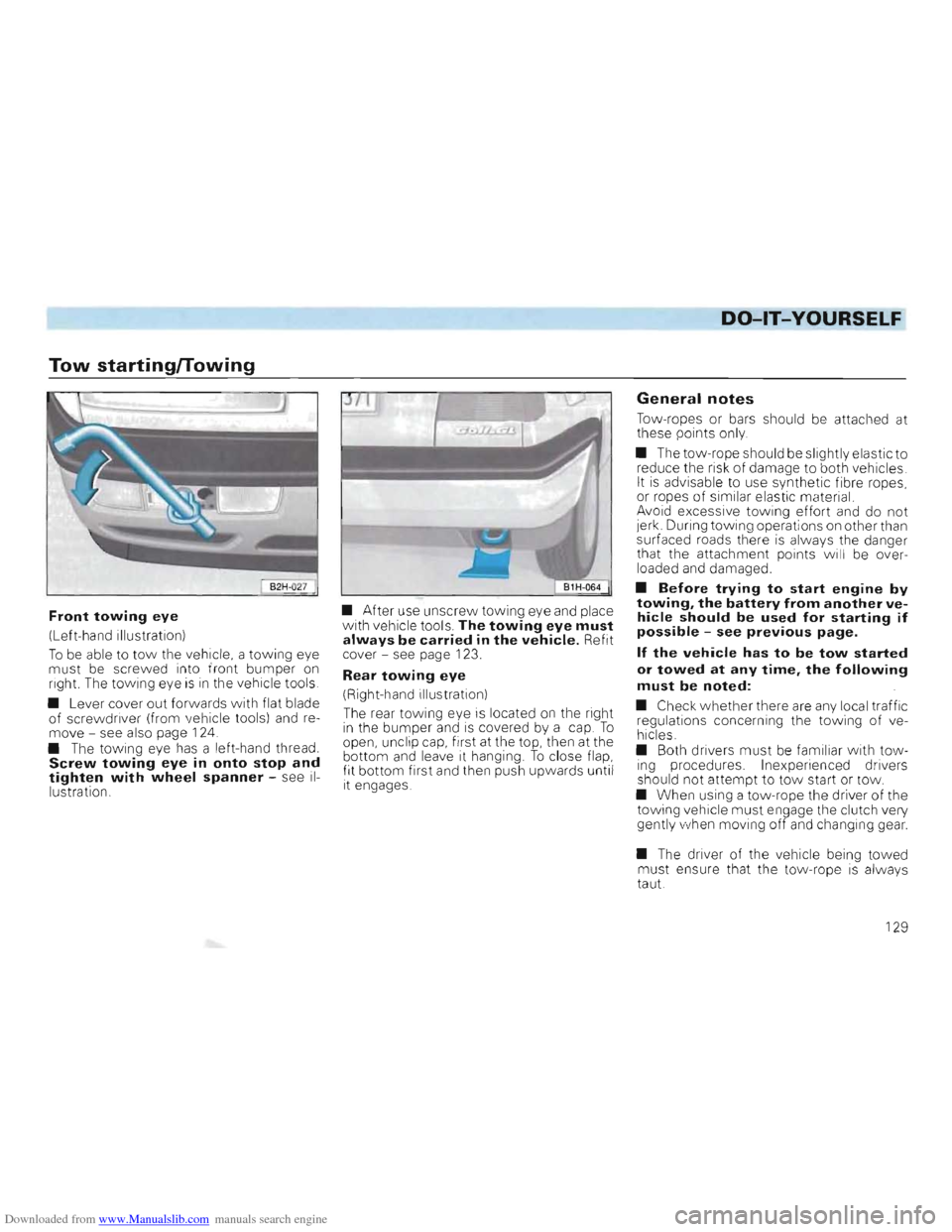
Front towing eye
(Left-hand illustration)
To be able to tow the vehicle, a towing eye
must be screwed into front bumper on
right. The towing eye is in the vehicle tools .
•
Lever cover out forwards with flat blade
of screwdri ver (fro m vehicle tools) and remove -see also page 124.
• The towing eye has a left- hand thread . ~crew to~ing eye in onto stop and tighten with wheel spanner -see illustration.
• . After use unscrew towing eye and place with vehicle tools. The towing eye must always be carried in the vehicle_ Refit
cove r -see page 123.
Rear towing eye
(Right-hand illustration)
The rear
towing eye is located on the right In the bumper and is covered by a cap. To
open, unclip ca p, first at the top, then at the
botto m and leave it hanging To close flap, lit bottom first and then push upwa rds unti l It engages .
General notes
Tow-ropes or bars should be atta ch ed at
these points only.
• The tow- rope
should be slight ly elastic to
reduce the risk of damage to both vehicles .
It IS advi sable to use synthe tic fibre ropes ,
or ropes of Similar elastic materia l.
Avoid excessive towing effort and do not
Jerk. DUring tow ing opera tions on other than
surfaced roads there is always the danger
that the attachment points will be over
loaded and damaged.
• Before trying to start engine by t?wing, the battery from another vehicle. should be used for starting if possible -see previous page.
If the vehicle has to be tow started
or towed at any time, the following
must be noted: .
• Check whethe r there are any local traffic regulat ions concerning the towing of ve
hicles .
• Both drivers
must be familiar with towIng procedures. Inexperienced drivers
should not attempt to tow start or tow.
• When using a to w-rope the driver of the
towing vehicle must engage the clutc h very
gent ly
v,/hen moving off and changing gear.
• The driver of the veh ic le being
towed must ensure that the tow -rope is always ta ut.
129