1993 VOLKSWAGEN GOLF brake
[x] Cancel search: brakePage 74 of 156
Downloaded from www.Manualslib.com manuals search engine DRIVING TIPS
Driving economically and ecologically
Various factors de te rmi ne the fuel c on
sumption, the bur de n on the environment
a n d the w ear on the engi ne, brake s an d
t y res .
The personal style of driving
Determine s to a g reat extent th e eco nomical asp ect and the e xha u st an d no ise deve lo pmen t:
r:Q,., Do not warm up the engine with '(!t!5 the vehicle stationary.
At idling speed it takes a very long time until the engine becomes operationally warm. However, in the warm-up phase, wear and the discharge of pollutants is particularly high. For this reason, drive off immediately the engine has started and avoid high engine speeds.
QiP Avoid full throttle acceleration.
N'6t only is the fuel consumption reduced considerably if one accelerates with feel
ing, but the disturbance to the environment and the wear are also reduced.
r:Q,., Do not drive with unnecessarily '(!t!5 high engine revs -change up as soon as possible, only change down when the engine no longer runs smoothly.
The fuel consumption is for example more than twice as high in 2nd gear than it is in top gear. At the same time, the reduced engine speed means a reduction in engine noise.
r:Q,., Try not to drive at m aximum '(!t!5 speed.
The fuel consumption, exhaust pollution and noise increase disproportionately at high speeds. If approximately only 3 quarters of top speed is utilised, the fuel consumption will be reduced by about half. Experience has shown that the loss
in time is only marginal.
r:Q,., Drive as smoothly as possible '(!t!5 and look well ahead.
Unnecessary acc eleration and braking must be paid for with higher fuel consumption and more disturbance to the environment.
r:Q,., Switch the engine off during '(!t!5 traffic hold-Ups.
The individual operating condi
tions
N atur ally also affect fuel cons umption .
T he fo
llowing facto rs fo r in sta n ce are not fa
vo urable to good fuel c on sumption:
• Hig h traff ic de ns it y , par ticularly larg e
t o w ns w ith numero us traffi c lig ht s
• Freq ue nt sto p/s tart d
riving, alw ay s re
s ta rti ng a nd warmin g up t he eng ine
• D riving
in heavy , slow moving traff ic in
l o w gear so that the eng ine sp eed is rela
ti vel y high in relati on to the distan ce cov
e red.
r:Q,., One should, therefore, p la n trips
'(!t!5 in advance and try to a void l ocal
traffic and overcrowded motor
ways.
O bvio usly the fuel consumption is also af
fec ted by facto rs o ve r w hich the drive r has
n o control. It is for exampl e no rma l for th e con sumpti o n t o increase in th e ,,\linte r or in arduous cond iti ons ( bad roads, trailer towing etc)
72
Page 77 of 156
Downloaded from www.Manualslib.com manuals search engine DRIVING TIPS
Brakes
General notes
• Brake lining wear depends to a la rge ex
t e nt on the operating conditions and style of riving. On vehicles which are used mainly
n town traffi c and stop/start conditions or are driven hard it may be nece ssary to have the thickness of the brake linings checked by a Volkswagen dealer in be tween the in
t er vals given in the Ser vice Schedule. On 'ehic les with brake pad wear indicato r, worn front pads w ill b e indic ated by a wa rnIng lamp -see page 48.
• Change down in good time when driving
d ownhill , in order to make use of the engine
braking effect. This relieves strain on the
brake system . When the brakes are appl ied
d o not keep them on conti nuo usly, apply
a n d release alternately.
• Under certain
operating conditions, for
ex ample after driv ing through water, after
h eavy ra in or after washi ng the vehicle the
braking effect may be reduced by wet, or in linter iced-up brake discs and linings -the
brakes must be dried out first by applying th e footbrake. The
fu
ll braking effect may also be reduced
when vehicle has been driven for som e
tim e on heavily salted roads witho ut using the bra kes, because th e layer of salt on
discs and pads has to wear off first.
Attention
If a front spoiler or full size wheel trims are retrofitted, it is necessary to ensure that the flow of air to the front brakes is not restricted -otherwise the brakes can overheat.
Brake serve
Attention The servo is operated by vacuum which is only generated when en
gine is running. For this reason the vehicle should not be allowed to roll with the engine switched off.
When the brake servo is not working because, for example, the vehicle is being towed or because a defect has occurred on the brake servo itself, the brake pedal must be pressed considerably harder to compensate for the absence of servo assistance.
75
Page 78 of 156
Downloaded from www.Manualslib.com manuals search engine DRIVING TIPS
Anti-locking brake system *
The AB S plays a major part in i ncreasing the active safety of the vehicle . The big adva ntage when compa red with a conve ntional brake system is t hat even when braking
hard on a s lippery road surfac e the bes t
poss ib le ste erabili ty is retained for the road
cond it io n because the wheels do not lock.
H
owever o ne mus t not expec t the ABS
sys tem t~ sho rt en the brak ing dis ta nce in all co nditions. When driv ing on grave l or o n
fr esh snow cove ring a slipp ery surf ace, I.e. when one shou ld be driving very care fully In
a ny case, the s topping distance may even be slightly longer
How the ABS system works
A n automatic check is made when a speed
of approx. 7 km/h is reached,. When this
hap pens a pumping no ise can be heard. W
he n the tu
rning speed of a w heel reac hes a leve l which is too low fo r the ve hicle speed
and it ten ds to lock , the brake pre ssu re to
t his whee l is r educ ed. On the fron t axle the
b rake press ure is regulated fo r eac h wheel
ind iv idually, whereas on the rear axle, the
press ure is regulated fo r bo th wheels at the
sam e tim e. As a result the braking effect IS the same f or both rear w heels and the driving stabi lity is reta ined as f a r as po~sible. This regulating process makes Itself known by movement .of the b~ake pedal and is accompanied by nOises. This is do ne deli berat ely as a warni ng to the
driver that a wheel or the wheels a re In th e
lock ing range So that the ABS can r egu la te
effec tively in th is range the brake peda l
must remai n depressed -on no account
should it be pumped l
Attention However the ABS system cannot overcome the physical limits. This must be borne in mind particularly on slippery or wet roads. When the ABS com es into the control range the speed must immediately be adapted to the road and traffic conditions. The increased amount of safety available must not tempt one into taking risks.
If a def ect occurs o n the ASS It is indicated by a warni ng lamp -see page 49.
76
Page 80 of 156
Downloaded from www.Manualslib.com manuals search engine DRIVING TIPS
Driving instructions
To obtain the best possible handling of ve
hicle and trailer, the following should be
noted :
•
Try to avoid driving w ith an unladen ve
hicle and a loaded trailer. If this cannot be
avoided, only drive
slowly to allow for the
unfavourable weight distribution .
• As driving stability
of vehicle and trailer
decreases when the speed increases do not drive at the maximum permissible top speed in unfavourable road, weather or wind conditions -particularly when going
downhill.
In any case the speed must be reduced im
mediately the trailer shows the slightest
sign of snaking . On no account try to stop
the snakin g by accelerating.
• For safety reasons one should not drive
faster than 80
km/h (50 mph). This also
applies in countries where higher speeds
are permitted. •
Al
ways brake in good time. If the trailer
has an overrun brake, apply the brakes gen
tl y at firs t then firmly. This will avoid the Je rk
ing caused by the trailer wheels loc king. Change down before going down a steep
hill so that the engine can act as a braka.
•
When a lon g climb in a low gear with ex
tremel y high engine revs must be nego
tiated at exceptionally high ambient temperatures the coolant temperature gauge must be observed. When the gauge needle
moves to the upper end of the scale, the
road speed must be reduced immediately
If nevertheles s the warning lamp flashes,
stop
immediatel y and allow the engine to
cool off at id l ing speed for several minutes.
• The coo ling
effect of the radiator fan can
not be increased by changing down, be
cause the speed of the fan is not dependent
on the engine speed. One should the refore
not change down even when towing a
trailer as 10ll g as the engine can cope without the vehicle speed dropping too much .
General notes
• It is advisable to hav e the vehicle serviced between the Insp ection in tervals it it
is used frequently for towing a trailer .
• The trailer and draw
bar load figures on
the data plate of the towing bracke t are for test ce rtific ation only. The correct figures
for the vehicle, which may be lower t han
th ese figures, are given in the eh icle documents and in this manual.
78
Page 82 of 156
Downloaded from www.Manualslib.com manuals search engine DRIVING TIPS
Brake testing
For brake testing on a brake test stand th e
props haft does not have to be detached .
On the rear w heels the brake test is carried
out in the same way as on two-wheel drive
vehicle .
When testing the front w heel brakes how
ever there are some special points to
be noted:
• The
ve hicle must be reversed onto the
te st stand so that the test stand rollers drive
the front w heels backwards .
• Then the gear lever
must be moved into
1 st gear w ith the ignition on and then back
into neutral again Th is disengages the free
wheel lock in the back axle.
Note
On no account must the reverse gear be se
lected when the rollers are running other
wise the freewheel lock would be engaged
again.
This would cause the rear wheel s to
be driven suddenly.
80
Page 90 of 156
Downloaded from www.Manualslib.com manuals search engine GENERAL MAINTENANCE
Cleaning seat belts
Keep belts clean because they ma y not
retract properly if very dirty .
Dirt y be
lts can be cleaned by was hing w ith
a mild soap solutio n without taking the belts
out of the vehicle.
Note
Inert ia reel belts should be completel y dry
before they are allowed to roll up.
Attention Do not have the belts cleaned chemically because the cleaning compounds damage the webbing material. Ensure that the belts do not come into contact with corrosive fluids.
Steel wheels
The wheels and the whee l tr ims should be
cle aned thoroughly at regular inter vals w hen the vehicle is being washed. This w ill
prevent brake dust , dirt and road salt from
accu mulating on the wheel. Persistent
ingr ained brake dust can be removed With an industrial grim e remov er. P aint damage
should be repaired before rust can form.
Alloy wheels
In order to maintain th e smart appearan ce
of all oy wheels for a long period, regular
car e is necessary . In particular, salt and brake pad dust must be washed off th or ough
ly
at leas t every tw o w eeks otherwise
the surface of the alloy Will be damaged
After being w ashed, the w heels shou ld be treated with an acid-free cleaner for al loy wheels. About every three months it is necessary to give wheels a good rubbing
w ith hard wax. Paint polish or other abrasiv e
solutions must not
be used. If the protecti ve
paint coat has been damaged , eg. by stone
impact, the damaged spots should be dealt with as soon as possible.
Cleaning and anti-corrosion
treatment of engine compart
ment
Attention Before doing any work in the engine compartment it is essential to read the notes on page 91!
The leaves, blossoms etc . w hich drop into
the water box (underneath the engine
bonnet
in f ront of the windscreen) should
be cleaned out occasional ly This w ill pre
v ent the water drain holes becoming
blocked
and -on veh ic les w ithout a fresh air
filter -foreign bodies entering the vehicle
interior v
ia the heating and ventilat ion sys
tem.
Attention For safety reasons pull out ignition key before reaching into the water box. Otherwise if the windscreen wipers are switched on unintentionally the movement of the wiper linkage could cause injury.
The engine compartment an d th e outsi de
surface of the power unit are given anti-cor
rosion treatment at the factor y.
In th e winter w hen the vehicle is being
driven frequ entl y on salted roads, good anti
corrosion treatment is very important. For
th is reason the entire engin e comp
artment and the plen um chamber should be thor
ough ly cleaned before and after the salting
period
and then preserved so that the salt cannot have a damag ing effect
The ignition must be switched off before washing the engine.
If the engine compartment is cle aned at any
time with greas e removing solution s 1) or if
one has the engine washed, the anti-cor
rosion compound is nearly alwa ys removed as wel l. It is the refore essential to ask for
durable preserv ation of all surfaces, seams,
joints and components in the engine compartment to be carried out. This applies also
1) Only the corre e clean ing solutions may be use d -on no aecoun petrol or Diesel.
88
Page 93 of 156
Downloaded from www.Manualslib.com manuals search engine GENERAL MAINTE NA NCE
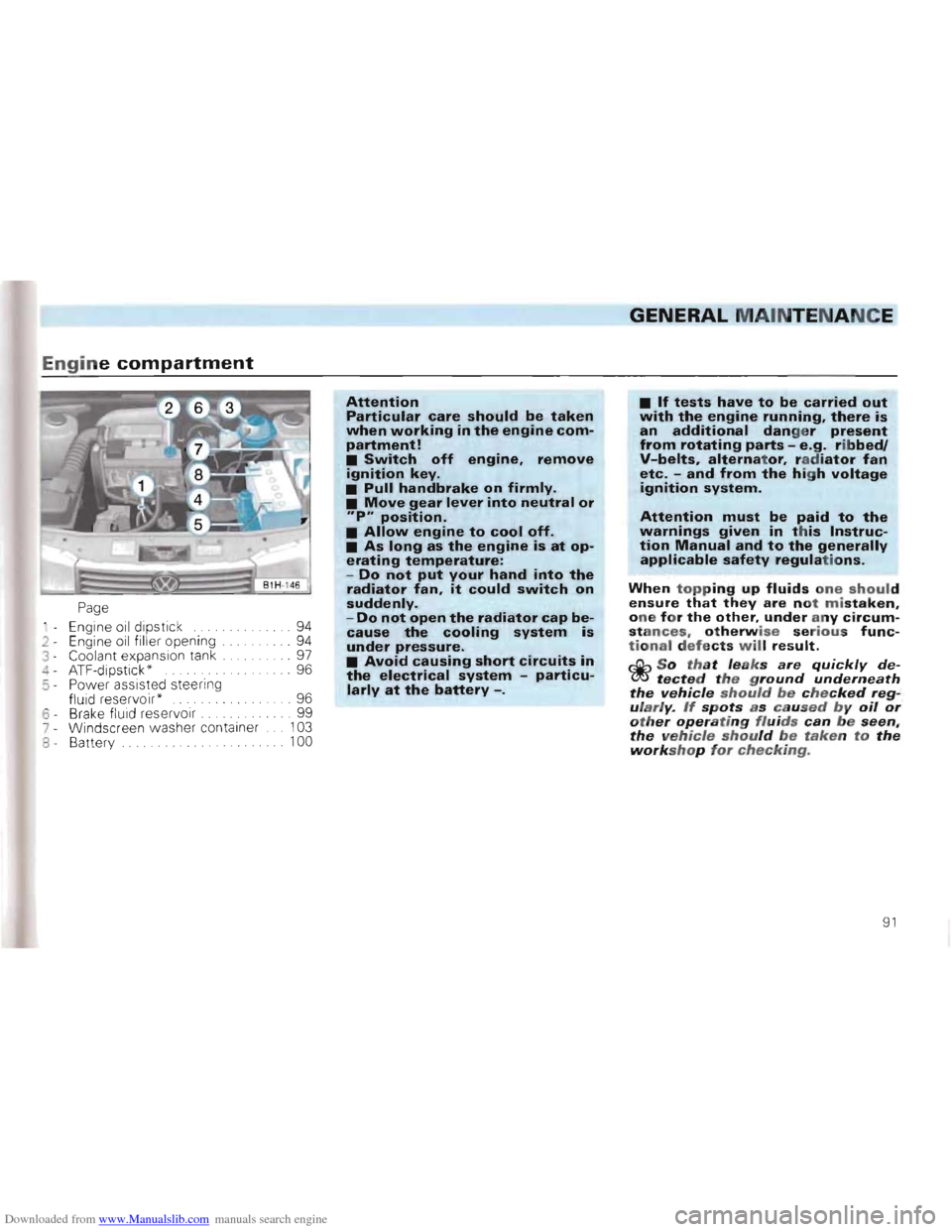
Engine c ompartmen t
Page
Engine oil dip sti ck . . 94
2 - Eng ine o
il filler openi ng ... ...... . 94
3 - Coolant exp ansion ta nk .. 97
4 -ATF-dip sti ck " . . . . . . . . . . . .. . 96
5 - Power assist ed steering flu id r eservoir '
6 Brak e fl uid re se rvo ir .
7 - Wi nd sc reen w ash er c on tainer
8 Battery .
Attention
Particular care should be taken
when working in the engine com
partment!
• Switch off engine. remove ignition key_
•
Pull handbrake on firmly.
• Move gear lever into neutral or
"P" position.
• Allow engine to cool off.
• As long as the engine is at op
erating temperature:
-Do not put your hand into the
radiator fan. it could switch on
suddenly.
-Do not open the radiator cap be
cause the cooling system is
under pressure.
• Avoid causing short circuits in
the electrical system -particu
larly at the battery -.
. .. 96
. .. 99
10 3
100
• If tests have to be ca rried o ut with the engine running. there is an additional dang e r present from rotating parts - e.g . ribbedl V-belts, alternator, ra d iator fan etc. -and fro m the high voltage ignition system.
Attention m ust be paid to the w arn ings given in this Instruction Manual and to the generally ap plicable safety regulations.
When topp ing up fluids one should ensure that they are not mistaken. one for the other, under any circum stances. otherwise serious fu nctional defects will result.
rJjh So that leaks are quickly de(!J!J tected the ground underneath the vehicle should be checked regularly. If spots as caused by oil or other operating fluids can be seen, the vehicle should be taken to the workshop for checking.
91
Page 98 of 156
Downloaded from www.Manualslib.com manuals search engine GENERAL MAINTENANCE
Automatic transmission fluid (ATF)*
The ATF' ) level must however be
checked between the interva ls given in the
Service Schedule. To do this the vehicle
must be standing on a level surface. The level must only be checked when the ATF is warm ( approximate ly 10 km afte r starting
from cold the ATF will reach the required
temperature). If ATF is cold or too hot the
reading w ill be incorrect.
The engine must be running at idling speed,
the handbrake must be appl ied and the se
lector lever at "N ".
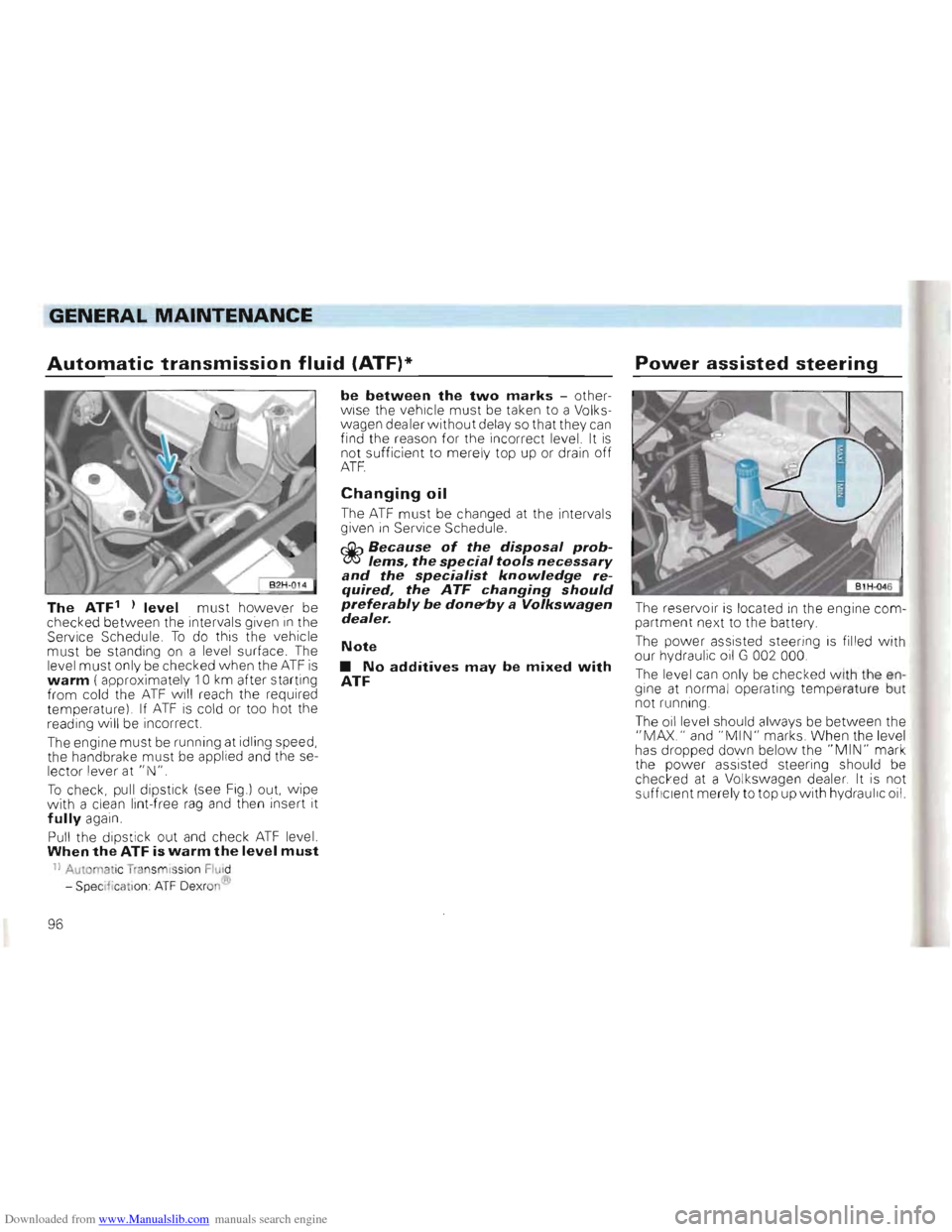
To check, pull dipstick (see Fig .) out. wipe
w ith a clea n lint -free rag and then insert it fully again.
Pull the dipstick out and check ATF level. When the ATF is warm the level must
11 Automat ic Transm is sion Fluid
- Spe cif ic ati on ATF Dexr on®
be between the two marks -other
w ise the vehicle must be taken to a Volks
wagen dealer without delay so that they can find the reason for the incorrect level. It is not sufficient to merely top up or drain off ATF.
Changing oil
The ATF must be changed at the intervals
given in Service Schedule .
r£il:-, Because of the disposal prob~lems, the special tools necessary and the specialist knowledge required, the ATF changing should preferably be donfY'by a Volkswagen dealer.
Note
• No additives may be mixed with ATF
Power assisted steering
The reservoir is located in the engine com
partment nex t to the battery.
The power assisted steering is fil led with
our hydraulic oil G 002 000.
The leve l can only be checked With the en
gine at normal operating temperature but
not running .
The oil level should always be between the
"MAX." and "MIN" m arks. When the leve l
has dropped down below the "MIN" mark
the power assisted steering should be
ched:ed at a Volkswagen dealer. It is not
suff iCient merely to top up with hy draulic oil.
96