1993 PONTIAC GRAND-AM service
[x] Cancel search: servicePage 225 of 306
Service & Appearance Care
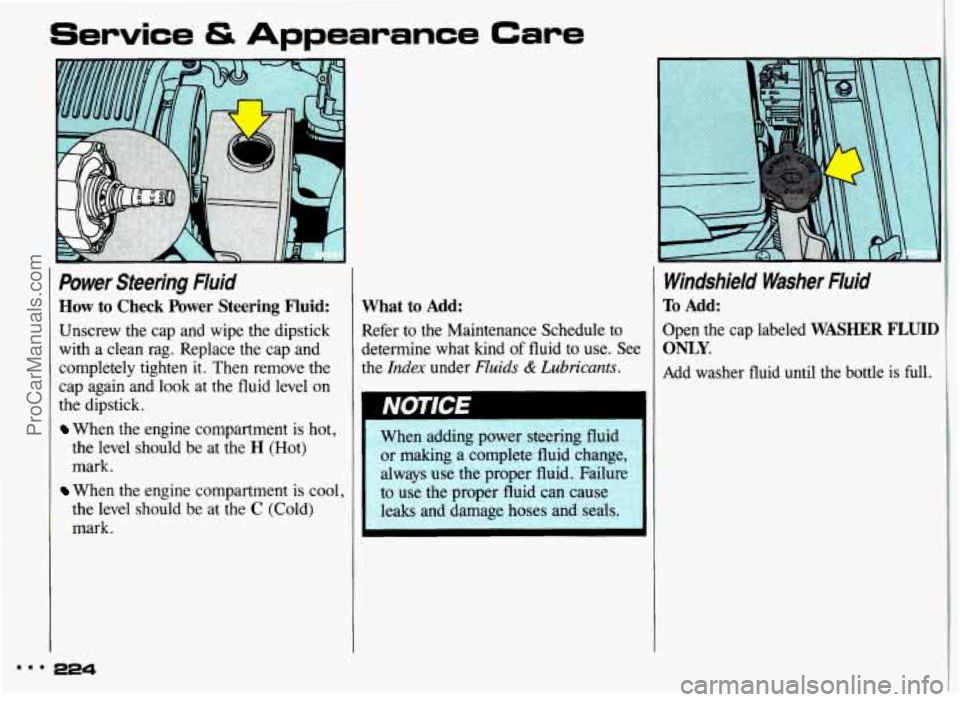
Power Steering Fluid
How to Check Power Steering Fluid:
Unscrew the cap and wipe the dipstick
with a clean rag. Replace the cap and
completely tighten
it. Then remove the
cap again and look at the fluid level
on
the dipstick.
When the engine compartment is hot,
the level should be at the
H (Hot)
mark.
the level should be at the
C (Cold)
mark.
When the engine compartment is cool,
What to Add:
Refer to the Maintenance Schedule to
determine what kind
of fluid to use. See
the
Index under Fluids & Lubricants.
Windshield Washer Fluid
To Add:
Open the cap labeled WASHER FLUID
ONLY.
Add washer fluid until the bottle is full.
mmm 224
ProCarManuals.com
Page 227 of 306

Service fS Appearance Care
Brake Master Cylinder (CONI)
I If you have too much brake
fluid, it can spill
on the
engine. The fluid will burn
if the
engine
is hot enough. You or
others could be burned, and your
vehicle could
be damaged. Add
brake fluid only when work is
done on the brake hydraulic
system.
When your brake fluid falls to a low
level, your brake warning light will
come on. See the
Index under Brake
System Warning Light.
What to Add:
When you do need brake fluid, use only
DOT-3 brake fluid-such as Delco
Supreme
ll@ (GM Part No. 1052535).
Use new brake fluid from a sealed
container only.
I DOT-5 silicone brake fluid can
;'Don't let someone put in the
:> 1 I :, !wrong i kind of fluid. For
example, just a few drops of
I , mineral-based oil, such as engine
-.?,'oil, in your brake system can
damage brake system parts
so
damage your vehicle. Don't use it.
". ,
I : '
" 1. , badly that they
; -qeplaced. %>, , .
Brake fluid can damage paint, so
be careful not to spill brake fluid
on your vehicle.
-
Replacing Brake System Parts
The braking system on a modern vehicle
is complex. Its many parts have to be of
top quality and work well together
if the
vehicle is to have really good braking.
Vehicles we design and test have top-
quality
GM brake parts in them, as your
Pontiac does when
it is new. When you
replace parts of your bralung system-
for example, when your brake linings
wear down and you have to have new
ones put in-be sure you get new
genuine
GM replacement parts. If you
don't, your brakes may no longer work
properly. For example,
if someone puts
in brake linings that are wrong for your
vehicle, the balance between your front
and rear brakes can change, for the
worse. The braking performance you've
come to expect can change
in many
other ways
if someone puts in the wrong
replacement brake parts.
m.. 226
ProCarManuals.com
Page 229 of 306

Service & Appearance Care
Headlight Bulb Replacement
For the type of bulb, see the Index under
Replacement Bulbs.
1. On the driver’s side only, unscrew the
butterfly fastener. Then lift the plate.
228
Both Sides:
2. Twist the bulb assembly counter-
clockwise
)/6 turn and pull out the
bulb assembly.
3. Unclip the bulb assembly from the wiring harness.
4. Reverse steps 1-3 to replace the bulb ,
assembly and headlight housing. I
ProCarManuals.com
Page 231 of 306

Service & Appearance Care
Windshield Wiper Blade
Replacement
Replacement blades come in different
types and are removed in different ways.
Here’s how to remove the type with a
release clip:
1 . Pull the windshield wiper arm away
2. Lift the release clip with a
from the windshield.
screwdriver and pull the blade
assembly off the wiper arm.
the wiper arm.
3. Push the new wiper blade securely on
Loading bur Vehicle
Two labels on your vehicle show how
much weight it may properly carry. The
Tire-Loading Information label found on
the rear edge of the driver’s door tells
you the proper size, speed rating and recommended inflation pressures for the
tires on your vehicle. It also gives
you
important information about the number
of people that can be in your vehicle and
the total weight that you can carry. This
weight is called the Vehicle Capacity
Weight and includes the weight of all
occupants, cargo, and all nonfactory- installed options. The other label is the Certification
sticker, also on the rear edge of the
driver’s door. It
tells you the gross
weight capacity of your vehicle, called
the GVWR (Gross Vehicle Weight
Rating). The GVWR includes the
weight of the vehicle, all occupants, fuel
and cargo. Never exceed the GVWR for
your vehicle, or the Gross Axle Weight Rating (GAWR) for either the front or
rear axle.
And, if you do have a heavy load, you
should spread it out. Don’t carry more
than
132 lbs. (60 kg) in your trunk.
ProCarManuals.com
Page 233 of 306

Service & Appearance Care
nres
We don’t make tires. Your new vehicle comes with high quality tires made by a
leading tire manufacturer. These tires are warranted by the tire manufacturers and
their warranties are delivered with every new Fbntiac. If your spare tire is a
different brand than your road tires, you will have a tire warranty folder from each
of these manufacturers.
Poorly maintained and improperly used tires dangerous.
a Overloading your tires can causy overheating as a result of too much
friction. You could have
an air-out and a serious accident. See the Index
under Loading Your Ehicle.
Underinflated tires pose the same danger as overloaded tires. The resulting
accident could
cause serious injury. Check all tires fiquently to maintain
the recommended presswe. Tire pressure should be checked when your
tires are cold.
Overinflated tires are more likely to be cut, punctured, or broken by a
sudden impacts such as when you hit a pothole. Keep tires at the
recommended pressure.
tires have been damaged, replace them.
m Worn, old tires can cause accidents. If your tread is badly worn, or if your
I I
lnflation-Tire Pressure
The Tire-Loading Information label
which is on the rear edge of the driver’t.
door shows the correct inflation
pressures for your tires, when they’re cold. “Cold” means your vehicle has
been sitting for at least three hours or
driven no more than a mile.
ProCarManuals.com
Page 235 of 306

Service & Appearance Care
Tire Inspection and Rotation
(CONT)
1 Rust or dirt on a wheel, or on
- b the. parts to which it is
htened, ean fnake wheel nuts I
become loose after a time, The
wheel could come off and cause an I accident. When you change a
wheel, remove any rust or dirt
from plks where the wheel
When lt’s Time for New Tires
One way to tell when it’s time for new
tires is to check the treadwear
indicators, which will appear when your
tires have only
2/32 inch (1.6 mm) or
less of tread remaining.
You need a new tire if:
You can see the indicators at three
You can see cord or fabric showing
The tread or sidewall is cracked. cut.
places around the tire.
through the tire’s rubber.
attaches to the vehicle. ~n an 7 -
emergency, you can use a cloth or I I or snagged deep enough to show cord
a ppr towel ta do this; but be or fabric.
sure t.a use a scraper or wire brush The tire has a bump, bulge or split.
later, if you need to, to get all the The tire has a puncture, cut, or other
rust or dirt off, (See the Index damage that can’t be repaired well
undkr hgiing a 2?i?af Ere.) because of the size or location of the
I damage.
... 234
Buying New Tires
To find out what kind and size of tires
you need, look at the Tire-Loading
Information label.
The tires installed on your vehicle when
it was new had a Tire Performance
Criteria Specification (TPC Spec)
number on each tire’s sidewall. When
you get new tires, get ones with that
same TPC Spec number. That way, your
vehicle will continue to have tires that
are designed to give proper endurance,
handling, speed rating, traction, ride and other things during normal service
on your vehicle.
If your tires have an all-
season tread design, the TPC number
will be followed by a
“MS” (for mud
and snow).
If you ever replace your tires with those
not having a TPC Spec number, make
sure they are the same size, load range,
speed rating and construction type (bias,
bias-belted
or radial) as your original
I tires.
ProCarManuals.com
Page 236 of 306

CAUTION
A
Mixing tires could cause you
to lose control while driving.
If you mix tires of different sizes
or types (radial and bias-belted
tires), the vehicle may not handle
properly, and you could have a
crash. Be sure to use the same size
and type tires on all wheels.
It's
all right to drive with your compact
spare, though. It was developed
for limited use
on your vehicle.
I
Grding
The following information relates to the
system developed by the United States
National Highway Traffic Safety
Administration which grades tires by
treadwear, traction and temperature
performance. (This applies only to vehicles sold in the United States.)
Treadwear
The treadwear grade is a comparative
rating based on the wear rate of the tire
when tested under controlled conditions
on a specified government test course.
For example, a tire graded
150 would
wear one and a half
(1%) times as well
on the government course as a tire
graded
100. The relative performance of
tires depends upon the actual conditions of their use, however, and may depart
significantly from the norm due to
variations in driving habits, service
practices and differences in road
characteristics and climate.
235 " '
ProCarManuals.com
Page 239 of 306

Service & Appearance Care
Tire Chains
...
Wheel Replacement (CONT.)
The wrong wheel can also cause
problems with bearing life, brake cooling, speedometer/odometer
calibration, headlight aim, bumper
height, vehicle ground clearance,
and tire or tire chain clearance to
the body and chassis.
I
238
Used Replacement Wheels
Putting a used wheel on your
L vehicle is dangerous. You
I cs know how it’s been used or
how many miles it’s been driven. It
-mid fail suddenly and cause an
accident. If you have
to replace a
\wheel, use a
new GM original If your Pontiac has P195/70R14,
P195/65R15
or P205/55R16 size
tires, don’t use tire chains; they can
damage your vehicle.
If you have other tires, use tire
chains only when you must. Use
only
SAE Class “S” type chains
that are
the proper size for your
tires. Install them
on the front tires
and tighten them as tightly as
possible with the ends securely fastened. Drive slowlv and follow
r’
the chain manufacturer’s
instructions. If you can
h
chains contacting your v
stop and retighten them. If the
contact continues, slow down until
it stops. Driving too fast with
chains on will damage your vehicle.
ProCarManuals.com