1993 PONTIAC GRAND-AM service
[x] Cancel search: servicePage 97 of 306

Features & Controls
Voltmeter (omoN)
When your engine is running, this gage
shows the condition of your charging
system.
When your engine is not running, but
the ignition is on (in the
Run position),
the gage shows your battery’s state of
charge in
DC volts. Readings between
the red warning zones indicate the
normal operating range.
Readings in either red warning zone
indicate a possible problem in the
electrical system. Have your vehicle
serviced immediately.
Brake System Warning Light
Your Pontiac’s hydraulic brake system is
divided into two parts. If one part isn’t
working, the other part can still work
and stop you. For good braking, though,
you need both parts working well.
If the warning light goes on, there could
be a brake problem. Have your brake
system inspected right away.
This light should come on as you start
the vehicle. If it doesn’t come
on then,
have it fixed
so it will be ready to warn
you if there’s a problem, This
light will
also come on when you
set your parking brake, and will stay on if your parking brake doesn’t release
fully. If it stays on after your parking
brake is
fully released, it means you
have a brake problem.
If the light comes
on while driving, pull off the road and
stop carefully. You may notice that the
pedal is harder to push. Or, the pedal
may
go closer to the floor. It may take
longer to stop. If the light is still on,
have the vehicle towed for service. (See
the
Index under Bwing Your Pontiac.)
m.. 96
ProCarManuals.com
Page 98 of 306
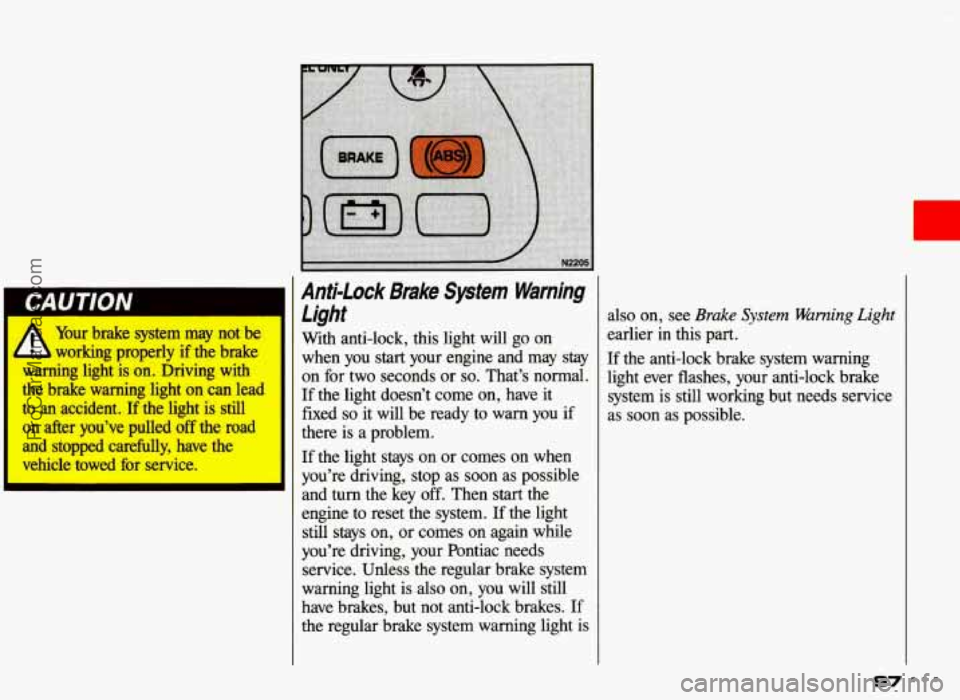
I CAUTION Anti-lock Brake Sptetn Warning
Light A Your brake system may not be
working properly if the brake
warning light is on. Driving with
the brake warning light on can lead
to
an accident. If the light is still
on after you’ve pulled off the road
and stopped carefully, have the
vehicle towed for service. Vith
anti-lock, this light will
go on
when you start your engine and may stay
on for two seconds or so. That’s normal.
If the light doesn’t come on, have it
fixed so it will be ready to warn you if
there is a problem.
If the light
stays on or comes on when
you’re driving, stop
as soon as possible
and turn the key off. Then start the
engine to reset the system.
If the light
still
stays on, or comes on again while
you’re driving, your Pontiac needs
service. Unless the regular brake system
warning light
is also on, you will still
have brakes, but not anti-lock brakes.
If
the regular brake system warning light is
also on, see Brake System Warning Light
earlier in this part.
If the anti-lock brake system warning
light ever flashes, your anti-lock brake
system
is still working but needs service
as soon as possible.
ProCarManuals.com
Page 99 of 306
Features tS Controls
!
-
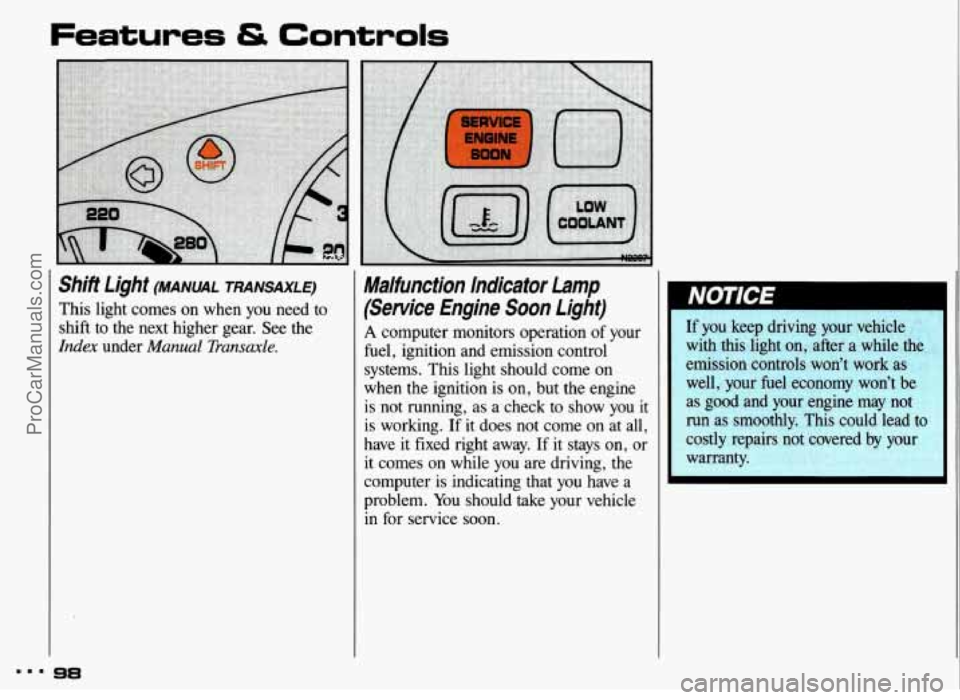
Shift Light (MANUAL TRANSAXLE)
This light comes on when you need to
shift to the next higher gear. See the
Index under Manual Transaxle.
98
Malfunction Indicator Lamp
(Service Engine Soon Light)
A computer monitors operation of your
fuel, ignition and emission control
systems. This light should come on
when the ignition is on, but the engine
is not running, as a check to show you
it
is working. If it does not come on at all,
have it fixed right away.
If it stays on, or
it comes on while you are driving, the
computer is indicating that
you have a
problem. You should take your vehicle
in for service soon.
If you keep driving your vehicle
with this light on, after a while the
emission controls won’t work as
well, your fuel economy won’t be
as good and your engine may not
run as smoothly. This could lead to
costly repairs not covered by your
warranty.
ProCarManuals.com
Page 119 of 306
Comfort Controls & Audio Systems
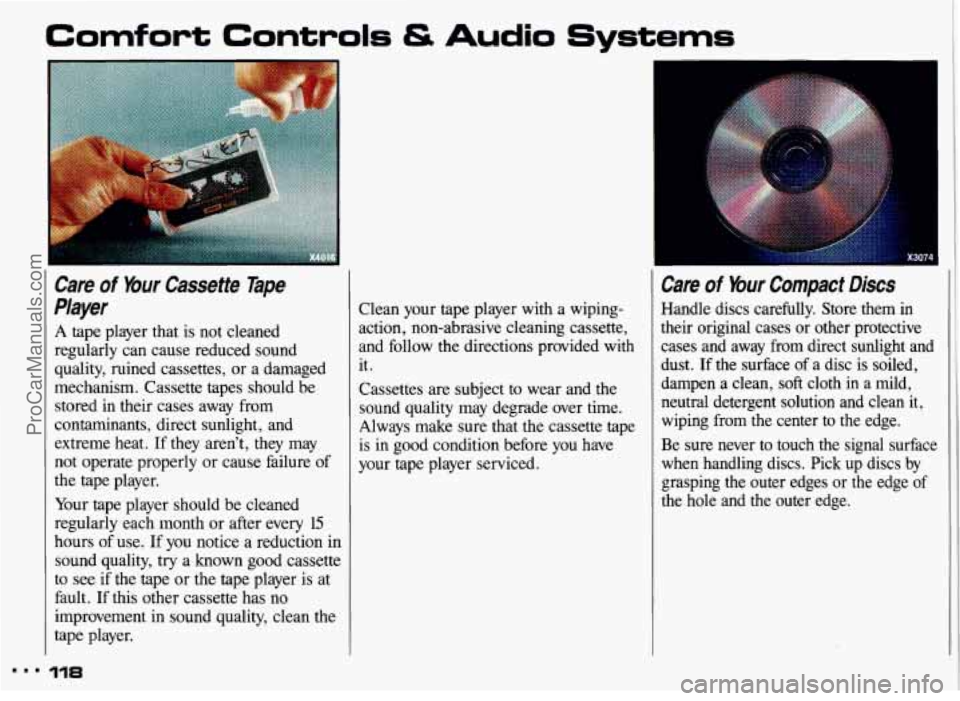
Care of Your Cassette Tape
Player
A tape player that is not cleaned
regularly can cause reduced sound
quality, ruined cassettes, or a damaged
mechanism. Cassette tapes should be stored in their cases away from
contaminants, direct sunlight, and
extreme heat. If they aren’t, they may
not operate properly
or cause failure of
the tape player.
Your tape player should be cleaned
regularly each month or after every 15
hours
of use. If you notice a reduction in
sound quality,
try a known good cassette
to see
if the tape or the tape player is at
fault. If this other cassette has no
improvement in sound quality, clean the
tape player.
118
Clean your tape player with a wiping-
action, non-abrasive cleaning cassette, and follow the directions provided with it.
Cassettes are subject to wear and the
sound quality may degrade over time.
Always make sure that the cassette tape
is in good condition before you have
your tape player serviced.
Care of Your Compact Discs
Handle discs carefully. Store them in
their original cases or other protective
cases and away from direct sunlight and
dust. If the surface
of a disc is soiled,
dampen a clean,
soft cloth in a mild,
neutral detergent solution and clean it,
wiping from the center to the edge.
Be sure never to touch the signal surface
when handling discs. Pick up discs by
grasping the outer edges or the edge
of
the hole and the outer edge.
ProCarManuals.com
Page 123 of 306
Your Driving and the Road
rn Road Signs
The road signs you see everywhere are
coded by color, shape and symbols. It’s
a good idea to know these codes
so that
you can quickly grasp the basic meaning
or intent
of the sign even before you
have a chance to read it.
STOP DO NOT WRONG
ENTER WAY
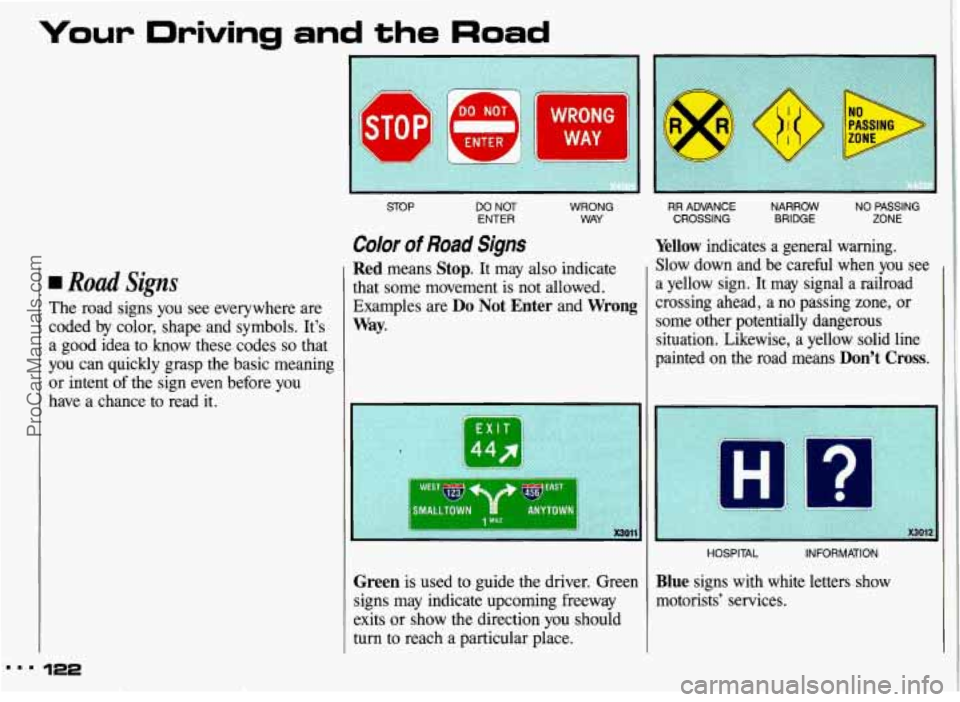
Color of Road Signs
Red means Stop. It may also indicate
that some movement is not allowed.
Examples are
Do Not Enter and Wrong
Way.
Green
is used to guide the driver. Green
signs may indicate upcoming freeway
exits or show the direction
you should
turn to reach a particular place.
RR ADVANCE NARROW NO PASSING
CROSSING BRIDGE ZONE
Yellow indicates a general warning.
Slow down and be careful when you see
a yellow sign.
It may signal a railroad
crossing ahead, a no passing zone,
or
some other potentially dangerous
situation. Likewise, a yellow solid line
painted
on the road means Don’t Cross.
Blue
signs with white letters show
motorists’ services.
... 122
ProCarManuals.com
Page 134 of 306

To Use Anti-Lock:
Don’t pump the brakes. Just hold the
brake pedal down and let anti-lock work
for
you. You may hear a clicking noise
as you accelerate after a hard stop.
Disc Brake Wear Indicators
Your Pontiac has front disc brakes and
rear drum brakes. Disc brake pads have
built-in wear indicators that make a
high-pitched warning sound when the
brake pads are worn and new pads are
needed. The sound may come and go or
be heard all the time your vehicle is
moving (except when you are pushing
on the brake pedal firmly).
A
The brake wear warning
sound means that sooner
or
later your brakes won’t work well.
That could lead to an accident.
When you hear the brake wear
warning sound, have your vehicle
serviced.
133
ProCarManuals.com
Page 143 of 306

Your Driving and the Road
Driving at Night
Night driving is more dangerous than
day driving. One reason is that some
drivers are likely to be impaired-by
alcohol or drugs, with night vision
problems, or by fatigue.
Here are some tips on night driving.
Drive defensively. Remember, this is
the most dangerous time.
Don’t drink and drive. (See the Index
under Drunken Driving for more on
this problem.)
Adjust your inside rearview mirror to
reduce the glare from headlights
behind you.
142
Since you can’t see as well, you may
need to slow down and keep more
space between you and other vehicles.
It’s hard to tell how fast the vehicle
ahead is going just by looking at its
taillights.
speed roads. Your headlights can light
up only
so much road ahead.
Slow down, especially on higher
In remote areas, watch for animals.
If you’re tired, pull off the road in a
safe place and rest.
Night Vision
No one can see as well at night as in the
daytime. But as we get older these
differences increase.
A 50-year-old
driver may require at least twice as
much light to see the same thing at night
as a 20-year-old.
What you do
in the daytime can also
affect your night vision. For example, if
you spend the day in bright sunshine you
are wise to wear sunglasses. Your eyes
will have less trouble adjusting to night.
But if you’re driving, don’t wear
sunglasses at night. They may cut down
on glare from headlights, but they also
make a lot of things invisible that should
remain visible-such as parked cars,
obstacles, pedestrians, or even trains
blocking railway crossings. You may
want to
put on your sunglasses after you
have pulled into a brightly-lighted
service or refreshment area. Eyes
ProCarManuals.com
Page 144 of 306
shielded from that glare may adjust
more quickly to darkness back on the
road. But be sure to remove your
sunglasses before you leave the service
area.
You can be temporarily blinded by
approaching lights. It can take a second
or two, or even several seconds, for your
eyes to readjust to the dark. When you
are faced with severe glare (as from a
driver who doesn’t lower the high
beams, or a vehicle with misaimed
headlights), slow down a little. Avoid
staring directly into the approaching
lights. If there is a line of opposing
traffic, make occasional glances over the line of headlights to make certain that
one of the vehicles isn’t starting to move
into your lane. Once you are past the
bright lights, give your eyes time to
~ readjust before resuming speed.
High Beams
If the vehicle approaching you has its
high beams on, signal by flicking yours
to high and then back to low beam. This
is the usual signal to lower the headlight
beams. If the other driver still doesn’t lower the beams, resist the temptation to
put your high beams on. This only
makes two half-blinded drivers.
On a freeway, use your high beams only
in remote areas where you won’t impair
approaching drivers. In some places,
like cities, using high beams is illegal.
When you follow another vehicle on a
freeway or highway, use low beams.
True, most vehicles now have day-night
mirrors that enable the driver to reduce
glare. But outside mirrors are not of this
type and high beams from behind can
bother the driver ahead.
A Few More Night Driving
Suggestions
Keep your windshield and all the glass
on your vehicle clean-inside and out.
Glare at night is made much worse by
dirt on the glass. Even the inside
of the
glass can build up a film caused by dust.
Tobacco smoke also makes inside glass
surfaces very filmy and can be a vision
hazard
if it’s left there.
Dirty glass makes lights dazzle and
flash more than clean glass would,
making the pupils
of your eyes contract
repeatedly. You might even want to keep
a cloth and some glass cleaner in your
vehicle if you need to clean your glass
frequently.
’143
F
ProCarManuals.com