1993 PONTIAC GRAND-AM coolant level
[x] Cancel search: coolant levelPage 103 of 306
Comfort Controls & Audio Systems
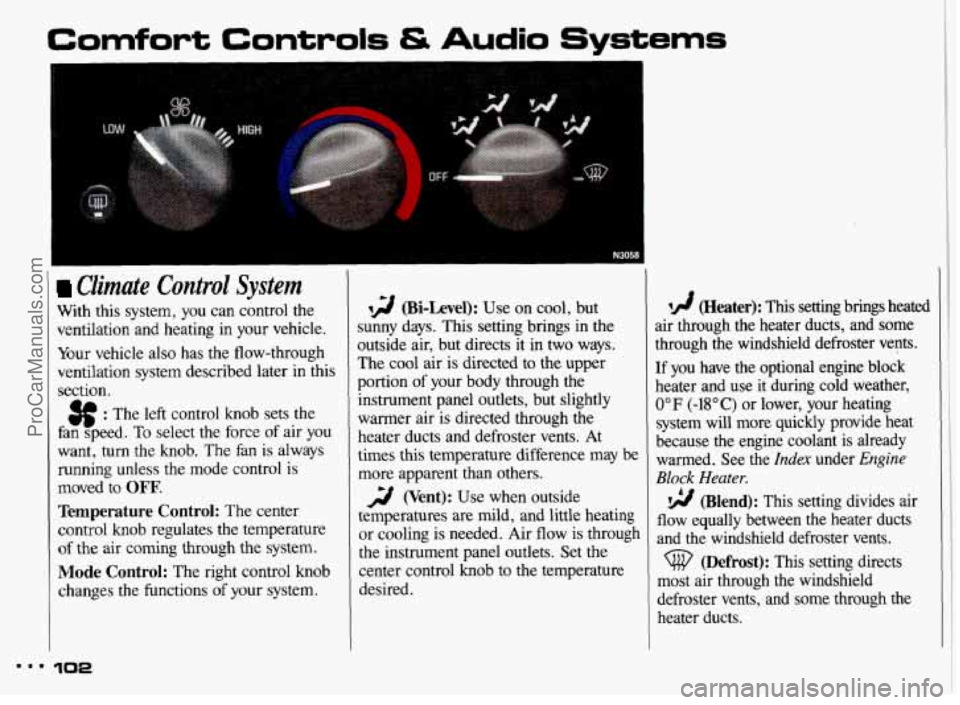
Climate Control System
With this system, you can control the
ventilation and heating in your vehicle.
Your vehicle also has the flow-through
ventilation system described later in this
section.
$$ : The left control knob sets the
fan speed.
To select the force of air you
want, turn the knob. The fan
is always
running unless the mode control
is
moved to OFF’.
Temperature Control: The center
control knob regulates the temperature
of the air coming through the system.
Mode Control: The right control knob
changes the functions
of your system.
N3058
12 (Bi-Level): Use on cool, but
;unny days. This setting brings in the
3utside air, but directs it in two ways.
rhe cool air is directed to the upper
2ortion
of your body through the
instrument panel outlets, but slightly
warmer air
is directed through the
heater ducts and defroster vents. At
times this temperature difference may be
more apparent than others.
temperatures are mild, and little heating
or cooling is needed. Air flow is through
the instrument panel outlets. Set the
center control
knob to the temperature
desired.
2 (Vent): Use when outside
lA (Heater): This setting brings heated
air through the heater ducts, and some
through the windshield defroster vents.
[f you have the optional engine block
heater and use it during cold weather,
0°F (-18°C) or lower, your heating
system will more quickly provide heat
because the engine coolant is already
warmed. See the
Index under Engine
Block Heater.
flow equally between the heater ducts
and the windshield defroster vents.
most air through the windshield
defroster vents, and some through the
heater ducts.
(Blend): This setting divides air
(Defrost): This setting directs
m.. 102
ProCarManuals.com
Page 105 of 306

Comfort Controls & Audio Systems
Air Conditionina (CONI) -.
qg (Bi-Level): Use on cool, but
sunny days. This setting brings in the
outside air, but directs it in two ways.
The cool air is directed to the upper
portion of your body through the
instrument panel outlets, but slightly
warmer air is directed through the
heater ducts and defroster vents. At
times this temperature difference may be
more apparent than others.
The air conditioner compressor operates
in all three air conditioning positions. It
also operates in (Defrost) when
the outside temperature is higher than
about
40°F (4.5"C).
Ventilation
Use when outside temperatures are
mild, and little heating or cooling is
needed. Turn the right control knob to
2 (Vent). Air flow is directed
through the instrument panel outlets. Set
the center control knob to the
temperature desired.
Heating
Turning the right control knob to
72 (Heater) and the center control
knob clockwise will send heated air
through the heater ducts, and some
through the defroster vents.
3 (Vent) and (Heater) are
economical positions because the air
conditioner compressor doesn't run in
these two settings. This reduces engine
load, resulting in improved fuel
economy. If either setting fails to keep you
comfortable, or causes your windows
to fog up, turn the right control knob to
one of the air conditioning positions, or
to
(j@ (Defrost).
If you have the optional engine block
heater and use it during cold weather,
0°F (-18°C) or lower, your heating
system will more quickly provide heat
because the engine coolant is already
warmed. See the
Index under Engine
Block Heater.
flow equally between the heater ducts
and the windshield defroster vents.
vg (Blend): This setting divides air
Defrosting
The (@ (Defrost) setting directs most
air through the defroster vents, and
some through the heater ducts.
8.8 104
ProCarManuals.com
Page 182 of 306

Cooling System
When you decide it’s safe to lift the
hood, here’s what you’ll see:
(A) Coolant surge tank with pressure cap
(B) Electric engine fan
bAU I IVIV
1 /r An electric fan under the hood
- b can start up even when the
engine is not running and can injure you. Keep hands, clothing
and tools away from any
underhood electric fan.
[f the coolant inside the coolant surge
tank is boiling, don’t do anything else
until
it cools down.
’he coolant level should be at or above
TJLL COLD.
f it isn’t, you may have a leak in the
adiator hoses, heater hoses, radiator,
dater pump or somewhere else
in the
ooling system.
A
Heater and radiator hoses, and
other engine parts, can be
very hot. Don’t touch them.
If you
do, you can be burned.
Don’t run the engine if there is a
leak. If
you run the engine, it
could lose all coolant. That could
cause an engine fire, and you could
be burned. Get any leak fixed
before
you drive the vehicle. Engine damage
from
runni
engine without coolant isn’
covered by your warranty.
there seems to be no leak, check
to
x if the electric engine fan is running.
C the engine is overheating, the fan
hould be running.
If it isn’t, your
chicle needs service.
181
ProCarManuals.com
Page 183 of 306

Problems on the Road
Engine Overheating (CONTJ
How to Add Coolant to the Coolant
Surge Tank:
If you haven’t found a problem yet, but
the coolant level isn’t at or above
FULL
COLD, add a 50/50 mixture of clean
water
(preferably distilled) and a proper
antifreeze at the coolant surge
tank, but
be sure the cooling system, including
the coolant surge
tank pressure cap, is
cool before
you do it. (See the Index
under Engine Coolant for more
information about the proper coolant
mix.)
182
L Steam and scalding liquids
L from a hot cooling system can
blow out and burn you badly. They
are under pressure, and if you turn
cap-evm a little-they can come
out at high speed. Never turn the
pressure cap when the cooliag
tank pressure cap, is hot. Wait for
the cooling system and coolant
you ever have to turn the pmsure
MP.
the coolant surge tank pressure
system, including the COoIant surge
surge tank pressure cap to cool if
Adding only plain water to
dangerous. Plain water, or some
other liquid like alcohol, can boil
before the proper coolant mix will.
Your vehicle’s coolant warning
system is set for the proper coolant
mix. With plain water or the
wrong mix, your engine could get
too hot but you wouldn’t get the overheat warning. Your engine
could catch fire and you or others
could be burned. Use a
50/50 mix
of
clean water and a proper
antifreeze.
k your cooling system can be I
ProCarManuals.com
Page 185 of 306
Problems on the Road
,
Engine Overheating (CONT.)
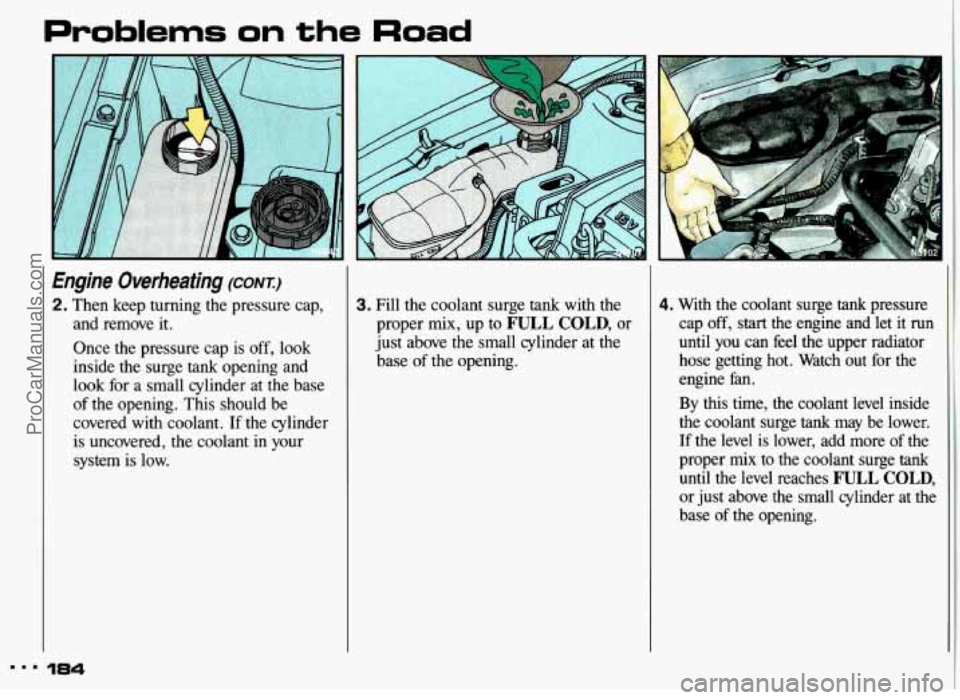
2. Then keep turning the pressure cap, and remove it.
Once the pressure cap is
off, look
inside the surge
tank opening and
look for a small cylinder at the base
of the opening. This should be
covered with coolant. If the cylinder
is uncovered, the coolant in your
system is low.
184
3. Fill the coolant surge tank with the
proper mix, up to
FULL COLD, or
just above the small cylinder at the
base of the opening.
4. With the coolant surge tank pressure
cap off,
start the engine and let it run
until you can feel the upper radiator
hose getting hot. Watch out for the
engine fan.
By this time, the coolant level inside
the coolant surge
tank may be lower.
If the level is lower, add more
of the
proper mix to
the coolant surge tank
until the level reaches F'ULL COLD,
or just above the small cylinder at the
base
of the opening.
ProCarManuals.com
Page 198 of 306

Part 6
... N604
Here you will find information
about the care of your Pontiac
. This
part begins with service and fuel
information. and then it shows how
to check important fluid and
lubricant levels
. There is also
technical information about your
vehicle. and a section devoted to its
appearance care
.
Service & Appearance Care
Service ................ .................................. 198
Fuel
........................................................... 199
HoodRelease .................................................... 205
Engineoil
...................................................... 209
Aircleaner
...................................................... 214
Transaxle Fluid
.................................................. 216
Engine Coolant
.................................................. 221
Power Steering Fluid
.............................................. 224
Windshield Washer Fluid
........................................... 224
Brakes
......................................................... 225
Battery
......................................................... 227
BulbReplacement
................................................ 228
Windshield Wiper Blade Replacement
................................. 230
Loading Your Vehicle
............................................. 230
Tires
.......................................................... 232
Appearancecare
................................................. 239
Vehicle Identification Number (VIN)
................................. 247
Add-on Electrical Equipment
....................................... 248
Fuses
& Circuit Breakers ........................................... 248
Capacities
& Specifications ......................................... 251
Fluids
& Lubricants ............................................... 253
Replacement Bulbs
............................................... 254
Normal Maintenance Replacement
Parts ............................. 257
197
ProCarManuals.com
Page 223 of 306

Service & Appearance Care
I Engine Coolant (CONI)
If you use an improper coolant
mix, your engine could overheat
and be badly damaged. The reDair
cost wouldn’t be covered by
yo
warranty. Too much water in the
mix can freeze and crack the
engine, radiator, heater
c ; and
other parts.
Adding Coolant
To Check Coolant:
When your engine is cold, the coolant
level should be at
FULL COLD, or a
little higher.
3
To Add Coolant:
If you need more coolant, add the
proper
mix at the surge tank, but only
when the engine is cool.
II
Turning the surge tank
L pressure cap when the engine
and radiator are hot can allow
sbeam and scalding liquids to blow
out and burn you badly. Never turn
the surge tank pressure capieven
a little-when the engine and I
radiator are hot.
ProCarManuals.com
Page 270 of 306

ITEM
NO. SERVICE
5 Engine Accessory Drive Belt Inspection*-
Inspect the belt. for cracks, fraying, wear and
proper tension. Replace
as needed.
6 Cooling System Service*-Drain, flush and refill
the system with new or approved recycled coolant
conforming to
GM Specification 1825M. Keep
coolant at the proper mixture as specified. See the
Index under Coolant. This provides proper freeze
protection, corrosion inhibitor level and engine
operating temperature.
Inspect hoses and replace if they are cracked,
swollen or deteriorated. Clean the outside of the
surge
tank and air conditioning condenser.
To help ensure proper operation, we recommend a
pressure test
of both the cooling system and the
surge
tank pressure cap.
doesn’t require changing.
7 Transaxle Service-For a manual transaxle, fluid
ITEM
NO. SERVICE
For an automatic transaxle, change both the fluid
and filter every
15,000 miles (25 OOO krn) if the
vehicle is mainly driven under one or more
of these
conditions:
In heavy city traffic where the outside temperature
regularly reaches 90°F
(32OC) or higher.
In hilly or mountainous terrain.
When doing frequent trailer towing. With some
models, you shouldn’t even tow a trailer. See the
Index under Towing a Trailer.
Uses such as found in taxi, police car or delivery
service.
8
9
If you do not use your vehicle under any of
these conditions, change both the fluid and filter
every 100,000 miles
(160 000 km).
Spark Plug Replacement *-Replace spark plugs
with the proper type. See the
Index under
Replacement Parts.
Spark Plug Wire Inspection (3300 V6 Code N
engine)**-Inspect for burns, cracks or other
damage. Check the boot fit at the coils and at the
spark plugs, Replace wires as needed.
ProCarManuals.com