1993 PONTIAC GRAND-AM service
[x] Cancel search: servicePage 151 of 306
Your Driving and the Road
Leaving the Freeway (CONT.)
extra time and flash your brake lights (in
addition to your turn signal) as extra
warning that you are about to slow
down and exit.
The exit ramp can be curved, sometimes
quite sharply. The exit speed is usually
posted. Reduce your speed according to
your speedometer, not to your sense of
motion. After driving for any distance at
higher speeds, you may tend to think
you are going slower than you actually
are. For example,
40 mph (65 km/h)
might seem like only
20 mph (32 km/h).
Obviously, this could lead to serious
trouble
on a ramp designed for 20 mph
(32 km/h)!
150
Driving a Long Distance
Although most long trips today are
made on freeways, there are still many
made on regular highways.
Long-distance driving on freeways and
regular highways is the same in some
ways. The trip has to be planned and the
vehicle prepared, you drive at higher-
than-city speeds, and there are longer
turns behind the wheel. You’ll enjoy
your trip more if you and your vehicle
are in good shape. Here are some tips
for a successful long trip.
Before Leaving on a Long nip
Make sure you’re ready. Try to be well
rested.
If you must start when you’re not
fresh-such as after a
day’s work-don’t
plan to make too many miles that first
part of the journey. Wear comfortable
clothing and shoes you can easily drive
in.
Is your vehicle ready for a long trip? If
you keep it serviced and maintained, it’s
ready to go. If it needs service, have it
done before starting out. Of course,
you’ll find experienced and able service
experts in Pontiac dealerships all across
North America. They’ll be ready and willing to help if you need it.
ProCarManuals.com
Page 153 of 306

your urwlng and the Road
Highway Hypnosis (CONI)
Keep your eyes moving. Scan the road
ahead and to the sides. Check your
rearview mirrors frequently and your
instruments from time to time. This
can help you avoid a fixed stare.
Wear good sunglasses in bright light.
Glare can cause drowsiness. But don’t
wear sunglasses at night. They will
drastically reduce your overall vision
at the very time you need all the
seeing power you have.
If you get sleepy, pull off the road into
a rest, service, or parking area and
take a nap, get some exercise, or both.
For safety, treat drowsiness on the
highway as an emergency.
As in any driving situation, keep pace
with traffic and allow adequate
following distances.
I CAUTION
d
Hill and Mountain Roads
Driving on steep hills or mountains is
different from driving in flat or rolling
terrain. If
you drive regularly in steep
country, or
if you’re planning to visit
there, here are
some tips that can make
your trips safer and more enjoyable.
Keep your vehicle in good shape.
Check all fluid levels and also the
brakes, tires, cooling system and
transaxle. These parts can work hard
on mountain roads.
Know how to go down hills. The most
important thing to know
is this: let
your engine do some of the slowing
down. Don’t make your brakes
do it
all. Shift to a lower gear when
you go
down a steep or long hill. That way,
you will slow down without excessive
use of your brakes.
A
If you don’t shift down, your
brakes could get
so hot that
they wouldn’t work well.
You
would then have poor braking or
even none going down a hill. You
could crash. Shift down to let your
engine assist your brakes on
a
steep downhill slope.
ProCarManuals.com
Page 163 of 306
Your Driving and the Road
If bu Do Decide to Pull a nailer
(COrvT)
You can ask your dealer for our
trailering information or advice, or
you can write us at:
Pontiac Customer Services
One Pontiac Plaza Pontiac, Michigan
48340-2952
General Motors of Canada Limited
Customer Assistance Center 1908 Colonel
Sam Drive
Oshawa, Ontario, L1H 8P7
Department
In Canada, write to:
162
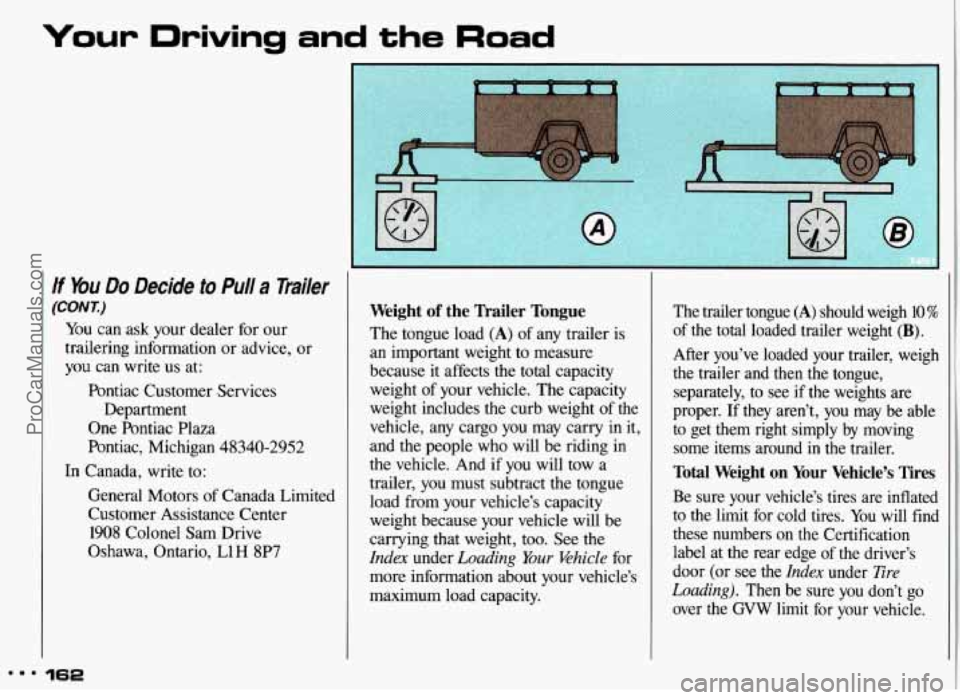
Weight of the Trailer Tongue
The
tongue load (A) of any trailer is
an
important weight to measure
because it affects the total capacity
weight
of your vehicle. The capacity
weight includes the curb weight of the
vehicle, any cargo you may carry in it,
and the people who will be riding
in
the vehicle. And if you will tow a
trailer, you must subtract the tongue
load from your vehicle’s capacity
weight because your vehicle will be carrying that weight, too. See the
Index under Loading Your Vehicle for
more information about your vehicle’s
maximum load capacity. The trailer tongue
(A) should weigh 10 %
of the total loaded trailer weight (B).
After you’ve loaded your trailer, weigh
the trailer and then the tongue, separately, to
see if the weights are
proper. If they aren’t, you may be able
to get them right simply by moving
some items around in the trailer.
Total Weight on Your Vehicle’s Tires
Be sure your vehicle’s tires are inflated
to the limit for cold tires. You will find
these numbers on the Certification
label at the rear edge of the driver’s
door
(or see the Index under Ere
Loading). Then be sure you don’t go
over the
GVW limit for your vehicle.
ProCarManuals.com
Page 167 of 306

Your Driving and the Road
Driving with a mailer (CONT.)
4. Reapply the regular brakes. Then
apply your parking brake, and then shift to
P (Park), or R (Reverse) for a
manual transaxle.
5. Release the regular brakes.
When You Are Ready to Leave After
Parking on a
Hill
1. Apply your regular brakes and hold
the pedal down while you:
Start your engine;
Shift into a gear; and
Release the parking brake.
2. Let up on the brake pedal.
3. Drive slowly until the trailer is clear
4. Stop and have someone pick up and
of the chocks.
store the chocks.
Maintenance When Tmiler Towing
Your vehicle will need service more
often when you’re pulling a trailer. See
the Maintenance Schedule for more on
this. Things that are especially important in trailer operation are
automatic transaxle fluid (don’t overfiil),
engine oil, belts, cooling system, and
brake adjustment. Each
of these is
covered
in this manual, and the Ida
will help you find them quickly. If
you’re trailering, it’s a good idea to
review these sections before you
start
your trip.
Check periodically to see that all hitch
nuts and bolts are tight.
m.. 166
ProCarManuals.com
Page 175 of 306
Problems on the Road
Jump Starting (CONI)
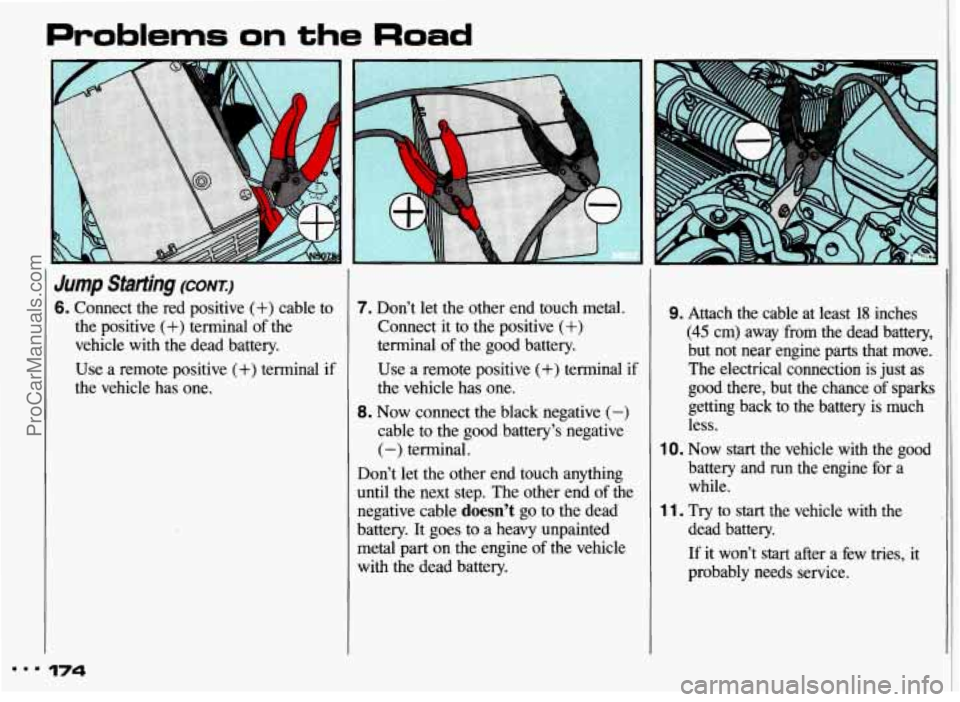
6. Connect the red positive (+) cable to
the positive
(+) terminal of the
vehicle with the dead battery.
Use a remote positive
(+) terminal if
the vehicle has one.
I74
7. Don’t let the other end touch metal.
Connect it to the positive
(+)
terminal of the good battery.
Use a remote positive
(+) terminal if
the vehicle has one.
8. Now connect the black negative (-)
cable to the good battery’s negative
(-) terminal.
Don’t let the other end touch anything
until the next step. The other end
of the
negative cable
doesn’t go to the dead
battery. It goes to a heavy unpainted
metal part on the engine of the vehicle
with the dead battery.
9. Attach the cable at least 18 inches
(45 cm) away from the dead battery,
but not near engine parts that move.
The electrical connection is just as
good there, but the chance
of sparks
getting back to the battery is much
less.
1 0. Now start the vehicle with the good
battery and run the engine for a
while.
11. Try to start the vehicle with the dead battery.
If it won’t
start after a few tries, it
probably needs service.
ProCarManuals.com
Page 176 of 306
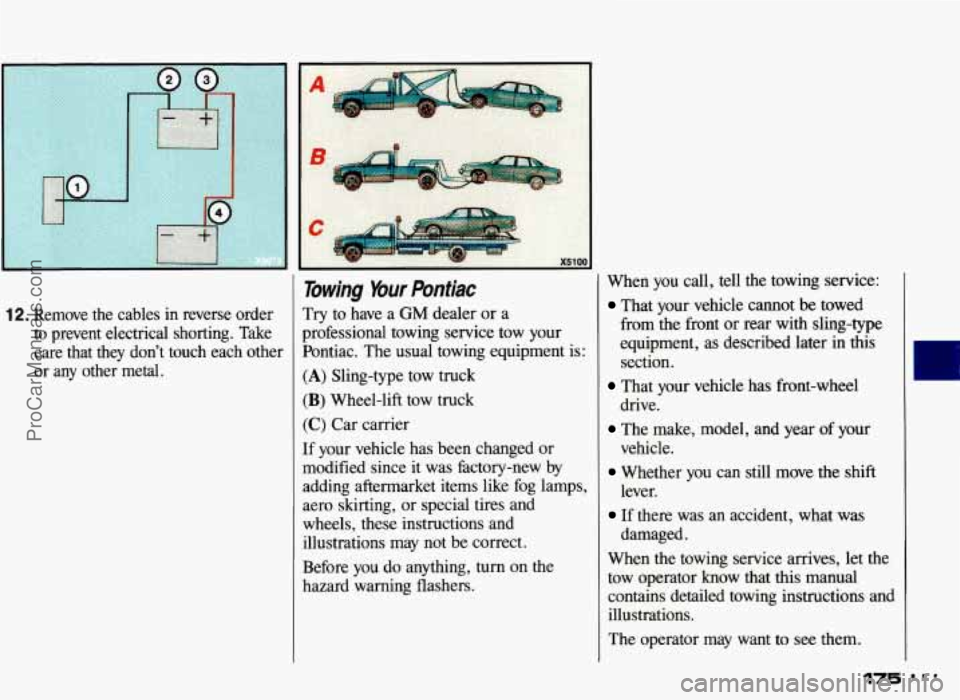
12. Remove the cables in reverse order
to prevent electrical shorting. Take
care that they don't touch each other
or any other metal.
lowing %ur Pontiac
Try to have a GM dealer or a
professional towing service tow your
Pontiac. The usual towing equipment is:
(A) Sling-type tow truck
(B) Wheel-lift tow truck
(C) Car carrier
If your vehicle has been changed or
modified since it was hctory-new
by
adding aftermarket items like fog lamps,
aero
skirting, or special tires and
wheels, these instructions and illustrations may not be correct.
Before you do anything,
turn on the
hazard warning flashers. When
you call,
tell the towing service:
That your vehicle cannot be towed
fram the front or rear with sling-type
equipment, as described later
in this
section.
drive. vehicle.
lever. damaged.
That your vehicle has front-wheel
The make, model, and year of your
Whether you can still move the shift
If there was an accident, what was
When the towing service arrives, let the
tow operator know that
this manual
contains detailed towing instructions and
illustrations.
The operator may want to
see them.
175 I..
ProCarManuals.com
Page 177 of 306
Problems on the Road
Towing Your Pontiac (CONT.:)
A others:
To help avoid injury to you or
0 Never let passengers ride in a
vehicle that is being towed.
Never tow faster than safe or
0 Never tow with damaged parts I
posted speeds.
0 Always use separate safety
chains on each side when towing
a vehicle.
hooks instead.
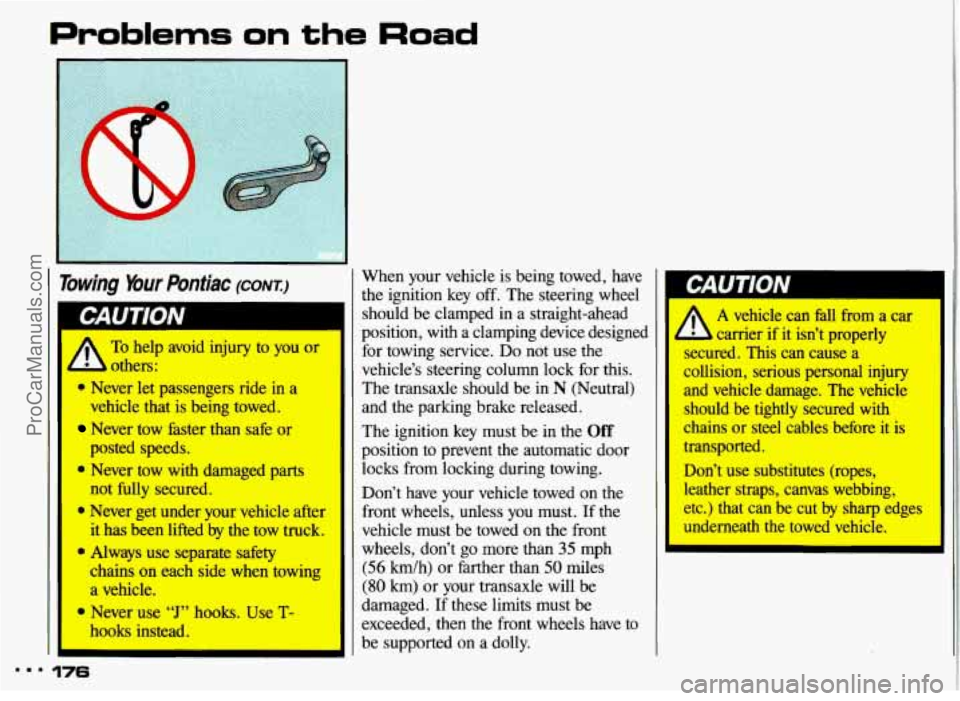
9 Never use “J” hooks. Use T-
... 176
When your vehicle is being towed, have
the ignition key off. The steering wheel
should be clamped
in a straight-ahead
position, with a clamping device designed for towing service.
Do not use the
vehicle’s steering column lock for this.
The transaxle should be
in N (Neutral)
and the parking brake released.
The ignition key must be in the
Off
position to prevent the automatic door
locks from locking during towing.
--
not fully secured. Don’t have your vehicle towed on the
Never get under your vehicle after front wheels, unless you must. If the
it has been lifted by the tow truck. vehicle must be towed on the front
wheels, don’t go more than
35 mph
(56 km/h) or farther than 50 miles
(80 km) or your transaxle will be
damaged. If these limits must be
exceeded, then the front wheels have to
be supported
on a dolly.
‘I
I‘
W
I A vehicle can fall from a car
b carrier if it isn’t properly
secured. This can cause a
collision, serious personal injury
I and vehicle damage. The vehicle
should be tightly secured with
chains or steel cables before it is
transported.
Don’t use substitutes (ropes, leather straps, canvas webbing,
etc.) that can be cut by sharp edges
underneath the towed vehicle.
ProCarManuals.com
Page 181 of 306
Problems on the Road
Engine Overheating (CONT)
If No Steam is Coming from Your
Engine:
If you get the overheat warning but see
or hear no steam, the problem may not
be
too serious. Sometimes the engine
can get a little too hot when you:
Climb a long hill on a hot day.
Stop after high speed driving.
Idle for long periods in traffic.
Tow a trailer.
180
If you get the overheat warning with no
sign of steam, try this for a minute or so:
1 . If you have an air conditioner, turn it
off.
2. Turn your heater to full hot at the
highest fan speed and open the window as necessary.
3. Try to keep your engine under load
(in a drive gear where the engine
runs slower).
If you no longer have the overheat
warning,
you can drive. Just to be safe,
drive slower for about ten minutes.
If
the warning doesn’t come back on, you
can drive normally.
If the warning continues, pull over, stop,
and park your vehicle right away. If there’s
still no sign of steam, you can
idle the engine for two or three minutes
while you’re parked, to
see if the
warning stops.
But then, if you still have the warning,
TURN
OFF THE ENGINE AND GET
EVERYONE OUT
OF THE VEHICLE
until it cools down.
You may decide not to lift the hood but
to get service help right away.
ProCarManuals.com