Page 293 of 436

6. Close the water drain valve and connect a hose going from the air bleed\
valve port
to a fuel-resistant container. The inside diameter of the hose
should be one-eighth of an inch.
for the starter to cool.
Do this until you can see clear fuel coming from
the air bleed valve.
7. Turn your ignition key to Start for 10 to 15 seconds. Wait one minute
8. Close the air bleed valve and replace the fuel tank cap.
9. Start your engine and let it idle for five minutes. Be sure to check your
fuel filter for leaks.
Fuels in Foreign Countries (Gasoline Engines)
If you plan on driving in another country outside the US. or Canada,
unleaded fuel may be hard to find.
Do not use leaded gasoline. If you use
even one tank full, your emission controls won’t work well \
or at all. With
continuous use, spark plugs can get fouled, the exhaust system \
can corrode,
and your engine oil can deteriorate quickly. Your vehicle’s three-way catalytic
converter and oxygen sensor will be damaged.
All of that means costly
repairs that wouldn’t be covered by your warranty.
To check on fuel availability, ask an auto club, or contact a major oil
company that does business in the country where you’ll be driving.
You can also write us at the following address for advice. Just tell us where
you’re going and give your Vehicle Identification Number (VIN).
General Motors of Canada Ltd.
International Export Sales
Post Office Box
828
Oshawa, Ontario L1H 7N1, Canada
6-1 5
ProCarManuals.com
Page 296 of 436
Service & Appearance Cam
i r:
PO21 7
If your vehicle has air conditioning, the auxiliary fan under the \
hood
can start up and injure you even when the engine is not runn\
ing.
Keep your hands, clothing and tools away from any underhood
electric fan,
if you have one.
Things that burn can get on hot engine parts and start
a fire. These
b include liquids like gasoline or diesel fuel, oil, coolant, bra\
ke fluid,
windshield washer and other fluids, and plastic or rubber. You or
others could be burned. Be careful not
to drop or spill things that will
burn onto a hot engine.
Before closing the hood, be sure all the filler caps are
on properly. Then just
pull the hood down and close it firmly.
6-1 8
ProCarManuals.com
Page 297 of 436

Cleaning Your Diesel Engine
you spray or pour water or any other liquid on your engine when it is
arm or hot,
or when it is running, you could cause serious damagl o it.
you ever clean the engine, clean it only when it is cold.
Noise Control System
The following information relates to compliance with Federal noi\
se emission
standards for vehicles with a Gross Vehicle Weight Rating (GVW\
R) of more
than 10,000 pounds
(4 536 kilograms). See your maintenance schedule for
information on maintaining the noise control system to minimize degradation
of
the noise emission control system during the life of your vehicle. The noise
control system warranty is given in your Warranty booklet.
These standards apply only to vehicles sold in the United States.
Tampering With Noise Control System Prohibited
Federal law prohibits the following acts or the causing thereof:
1. The removal or rendering inoperative by any person, other t\
han for purposes of maintenance, repair or replacement, of any device
or
element of design incorporated into any new vehicle for the purpose of
noise control, prior to its sale or delivery to the ultimate purchaser or
while it is in use;
or
2. The use of the vehicle after such device or element of design has been
removed or rendered inoperative by any person.
Among those acts presumed to constitute tampering are the acts listed below.
Insulation:
Removal of noise shields or underhood insulation.
Engine:
Removal or rendering engine speed governor, if so equipped, inoperative
so as to allow engine speed to exceed manufacturer specifications.
Fan and Drive:
Removal of fan clutch, if so equipped, or rendering clutch inoperative.
Removal of fan shroud, if so equipped.
Air Intake:
Removal of air cleaner silencer.
Reversing air cleaner cover.
6-1
9
ProCarManuals.com
Page 298 of 436
Service & Appearance Care
Exhaust:
Removal of muffler andlor resonator.
Removal of exhaust pipes and exhaust pipe clamps.
Engine Oil (Except Diesel)
It's a good idea to check your engine oil every time you get fuel. In order to
get an accurate reading, the oil must be warm and the vehicle\
must be on
level ground.
t
L
K2389
Turn off the engine and give the oil a few minutes to get back down into the
oil pan.
If you don't, the oil dipstick might not show the actual level.
I
K2613
To Check Engine Oil: Pull out the dipstick and clean it with a paper towel or
cloth, then push it back in all the way. Remove it again, keeping the tip lower.
6-20
ProCarManuals.com
Page 299 of 436
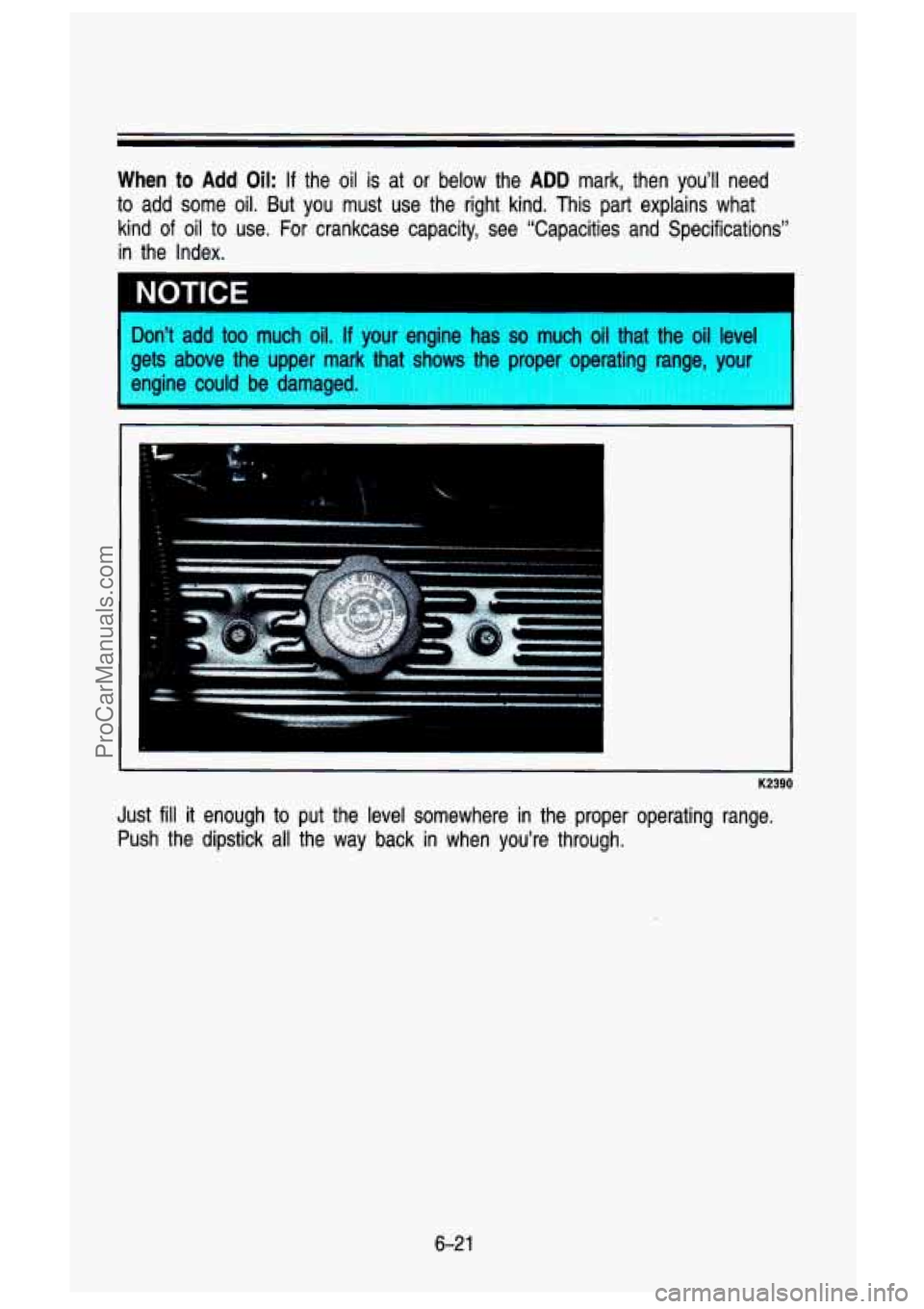
When to Add Oil: If the oil is at or below the ADD mark, then you’ll need
to add some oil. But you must use the right kind. This part explains what
kind
of oil to use. For crankcase capacity, see “Capacities and Specifications”
in the Index.
Don’t add too much
oil. If your engine has so much oil that the oil level
gets above the upper mark that shows the proper operating range, your
engine
could be damaged.
I
.I a.. ;
K2390
Just fill it enough to put the level somewhere in the proper operating range.
Push the dipstick all the way back in when you’re through.
6-2 1
ProCarManuals.com
Page 303 of 436

These numbers on an oil container show its viscosity, or thickness.
Do not use other viscosity oils such as
SAE IOW-40 or SAE 2OW-50.
Energy Conserving II
Oils with these words on the container will help you save fuel.
This doughnut-shaped logo (symbol) is used on most oil containers to help
you select the correct oil.
You should look for this on the oil container, and use
only those oils that
display the logo.
GM Goodwrench@ oil (in Canada, GM Engine Oil) meets all the requirements
for your vehicle.
Engine Oil Additives:
Don’t add anything to your oil. Your GM dealer is ready to advise if you think
something should be added.
When to Change Engine Oil:
See if any one of these is true for you:
Most trips are less than 4 miles (6 km).
It’s below freezing outside and most trips are less than 10 miles
(16 km).
The engine is at low speed most of the time (as in door to door
delivery, or in stop-and-go traffic).
You tow a trailer often.
Most trips are through dusty places.
The vehicle is frequently operated off-road.
If any one of these is true for your vehicle, then you need to change your
oil and filter every 3,000 miles (5000 km) or 3 months-whichever comes
first.
Vehicles with Light Duty Emissions (8500 GVWR or less).
If none of them is true, change the oil every 7,500 miles (12 500 km) or 12
months-whichever comes first. Change the filter at the first oil change and at
every other oil change after that.
Vehicles with Heavy Duty Emissions (8501 GVWR or more).
If none of them is true, change the oil every 6,000 miles (10 000 km) or 12
months-whichever comes first. Change the filter at the first oil change and at
every other oil change after that
‘if mileage determines when you change your
oil.
If time determines when you change your oil, change the filter ea\
ch time
you change your oil.
6-25
ProCarManuals.com
Page 304 of 436

Service & Appearance Care
Engine Block Heater:
An engine block heater can be a big help if you have to park outside in very
cold weather,
0°F (-18°C) or colder. If your vehicle has this option, see
“Engine Block Heater” in the Index.
What to Do with Used Oil:
I CAUTION I
Used engine oil contains things that have caused skin cancer
laboratory animals. Don’t let used oil stay on your skin fo\
r very
I
Clean your skin and nails with soap and water, or a good han\
d
cleaner. Wash or properly throw away clothing or rags containin\
g
used engine oil.
Used-oil can be a real threat
to the environment. If you change your own oil,
be sure to drain all free-flowing oil from the filter before disp\
osal. Don’t ever
dispose of oil by putting it in the trash, pouring it on the ground, into sewers,
or into streams or bodies of water. Instead, recycle it by taking it to a place
that collects used
oil. If you have a problem properly disposing of your used
oil, ask your dealer, a service station or a local recycling \
center for help.
Engine Oil (Diesel Engines)
It’s a good idea to check your engine oil level every time you get fuel. In
order
to get an accurate reading, the oil must be warm and the vehicle\
must
be on level ground.
c
-
K2394
Turn off the engine and give the oil a few minutes to drain back into the oil
pan. If you don’t the
oil dipstick might not show the actual level.
6-26
ProCarManuals.com
Page 305 of 436
T-
K2613
To Check Engine Oil: Pull out the dipstick and clean it with a paper towel
or a cloth, then push it back in all the way. Remove it again, keeping the tip
lower.
When to Add Oil: If the oil is at or below the ADD line, then you’ll need to
add some oil. But you must use the right kind. This part explains what kind\
of oil to use. For crankcase capacity, see “Capacities and Spec\
ifications’’ in
the Index.
Don’t add too much oil. If your engine has so much oil that the oil level
gets above the proper operating range, your engine could
be damaged. I
I
w
ii
I
- “‘I
. ..
Ll
6 -”
i f f i
w
K2395
6-27
ProCarManuals.com