1993 CHEVROLET S10 check oil
[x] Cancel search: check oilPage 198 of 356

Downloaded from www.Manualslib.com manuals search engine Your Driving and the Road
..
C. .-, - ._ .
may tend to think you are going slower than you actually are.\
For example,
40 mph (65 km/h) might seem like only 20 mph (30 km/h). Obviously, this
could lead to serious trouble on a ramp designed for
20 mph (30 km/h)!
Driving a Long Distance
Although most long trips today are made on freeways, there are\
still many
made on regular highways.
Long-distance driving on freeways and regular highways is the s\
ame in some
ways. The trip has to be planned and the vehicle prepared, yo\
u drive at
higher-than-city speeds, and there are longer turns behind the \
wheel. You’ll
enjoy your trip more if you and your vehicle are in good shape. Here are
some tips for a successful long trip.
Before Leaving on a Long Trip
Make sure you’re ready. Try to be well rested. If you must start when you’re
not fresh-such as after a day’s work-don’t plan to make too many miles
that first part of the journey. Wear comfortable clothing and shoes you can
easily drive in.
Is your vehicle ready for a long trip? If you keep it serviced and maintained,
it’s ready to go.
If it needs service, have it done before starting out. Of
course, you’ll find experienced and able service experts in \
your vehicle’s
dealerships all across North America. They’ll be ready and w\
illing to help
if
YOU
Her1
0
need it.
ire
Some things you can check before a trip:
Windshield Washer Fluid:
Is the reservoir full? Are all windows clean
inside and outside?
Wiper Blades: Are they in good shape?
Fuel, Engine Oil, Other Fluids: Have you checked all levels?
Lights: Are they all working? Are the lenses clean?
Tires: They are vitally important to a safe, trouble-free trip.\
Is the tread
good enough for long-distance driving? Are the tires all inflat\
ed to the
recommended pressure?
Weather Forecasts: What’s the weather outlook along your rout\
e? Should you delay your trip
a short time to avoid a major storm system?
Maps:
Do you have up-to-date maps?
4-44
Page 216 of 356

Downloaded from www.Manualslib.com manuals search engine Your Driving and the Road
2. Let up on the brake pedal.
3. Drive slowly until the trailer is clear of the chocks.
4. Stop and have someone pick up and store the chocks.
Maintenance When Trailer Towing
Your vehicle will need service more often when you’re pulling a \
trailer. See
the Maintenance Schedule for more on this. Things that are esp\
ecially important in trailer operation are automatic transmission fluid (don’t ove\
rfill),
engine oil, axle lubricant, belt, cooling system, and brake adj\
ustment. Each of
these is covered in this manual, and the Index will help you find them
quickly.
If you’re trailering, it’s a good idea to review these sections before
you start your trip.
Check periodically to see that all hitch nuts and bolts are tight.
Trailer Light Wiring
See “Trailer Wiring Harness” in the Index.
Power Winches
If you wish to use a power winch on your vehicle, only use it when your
vehicle is stationary or anchored.
NOTICE
Use the regular brakes, set the parking brake Or UIWK ihe wheels IW keep
your vehicle from rolling.
4-62
Page 249 of 356
Downloaded from www.Manualslib.com manuals search engine Service & Appearance Care
-
Section
Here you will find information about the care of your vehicle. This part begins
with service and fuel information, and then it shows how to check important
fluid and lubricant levels. There
is also technical information about your
vehicle, and a section devoted to its appearance care.
Service
.. . . .. . . . . , . , . . r.l. .. . . .. ,. . . . . . . . . , , . . . . . . .. , . . .. , . . . . . . . . . . . . . . . . . . . . ..,. . . . . . . . . . . . . . . .=. . . . . . . . . . . . .. . .=. . . . . 6-3
Fuel
...... . .. .. . . . . ....... , .. . .. . . . . . . ... . .. ... .. ... .... .. . . . . . . ... . . .. . .. . ... ,..,, ,. .. . .. .. . .. . . .... . *. . . ., . . . .. .. .. 6-4
Checking Things Under the
Hood .................................................................,..... \
6-7
Engine Oil
I.....................1............11..........,.......,.,..I...........\
........r............. .......,. .... 6-9
Air Cleaner
..................,................................................. ...... .... ...- ......... - ..... ...... 6-14
Automatic Transmission Fluid
....... . .. . . .. . . . . .. ....-. . ... . . . . . .. .. . . . . . . . . . ... .. . . . . .. . ... . . ...... .. 6-16
Manual Transmission Fluid
....,. , . . . . ....... ... . . . .. .. . . . .. .. . .. .. . . ... . .. . . . . .. . ... . ... . . ... . . ... . . . .. 6-1 9
Hydraulic Clutch
,..........,......,....,..........I...I....I...................... ...................... ..... 6-20
Rear Axle
............ ..................... = .............I...............I..I........................ -.. ..... . .... ..... 6-21
Transfer Case
................................................,.~.....................\
..........................6-21
Front Axle .......I.............I......I.....................r..........I...r......\
............I......I.II...I...... 6-22
Engine Coolant
........................... ~ ................................. r..l ................................ 6-23
Power Steering Fluid
.....,. 3.,Iri.1111r ..................................................................... 6-27
Windshield Washer Fluid
...................................................... .................... 6-28
Brake Master Cylinder
........ . . . . .. . .... . .. .. . . . . ... . . . . .. . . . .. ..... .... . . . . . . . .. .. . . . . . .6-29
Replacing Brake System Parts
............................................................,..........,\
.. 6-30
6-1
Page 254 of 356

Downloaded from www.Manualslib.com manuals search engine Service & Appearance Care
Fuels in Foreign Countries
If you plan on driving in another country outside the US. or Canada,
unleaded fuel may be hard
to find. Do not use leaded gasoline. If you use
even one tankful, your emission controls won’t work well or at all. With
continuous use, spark plugs can get fouled, the exhaust system \
can corrode,
and your engine oil can deteriorate quickly. Your vehicle’s three-way catalytic
converter and oxygen sensor will be damaged.
All of that means costly
repairs that wouldn’t be covered by your warranty.
To check on fuel availability, ask an auto club, or contact a major oil
company that does business in the country where you’ll be d\
riving.
You can also write us at the following address for advice.
Just tell us where
you’re going and give your Vehicle Identification Number (VI\
N).
General Motors
of Canada Limited
International Export Sales
P.O. Box 828
Oshawa, Ontario LIH 7N1, Canada
Filling Your Tank
A Gasoline vapor is highly flammable. It burns violently, and that can
cause very bad injuries. Don’t smoke if you’re near g’asoline or
aefuel’ing your vehicle. Keep sparks, flames, and smoking mat\
erials
away fmm gasoline.
I
6-6
Page 257 of 356
Downloaded from www.Manualslib.com manuals search engine I
Engine Oil
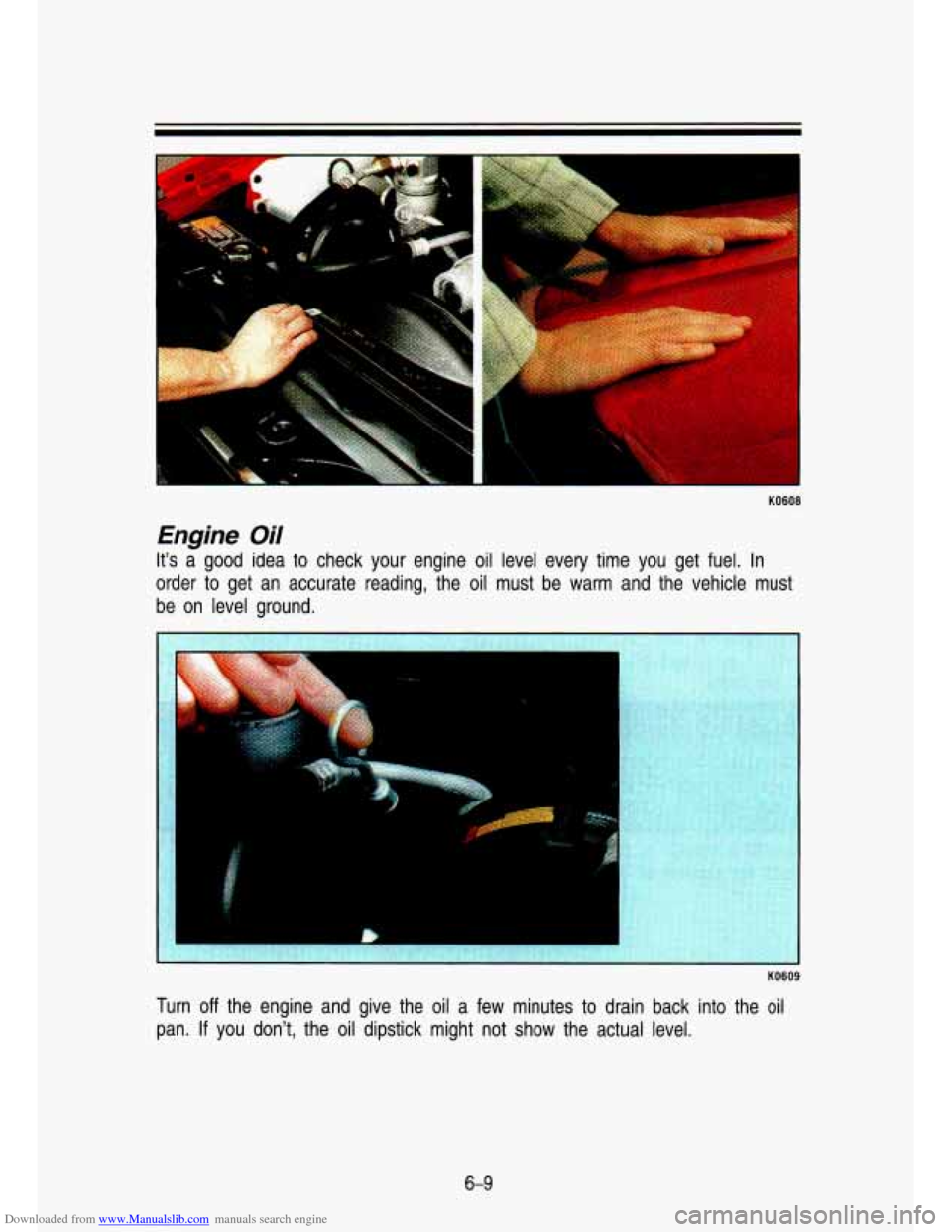
It's a good idea to check your engine oil level every time you get fuel. In
order to get an accurate reading, the oil must be warm and the vehicle\
must
be on level around.
a
KO609
Turn off the engine and give the oil a few minutes to drain back into\
the oil
pan.
If you don't, the oil dipstick might not show the actual level.
6-9
Page 258 of 356
Downloaded from www.Manualslib.com manuals search engine Service & Appearance Care
--
*I
KO61 0
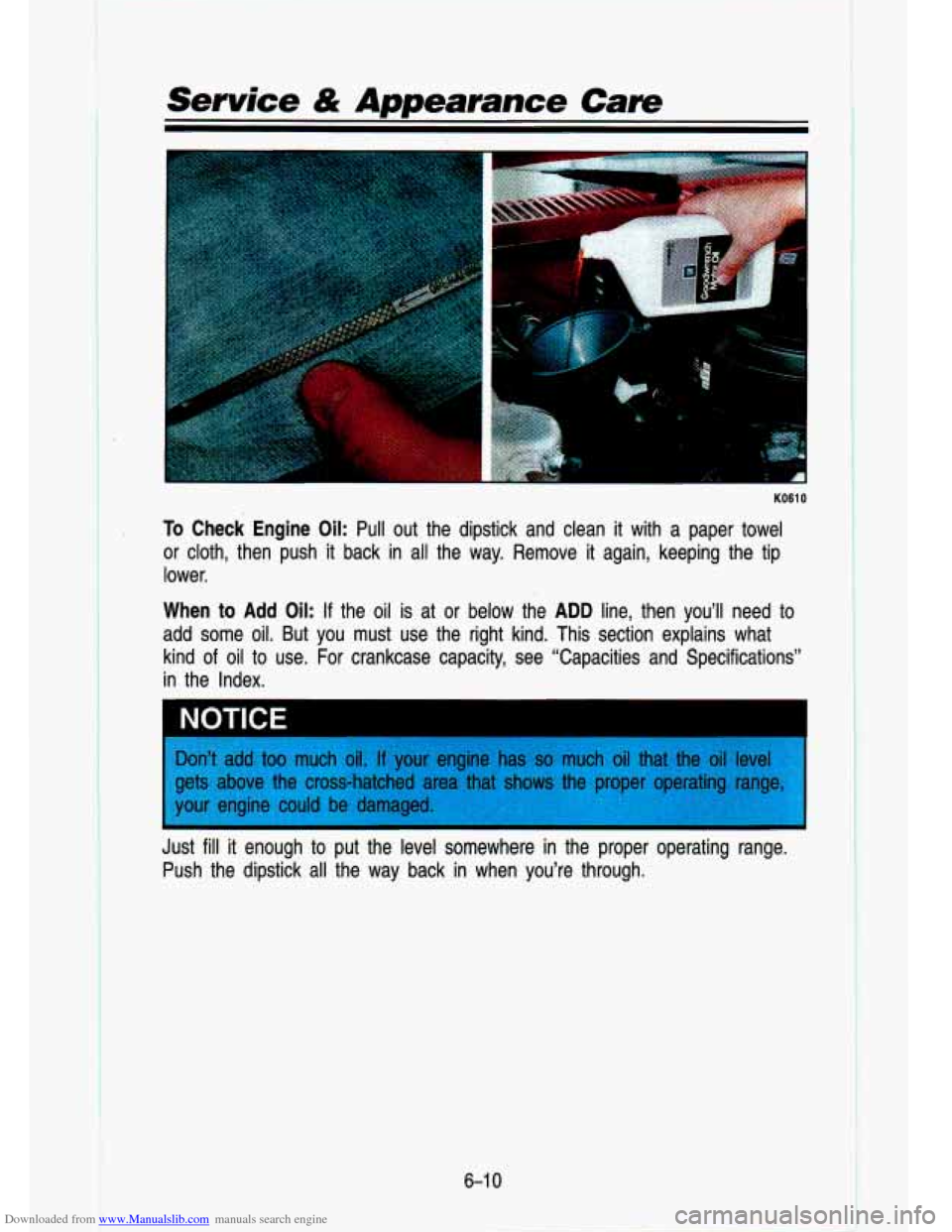
. To Check Engine Oil: Pull out the dipstick and clean it with a paper towel
or cloth, then push it back in all the way. Remove it again, keeping the tip
lower.
When to Add Oil: If the oil is at or below the ADD line, then you’ll need to
add some oil. But you must use the right kind. This section \
explains what
kind
of oil to use. For crankcase capacity, see “Capacities and Specification\
s”
in the Index.
NOTICE I
I
Just till it enough to put the level somewhere in the proper operating range.
Push the dipstick
all the way back in when you’re through.
6-1 0
Page 264 of 356
Downloaded from www.Manualslib.com manuals search engine Service & Appearance Care
Automatic Transmission Fluid
When to Check and Change:
A good time to check your automatic transmission fluid level is when the
engine oil is changed. Refer to the Maintenance Schedule to de\
termine when
to change your fluid. See “Scheduled Maintenance Services” \
in the Index.
How to Check:
Because this operation can be a little difficult, you may choo\
se to have this
done at a dealership Service Department.
If you
do it yourself, be sure to follow all the instructions here, or \
you could
get a false reading on the dipstick.
I NOTICE
Wait at least 30 minutes before checking the transmission fluid level if you
have been driving:
When outside temperatures are above 90°F (32°C).
At high speed for quite a while.
In heavy traffic-especially in hot weather.
While pulling a trailer.
To get the right reading, the fluid must be at normal operating \
temperature,
which is 180°F to 200°F (82°C to 93°C).
To check transmission fluid hot: Get the vehicle warmed up by driving
about
15 miles (24 km) when outside temperatures are above 50°F (10°C). If
it’s colder then 50°F (IO’C), drive the vehicle in D (3rd gear) until the
temperature gage moves and then remains steady for ten minutes.\
Then
follow the hot check procedures.
To check transmission fluid cold: A cold check is made after the vehicle
has been sitting for eight hours or more with the engine off and is used
only
as a reference. Let the engine run at idle for five minutes if outside
temperatures are
50°F (10°C) or more. If it’s colder than 50°F (lO°C), you
may have to idle the engine longer. A hot check must follow when fluid is
added during a cold check.
6-1 6
I
Page 267 of 356

Downloaded from www.Manualslib.com manuals search engine Manual Transmission Fluid
When to Check:
A good time to have it checked is when the engine oil is chang\
ed. However,
the fluid in your manual transmission doesn’t require changin\
g.
How to Check:
Because this operation can be a little difficult, you may choose to have this
done at a
GM dealership Service Department.
If you do it yourself, be sure to follow all the instructions here, or \
you could
get a false reading.
Check the fluid level only when your engine is off, the vehic\
le
is parked on
level place and the transmission is cool enough for you to re\
st your fingers
on the transmission case.
Then,
follow these steps: a
PO336
1. Remove the filler plug.
2. Check that the lubricant level
is up to the bottom of the filler plug hole.
3. If the fluid level is good, install the plug and be sure it is fully seated. If
the fluid level is low, add more fluid as described in the next steps.
6-1 9