Page 246 of 356
Downloaded from www.Manualslib.com manuals search engine Pm6/ems on the Road
If You’re Stuck: In Sand, Mud, Ice or
snow
What you don’t want to do when your vehicle is stuck is to spin your
wheels. The method known as “rocking” can help you get o\
ut when you’re
stuck, but you must use caution.
~
fi If you let your tires spin at high speed, they can explode and you1 or
others could be injured. And, the transmiss’ion or other parts of the
vehicle
can overheat. That could cause an engine comparlme’nt fire
or other damage. When you’re
stuck, spin the wheels as little as
possible.
Don’t spin the wheels above 35 rnph 1(55 krn/h) as shown
oln the speedometer.
Rocking Your Vehicle To Get It Out:
First, turn your steering wheel left and right. That will clear the area \
around
your front wheels. Then shift back and forth between
R (Reverse) and a
forward gear (or with a manual transmission, between
1 (First) or 2 (Second)
gear and
R (Reverse), spinning the wheels as little as possible. Release \
the
accelerator pedal while you shift, and press lightly on the accelerator pedal
when the transmission is in gear.
If that doesn’t get you out after a few tries,
you may need to be towed
out. Or, you can use your recovery hooks, if your
vehicle has them.
If you do need to be towed out, see “Towing Your Vehicle’’
in the Index.
5-30
Page 258 of 356
Downloaded from www.Manualslib.com manuals search engine Service & Appearance Care
--
*I
KO61 0
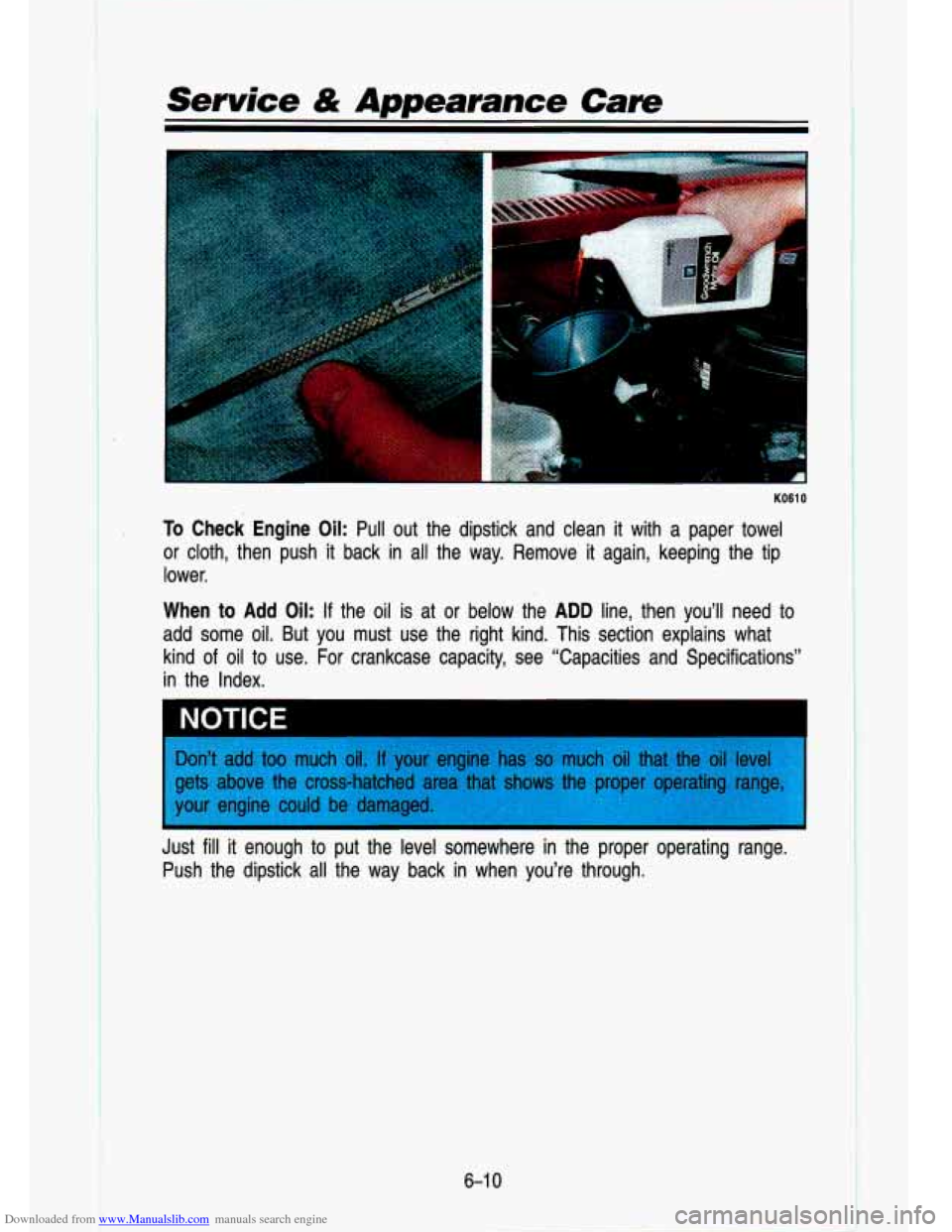
. To Check Engine Oil: Pull out the dipstick and clean it with a paper towel
or cloth, then push it back in all the way. Remove it again, keeping the tip
lower.
When to Add Oil: If the oil is at or below the ADD line, then you’ll need to
add some oil. But you must use the right kind. This section \
explains what
kind
of oil to use. For crankcase capacity, see “Capacities and Specification\
s”
in the Index.
NOTICE I
I
Just till it enough to put the level somewhere in the proper operating range.
Push the dipstick
all the way back in when you’re through.
6-1 0
Page 261 of 356
Downloaded from www.Manualslib.com manuals search engine Energy Conserving II
Oils with these words on the container will help you save fuel.
This doughnut-shaped logo (symbol) is used
on most oil containers to help
you select the correct oil.
You should look for this on the oil container, and use
only those oils that
display the logo.
GM Goodwrench@ oil (in Canada, GM Engine Oil) meets all the requirements
for your vehicle.
Engine Oil Additives:
Don’t add anything to your oil. Your GM dealer is ready to advise if you think
something should be added.
When to Change Engine c)k
See if any one of these is true for you:
Most trips are less than 4 miles (6 km).
It’s below freezing outside and most trips are less than 10 miles
(16 km).
The engine is at low speed most of the time (as in door-to-door delivery,
You tow a trailer often.
or in stop-and-go traffic).
Most trips are through dusty places.
The vehicle is frequently operated off-road.
If any one of these is true for your vehicle, you need to chang\
e your oil and
filter every 3,000 miles (5000 km) or 3 months-whichever comes first.
If none of them are true, change the oil every 7,500 miles (12 500 km) or
12 months-whichever comes first. Change the filter at the first oil change
and at every other oil change after that.
If your vehicle has 4-wheel drive, you ,will have a remote oil filter located
under the hood.
It is mounted to the front left inner fender, behind the
headlights.
Engine Block Heater:
An engine block heater can be a big help if you have to park outside in very
cold weather,
-0°F (-18°C) or colder. If your vehicle has this option, see
“Engine Block Heater” in the Index.
6-1 3
Page 265 of 356
Downloaded from www.Manualslib.com manuals search engine To check the fluid hot or cold:
Park your vehicle on a level place.
Place the shift lever in P (Park) with the parking brake applied.
With your foot on the brake pedal, move the shift lever through each
gear range, pausing for about three seconds in each range. Then,
position the shift lever in
P (Park).
Let the engine run at idle for three minutes or more.
Then, without shutting
off the engine, follow these steps:
NO031
I------
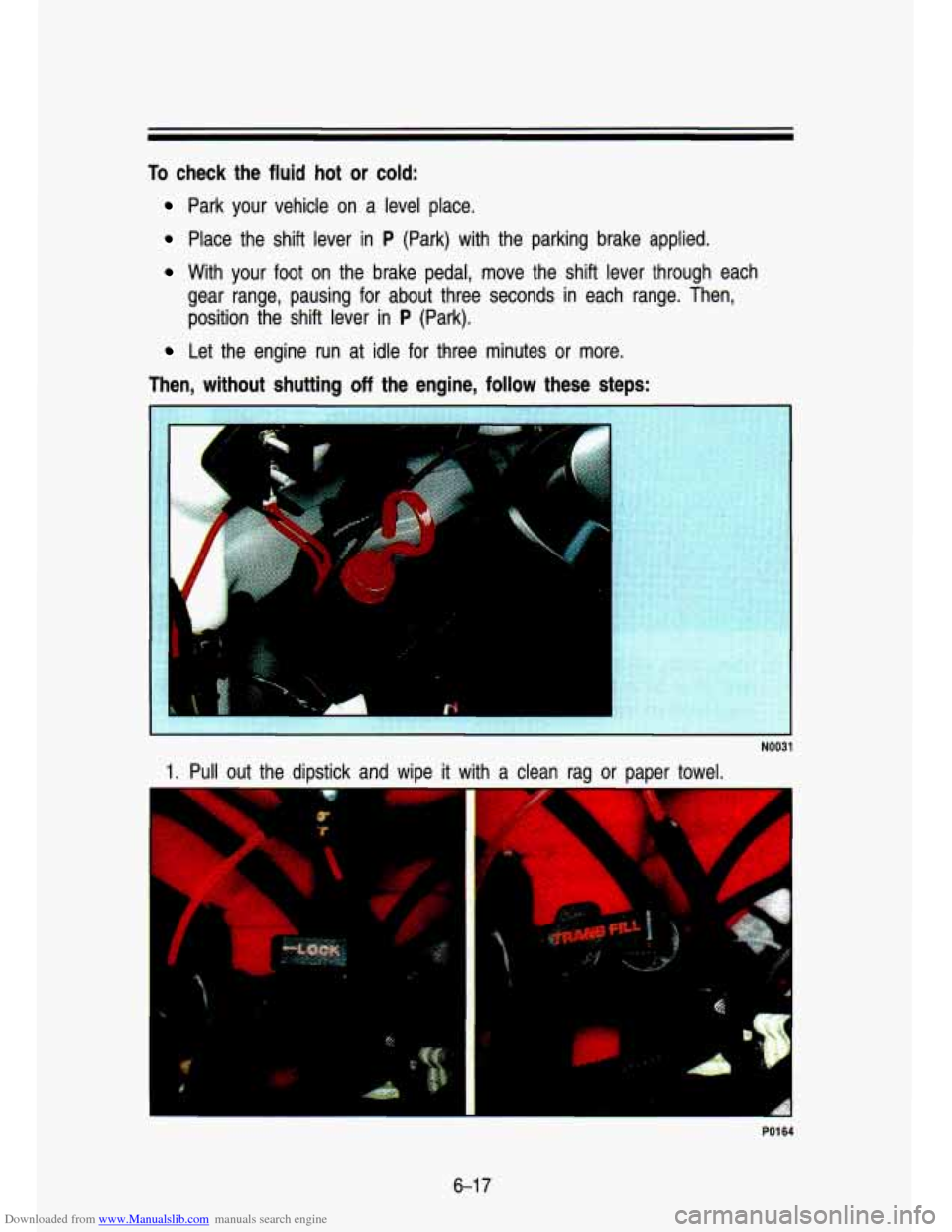
1. Pull out the dipstick and wipe it with a clean rag or paper towel.
PO1 64
6-1 7
Page 266 of 356

Downloaded from www.Manualslib.com manuals search engine Service & Appearance Care
If you have a 4.3L engine, you will have a flip-top handle. Flip\
the
handle up and then pull out the dipstick and wipe it clean with a rag or
paper towel.
2. Push it back in all the way, wait three seconds and then pull it back out
again. Flip top handle should remain in open position.
c
PO1 65
3. Check both sides of the dipstick, and read the lower level. The fluid
level must be in the COLD area for a cold check or in the HOT area or
cross-hatched area for a hot check.
4.
If the fluid. level is where it should be, push the dipstick bac\
k in all the
way.
If you have a flip-top handle, flip the handle down to lock it in place.
How To Add Fluid:
Refer to the Maintenance Schedule to determine what kind of transmission
fluid to use. See “Recommended Fluids and Lubricants” in \
the Index.
If the fluid level is low, add only enough of the proper fluid to bring the level
up to the COLD area for a cold check or the HOT area for a hot c\
heck. It
doesn’t take much fluid, generally less than a pint. Don’\
t overfill. We
recommend you use only fluid labeled DEXRON@lIE, because fluids \
with that
label are made especially for your automatic transmission. Damag\
e caused by
fluid other than DEXRON@IIE is not covered by your new vehicle\
warranty.
After adding fluid, recheck the fluid level as described under \
“How To
Check”.
When the correct fluid level is obtained, push the dipstick ba\
ck in all the
way. Flip the handle down
if you have a flip-top handle.
6-1 8
1
Page 288 of 356
Downloaded from www.Manualslib.com manuals search engine .-
.. .. -. .- -. -. .
Service & Appearance Care
Trailering Package
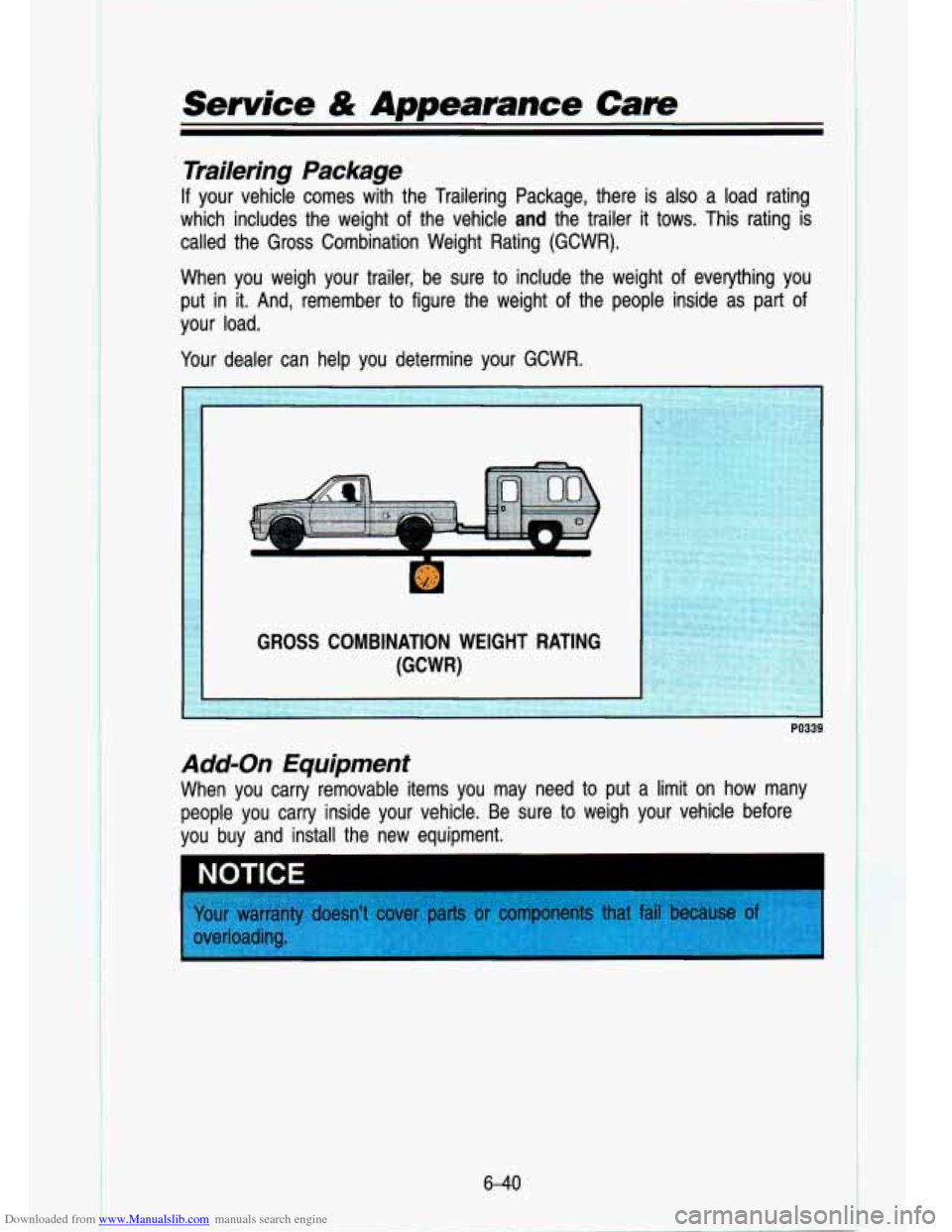
If your vehicle comes with the Trailering Package, there is also a load rating
which includes the weight of the vehicle
and the trailer it tows. This rating is
called the Gross Combination Weight Rating (GCWR).
When you weigh your trailer, be sure to include the weight of everything you
put in it. And, remember to figure the weight
of the people inside as part of
your load.
Your dealer can help you ?-‘ermine your GCWR.
Page 293 of 356
Downloaded from www.Manualslib.com manuals search engine K2655
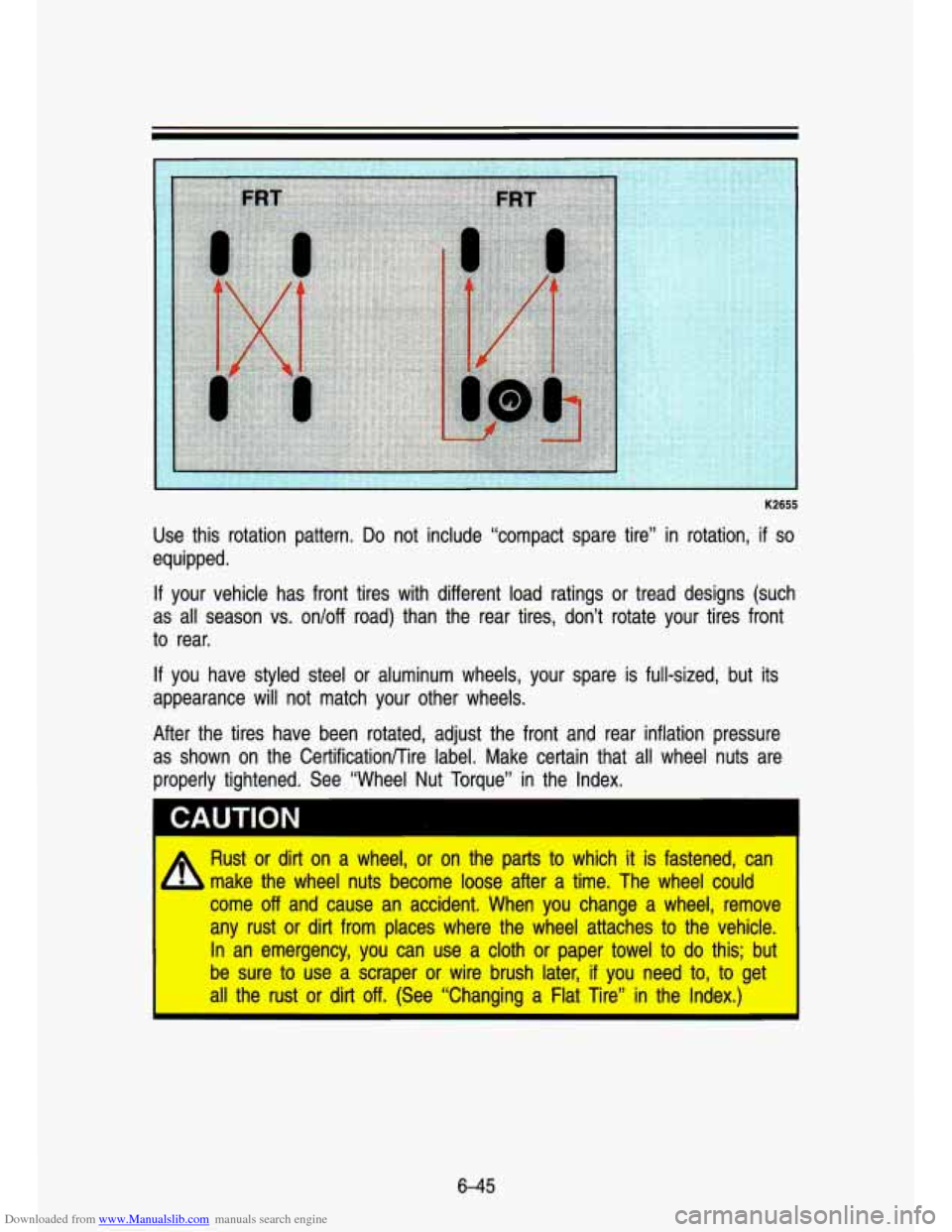
Use this rotation pattern. Do not include “compact spare tire” in rotation, if so
equipped.
If your vehicle has front tires with different load ratings or tr\
ead designs (such
as all season vs. on/off road) than the rear tires, don’t \
rotate your tires front
to rear.
If you have styled steel or aluminum wheels, your spare is full-s\
ized, but its
appearance will not match your other wheels.
After the tires have been rotated, adjust the front and rear \
inflation pressure as shown on the CertificationRire label. Make certain that
all wheel nuts are
properly tightened. See “Wheel Nut Torque” in the Index.
A
Rust or dirt on a wheel, or on the parts to which it is fastened, can
make the wheel nuts become loose after a time. The wheel coul\
d
come off and cause an accident. When you change a wheel, remove
any rust or dirt from places where the wheel attaches to the \
vehicle.
In an emergency, you can use a cloth or paper towel to
do this; but
be sure to use a scraper or wire brush later, if you need to, to get
all the rust or dirt off. (See “Changing a Flat Tire” in t\
he Index.)
6-45
Page 300 of 356
Downloaded from www.Manualslib.com manuals search engine Service & Appearance
Rinse the section with a clean, wet sponge.
Wipe off what’s left with a slightly damp paper towel or c\
loth.
Then dry it immediately with an air hose, a hair dryer or a heat lamp.
Wipe wlrh a clean cloth.
Using Solvent-Type Cleaner on Fabric
First, see if you have to use solvent-type cleaner at all. Some spots and
stains will clean off better with just water and mild soap.
If you need to use it, then:
Gently scrape excess soil from the trim material with a clean,\
dull knife
or scraper. Use very little cleaner, light pressure and clean cloths
(preferably cheesecloth). Cleaning should start at the outside \
of the stain,
“feathering” toward the center. Keep changing to a clean section of the
cloth.
When you clean a stain from fabric, immediately dry the area \
with an air hose, hair dryer, or heat lamp to help prevent a cleaning ring. (See
.
previous NOTICE.)
Special Cleaning Problems
Greasy or Oily Stains: Like grease, oil, butter, margarine, shoe polish, coffee
with cream, chewing gum, cosmetic creams, vegetable oils, wax c\
rayon, tar and asphalt.
Carefully scrape off excess stain.
Then follow the solvent-type instructions above.
Shoe polish, wax crayons, tar and asphalt will stain if left on a vehicle
seat fabric. They should be removed as soon as possible. Be c\
areful, because the cleaner will dissolve them and may cause them
to bleed.
Non-Greasy Stains: Like catsup, coffee (black), egg, fruit, fr\
uit juice, milk,
soft drinks, wine, vomit, urine and blood.
Carefully scrape off excess stain, then sponge the place with cool water.
If a stain remains, follow the foam-type instructions above.
6-52
i