1993 CHEVROLET S10 change time
[x] Cancel search: change timePage 199 of 356

Downloaded from www.Manualslib.com manuals search engine On the Road
Unless you are the only driver, it is good to share the driving task with
others. Limit turns behind the wheel to about
100 miles (160 km) or two
hours at a sitting. Then, either change drivers or stop for s\
ome refreshment
like coffee, tea or soft drinks and some limbering up. But
do stop and move
around. Eat lightly along the way. Heavier meals tend to make some people
sleepy.
On two-lane highways or undivided multilane highways that
do not have
controlled access, you’ll want to watch for some situations not usually found
on freeways. Examples are: stop signs and signals, shopping cen\
ters with
direct access to the highway, no passing zones and school zones, vehicles
turning left and right
off the road, pedestrians, cyclists, parked vehicles, and
even animals.
Highway Hypnosrs
Is there actually such a condition as “highway hypnosis?” Or \
is it just plain
falling asleep at the wheel? Call it highway hypnosis, lack of awareness, or
whatever.
There is something about an easy stretch of road with the same scenery,
along with the hum of the tires on the road, the drone of the engine, and the
rush of the wind against the vehicle that can make you sleepy. Don’\
t let it
happen to you!
If it does, your vehicle can leave the road in less than a
second, and you could crash and be injured.
What can you
do about highway hypnosis? First, be aware that it can
happen.
Then here are some tips:
Make sure your vehicle is well ventilated, with a comfortably \
cool interior.
Keep your eyes moving. Scan the road ahead and to the sides. \
Check
your rearview mirrors frequently and your instruments from time \
to time.
This can help you avoid a fixed stare.
Wear good sunglasses in bright light. Glare can cause drowsines\
s. But don’t wear sunglasses at night. They will drastically reduce \
your overall
vision at the very time you need all the seeing power you have.
If you get sleepy, pull off the road into a rest, service, or parking area
and take a nap, get some exercise, or both. For safety, treat drowsiness
on the highway as an emergency.
As in any driving situation, keep pace with traffic and allow adequat\
e
following distances.
4-45
Page 241 of 356
Downloaded from www.Manualslib.com manuals search engine I
CAUT'oN
I A Rust or dirt on the wheel, or on the parts to which it is fastened,
4 can make the wheel nub become loose after a time. The wheel
could come off and cause an accident. When you change a wheel,
remove any rust or dirt from the places where the wheel attaches to
the vehicle.
In an emergency, you can use a doth or a paper towel
to
do this; but be sure to use a scraper or wire brush later, if you
need to, to get all the rust or dirt off.
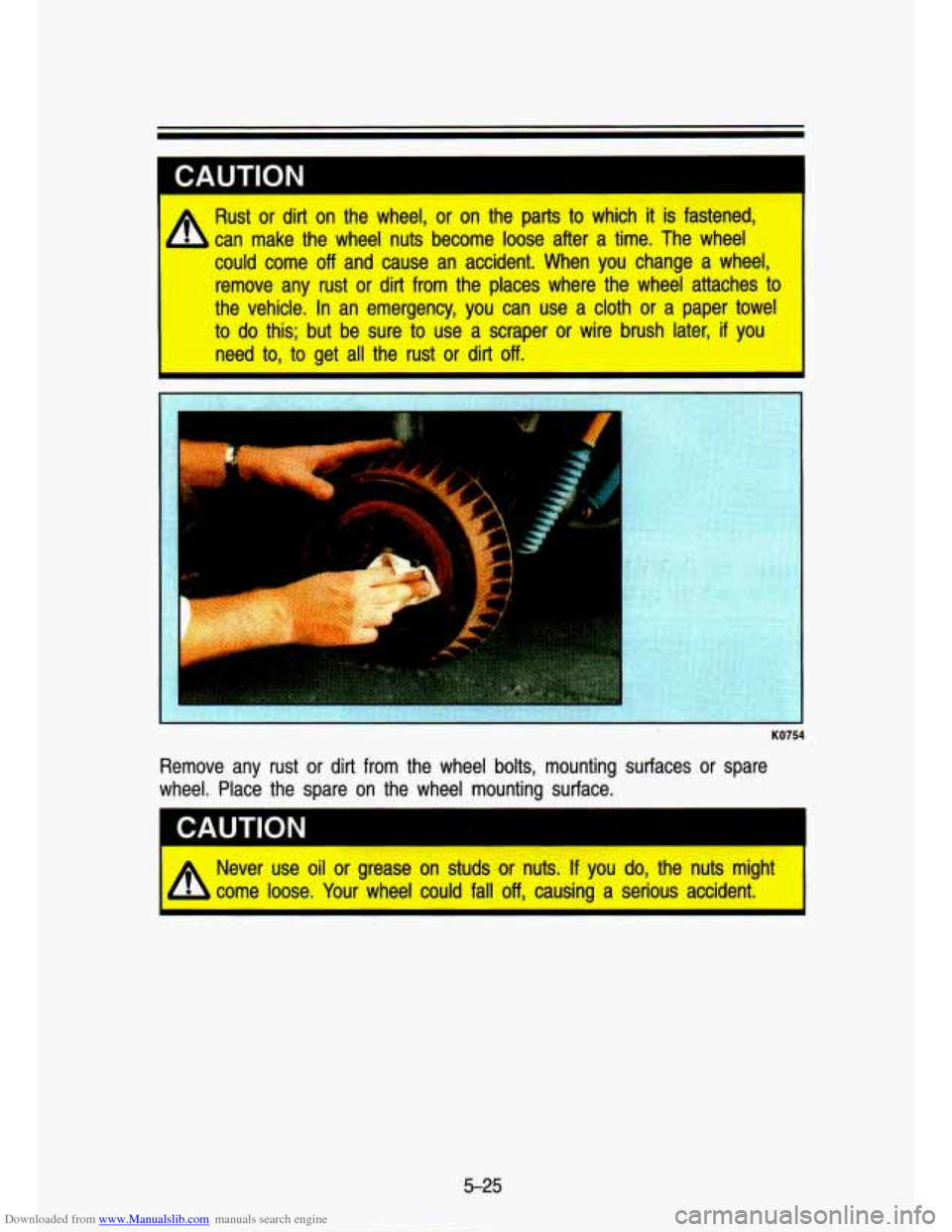
KO754
Remove any rust or dirt from the wheel bolts, mounting surface\
s or spare
wheel. Place the spare on the wheel mounting surface.
I Never use oil or grease on studs or nuts. If you do, the nuts might
L come loose. Your wheel could fall off, causing a serious accident.
Page 261 of 356
Downloaded from www.Manualslib.com manuals search engine Energy Conserving II
Oils with these words on the container will help you save fuel.
This doughnut-shaped logo (symbol) is used
on most oil containers to help
you select the correct oil.
You should look for this on the oil container, and use
only those oils that
display the logo.
GM Goodwrench@ oil (in Canada, GM Engine Oil) meets all the requirements
for your vehicle.
Engine Oil Additives:
Don’t add anything to your oil. Your GM dealer is ready to advise if you think
something should be added.
When to Change Engine c)k
See if any one of these is true for you:
Most trips are less than 4 miles (6 km).
It’s below freezing outside and most trips are less than 10 miles
(16 km).
The engine is at low speed most of the time (as in door-to-door delivery,
You tow a trailer often.
or in stop-and-go traffic).
Most trips are through dusty places.
The vehicle is frequently operated off-road.
If any one of these is true for your vehicle, you need to chang\
e your oil and
filter every 3,000 miles (5000 km) or 3 months-whichever comes first.
If none of them are true, change the oil every 7,500 miles (12 500 km) or
12 months-whichever comes first. Change the filter at the first oil change
and at every other oil change after that.
If your vehicle has 4-wheel drive, you ,will have a remote oil filter located
under the hood.
It is mounted to the front left inner fender, behind the
headlights.
Engine Block Heater:
An engine block heater can be a big help if you have to park outside in very
cold weather,
-0°F (-18°C) or colder. If your vehicle has this option, see
“Engine Block Heater” in the Index.
6-1 3
Page 264 of 356
Downloaded from www.Manualslib.com manuals search engine Service & Appearance Care
Automatic Transmission Fluid
When to Check and Change:
A good time to check your automatic transmission fluid level is when the
engine oil is changed. Refer to the Maintenance Schedule to de\
termine when
to change your fluid. See “Scheduled Maintenance Services” \
in the Index.
How to Check:
Because this operation can be a little difficult, you may choo\
se to have this
done at a dealership Service Department.
If you
do it yourself, be sure to follow all the instructions here, or \
you could
get a false reading on the dipstick.
I NOTICE
Wait at least 30 minutes before checking the transmission fluid level if you
have been driving:
When outside temperatures are above 90°F (32°C).
At high speed for quite a while.
In heavy traffic-especially in hot weather.
While pulling a trailer.
To get the right reading, the fluid must be at normal operating \
temperature,
which is 180°F to 200°F (82°C to 93°C).
To check transmission fluid hot: Get the vehicle warmed up by driving
about
15 miles (24 km) when outside temperatures are above 50°F (10°C). If
it’s colder then 50°F (IO’C), drive the vehicle in D (3rd gear) until the
temperature gage moves and then remains steady for ten minutes.\
Then
follow the hot check procedures.
To check transmission fluid cold: A cold check is made after the vehicle
has been sitting for eight hours or more with the engine off and is used
only
as a reference. Let the engine run at idle for five minutes if outside
temperatures are
50°F (10°C) or more. If it’s colder than 50°F (lO°C), you
may have to idle the engine longer. A hot check must follow when fluid is
added during a cold check.
6-1 6
I
Page 272 of 356
Downloaded from www.Manualslib.com manuals search engine t
..-
.I
Service & Appearance Care
What to Use:
Use a mixture of clean water (preferably distilled) and antifreeze that meets
“GM Specification 6038-M,” which won’t damage aluminum parts. Also use
GM Engine Coolant Supplement (sealer) with
a complete coolant change. If
you use these, you don’t need to add anything else.
I
Adding only plain water to your cooling system can be dangerous.
proper coolant mix will. Your vehicle’s coolant warning system is set
for the proper coolant mix. With plain water or the wrong mix, your
engine could get
too hot but you wouldn’t get the overheat warning.
Your engine could catch fire and you or others could be burned. Use
- Plain water, or some other liquid like alcohol, can boil before the
II a 50/50 mix of clean water and a proper antifreeze.
NOTICE
J use an improper coolant mix, your engine could overheat and be
badly damaged. The repair cost wouldn’t be covered by your warrant\
y
much water
in the mix can freeze and crack the engine, radiator, hea
core and other
part
Some conditions, such as air trapped in the cooling system, can affect the
coolant level in the radiator. Check the coolant level when th\
e engine is cold
and follow the steps under “Adding Coolant” for the prope\
r way to add
coolant.
If you have to add coolant more than four times a year, have your dealer
check your cooling system.
’‘ you use the proper coolant, you don’t have to add extra inhibitors c-
auditives which claim to improve the system. These can be harmful. ~ ~~~~~
6-24
Page 293 of 356
Downloaded from www.Manualslib.com manuals search engine K2655
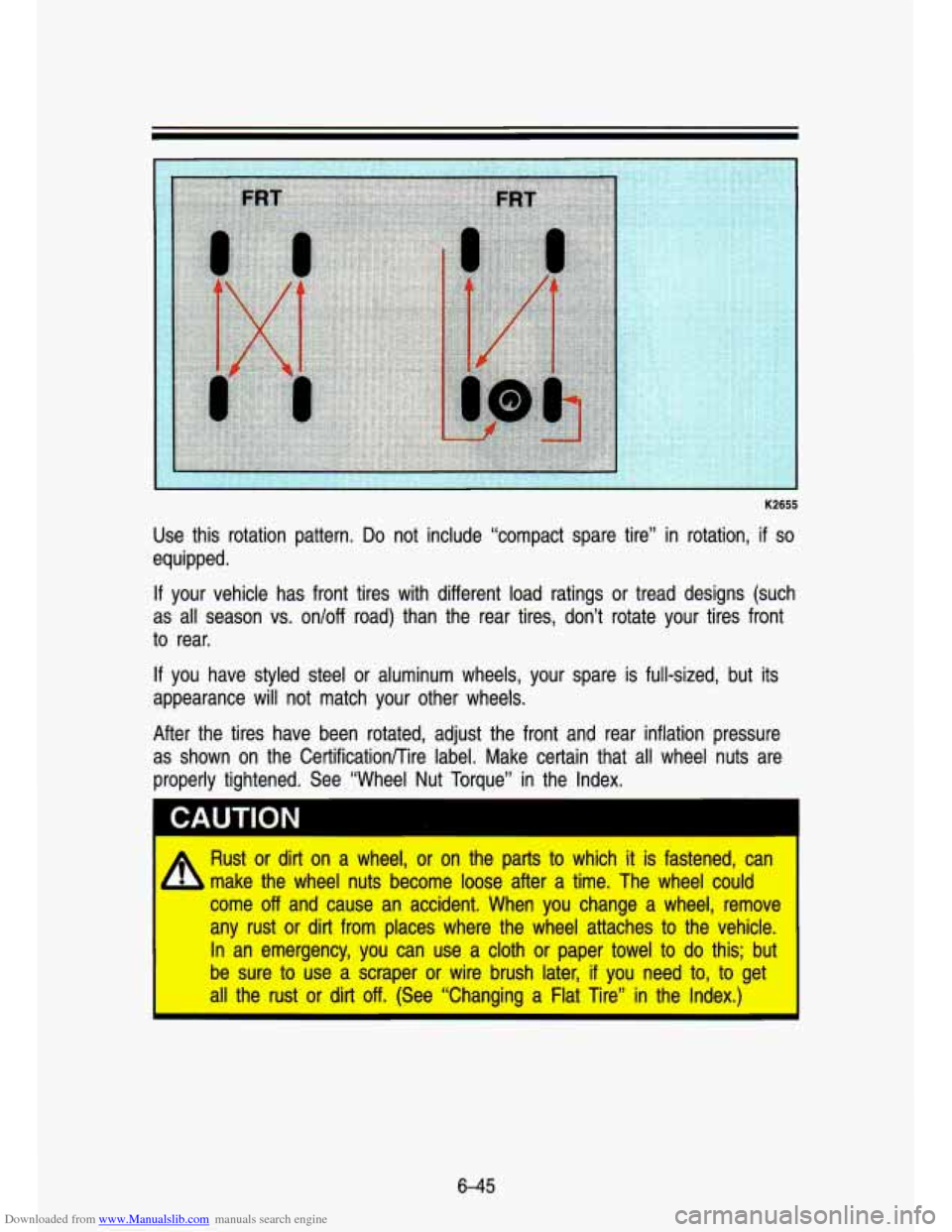
Use this rotation pattern. Do not include “compact spare tire” in rotation, if so
equipped.
If your vehicle has front tires with different load ratings or tr\
ead designs (such
as all season vs. on/off road) than the rear tires, don’t \
rotate your tires front
to rear.
If you have styled steel or aluminum wheels, your spare is full-s\
ized, but its
appearance will not match your other wheels.
After the tires have been rotated, adjust the front and rear \
inflation pressure as shown on the CertificationRire label. Make certain that
all wheel nuts are
properly tightened. See “Wheel Nut Torque” in the Index.
A
Rust or dirt on a wheel, or on the parts to which it is fastened, can
make the wheel nuts become loose after a time. The wheel coul\
d
come off and cause an accident. When you change a wheel, remove
any rust or dirt from places where the wheel attaches to the \
vehicle.
In an emergency, you can use a cloth or paper towel to
do this; but
be sure to use a scraper or wire brush later, if you need to, to get
all the rust or dirt off. (See “Changing a Flat Tire” in t\
he Index.)
6-45
Page 309 of 356
Downloaded from www.Manualslib.com manuals search engine Be sure to use the correct fuse. If you ever have a problem on the road and
don’t have a spare fuse, you can “borrow” one of the correct value. Just pick
some feature of your vehicle that you can get along without-like the radio or
cigarette lighter-and use its fuse,
if it is of the value you need. Replace it
as soon as you can. See “Fuses and Circuit Breakers” in this section.
Cap cities and Specification Charts
Replac -merit Parts
Replacement part numbers listed in this section are based on the latest
information available at the time of printing, and are subject to change.
If a
part listed in this manual is not the same as the part used in your vehicle
when
it was built, or if you have any questions, please contact your GM truck
dealer.
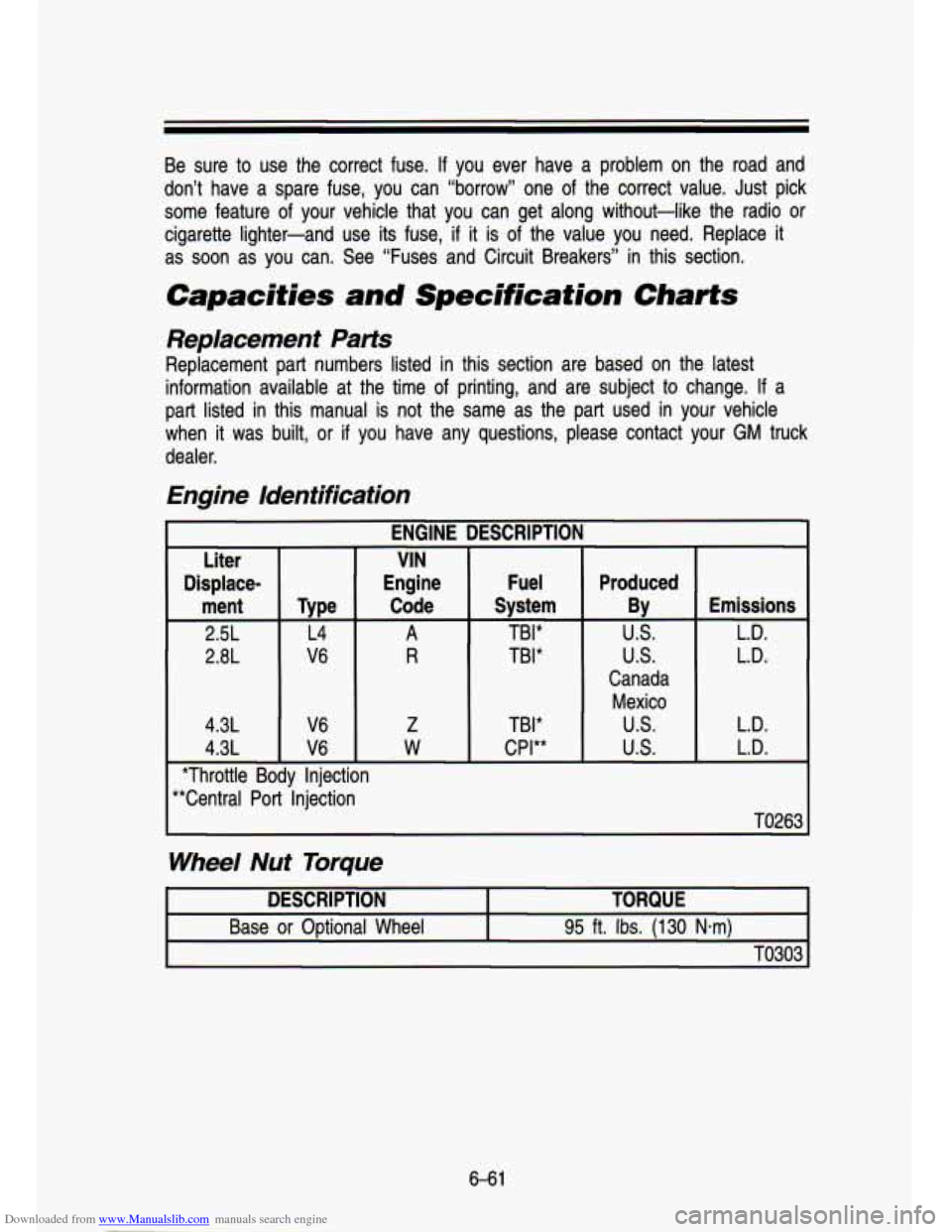
Engine Identification
ENGINE DESCRIPTION I
Liter VJN
Displace- Engine ment Type Cde
2.5L L4
A
2.8L V6 R
4.3L
V6 Z
4.3L V6 W
*Throttle Body Injection
“Central Port Injection Fuel
Svstem
TBI*
TBI*
TBI*
CPI**
Produced
BY
U.S.
us.
Canada Mexico
US.
U.S.
Emissions
L.D.
L.D.
L.D.
L.D.
TO263
Wheel Nut Torque
DESCRIPTION TORQUE
Base or Optional Wheel
95 ft. Ibs. (1 30 Nam)
TO303
6-61
Page 324 of 356
Downloaded from www.Manualslib.com manuals search engine Scheduled Maintenance Services
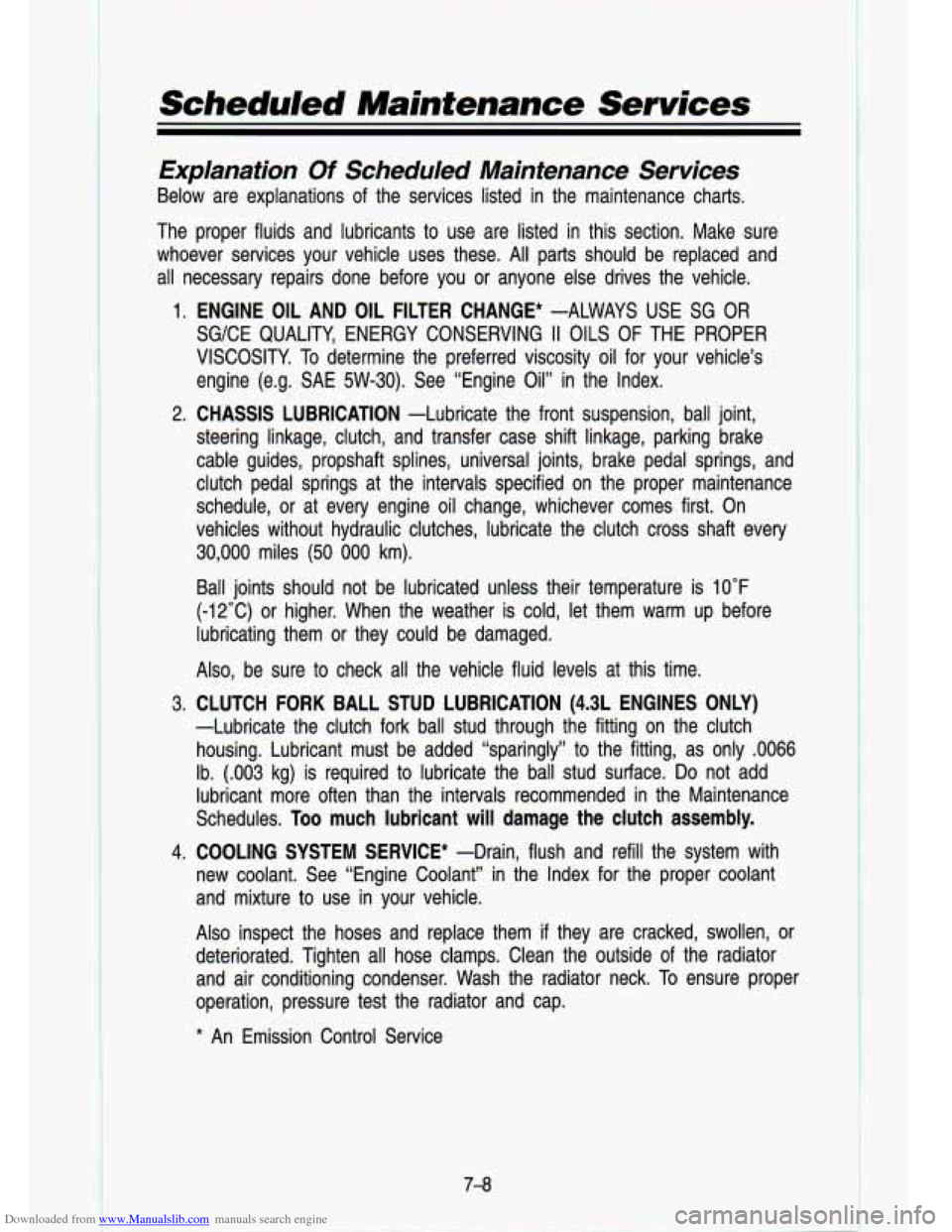
Explanation Of Scheduled Maintenance Services
Below are explanations of the services listed in the maintenance charts.
The proper fluids and lubricants to use are listed in this se\
ction. Make sure whoever services your vehicle uses these. All parts should be \
replaced and all necessary repairs done before you or anyone else drives th\
e vehicle.
1. ENGINE OIL AND OIL FILTER CHANGE* -ALWAYS USE SG OR SG/CE QUALITY, ENERGY CONSERVING
II OILS OF THE PROPER
VISCOSITY. To determine the preferred viscosity oil for your vehicle’s
engine (e.g. SAE 5W-30). See “Engine Oil” in the Index.\
2. CHASSIS LUBRICATION -Lubricate the front suspension, ball joint,
steering linkage, clutch, and transfer case shift linkage, parki\
ng brake
cable guides, propshaft splines, universal joints, brake pedal s\
prings, and
clutch pedal springs at the intervals specified on the proper \
maintenance
schedule, or at every engine oil change, whichever comes first.\
On
vehicles without hydraulic clutches, lubricate the clutch cross \
shaft every
30,000 miles
(50 000 km).
Ball joints should not be lubricated unless their temperature i\
s 10°F
(-12°C) or higher. When the weather is cold, let them war\
m up before
lubricating them or they could be damaged.
Also, be sure to check all the vehicle fluid levels at this \
time.
3. CLUTCH FORK BALL STUD LUBRICATION (4.3L ENGINES ONLY)
-Lubricate the clutch fork ball stud through the fitting on th\
e clutch housing. Lubricant must be added “sparingly” to the fittin\
g, as only
.0066
Ib. (.003 kg) is required to lubricate the ball stud surface\
. Do not add
lubricant more often than the intervals recommended in the Main\
tenance
Schedules. Too much lubricant
will damage the clutch assembly.
4. COOLING SYSTEM SERVICE* -Drain, flush and refill the system wit\
h
new coolant. See “Engine Coolant’’ in the Index for th\
e proper coolant
and mixture to use in your vehicle.
Also inspect the hoses and replace them
if they are cracked, swollen, or
deteriorated. Tighten all hose clamps. Clean the outside of the radiator
and air conditioning condenser. Wash the radiator neck. To ensure proper
operation, pressure test the radiator and cap.
* An Emission Control Service
7-8