1993 CHEVROLET DYNASTY boot
[x] Cancel search: bootPage 1859 of 2438
AUTO SHUTDOWN (ASD) RELAY AND FUEL PUMP
RELAYÐPCM OUTPUT
The PCM operates the auto shutdown (ASD) relay
and fuel pump relay through one ground path. The
PCM operates the relays by switching the ground
path on and off. Both relays turn on and off at the
same time. The ASD relay connects battery voltage to the fuel
injector and ignition coil. The fuel pump relay con-
nects battery voltage to the fuel pump and oxygen
sensor heating element. The PCM turns the ground path off when the igni-
tion switch is in the Off position. Both relays are off.
When the ignition switch is in the On or Crank po-
sition, the PCM monitors the distributor pick-up sig-
nal to determine engine speed and ignition timing (coil dwell). If the PCM does not receive a distributor
signal when the ignition switch is in the Run posi-
tion, it will de-energize both relays. When the relays
are de-energized, battery voltage is not supplied to
the fuel injector, ignition coil, fuel pump and oxygen
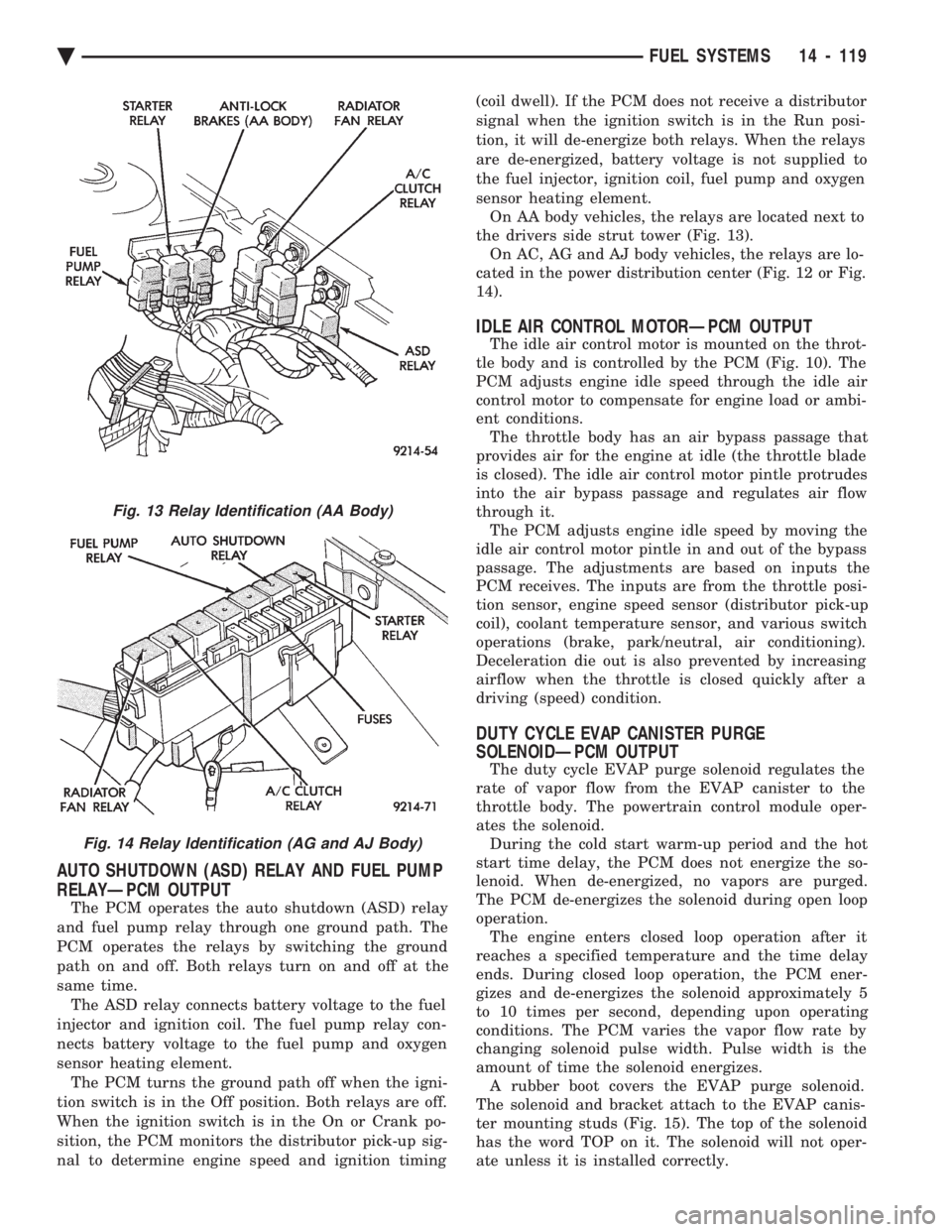
sensor heating element. On AA body vehicles, the relays are located next to
the drivers side strut tower (Fig. 13). On AC, AG and AJ body vehicles, the relays are lo-
cated in the power distribution center (Fig. 12 or Fig.
14).
IDLE AIR CONTROL MOTORÐPCM OUTPUT
The idle air control motor is mounted on the throt-
tle body and is controlled by the PCM (Fig. 10). The
PCM adjusts engine idle speed through the idle air
control motor to compensate for engine load or ambi-
ent conditions. The throttle body has an air bypass passage that
provides air for the engine at idle (the throttle blade
is closed). The idle air control motor pintle protrudes
into the air bypass passage and regulates air flow
through it. The PCM adjusts engine idle speed by moving the
idle air control motor pintle in and out of the bypass
passage. The adjustments are based on inputs the
PCM receives. The inputs are from the throttle posi-
tion sensor, engine speed sensor (distributor pick-up
coil), coolant temperature sensor, and various switch
operations (brake, park/neutral, air conditioning).
Deceleration die out is also prevented by increasing
airflow when the throttle is closed quickly after a
driving (speed) condition.
DUTY CYCLE EVAP CANISTER PURGE
SOLENOIDÐPCM OUTPUT
The duty cycle EVAP purge solenoid regulates the
rate of vapor flow from the EVAP canister to the
throttle body. The powertrain control module oper-
ates the solenoid. During the cold start warm-up period and the hot
start time delay, the PCM does not energize the so-
lenoid. When de-energized, no vapors are purged.
The PCM de-energizes the solenoid during open loop
operation. The engine enters closed loop operation after it
reaches a specified temperature and the time delay
ends. During closed loop operation, the PCM ener-
gizes and de-energizes the solenoid approximately 5
to 10 times per second, depending upon operating
conditions. The PCM varies the vapor flow rate by
changing solenoid pulse width. Pulse width is the
amount of time the solenoid energizes. A rubber boot covers the EVAP purge solenoid.
The solenoid and bracket attach to the EVAP canis-
ter mounting studs (Fig. 15). The top of the solenoid
has the word TOP on it. The solenoid will not oper-
ate unless it is installed correctly.
Fig. 13 Relay Identification (AA Body)
Fig. 14 Relay Identification (AG and AJ Body)
Ä FUEL SYSTEMS 14 - 119
Page 1933 of 2438
(12) Transfer Required parts to the new power
steering pump assembly before installing in vehicle.
INSTALL
(1) Install the power steering pump assembly back
in vehicle in reverse order of removal. (2) Hold power steering pump against mounting
plate. Align power steering pump mounting holes
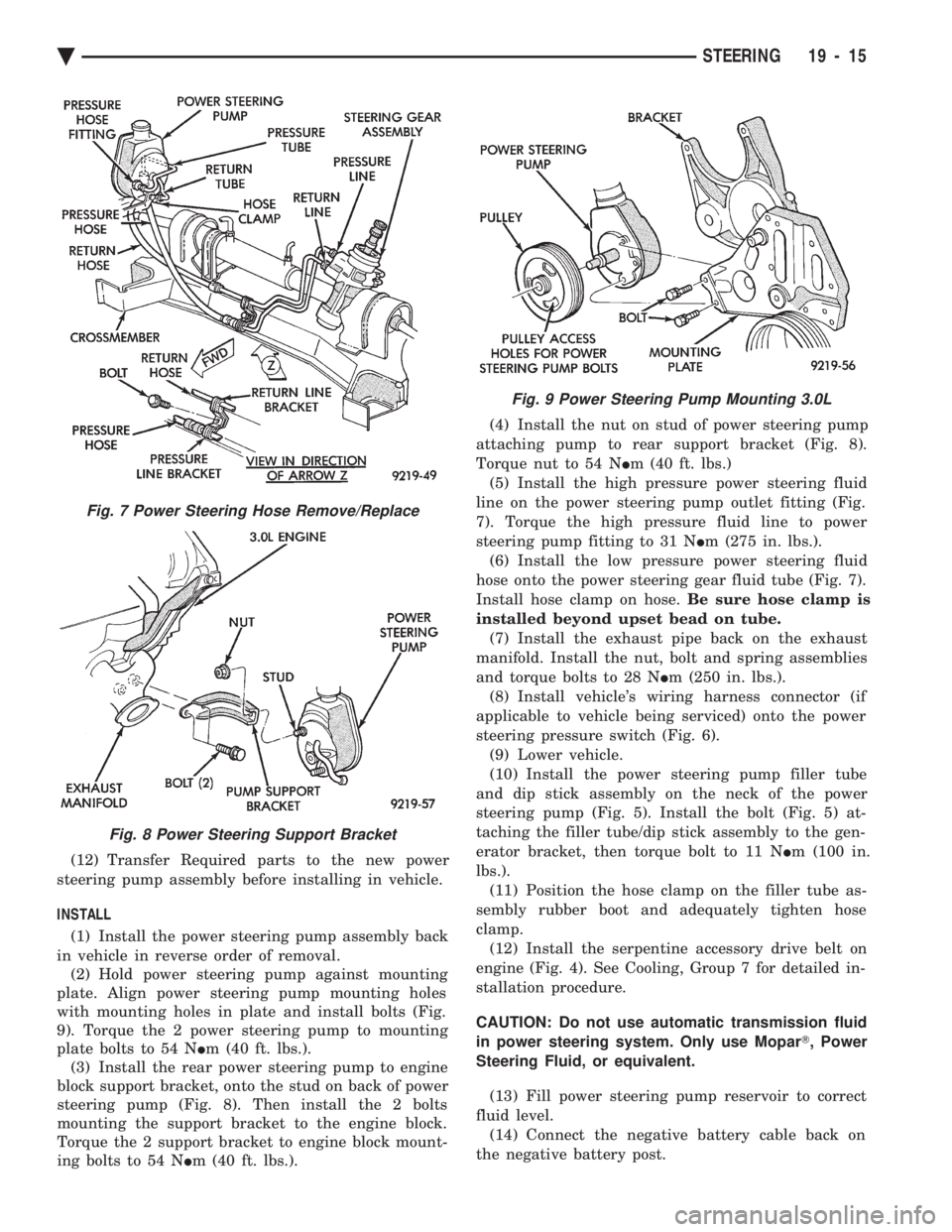
with mounting holes in plate and install bolts (Fig.
9). Torque the 2 power steering pump to mounting
plate bolts to 54 N Im (40 ft. lbs.).
(3) Install the rear power steering pump to engine
block support bracket, onto the stud on back of power
steering pump (Fig. 8). Then install the 2 bolts
mounting the support bracket to the engine block.
Torque the 2 support bracket to engine block mount-
ing bolts to 54 N Im (40 ft. lbs.). (4) Install the nut on stud of power steering pump
attaching pump to rear support bracket (Fig. 8).
Torque nut to 54 N Im (40 ft. lbs.)
(5) Install the high pressure power steering fluid
line on the power steering pump outlet fitting (Fig.
7). Torque the high pressure fluid line to power
steering pump fitting to 31 N Im (275 in. lbs.).
(6) Install the low pressure power steering fluid
hose onto the power steering gear fluid tube (Fig. 7).
Install hose clamp on hose. Be sure hose clamp is
installed beyond upset bead on tube. (7) Install the exhaust pipe back on the exhaust
manifold. Install the nut, bolt and spring assemblies
and torque bolts to 28 N Im (250 in. lbs.).
(8) Install vehicle's wiring harness connector (if
applicable to vehicle being serviced) onto the power
steering pressure switch (Fig. 6). (9) Lower vehicle.
(10) Install the power steering pump filler tube
and dip stick assembly on the neck of the power
steering pump (Fig. 5). Install the bolt (Fig. 5) at-
taching the filler tube/dip stick assembly to the gen-
erator bracket, then torque bolt to 11 N Im (100 in.
lbs.). (11) Position the hose clamp on the filler tube as-
sembly rubber boot and adequately tighten hose
clamp. (12) Install the serpentine accessory drive belt on
engine (Fig. 4). See Cooling, Group 7 for detailed in-
stallation procedure.
CAUTION: Do not use automatic transmission fluid
in power steering system. Only use Mopar T, Power
Steering Fluid, or equivalent.
(13) Fill power steering pump reservoir to correct
fluid level. (14) Connect the negative battery cable back on
the negative battery post.
Fig. 7 Power Steering Hose Remove/Replace
Fig. 8 Power Steering Support Bracket
Fig. 9 Power Steering Pump Mounting 3.0L
Ä STEERING 19 - 15
Page 1943 of 2438
POWER STEERING GEAR INDEX
page page
General Information ....................... 25
Outer Tie Rod ........................... 27 Steering Gear Service
..................... 25
GENERAL INFORMATION
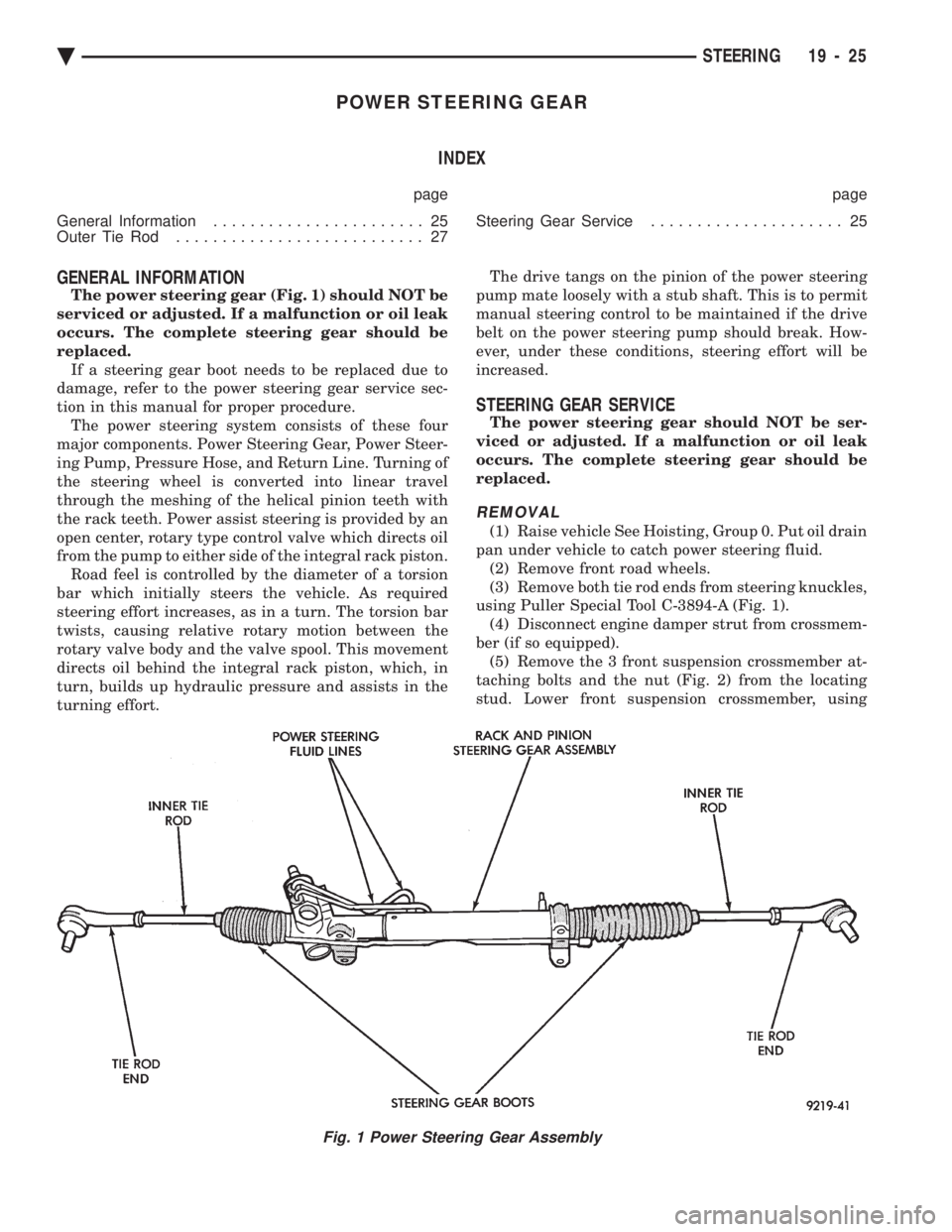
The power steering gear (Fig. 1) should NOT be
serviced or adjusted. If a malfunction or oil leak
occurs. The complete steering gear should be
replaced. If a steering gear boot needs to be replaced due to
damage, refer to the power steering gear service sec-
tion in this manual for proper procedure. The power steering system consists of these four
major components. Power Steering Gear, Power Steer-
ing Pump, Pressure Hose, and Return Line. Turning of
the steering wheel is converted into linear travel
through the meshing of the helical pinion teeth with
the rack teeth. Power assist steering is provided by an
open center, rotary type control valve which directs oil
from the pump to either side of the integral rack piston. Road feel is controlled by the diameter of a torsion
bar which initially steers the vehicle. As required
steering effort increases, as in a turn. The torsion bar
twists, causing relative rotary motion between the
rotary valve body and the valve spool. This movement
directs oil behind the integral rack piston, which, in
turn, builds up hydraulic pressure and assists in the
turning effort. The drive tangs on the pinion of the power steering
pump mate loosely with a stub shaft. This is to permit
manual steering control to be maintained if the drive
belt on the power steering pump should break. How-
ever, under these conditions, steering effort will be
increased.
STEERING GEAR SERVICE
The power steering gear should NOT be ser-
viced or adjusted. If a malfunction or oil leak
occurs. The complete steering gear should be
replaced.
REMOVAL
(1) Raise vehicle See Hoisting, Group 0. Put oil drain
pan under vehicle to catch power steering fluid. (2) Remove front road wheels.
(3) Remove both tie rod ends from steering knuckles,
using Puller Special Tool C-3894-A (Fig. 1). (4) Disconnect engine damper strut from crossmem-
ber (if so equipped). (5) Remove the 3 front suspension crossmember at-
taching bolts and the nut (Fig. 2) from the locating
stud. Lower front suspension crossmember, using
Fig. 1 Power Steering Gear Assembly
Ä STEERING 19 - 25
Page 1945 of 2438
bolts and nut on locating stud (Fig. 2). The right rear
crossmember stud is a pilot that correctly locates
the crossmember. Tighten down this bolt first,
then torque all 4 crossmember fasteners to 122
N Im (90 ft. lbs.).
CAUTION: Proper torque on the crossmember to
frame rail mounting bolts is very important.
(3) Torque the 4 bolts (Fig. 3) attaching the steering
gear assembly to front crossmember, to 68 N Im (50 ft.
lbs.). To ensure proper alignment of the steering
gear tighten left front bolt first. (4) Attach the engine damper strut from the engine
to the crossmember (if so equipped). (5) Attach the fluid tubes (Fig. 3) from the power
steering pump to the fittings on the steering gear.
Torque the fluid pressure line to steering gear tube nut
to 31 N Im (275 in. lbs.).
(6) Mount the outer tie rod ends to the steering
knuckles. Install the tie rod end to steering knuckle
attaching nuts. Torque the tie rod end to steering
knuckle nuts to 52 N Im (38 ft. lbs.). Install cotter pin
in tie rod end. (7) Install the front tire and wheel assemblies on
vehicle. Install the wheel lug nuts and torque to 129
N Im (95 ft. lbs.).
(8) Lower vehicle.
CAUTION: Do not use automatic transmission fluid. (9) Fill power steering pump fluid reservoir to the
(Full-Cold) proper level. (10) Start the engine and let run for a few seconds.
Then turn the engine off.
(11) Add fluid if necessary.
(12) Raise front wheels of vehicle off the ground.
(13) Start engine and turn steering wheel several
times from stop to stop to bleed air from fluid in
system. Stop engine, check fluid level, and inspect
system for leaks. Fill pump reservoir to correct
level with Mopar t, Power Steering Fluid, or
equivalent. See Checking Fluid Level.
(14) Lower front wheels of vehicle back on the
ground. (15) Adjust toe (Refer to Group 2 Suspension).
OUTER TIE ROD
REMOVAL
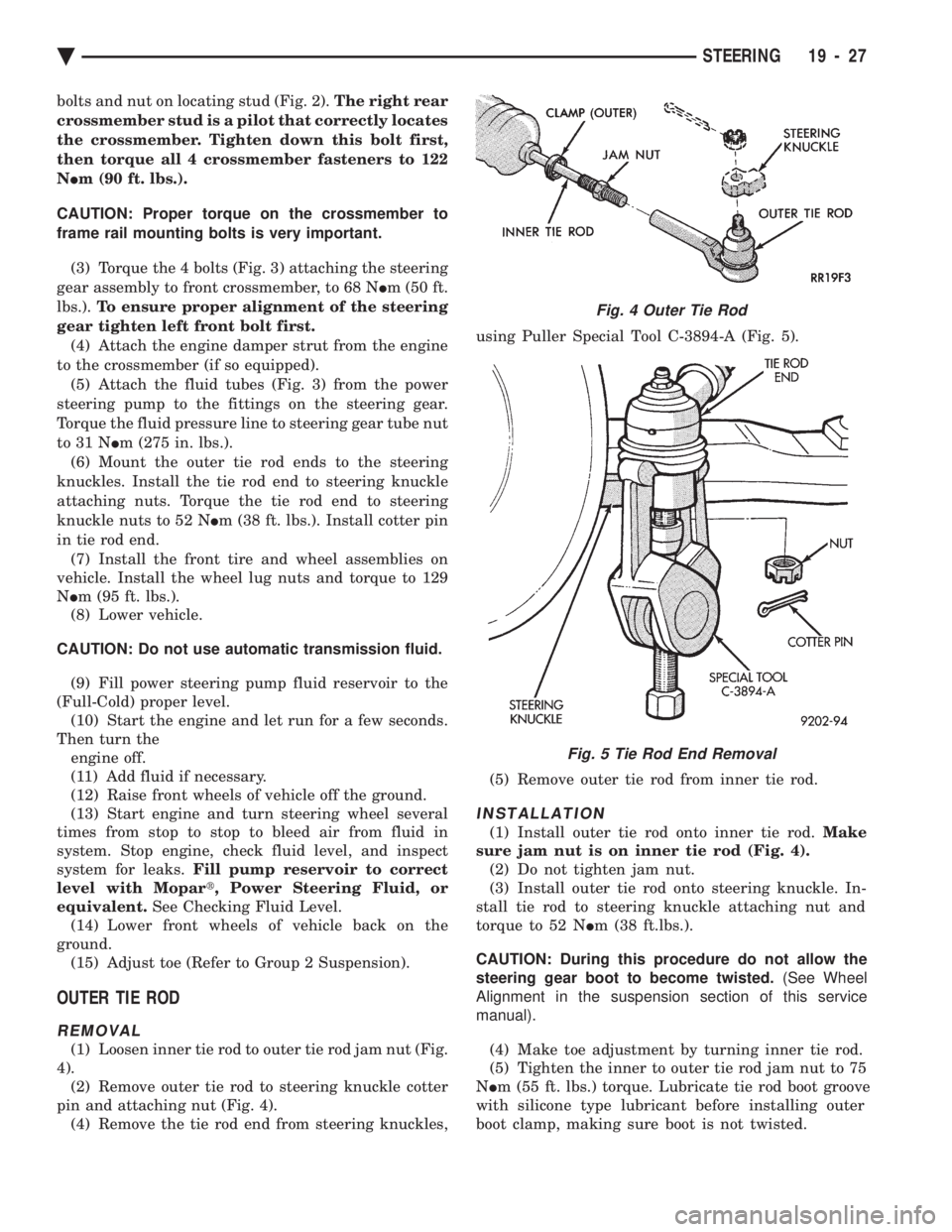
(1) Loosen inner tie rod to outer tie rod jam nut (Fig.
4). (2) Remove outer tie rod to steering knuckle cotter
pin and attaching nut (Fig. 4). (4) Remove the tie rod end from steering knuckles, using Puller Special Tool C-3894-A (Fig. 5).
(5) Remove outer tie rod from inner tie rod.
INSTALLATION
(1) Install outer tie rod onto inner tie rod. Make
sure jam nut is on inner tie rod (Fig. 4). (2) Do not tighten jam nut.
(3) Install outer tie rod onto steering knuckle. In-
stall tie rod to steering knuckle attaching nut and
torque to 52 N Im (38 ft.lbs.).
CAUTION: During this procedure do not allow the
steering gear boot to become twisted. (See Wheel
Alignment in the suspension section of this service
manual).
(4) Make toe adjustment by turning inner tie rod.
(5) Tighten the inner to outer tie rod jam nut to 75
N Im (55 ft. lbs.) torque. Lubricate tie rod boot groove
with silicone type lubricant before installing outer
boot clamp, making sure boot is not twisted.
Fig. 4 Outer Tie Rod
Fig. 5 Tie Rod End Removal
Ä STEERING 19 - 27
Page 1963 of 2438
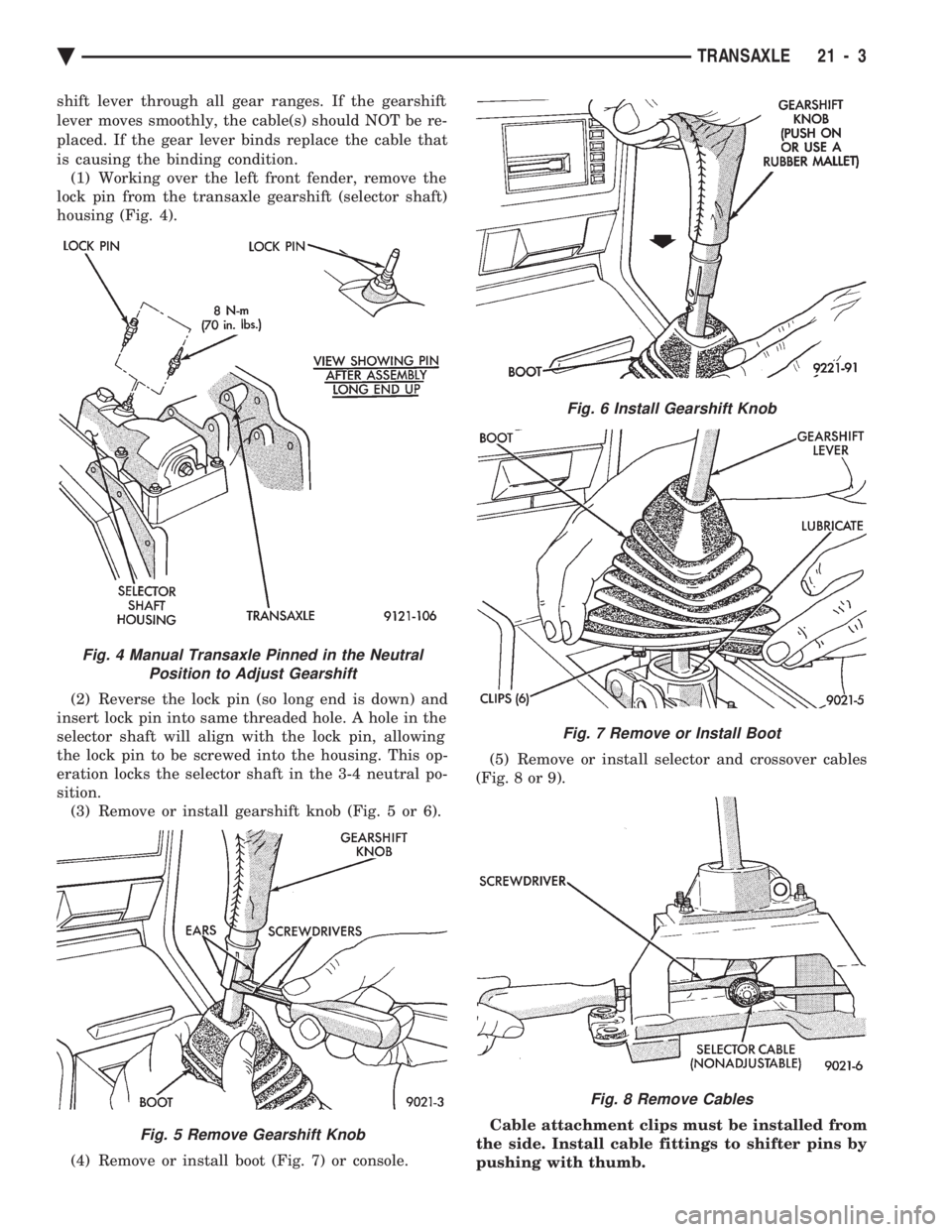
shift lever through all gear ranges. If the gearshift
lever moves smoothly, the cable(s) should NOT be re-
placed. If the gear lever binds replace the cable that
is causing the binding condition. (1) Working over the left front fender, remove the
lock pin from the transaxle gearshift (selector shaft)
housing (Fig. 4).
(2) Reverse the lock pin (so long end is down) and
insert lock pin into same threaded hole. A hole in the
selector shaft will align with the lock pin, allowing
the lock pin to be screwed into the housing. This op-
eration locks the selector shaft in the 3-4 neutral po-
sition. (3) Remove or install gearshift knob (Fig. 5 or 6).
(4) Remove or install boot (Fig. 7) or console. (5) Remove or install selector and crossover cables
(Fig. 8 or 9).
Cable attachment clips must be installed from
the side. Install cable fittings to shifter pins by
pushing with thumb.
Fig. 4 Manual Transaxle Pinned in the Neutral Position to Adjust Gearshift
Fig. 5 Remove Gearshift Knob
Fig. 6 Install Gearshift Knob
Fig. 7 Remove or Install Boot
Fig. 8 Remove Cables
Ä TRANSAXLE 21 - 3
Page 1981 of 2438
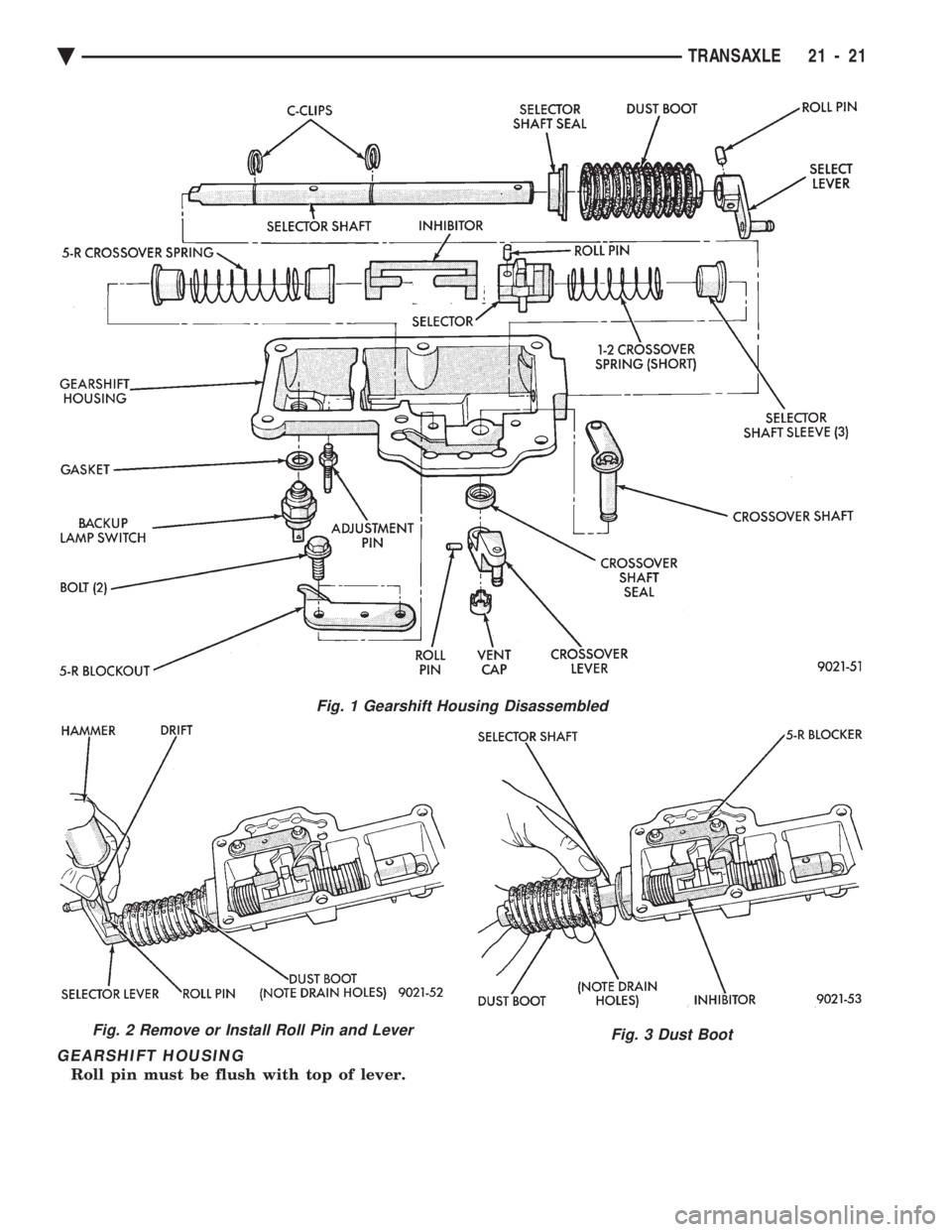
GEARSHIFT HOUSING
Roll pin must be flush with top of lever.
Fig. 1 Gearshift Housing Disassembled
Fig. 2 Remove or Install Roll Pin and LeverFig. 3 Dust Boot
Ä TRANSAXLE 21 - 21
Page 2185 of 2438
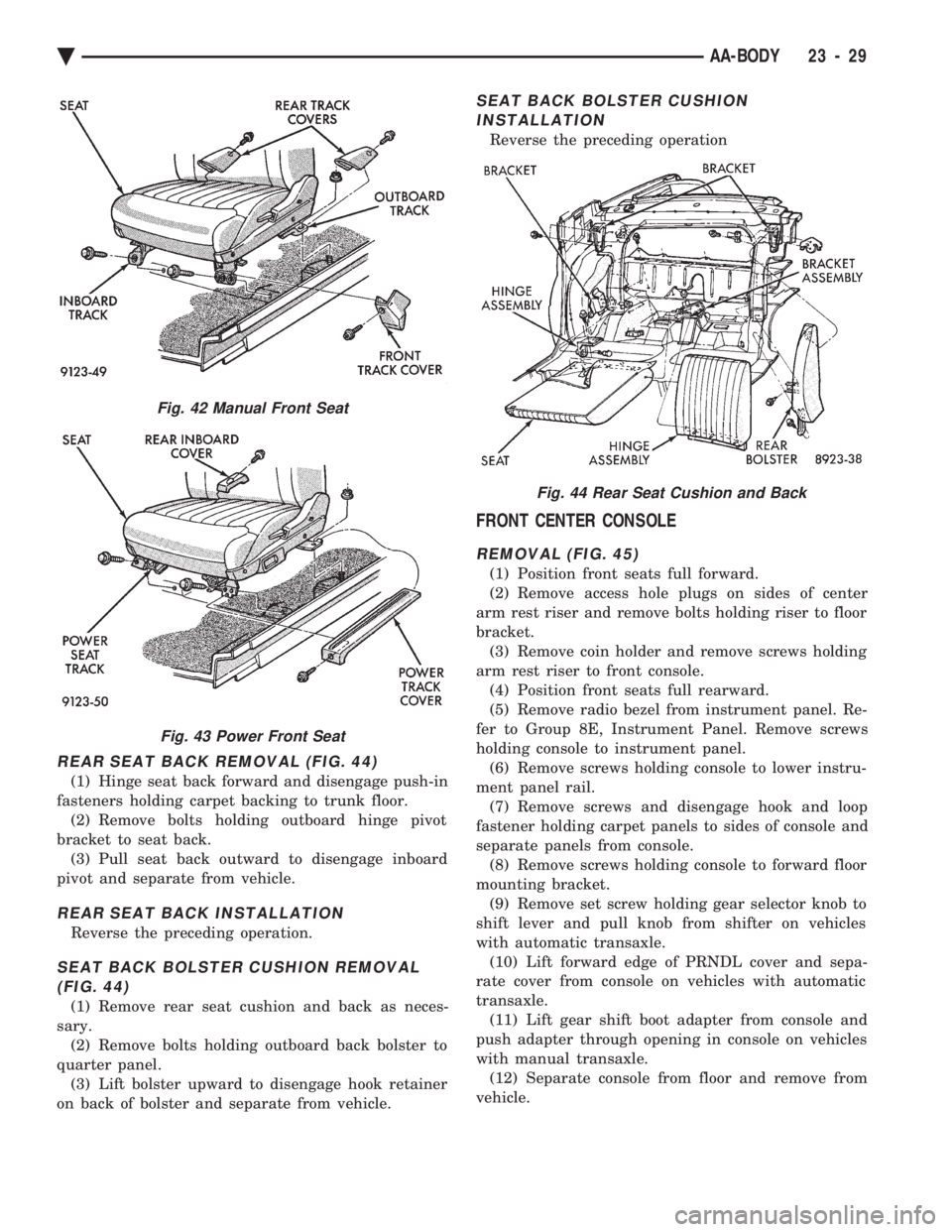
REAR SEAT BACK REMOVAL (FIG. 44)
(1) Hinge seat back forward and disengage push-in
fasteners holding carpet backing to trunk floor. (2) Remove bolts holding outboard hinge pivot
bracket to seat back. (3) Pull seat back outward to disengage inboard
pivot and separate from vehicle.
REAR SEAT BACK INSTALLATION
Reverse the preceding operation.
SEAT BACK BOLSTER CUSHION REMOVAL (FIG. 44)
(1) Remove rear seat cushion and back as neces-
sary. (2) Remove bolts holding outboard back bolster to
quarter panel. (3) Lift bolster upward to disengage hook retainer
on back of bolster and separate from vehicle.
SEAT BACK BOLSTER CUSHION INSTALLATION
Reverse the preceding operation
FRONT CENTER CONSOLE
REMOVAL (FIG. 45)
(1) Position front seats full forward.
(2) Remove access hole plugs on sides of center
arm rest riser and remove bolts holding riser to floor
bracket. (3) Remove coin holder and remove screws holding
arm rest riser to front console. (4) Position front seats full rearward.
(5) Remove radio bezel from instrument panel. Re-
fer to Group 8E, Instrument Panel. Remove screws
holding console to instrument panel. (6) Remove screws holding console to lower instru-
ment panel rail. (7) Remove screws and disengage hook and loop
fastener holding carpet panels to sides of console and
separate panels from console. (8) Remove screws holding console to forward floor
mounting bracket. (9) Remove set screw holding gear selector knob to
shift lever and pull knob from shifter on vehicles
with automatic transaxle. (10) Lift forward edge of PRNDL cover and sepa-
rate cover from console on vehicles with automatic
transaxle. (11) Lift gear shift boot adapter from console and
push adapter through opening in console on vehicles
with manual transaxle. (12) Separate console from floor and remove from
vehicle.
Fig. 42 Manual Front Seat
Fig. 43 Power Front Seat
Fig. 44 Rear Seat Cushion and Back
Ä AA-BODY 23 - 29
Page 2243 of 2438
QUARTER WINDOW
REMOVAL
(1) Disengage snaps holding sling well to rear deck
panel. (2) From each side of vehicle, Disengage clips hold-
ing sling well to belt reinforcement brace. Drape
sling well over rear seat back into passenger com-
partment. (3) Remove screw holding quarter trim panel and
door weatherstrip to door opening. (4) Remove the cowl trim and scuff plate covers.
(5) Remove the rear seat cushion.
(6) Disconnect rear speaker wire connectors.
(7) Remove screws holding seat back to floor
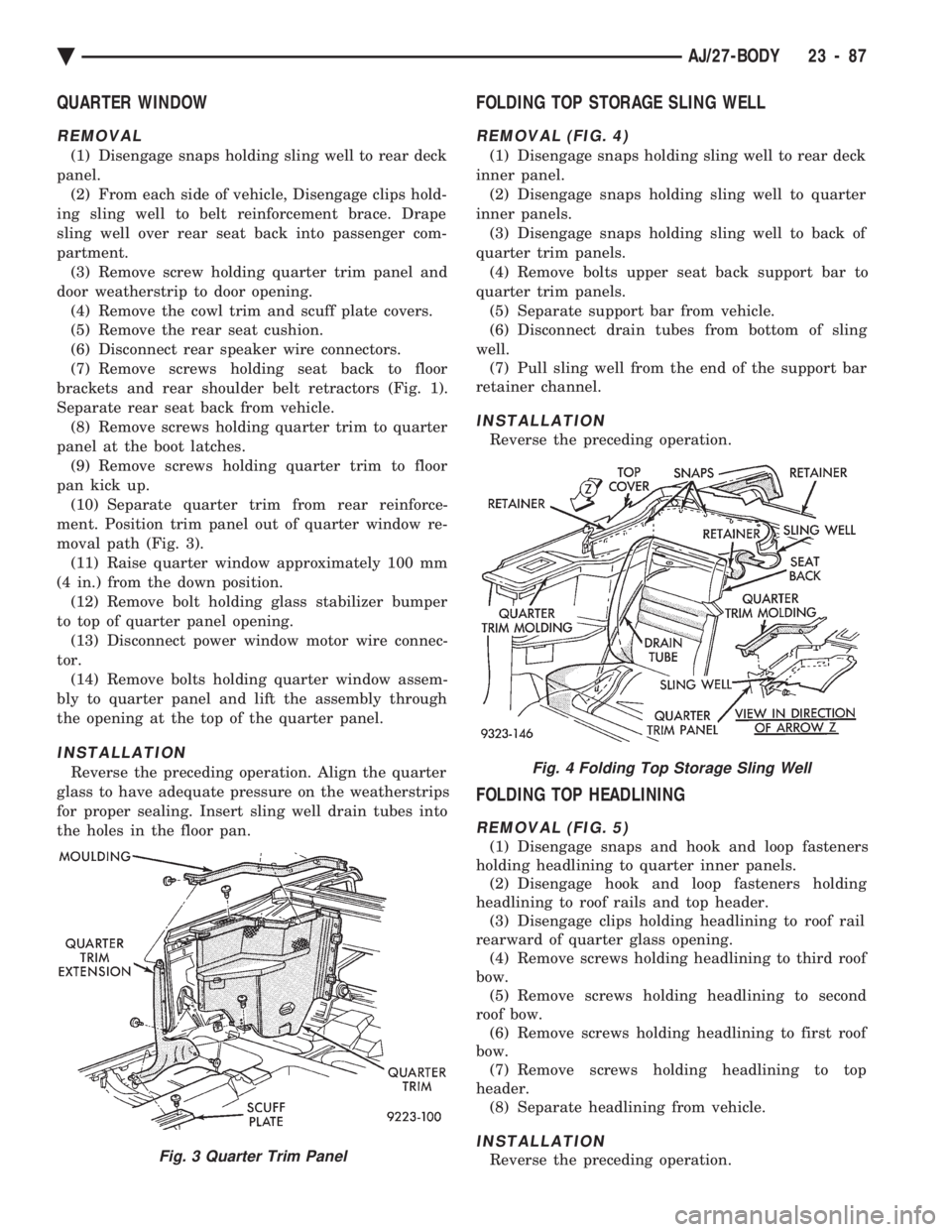
brackets and rear shoulder belt retractors (Fig. 1).
Separate rear seat back from vehicle. (8) Remove screws holding quarter trim to quarter
panel at the boot latches. (9) Remove screws holding quarter trim to floor
pan kick up. (10) Separate quarter trim from rear reinforce-
ment. Position trim panel out of quarter window re-
moval path (Fig. 3). (11) Raise quarter window approximately 100 mm
(4 in.) from the down position. (12) Remove bolt holding glass stabilizer bumper
to top of quarter panel opening. (13) Disconnect power window motor wire connec-
tor. (14) Remove bolts holding quarter window assem-
bly to quarter panel and lift the assembly through
the opening at the top of the quarter panel.
INSTALLATION
Reverse the preceding operation. Align the quarter
glass to have adequate pressure on the weatherstrips
for proper sealing. Insert sling well drain tubes into
the holes in the floor pan.
FOLDING TOP STORAGE SLING WELL
REMOVAL (FIG. 4)
(1) Disengage snaps holding sling well to rear deck
inner panel. (2) Disengage snaps holding sling well to quarter
inner panels. (3) Disengage snaps holding sling well to back of
quarter trim panels. (4) Remove bolts upper seat back support bar to
quarter trim panels. (5) Separate support bar from vehicle.
(6) Disconnect drain tubes from bottom of sling
well. (7) Pull sling well from the end of the support bar
retainer channel.
INSTALLATION
Reverse the preceding operation.
FOLDING TOP HEADLINING
REMOVAL (FIG. 5)
(1) Disengage snaps and hook and loop fasteners
holding headlining to quarter inner panels. (2) Disengage hook and loop fasteners holding
headlining to roof rails and top header. (3) Disengage clips holding headlining to roof rail
rearward of quarter glass opening. (4) Remove screws holding headlining to third roof
bow. (5) Remove screws holding headlining to second
roof bow. (6) Remove screws holding headlining to first roof
bow. (7) Remove screws holding headlining to top
header. (8) Separate headlining from vehicle.
INSTALLATION
Reverse the preceding operation.Fig. 3 Quarter Trim Panel
Fig. 4 Folding Top Storage Sling Well
Ä AJ/27-BODY 23 - 87