Page 53 of 308
Downloaded from www.Manualslib.com manuals search engine I
..
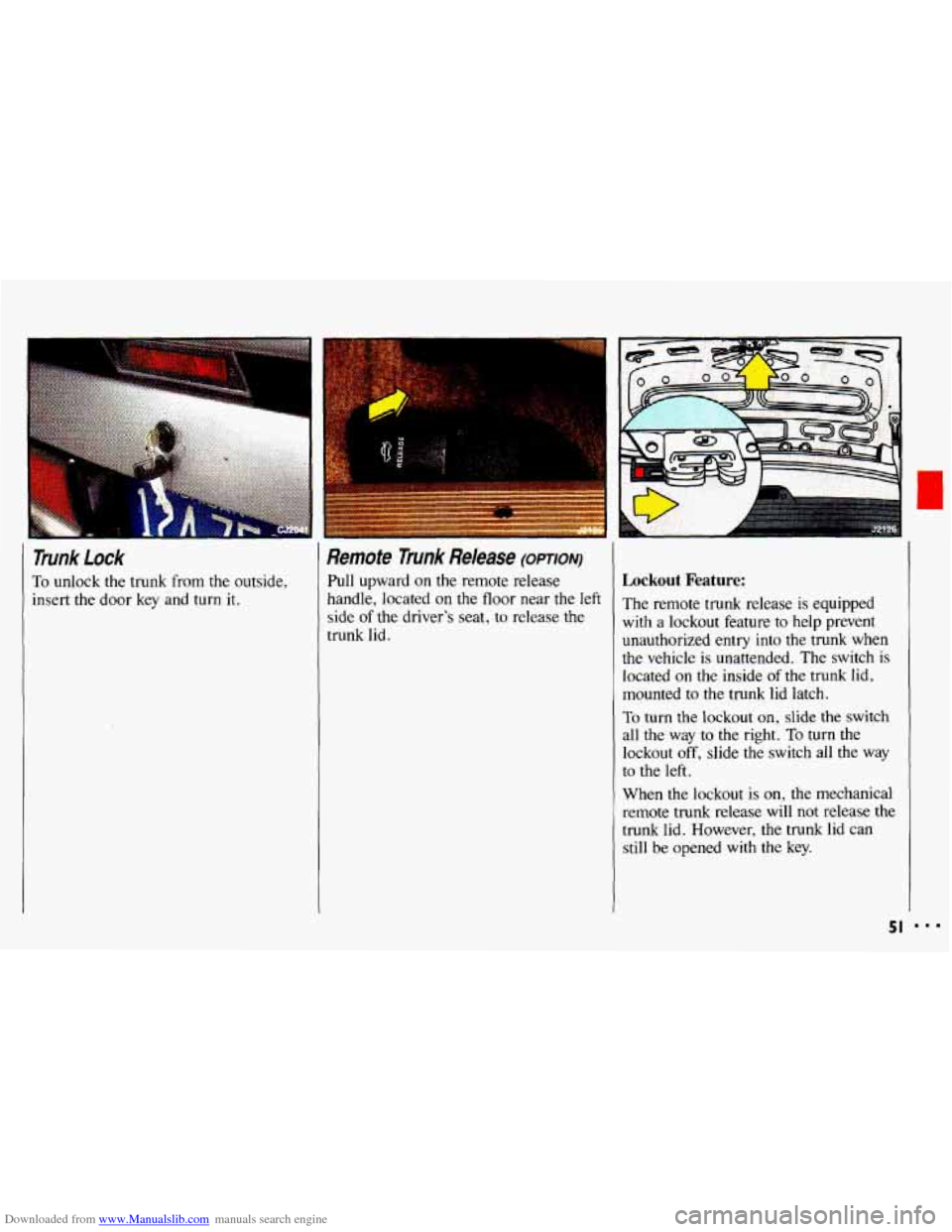
Trunk lock
To unlock the trunk from the outside,
insert the door
key and turn it.
Remote Trunk Release (OPTION)
Pull upward on the remote release
handle, located on the floor near the left
side
of the driver’s seat, to release the
trunk lid.
Lockout Feature:
The remote trunk release is equipped
with a lockout feature to help prevent
unauthorized entry into the trunk when
the vehicle is unattended. The switch
is
located on the inside of the trunk lid,
mounted
to the trunk lid latch.
To turn the lockout on, slide the switch
all the way to
the right. To turn the
lockout off, slide the switch all the way
to the
left.
When the lockout is on, the mechanical
remote trunk release will not release the
trunk lid. However, the trunk
lid can
still be opened with the key.
51
Page 54 of 308
Downloaded from www.Manualslib.com manuals search engine Features & Controls
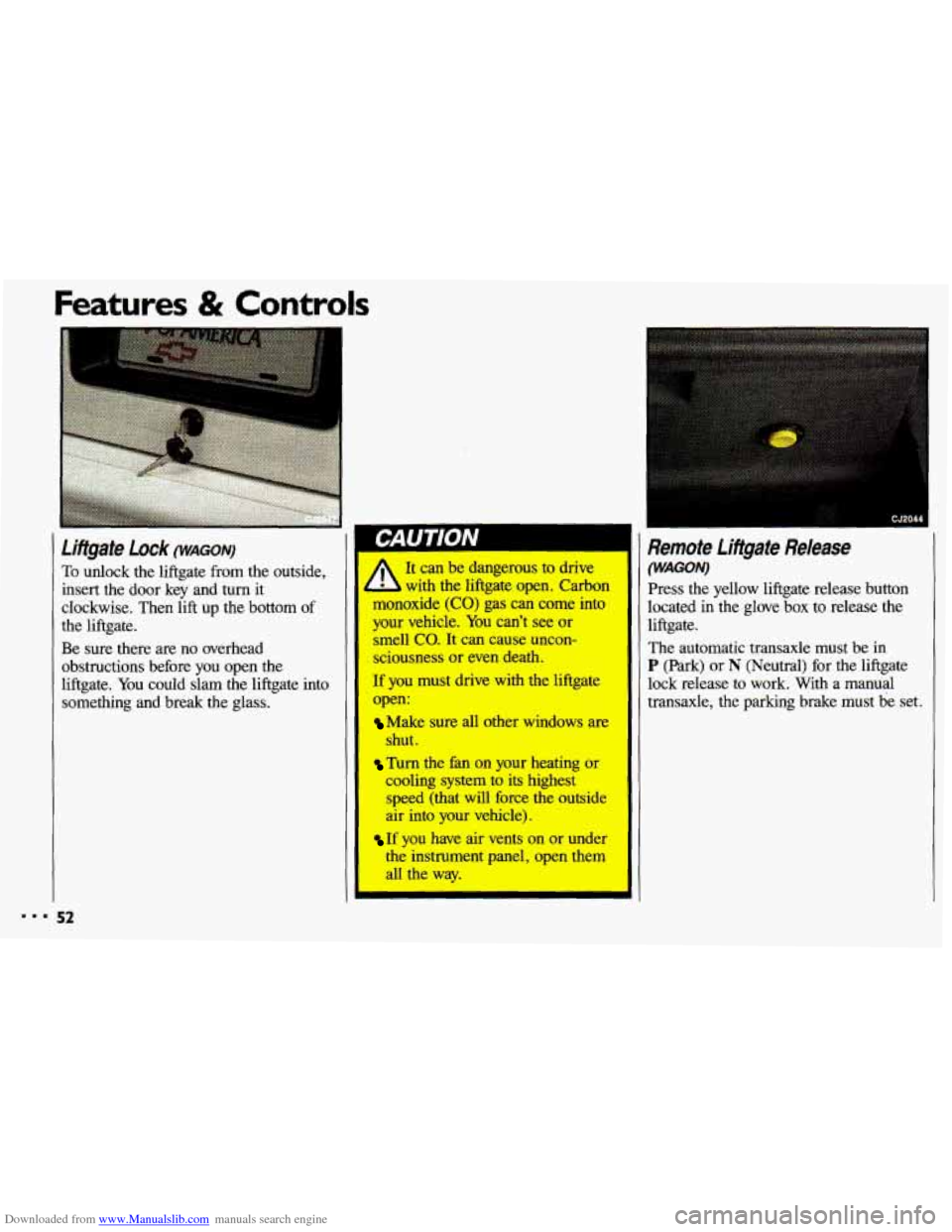
To &dock the liftgate from the outside,
insert the door key and turn it
clockwise. Then
lift up the bottom of
the liftgate.
Be sure there are no overhead
obstructions before you open the
liftgate. You could slam the liftgate into
something and break the glass.
I CJ2044
Remote Lifigate Release
(WAGON) It can be dangerous to drive
L with the liftgate open. Carbon
monoxide
(CO) gas can come into
your vehicle.
You can’t see or I smell co. It can cause uncon-
sciousness or even death.
If you must drive with the liftgate lock release to work. With a manual
open: transaxle, the parking brake must be set.
I
The automatic transaxle must be in
P (Park) or N (Neutral) for the liftgate
Make sure all other windows are
shut.
Turn the fan on your heating or
cooling system to its highest
speed (that will force the outside
air into your vehicle).
If you have air vents on or under
the instrument panel, open them
all the way. Press the
yellow liftgate release button
located in the glove box to release the
liftgate.
Page 55 of 308
Downloaded from www.Manualslib.com manuals search engine Theft
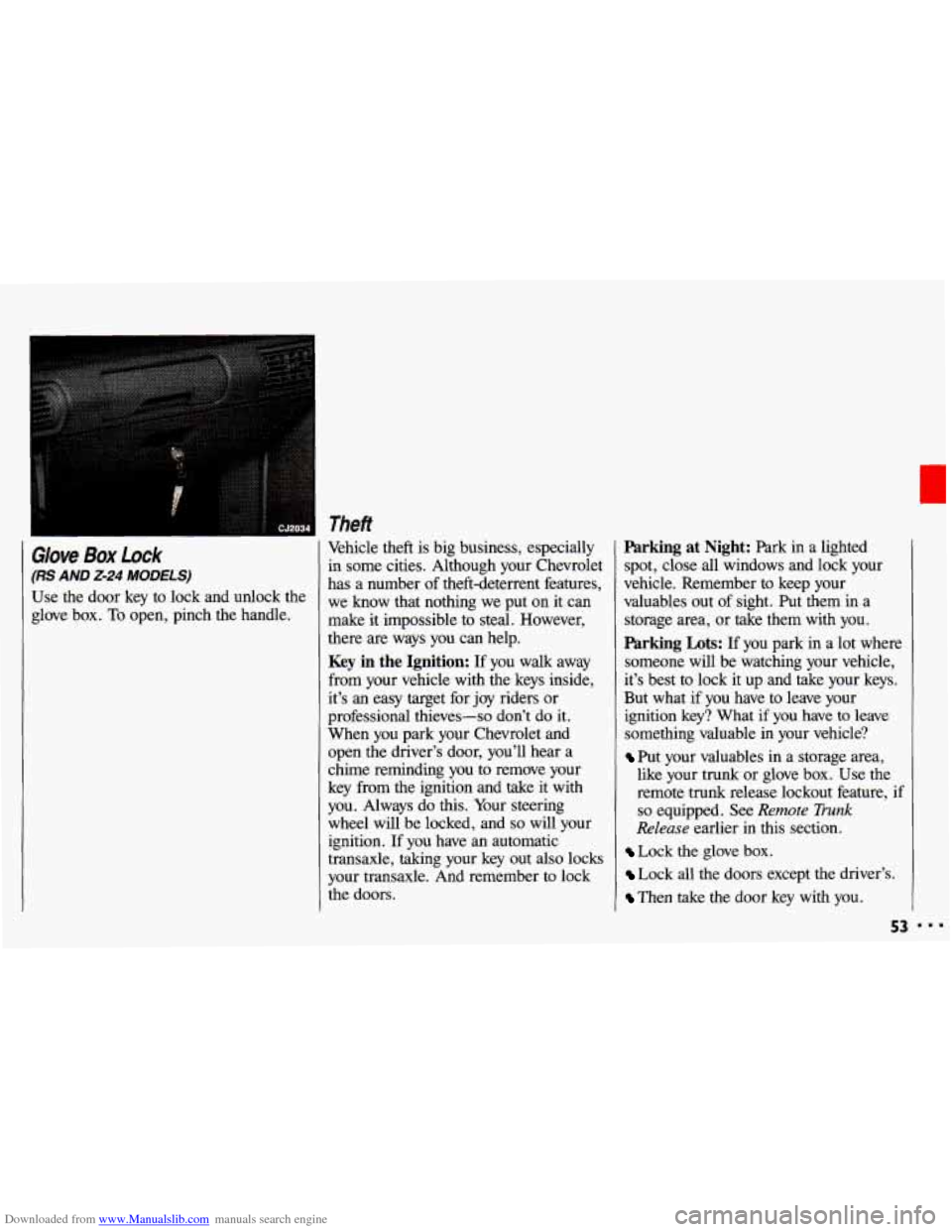
Glove Box Lock
(RS AND 2-24 MODELS)
Use the door key to lock and unlock the
glove box.
To open, pinch the handle, Vehicle theft
is big business, especially
in some cities. Although your Chevrolet
has a number of theft-deterrent features,
we know that nothing we put on it can
make it impossible to steal. However,
there are ways you can help.
Key in the Ignition: If you walk away
from your vehicle with the keys inside,
it’s an easy target for joy riders or
professional thieves-so don’t do it.
When you park your Chevrolet and
open the driver’s door, you’ll hear a
chime reminding you
to remove your
key from the ignition and take
it with
you. Always do this. Your steering
wheel will be locked, and
so will your
ignition. If you have an automatic
transaxle, taking your key out also locks
your transaxle. And remember to lock
the doors.
Parking at Night: Park in a lighted
spot, close all windows and lock your
vehicle. Remember to keep your
valuables out of sight. Put them in a
storage area, or take them with you.
Parking Lots: If you park in a lot where
someone will be watching your vehicle,
it’s best
to lock it up and take your keys.
But what if you have to leave your
ignition key? What if you have to leave
something valuable in your vehicle?
Put your valuables in a storage area,
like your trunk or glove box. Use the
remote trunk release lockout feature,
if
so equipped. See Remote Trunk
Release earlier in this section.
Lock the glove box.
Lock all the doors except the driver’s.
Then take the door key with you.
53
Page 57 of 308
Downloaded from www.Manualslib.com manuals search engine Ignition Switch
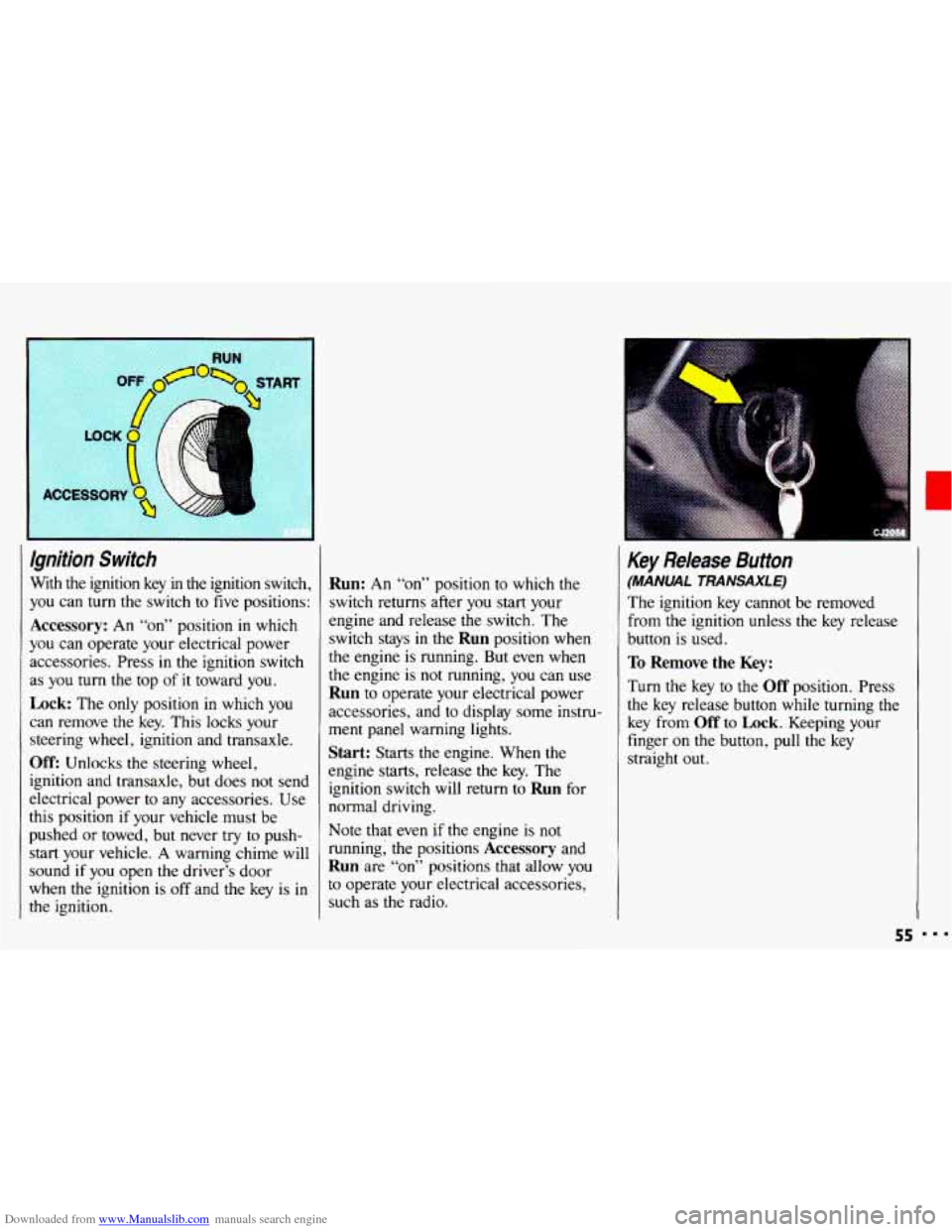
With the ignition key in the ignition switch,
you can
turn the switch to five positions:
Accessory: An “on” position in which
you can operate your electrical power
accessories. Press in the ignition switch
as
you turn the top of it toward you.
Lock: The only position in which you
can remove the key. This locks your
steering wheel, ignition and transaxle.
Off: Unlocks the steering wheel,
ignition and transaxle, but does not send
electrical power
to any accessories. Use
this position
if your vehicle must be
pushed
or towed, but never try to push-
start your vehicle.
A warning chime will
sound
if you open the driver’s door
when the ignition is
off and the key is in
the ignition.
Run: An “on” position to which the
switch returns after
you start your
engine and release the switch. The
switch stays in
the Run position when
the engine is running. But even when
the engine is not running, you can use
Run to operate your electrical power
accessories, and to display some instru-
ment panel warning lights.
Start: Starts the engine. When the
engine starts, release the key. The
ignition switch will return to
Run for
normal driving.
Note that even
if the engine is not
running; the positions
Accessory and
Run are “on” positions that allow you
to operate your electrical accessories,
such as the radio.
Key Release Button
(MANUAL TRANSAXLE)
The ignition key cannot be removed
from
the ignition unless the key release
button is used.
To Remove the Key:
Turn the key to the Off position. Press
the key release button while turning the
key from
Off to Lock. Keeping your
finger
on the button, pull the key
straight
out.
55
Page 58 of 308
Downloaded from www.Manualslib.com manuals search engine Features & Contr
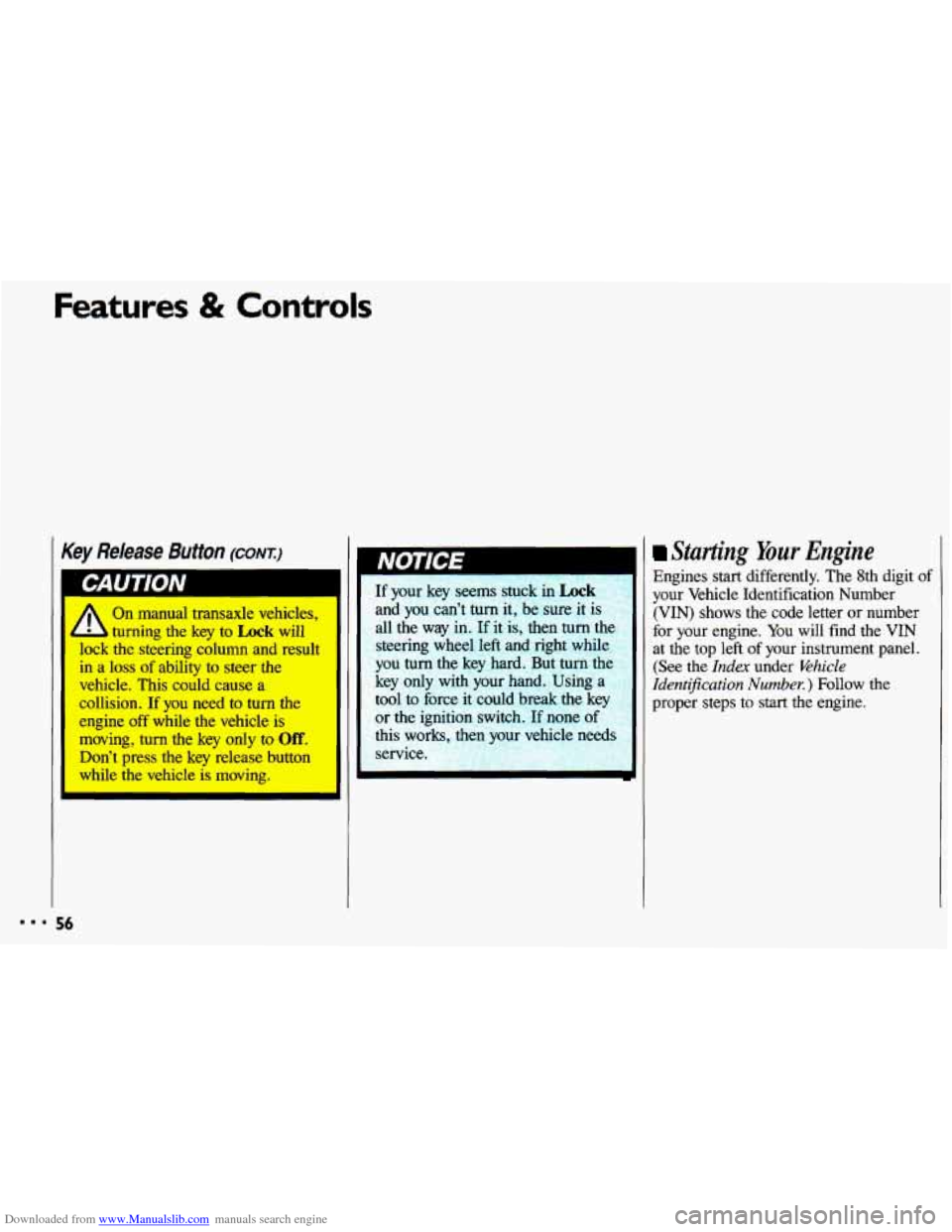
Key Release Button (CONT.)
On manual transaxle vehicles,
- udng the key ta Lock will
lock the shMg column and result
in a loss of ability to steer the
vehicle. This could cause a
collision, If you need to tum the
engine off while the vehicle is
moving, turn the key only to Off.
Don’t press the key release button
while the vehicle is mcwing.
If your key seems stuck in Lock
and you can’t turn it, be sure it is
all the way in.
If it is, then turn tl
steering wheel left and right while
you
turn the key hard. But turn the
key only with your hand. Using a
tool to force it could break the
key
or the ignition switch. If none
this works,
t 1 yc vehicle needs
service.
Starting Your Engine
Engines start differently. The 8th digit of
your Vehicle Identification Number
(VIN) shows the code letter or number
for your engine. You will find the
VIN
at the top left of your instrument panel.
(See the Index under &hick
Ident@cation Number. ) Follow the
proper steps to start the engine.
56
Page 61 of 308
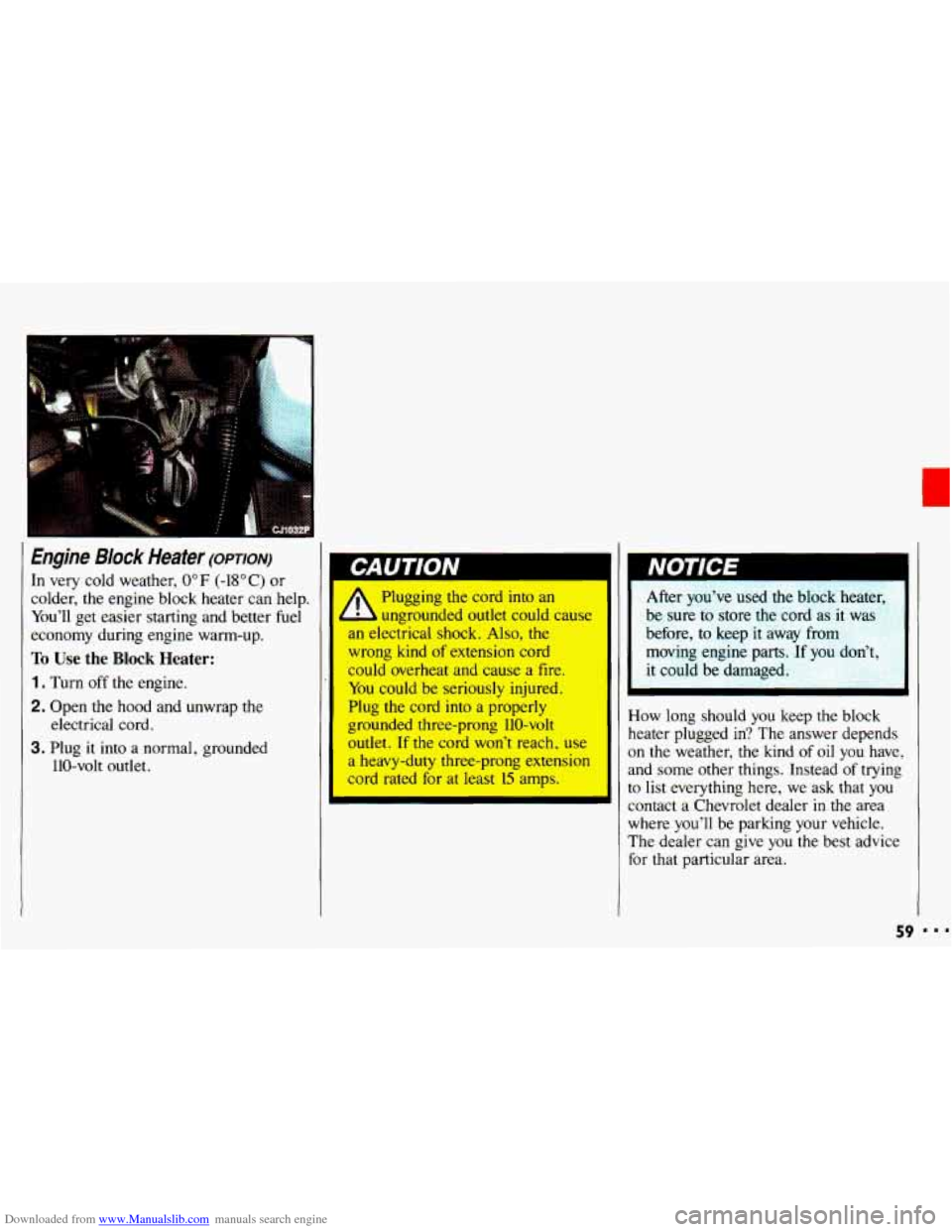
Downloaded from www.Manualslib.com manuals search engine Engine Block Heater (OPTION)
In very cold weather, 0°F (-18°C) or
colder, the engine block heater can help.
You’ll get easier starting and better fuel
economy during engine warm-up.
To Use the Block Heater:
1. Turn off the engine.
2. Open the hood and unwrap the
3. Plug it into a normal, grounded
electrical cord.
110-volt
outlet.
A
Plugging the cord into an
ungrounded outlet could cause
an electrical shock. Also, the
wrong kind
of extension cord
could overheat and cause a
fire.
You could be seriously injured.
Plug the cord into a properly
grounded three-prong 110-volt
outlet.
If the cord won’t reach, use
a heavy-duty three-prong extension
cord rated for at least
15 amps. After
you’ve
used the bfock hea,,,
be sure to store the cord as it was
before, to keep it away from
moving engine parts. If
you don’t,
it could be damaged.
How long should
you keep the block
heater plugged in? The answer depends
on the weather, the
kind of oil you have,
and some other things. Instead of trying
to list everything here,
we ask that you
contact a Chevrolet dealer
in the area
where you’ll be parking
your vehicle.
The dealer can give
you the best advice
for that particular area.
59 I..
Page 62 of 308
Downloaded from www.Manualslib.com manuals search engine Features & Controls
rn Shifting the
Automatic Transaxle
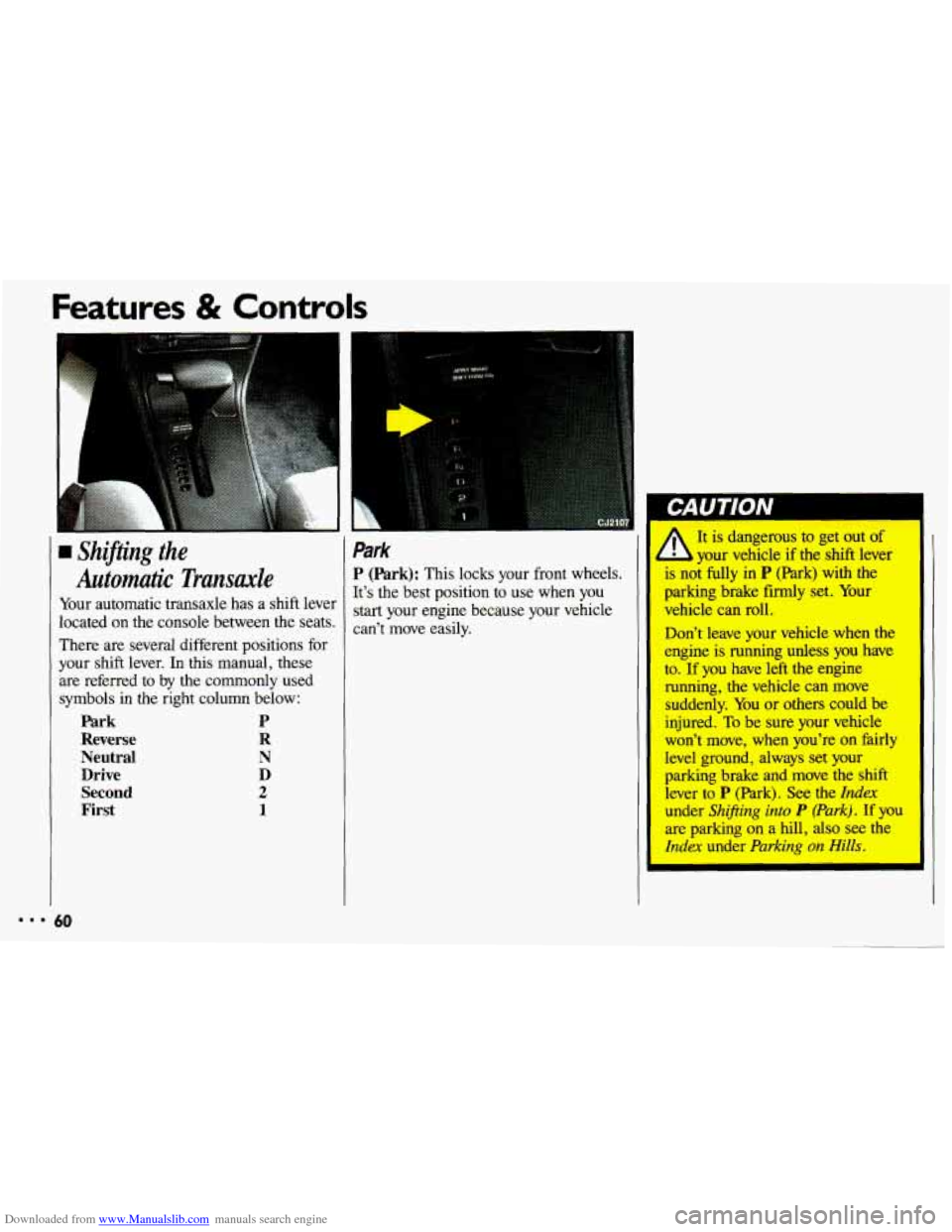
Your automatic transaxle has a shift lever
located
on the console between the seats.
There are several different positions for
your shift lever. In this manual, these
are referred to by the commonly used
symbols in
the right column below:
Park P
Reverse R
Neutral
N
Drive D
Second
2
First 1
Park
P (Park): This locks your front wheels.
It’s the best position to use when you
start your engine because your vehicle
can’t move easily.
I It is dangerous to get out of
your vehicle if the shift lever
is noi fully in
P (Park) with the
parking brake firmly set. Your
vehicle can roll.
Don’t leave your vehicle when the
engine is running unless
you have
to.
If you have left the engine
running, the vehicle can move
suddenly. You or others could be
injured.
To be sure your vehicle
won’t move, when you’re on fairly
level ground, always set your
parking brake and move the shift
lever to
P (Park). See the Index
under Shifting into P (Park). If you
are parking on a hill, also see the
Index under Parking on Hills.
Page 63 of 308

Downloaded from www.Manualslib.com manuals search engine Ensure the shift lever is fully in P (Park)
range before starting the engine. Your
Chevrolet has a brake-transaxle shift
interlock. You have to fully
apply your
regular brakes
before you can shift fiom
P (Park) when the ignition key is in the
Run position. If you cannot shift out of
P (Park), ease pressure on the shift
lever-push the shift lever
all the way
into
P (Park) and also release the shift
lever button as you maintain brake
application. Then move the shift lever
into
the gear you wish. See the Index
under Shifting Out of P (Park),
U
Reverse
R (Reverse): Use this gear to back up.
Shifting to
R (Reverse) while your
vehicle
is moving forward could
damage your transaxle. Shift
to R
only after your vehicle has
Stopped-
Neutmi
N (Neutral): In this position, your
engine doesn’t connect with the wheels.
To restart when you’re already moving,
use
N (Neutral) only. Also, use N when
your vehicle
is being towed.
To rock your vehicle back and forth to
get out of snow, ice or sand without
damaging your transaxle, see the
Index
under If You ’re Stuck: In Sand, Mud,
Ice or Snow.
61