1993 CHEVROLET BLAZER manual transmission
[x] Cancel search: manual transmissionPage 64 of 386

. Featums & Controls
I
Section
Here you can learn about the many standard and optional featur\
es on your
vehicle. and information on starting. shifting. and braking
. Also explained are
the instrument panel and the warning systems that tell you
if everything is
working properly-and what to do if you have a problem
.
For explanation of vehicle symbols in this section. refer to “Vehicle
Symbols” in Section 0 .
Keys ........................................................................\
............................................... 2-3
Your DobrS and How They Work
........................................................................\
2-5
Side Doors
........................................................................\
................................. 2-5
Door Locks
........................................................................\
................................. 2-6
Tailgate. Tailgate Glass and Rear Doors
............................................................ 2-7
Tailgate
........................................................................\
....................................... 2-8
Panel Doors ........................................................................\
............................... 2-9
Theft
........................................................................\
............................................. 2-10
New Vehicle Break-In
........................................................................\
................. 2-11
Ignition Switch
........................................................................\
............................. 2-11
Starting Your Engine ........................................................................\
................... 2-14
Driving Through Water
........................................................................\
............ 2-15
Automatic Transmission
........................................................................\
.............. 2-17
Five-Speed Manual Transmission ...................................................................... 2-20
2-1
Page 75 of 386
Features & Controls
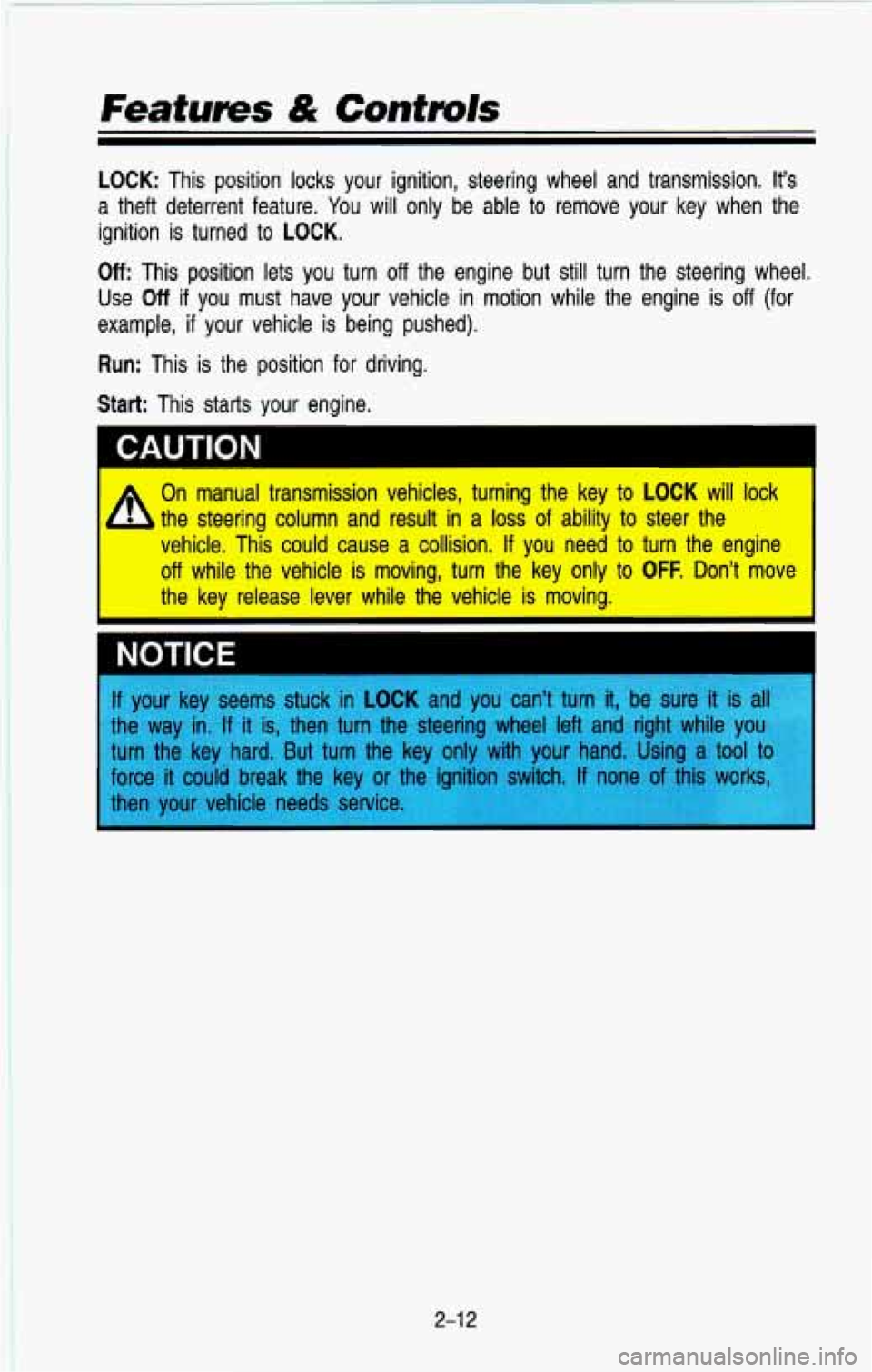
LOCK: This position locks your ignition, steering wheel and transmission. it's
we your key when the a theft deterrent feature. You will only be able to rem(
ignition is turned to
LOCK.
Off: This position lets you turn off the engine but still
Use
Off if you must have your vehicle in motion while
example,
if your vehicle is being pushed).
Run: This is the position for driving.
Start: This starts your engine. turn the steering wheel.
1 the engine
is off (for
'a
On manual transmission vehicles, turning the key to LOCK will lock
the steering column and result in a
loss of ability to steer the
vehicle. This could cause a collision.
If you need to turn the engine
off while the vehicle is moving, turn the key only to OFF. Don't move
the key release lever while the vehicle
is moving.
I
I
NOTICE
2-1 2
Page 76 of 386
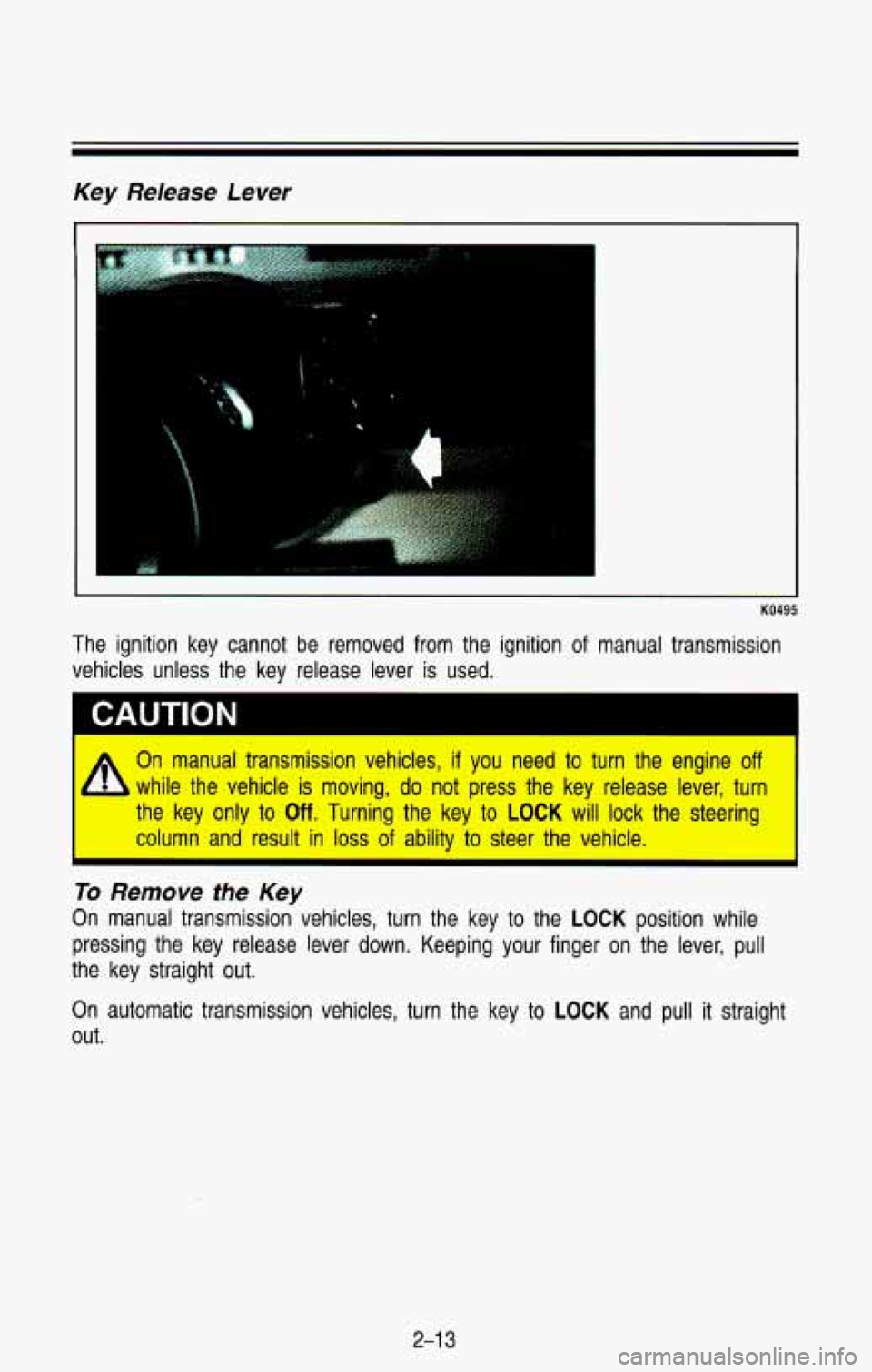
Key Release Lever
I
KO495
The ignition key cannot be removed from the ignition of manual transmission
vehicles unless the key release lever is used.
I
A
On manual transmission vehicles, if you need to turn the engine off
while the vehicle is moving, do not press the key release lever, turn
the key only to
Off. Turning the key to LOCK will lock the steering
column and result in
loss of ability to steer the vehicle. I
I
To Remove the Key
On manual transmission vehicles, turn the key to the LOCK position while
pressing the key release lever down. Keeping your finger on th\
e lever, pull
the key straight out.
On automatic transmission vehicles, turn the key to
LOCK and pull it straight
out.
2-1 3
Page 77 of 386
Features & Controls
kmrting Your Engine
Engines start differently. The 8th digit of your Vehicle Identification Number
(VIN) shows the code letter or number for your engine. You
will find the VIN
at the top left of your instrument panel. (See “Vehicle Identification Number\
”
in the Index.) Follow the proper steps to start the engine.
To Start Your 5.7 Liter (Code K) engine
or
7.4 Liter (Code N) engine:
1. Automatic Transmission
Move your shift lever to P (Park) or N (Neutral). Your engine won’t start
in any other position-that’s a safety feature. To restart when you’re
already moving, use
N (Neutral) only.
NOTICE I
Don’t try to shift to P (Park) if your vehicle is moving. If you do, you^^^^
p~&w$gp!
could damaa our P . icle is
stormed
Manual Transmission
Shift your gear selector to neutral and hold the clutch pedal \
to the floor
while starting the engine, Your vehicle won’t start if the clutch pedal is
not
all the way down-that’s a safety feature.
2. Don’t push the accelerator pedal before starting your engine.\
In some
other vehicles you might need to do this, but because of your vehicle’s
computer systems, you don’t.
key. The idle speed will go down as your engine gets warm.
7.4L Engine Cold Start: In cold weather, below 60°F (16°C)’ start the
engine the same way but push the accelerator pedal one-quarter \
of the
way down and hold it there for about 2 seconds after the engine starts.
3. Turn your ignition key to Start. When the engine starts, let go of the
Holding your key in
Start for ‘longer than 15 seconds at a time will cause
your battery to be drained much sooner. And the excessive he
damage
your starter motor.
4. If it doesn’t start right away, hold your key in Start. If it doesn’t start in
three seconds, push the accelerator pedal about one-quarter of the way
down for 12 more seconds,
or until it starts.
2-1
4
Page 82 of 386
NOTICE
Damage to your transmission caused by shifting out of P (Park) or N
{Neutral) with the engine racing isn’t covered by your warranty.
OD (Automatic Overdrive)
This position is for normal driving.
If you need more power for passing, and
vou’re:
- Going less than about 35 mph (56 km/h), push your accelerator
pedal about halfway down
- Going about 35 mph (56 km/h) or more, push the accelerator all the
way down
You’ll shift down to the next gear and have more power.
OD should not be used when towing a trailer, carrying a heavy load, driving
on steep hills, or for off-road driving. Select
D (third gear) when operating the
vehicle under any of these conditions.
D (Third Gear)
This is like
OD, but you never go into Overdrive. You should use D when
towing a trailer, carrying a heavy load, driving on steep hills, or for off-road
driving.
2 (Second Gear)
This position gives you more power but lower fuel economy. You can use
2
on hills. It can help control your speed as you go down steep mountain
roads, but then you would also want
to use your brakes off and on.
If you manually select 2, the transmission will drive in second gear. You may
use this feature for reducing torque to the rear wheels when you are trying to
start your vehicle from a stop on slippery road surfaces.
1 (First Gear)
This position gives you even more power (but lower fuel economy) than
2.
You can use it on very steep hills, or in deep snow or mud. If the selector
lever is put
in 1, the transmission won’t shift into first gear until the vehicle is
going
‘slowly enough.
2-1 9
Page 83 of 386
. . -.
1
I lf your rear wheels can’t rotate, don’t try to drive, This might happen if
pu were stuck in very deep sand or mud or were up against a solid
-‘-’ect. You could damage your transmission. *?isgi%
so, if you stop when going uphill, don’t hold your vehicle there wi onl,
:he accelerator pedal. This could overheat and damage the transmission.
Jse your brakes or shift to P (?k) to hold your vehicle in position on a
?ill.
:,e%-=
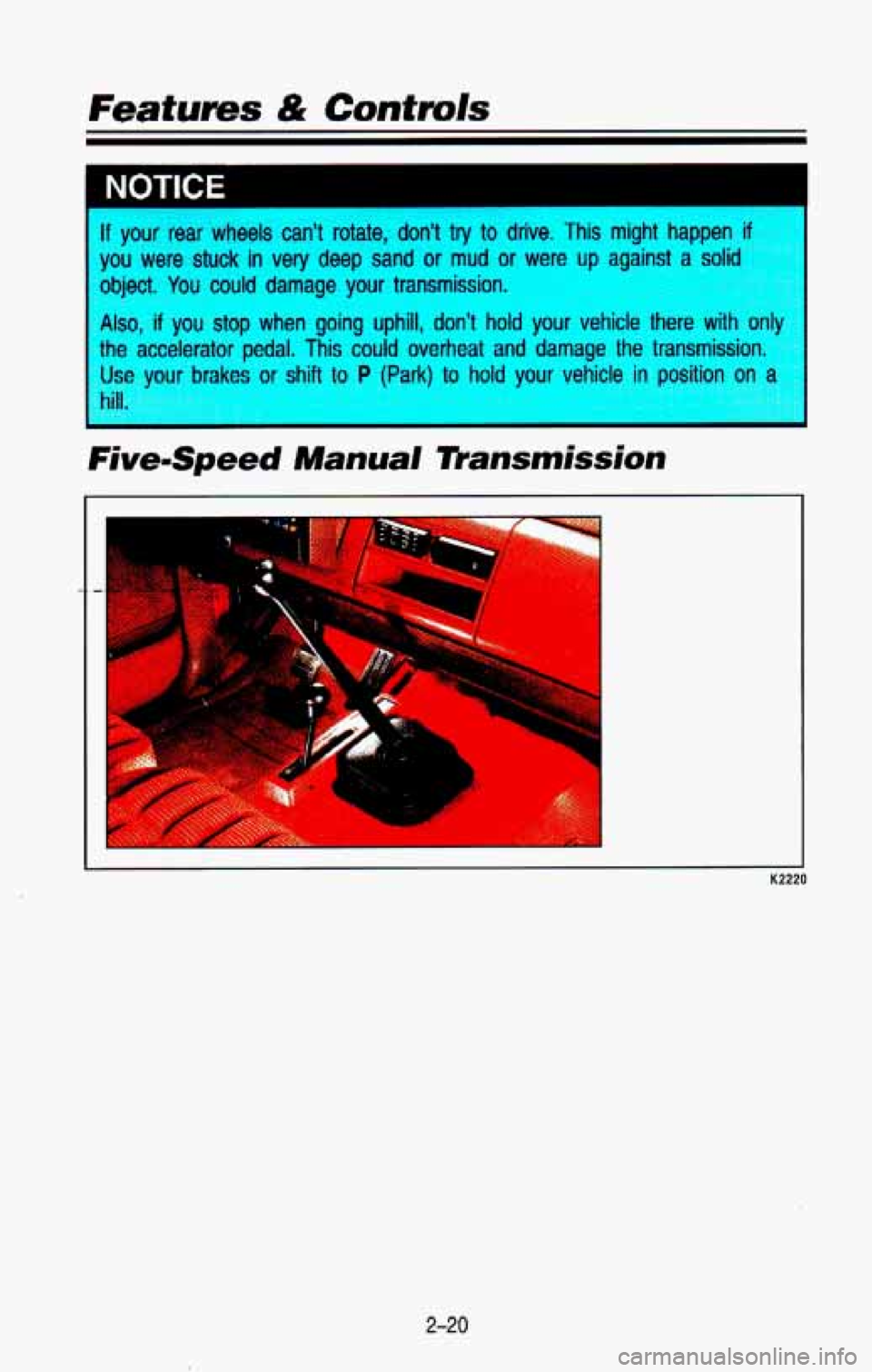
FivemSpeed Manual 7Pansmission
I
2-20
Page 85 of 386
Shift to R (Reverse) only after your vehicle is stopped. Shifting to R :I
?verse) while your vehicle is moving could damage your transmisslor
Also. use Reverse. alona with the Darkina brake. for oarkina vour ve\
hic.,
.-
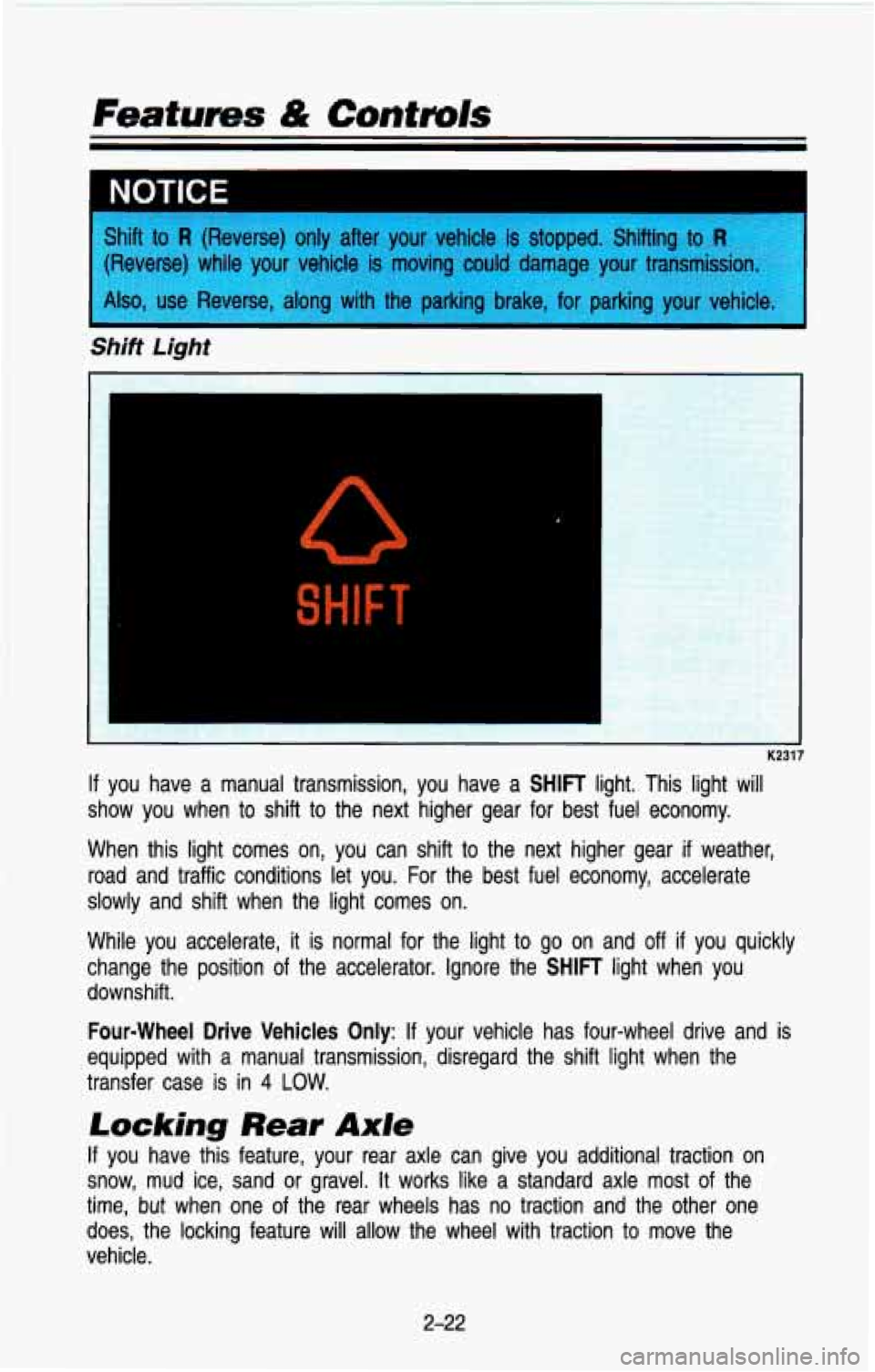
Shift Light
1 K2317
If you have a manual transmission, you have a SHIFT light. This light will
show you when to shift to the next higher gear for best fuel\
economy.
When this light comes on, you can shift to the next higher g\
ear
if weather,
road and traffic conditions let you.
For the best fuel economy, accelerate
slowly and shift when the light comes on.
While you accelerate, it
is normal for the light to go on and off if you quickly
change the position
of the accelerator. Ignore the SHIFT light when you
downshift.
Four-wheel Drive Vehicles Only: If your vehicle has four-wheel drive and is
equipped with a manual transmission, disregard the shift light \
when the
transfer case is in
4 LOW.
Locking Rear Axle
If you have this feature, your rear axle can give you additional \
traction on
snow, mud ice, sand or gravel. It works like a standard axle \
most of the
time, but when one of the rear wheels has no traction and the other one
does, the locking feature will allow the wheel with traction t\
o move the
vehicle.
2-22
Page 89 of 386
Features & Controls
Leaving Your Vehicle With the Engine Running (Automatic
Transmission Models Only)
A It can be dangerous to leave your vehicle with the engine running.
h Your vehicle could move suddenly if the shift lever is not fully in
P (Park) with the parking brake firmly set.
If you have four-wheel drive with a manual transfer case shift le\
ver
and your transfer case
is in N (Neutral), your vehicle will be free to
roll, even
if your shift lever is in P (Park). So be sure the transfer
case is in a drive gear-not in
N (Neutral).
And,
if you leave the vehicle with the engine running, it could
overheat and even catch fire. You or others could be injured. Don’t
I leave your vehicle with the engine running unless you have to.\
If you have to leave your vehicle with the englne runnmg, De sure your
vehicle is in
P (Park) and your parking brake is firmly set, before you leave
it.
If you have four-wheel drive with a manual transfer case shift le\
ver, be sure
that the transfer case is in a drive gear-not in
N (Neutral).
After you’ve moved the shift lever into the
P (Park) position, hold the regular
brake pedal down. Then,
see if you can move the shift lever away from
P (Park) without first pulling it toward you.
If you can, it means that the shift lever wasn’t fully locked \
into P (Park).
Parking Your Vehicle (Manual Transmission Models Only)
Before you get out of your vehicle, put your manual transmission in
R (Reverse) and firmly apply the parking brake.
If you have four-wheel drive, be sure your transfer case is in a drive gear.
Your vehicle could roll
if it isn’t.
If you are parking on a hill, or if your vehicle is equipped to tow a trailer,
see “Towing a Trailer” or “Parking on Hills” in the Index.
2-26