1993 CHEVROLET BLAZER manual transmission
[x] Cancel search: manual transmissionPage 97 of 386

Electric Tailgate Glass Release
PO271
Before operating your electric tailgate glass release, see the \
caution under
"Tailgate, Tailgate Glass and Rear
Doors" in this section.
The electric hatch release button, located below the headlight \
switch, lets you release the tailgate glass.
To use it, slide the button to the right until you
hear the latch release the window.
If you have an automatic transmission, your shift lever must be in P (Park) or
N (Neutral) for the release to work. With a manual transmission, you must
apply the parking brake for the release to work.
2-34
Page 104 of 386

K2247
With Cruise Control, you can maintain a speed of about 25 mph (40 km/h)
or more without keeping your foot on the accelerator. This can\")
I NOTICE
Cruise Control (Option)
K2247
With Cruise Control, you can maintain a speed of about 25 mph (40 km/h)
or more without keeping your foot on the accelerator. This can\
really help
on long trips. Cruise Control does not work at speeds below a\
bout
25 mph
(40 krn/h).
When you apply your brakes, or the clutch pedal,
if you have a manual
transmission, the Cruise Control shuts
off.
2-41
Page 108 of 386
2. To slow down in very small amounts, push the button for less than half
a second. Each time you do this, you'll
go about 1 mph (1.6 kmlh)
slower.
Passing Another Vehicle While Using Cruise Control
Use the accelerator pedal to increase your speed. When you take your foot
off the pedal, your vehicle will slow down to the Cruise Control \
speed you set
earlier.
Using Cruise Control on Hills
How well your Cruise Control will work on hills depends upon your speed,
load, and the steepness of the hills. When going up steep hil\
ls, you may
have to step on the accelerator pedal to maintain your speed. When going
downhill, you may have to brake or shift to
a lower gear to keep your speed
down. Of course, applying the brake takes you out of Cruise Control. Many
drivers find this to be
too much trouble and don't use Cruise Control on
steep hills.
To Get Out of Cruise Control
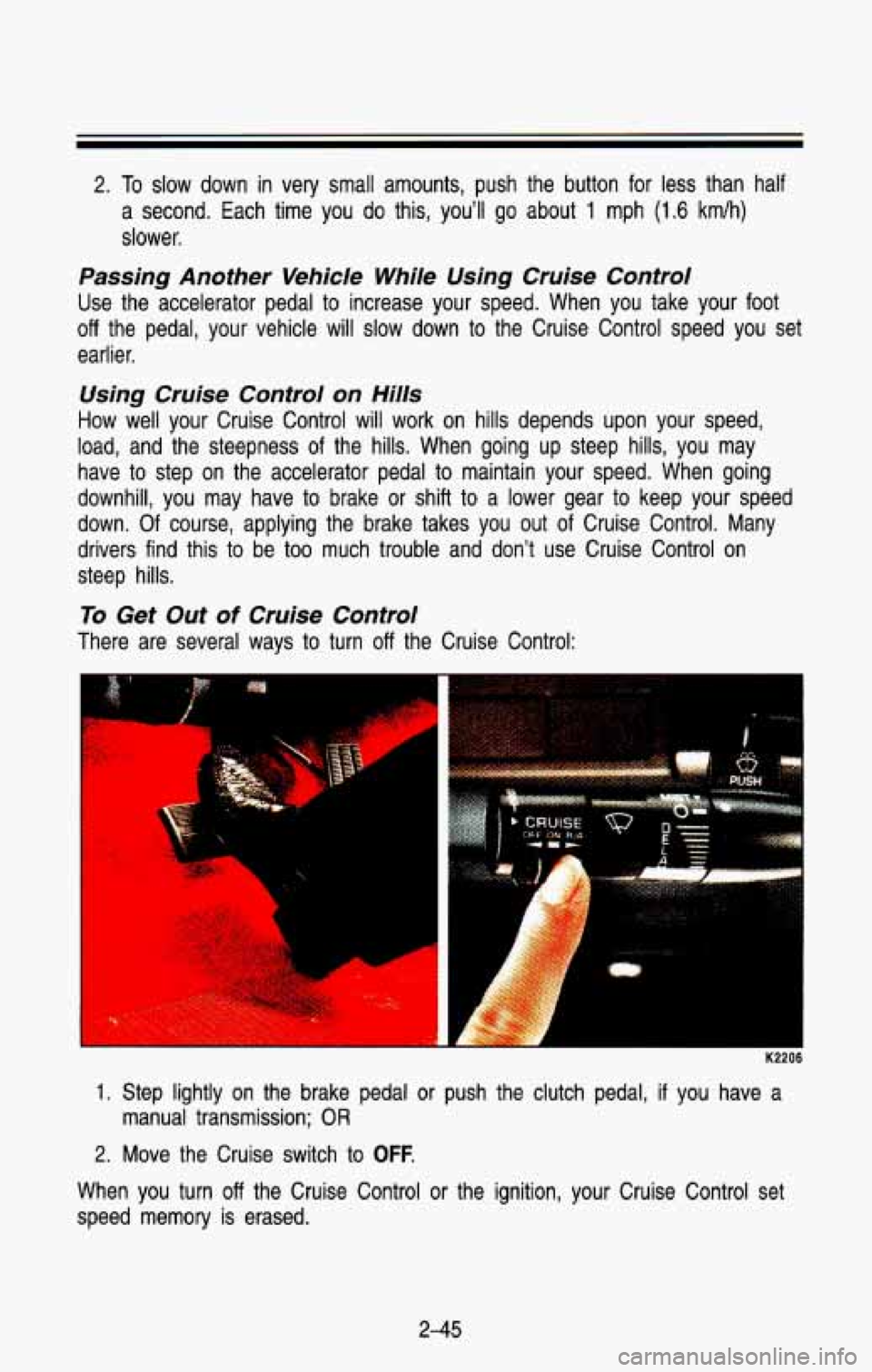
There are several ways to turn off the Cruise Control:
.Y ..
1. Step lightly on the brake pedal or push the clutch pedal, if you have a
manual transmission; OR
2. Move the Cruise switch to OFF.
When you turn off the Cruise Control or the ignition, your Cruise Control set
speed memory is erased.
2-45
Page 137 of 386

SHIFT Indicator Light
I
K2317
This light, with the SHlFTlarrow symbol, is at the left side of the instrument
cluster on some vehicles with manual transmissions. Depending on your
particular model, your vehicle may not have this light. The SHIFT indicator
light
will help you get the best fuel economy. See “Shift Light” or “Shift
Speeds-Vehicles Without Shift Light”
in this section for more information.
Headlight High Beam Indicator Light
I
K2331
This light with the blue high beam symbol is on the left side of the
instrument cluster. The
high beam indicator is on whenever you use your high
2-74
Page 196 of 386
h
Turning or driving across steep hills can be dangerous. You could
lose traction, slide sideways, and possibly roll over. You could be
seriously injured or killed. When driving up hills, always try to
go
I straight up.
Ease up on your speed as you approach the top of the hill.
Attach a flag to the vehicle to make you more visible to approaching
Sound the horn as you approach the top of hill to let opposing traffic
Use your headlights even during the day. They make you more visible to
traffic on trails
or hills.
know you’re there.
oncoming traffic.
I CAUTION
’ rf Driving to the top (crest) of a hill at full speed can cause an
1 the top of a hill, slow down and stay alert.
ccident.
There could be a drop-off, embankment, cliff, or even
another vehicle. You could be seriously injured or killed.
As you near
Q: What should I do if my vehicle stalls, or is about to stall, and I can’t
make it up the hill?
A: If this happens, there are some things you should do, and there \
are some
things you must not do. First, here’s what you should do:
Push the brake pedal to stop the vehicle and keep it from rolling
backwards.
Also, apply the parking brake.
If your engine is still running, shift the transmission into reverse, release
the parking brake, and slowly back down the hill in reverse.
If your engine has stopped running, you’ll need to restart it. With the
brake pedal depressed and the parking brake still applied, shift the
transmission to
P (Park) (or, shift to N (Neutral) if your vehicle has a
manual transmission) and restart the engine. Then, shift
to reverse,
release the parking brake, and slowly back down the hill
in reverse.
As you are backing down the hill, put your left hand on the steering
wheel at the
12 o’clock position. This way, you’ll be able to tell if your
wheels are straight or turned to the left or right as you back down.
4-29
Page 197 of 386
Here are some things you must not do if you stall, or are about to stall,
when going up a hill.
Never attempt to prevent a stall by shifting into N (Neutral) (or
depressing the clutch,
if you have a manual transmission) to “rev-up” the
engine and regain forward momentum. This won’t work. Your vehicle will
roll backwards very quickly and you could go out
of control.
Instead, apply the regular brake
to stop the vehicle. Then apply the parking
brake. Shift into reverse, release the parking brake, and slowl\
y back down.
Never attempt to turn around if you are about to stall when going up a
hill. If the hill is steep enough
to stall your vehicle, it’s steep enough to
cause you to roll over if you turn around. If you can’t make it up the
hill, you must back down the hill.
Q: Suppose, after stalling, I try to back down the hill and decide I just
can’t
do it. What should I do?
A: Set the parking brake, put your transmission in P (Park) (or the manual
transmission in first gear), and turn
off the engine. Leave the vehicle and go
get some help. Exit
on the uphill side and stay clear of the path the vehicle
would take
if it rolled downhill. Do not shift the transfer case to N (Neutral)
when you leave the vehicle. Leave
it in some gear.
Shifting the transfer case to N (Neutral) can cause your vehicle to
manual transmission, even if you’re in gear). This is because the N
(Neutral) position on the transfer case overrides the transmission. If
you are going to leave your vehicle, set the parking brake and shift
the transmission to P (Park) (or, put your manual transmission in first
gear). But do not shift the transfer case to the N (Neutral) position.
rn ‘ roll even if the transmission is in P (Park) (or, if you Rave the
I Leave the transfer case in the 2 Wheel, 4 High or 4 Low position. I
Driving Downhill
When off-roading takes you downhill, you’ll want to consider a number of
things:
How steep is the downhill? Will I be able to maintain vehicle control?
What’s the surface like? Smooth? Rough? Slippery? Hard-packed \
dirt?
Are there hidden surface obstacles? Ruts? Logs? Boulders?
Gravel?
4-30
Page 198 of 386
What’s at the bottom of the hill? Is there a hidden creek bank or even a
river bottom with large rocks?
If you decide you can go down a hill safely, then try to keep your vehicle
headed straight down, and use a low gear. This way, engine drag can help
your brakes and they won’t have to do all the work. Descend slowly, keeping
your vehicle under control at all times.
’ [ Heavy braking when going down a hill can cause your brakes to
overheat and fade. This could cause
loss of control and a serious
accident. Apply the brakes lightly when descending a hill and use a
I low gear to keep vehicle speed under control. 1
Q: Are there some things I should not do when driving down a hill?
A: Yes! These are important because if you ignore them you could lose
control and have
a serious accident.
When driving downhill, avoid turns that take you &%C>Ss the incline of the
hill.
A hill that’s not too steep to drive down may be too steep to drive
across. You could roll over
if you don’t drive straight down.
Never go downhill with the transmission in N (Neutral), or with the clutch
pedal depressed in a manual shift. This is called “free-wheeling.” Your
brakes will have to do all the work and could overheat and fade.
Q: Am I likely to stall when going downhill?
A: It’s much more likely to happen going uphill, But if it happens going
downhill, here’s what to do.
Stop your vehicle by applying the regular brakes. Apply the parking
Shift to P (Park) (or to Neutral with the manual transmission) and, while
Shift back to a low gear, release the parking brake, and drive straight
brake.
still braking, restart the engine.
down.
If the engine won’t start, get out and get help.
Driving Across an Incline
Sooner or later, an off-road trail will probably go across the incline of a hill. If
this happens, you have to decide whether to try
to drive across the incline.
Here are
some things to consider:
4-3 1
Page 229 of 386
Your Driving and the Road
Turn Signals When Towing a Trailer
When you tow a trailer, your vehicle has to have a different turn signal
flasher and extra wiring. The green arrows on your instrument \
panel will flash
whenever you signal a turn
or lane change. Properly hooked up, the trailer
lights will also flash, telling other drivers you’re about
to turn, change lanes,
or stop.
When towing a trailer, the green arrows on your instrument pan\
el will flash for
turns even
if the bulbs on the trailer are burned out. Thus, you may think \
drivers behind you are seeing your signal when they are not.
It’s important to
check occasionally to be sure the trailer bulbs are still working.
Driving on Grades
Reduce speed and shift to a lower gear before you start down a long or
steep downgrade. If you don’t shift down, you might have to use your brakes
so much that they would get hot and no longer work well.
On
a long uphill grade, shift down and reduce your speed to 45 mph (70
kmlh) or less to reduce the possibility of engine and transmission overheating.
If you have an automatic transmission, you should use D (or, as you need to,
a lower gear) when towing a trailer. Operating your vehicle in D when towing
a trailer will minimize heat buildup and extend the
life of your transmission.
Or,
if you have a manual transmission with fifth gear and you are to\
wing a
trailer, it’s better not
to use fifth gear, just drive in fourth gear (or, as you
need to, a lower gear).
Parking on Hilk
You really should not park your rig on a hill. If something goes wrong, your
rig could start
to move. People can be injured and both your vehicle and the
trailer can be damaged.
But
if you ever have to park your rig on a hill, here’s how to do it:
1. Apply your regular brakes, but don’t shift into P (Park) yet, or into gear
for a manual transmission.
2. Have someone place chocks under the trailer wheels.
3, When the wheel chocks are in place, release the regular brakes\
until the
4. Reapply the regular brakes. Then apply your parking brake, and \
then
chocks absorb the load.
shift
to P (Park), or R (Reverse) for a manual transmission.
5. If you have a four-wheel-drive vehicle, be sure the transfer case \
is in
a
drive gear-not in
N (Neutral).
4-62