Page 298 of 407
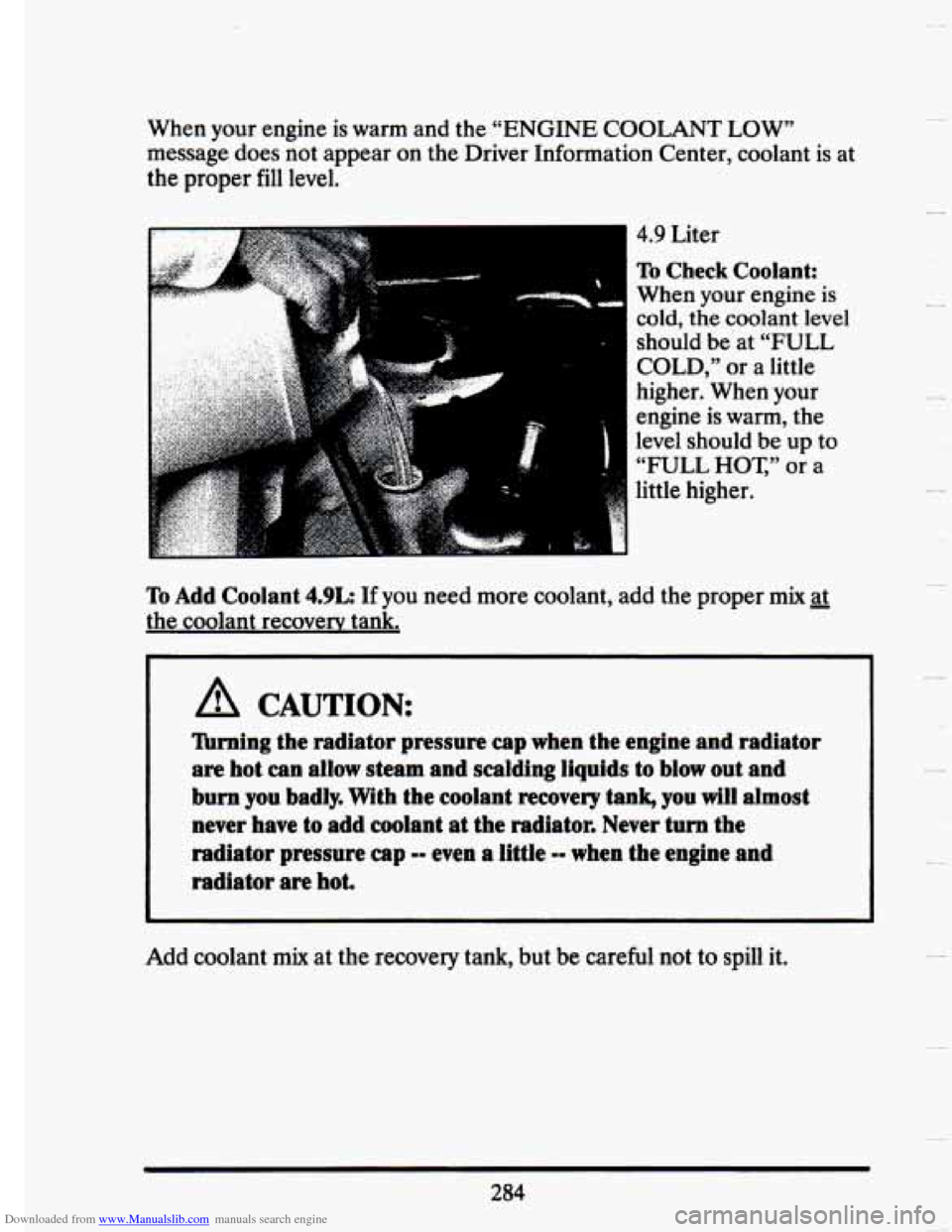
Downloaded from www.Manualslib.com manuals search engine When your engine is warm and the “ENGINE COOLANT LOW”
message does not appear on the Driver Information Center, coolant
is at
the proper fill level.
4.9 Liter
To Check Coolant:
When your engine is
cold, the coolant level
should be at
“FULL
COLD,” or a little
higher. When your
engine is warm,
the
level should be up to
“FULL
HOT,” or a
little higher.
To Add Coolant 4.9L If you need more coolant, add the proper mix at
the coolant recoverv tank.
A CAUTION
flrrning the radiator pressure cap when the engine and radiator
are hot can allow steam and scalding liquids to blow
out and
bum you badly. With the coolant recovery
tank, you will almost
never have to add coolant at the radiator. Never turn the
~ radiator pressure cap -- even a little -- when the engine and
radiator are hot.
Add coolant mix at the recovery tank, but be careful not to spill it.
284
Page 299 of 407
Downloaded from www.Manualslib.com manuals search engine I
A CAUTION:
You can be burned if you spill coolant on hot engine parts.
Coolant contains ethylene glycol, and it
will burn if the engine
parts are hot enough. Don’t
spill coolant on a hot engine.
To Add Coolant 4.6L (Northstar): If you need more coolant, add the
proper
mix at the coolant surPe tank.
A CAUTION:
lbrning the surge tank pressure cap when the engine and
radiator are hot
can allow steam and scalding liquids to blow
out and burn you badly. Never turn the surge tank pressure cap
-- even a little -- when the engine and radiator are hot.
You can be burned if you spill coolant on hot engine parts.
Coolant contains ethylene glycol, and it
will burn if the engine
parts are hot enough. Don’t spill coolant
on a hot engine.
To Check or Add Coolant: When the engine is cold, the coolant level
should be at
“FULL COLD,” or a little higher. Remove the pressure cap
from the surge tank;
use a flashlight as necessary to see into the tank. The
coolant Ievel should be at or above the seam inside the tank.
If you need more coolant, add the proper mix.
Page 301 of 407
Downloaded from www.Manualslib.com manuals search engine P
L
r
r
c
P
P
c
P
I.
How To Check Power Steering Fluid:
4.6 Liter (Northstar)
Unscrew the cap and wipe the dipstick with a clean rag. Replace the cap
and completely tighten it. Then remove the cap again and look at the
fluid level
on the dipstick.
0
0
When the engine
compartment is
hot, the level
should
be at the
“HOT” mark.
When the engine
compartment is
cool, the
level
should be at the
“FULL COLD”
mark.
287
I
Page 305 of 407
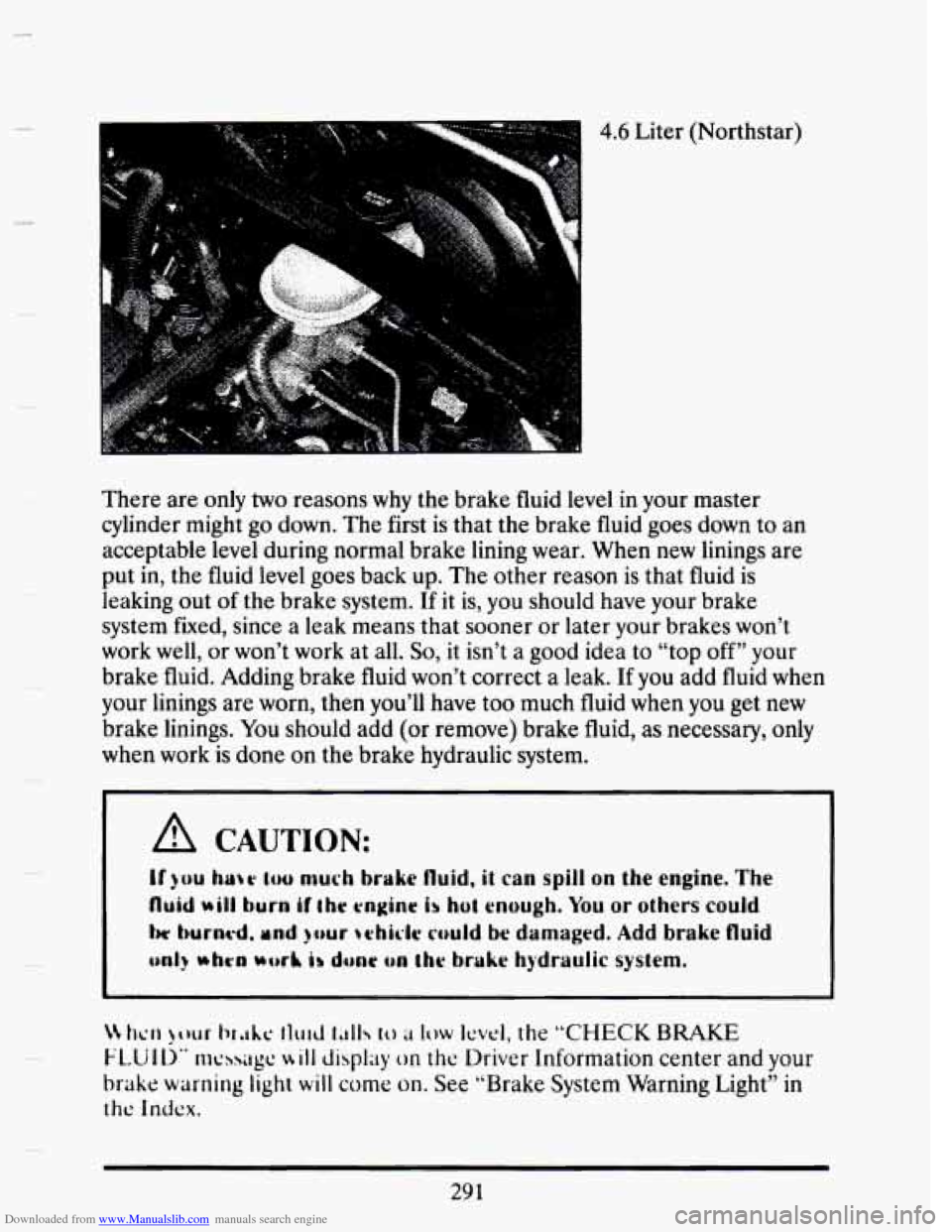
Downloaded from www.Manualslib.com manuals search engine There are only two reasons why the brake fluid level in your master
cylinder might go down. The first is that the brake fluid goes down to an
acceptable level during normal brake lining wear. When
new linings are
put in, the fluid level goes back up. The other reason is that fluid is
leaking out
of the brake system. If it is, you should have your brake
system
fixed, since a leak means that sooner or later your brakes won’t
work well, or won’t work at all.
So, it isn’t a good idea to “top off” your
brake fluid. Adding brake fluid won’t correct a leak. If you add fluid when
your linings are worn, then you’ll have too much fluid when you get new
brake linings.
You should add (or remove) brake fluid, as necessary, only
when work
is done on the brake hydraulic system.
A CAUTION:
If ),ou hate loo much brake fluid, it can spill on the engine. The
fluid will burn if the engine is hot enough. You or others could
tw borntd. and )our whicle could be damaged. Add brake fluid
onl) whco wcC h dune on the bruke hydraulic system.
\C hc‘n !our tmk tlu~cj 1,1115 10 ;I Iuw Icvel, the “CHECK BRAKE
FLU ID” ~nc~gc L+ ill display on the Driver Information center and your
brake warning light will come on. See “Brake System Warning Light” in
the Index.
291
Page 306 of 407
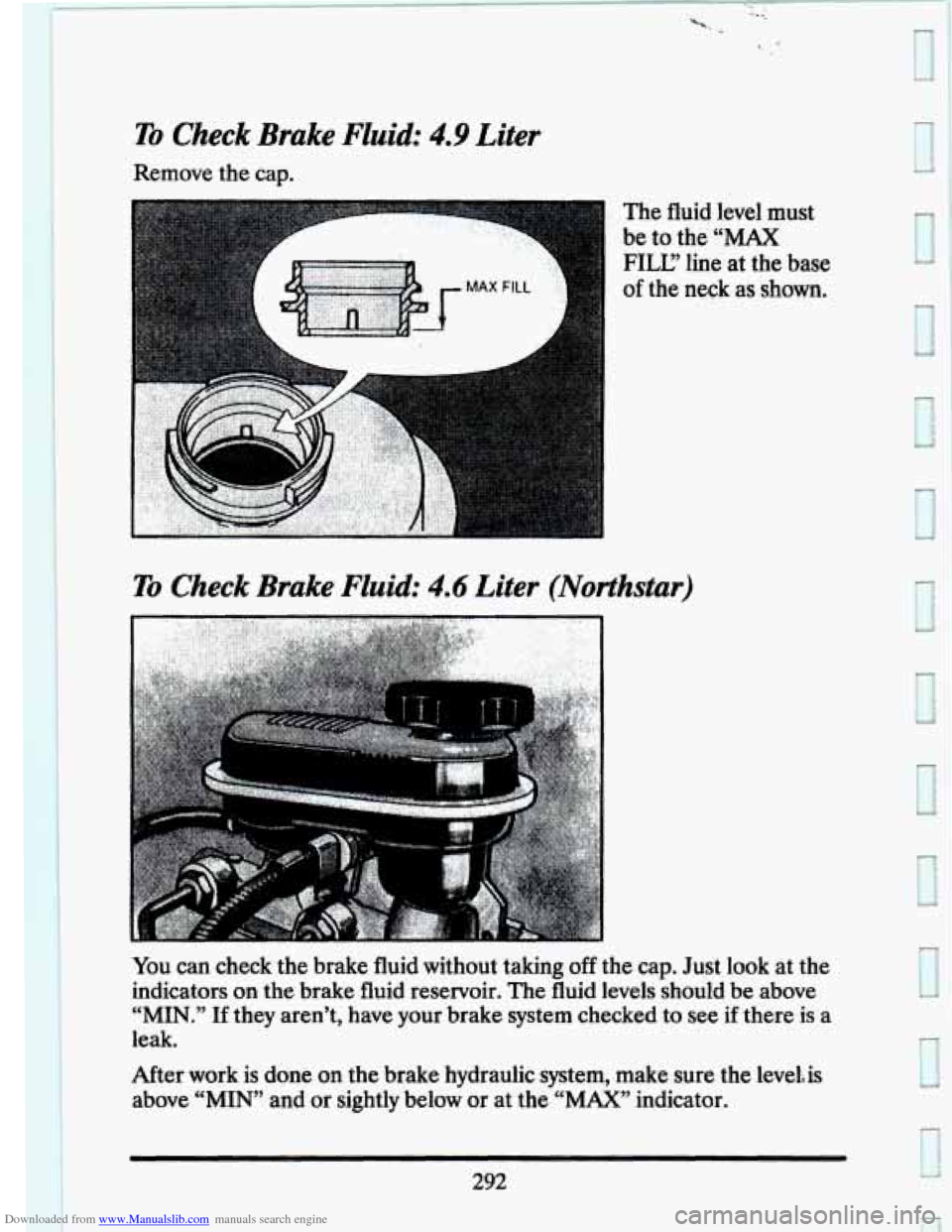
Downloaded from www.Manualslib.com manuals search engine To Check Brake Fluid: 4.9 Liter
Remove the cap.
The fluid level must
be to the 'CMAX
FILE line at the base
of the neck as shown.
To Check Brake Fluid: 4.6 Liter (Northstar)
292
Page 321 of 407
Downloaded from www.Manualslib.com manuals search engine 3
A CAUTION
Poorly maintained and improperly used tires are dangerous.
Overloading your tires can cause overheating as a result of
too much fkiction. You could have an air-out and a serious
accident. See “Loading Your Vehicle” in the Index.
Underinflated tires pose the same danger as overloaded
tires. The resulting accident could cause serious iqjury.
Check all tires frequently to maintain the recommended
pressure. Tire pressure should be checked when your tires
are cold.
Overinflated tires are more likely to be cut, punctured, or
broken
by a sudden impact, such as when you hit a pothole.
Keep tires at the recommended pressure.
Worn, old tires can cause accidents. If your tread is badly
worn, or if your tires have been damaged, replace them.
See “Inflation
- Tire Pressure” in this section for inflation
pressure adjustment
for higher speed driving.
In@tion - Tire Pressure
The Tire-Loading Information label which is located on the driver’s door
shows the correct inflation pressures for your tires, when they’re cold.
“Cold” means your vehicle has been sitting
for at least three hours or
driven no more than a mile.
If you’ll be driving at speeds higher than
100 mph (160 kmh) where it is
legal, raise the “cold” inflation pressure
of each tire to 35 psi (240 kPa).
When you end this
very high speed driving, reduce the “cold” inflation
pressures
to those listed on the Tire-Loading Information label. Never
inflate the tires higher than the maximum “cold” inflation pressures
stated on the sidewall
of the tires.
307
Page 322 of 407
Downloaded from www.Manualslib.com manuals search engine When to Check Check your tires once a month or more.
The Seville tire pressures are:
Front - 28 psi (200 kPa)
Rear - 26 psi (179 kPa)
Seville recommended
tire size is:
XGT4 IIburing Design Blackwall (P225/6OR16)
The
STS tire pressures are:
Front - 29 psi (200 kPa)
Rear - 29 psi (200 kPa)
308
Page 323 of 407
Downloaded from www.Manualslib.com manuals search engine STS recommended tire size is:
GA Performance Blackwall (P225/60ZR 16)
Don’t forget your compact spare tire. It should be at 60 psi (420 kPa).
How to Check Use a good quality pocket-type gage to check tire
pressure. Simply looking at the tires
will not tell you the pressure,
especially if you have radial tires
-- which may look properly inflated even
if they’re underinflated.
If your tires have valve caps, be sure to put them back on. They help
prevent leaks
by keeping out dirt and moisture.
Tire Inspection and Rotation
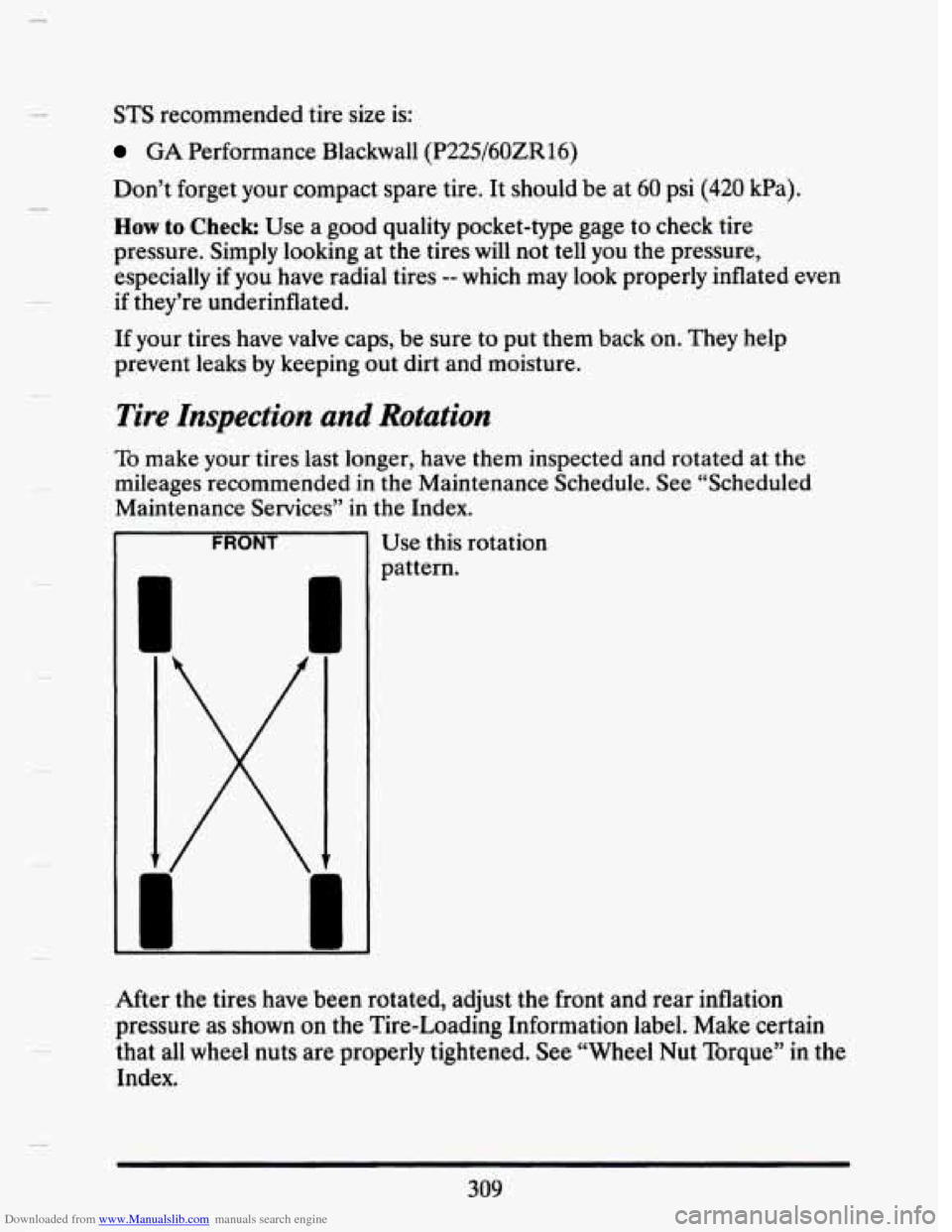
To make your tires last longer, have them inspected and rotated at the
mileages recommended
in the Maintenance Schedule. See “Scheduled
Maintenance Services”
in the Index.
FRONT Use this rotation
pattern.
After the tires have been rotated, adjust the front and rear inflation
pressure as
shown on the Tire-Loading Information label. Make certain
that
all wheel nuts are properly tightened. See “Wheel Nut Torque’’ in the
Index.
309