1993 CADILLAC SEVILLE warning
[x] Cancel search: warningPage 264 of 407
Downloaded from www.Manualslib.com manuals search engine If your tire goes flat, the next section shows how to use your jacking
equipment
to change a flat tire safely.
CHANGING A FLAT TIRE
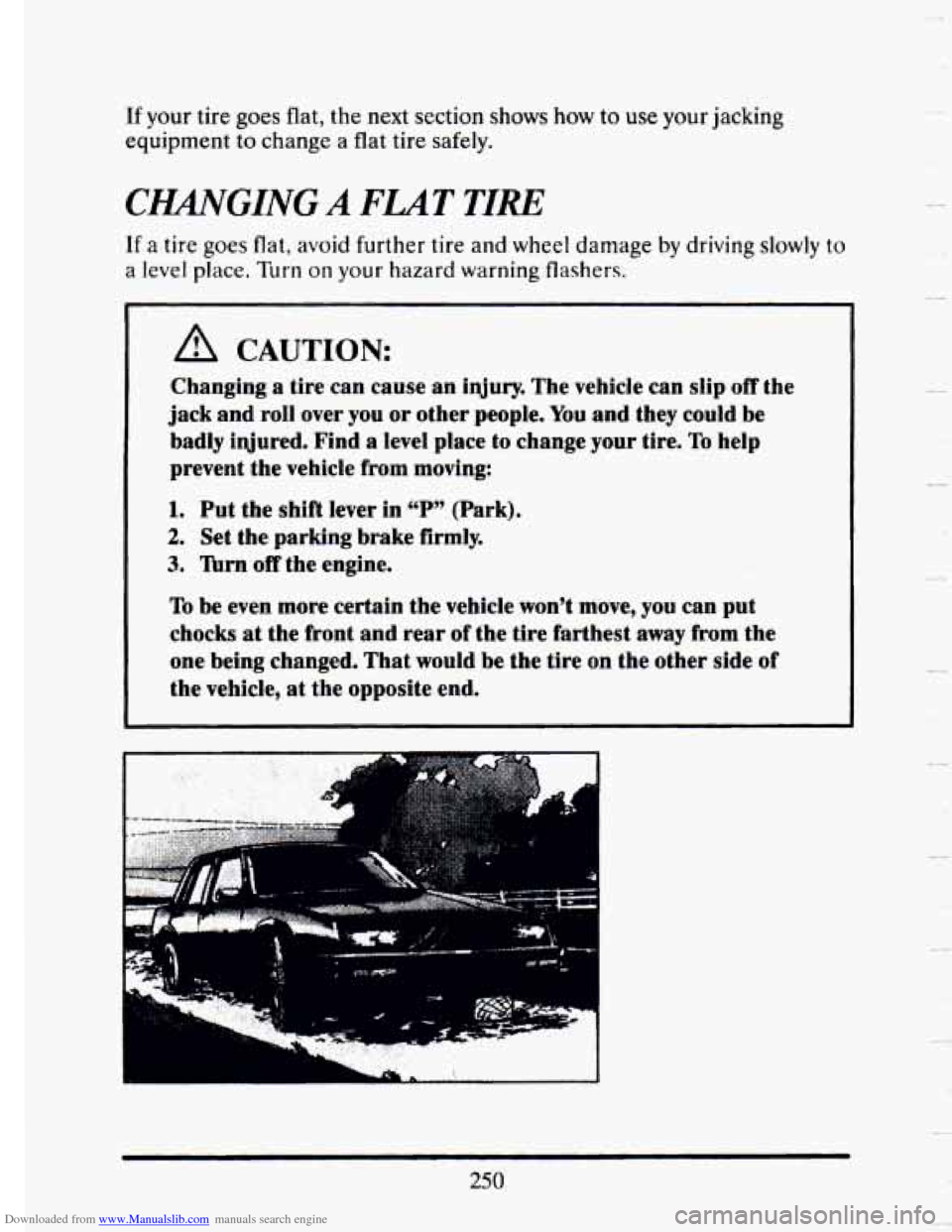
If a tire goes flat, avoid further tire and wheel damage by driving slowly to
a level place. Turn on your hazard warning flashers.
A CAUTION:
Changing a tire can cause an injury. The vehicle can slip off the
jack and ro11 over you or other people. You and they could be
badly injured. Find a level place
to change your tire. To help
prevent the vehicle from moving:
1. Put the shift lever in “P” (Park).
2. Set the parking brake firmly.
3. lhrn off the engine.
To be even more certain the vehicle won’t move, you can put
chocks
at the front and rear of the tire farthest away from the
one being changed. That would be the tire
on the other side of
the vehicle, at the opposite end.
250
.-
_-
I
u
L.
Page 272 of 407
Downloaded from www.Manualslib.com manuals search engine A CAUTION:
Storing a jack, a tire or other equipment in the passenger
compartment
of the vehicle could cause injury. In a sudden stop
or collision, loose equipment could strike someone. Store all
these in the proper place.
COMPACT SPARE TIRE
Although the compact spare was fully inflated when your vehicle was
new, it can lose air after a time. Check the inflation pressure regularly. It
should be
60 psi (420 kPa). The compact spare is made to go up to 3,000
miles (5000 km), so you can finish your trip and have your full-size tire
repaired or replaced where you want. Of course, it’s best to replace your
spare with a full-size tire as
soon as you can. Your spare will last longer
and be
in good shape in case you need it again.
Your anti-lock brake system warning light may come on when you are
driving with a compact spare. See “Anti-Lock Brake System Warning
Light” in the Index.
258
I
Page 296 of 407
Downloaded from www.Manualslib.com manuals search engine When the correct fluid level is obtained, push the dipstick back in all
the way.
How To Reset Transaxle Fluid Change Indicator: 4.6L (Northstar)
Your vehicle is equipped with a transaxle fluid change indicator.
A
“CHANGE TRANS FLUID” message will display on the Information
Center
when the power train computer determines that the transaxle
fluid needs to be changed or at each 100,000 miles
(160,000 km) interval,
whichever occurs first. When this message appears, change the t\
ransaxle
fluid and reset the transaxle fluid life indicator
as follows:
Turn the key “ON” with the engine stopped.
Press and hold the “OFF” and “REAR DEFOG” buttons on the
climate control simultaneously
until the “TRANS FLUID RESET”
message appears
in the Information Center (between 5 and 20
seconds).
ENGINE COOLANT
The following explains your cooling system and how to add coolant when
it is low. If you have
a problem with engine overheating, see “Engine
Overheating” in the Index.
The proper coo’ It for
your Cadillac will:
Give freezing protection down to -34°F (-37’C) .
Give boiling protection up to 262 ” F (128 ” C) .
Protect against rust and corrosion.
Help keep the proper engine temperature.
Let the warning lights work as they should.
What to Use:
Use a mixture of one-half clean water (preferably distilled) and one\
-half
antifreeze that meets
“GM Specification 1825-M,” which won’t damage
aluminum parts. You can also use a recycled coolant conforming to
GM
Specification 1825-M with a complete coolant flush and refill. Use GM
Engine Coolant Supplement (sealer) with any complete coolant c\
hange.
If you use these, you don’t need to add anything else.
Y
c.
282
Page 297 of 407
Downloaded from www.Manualslib.com manuals search engine r ir
P
P
r
P I
A CAUTION
Adding only plain water to your cooling system can be
dangerous. Plain water, or some other liquid like alcohol, can
boil before the proper coolant
mix will. Your vehicle’s coolant
warning system
is set for the proper coolant mix. With plain
water or the
wrong mix, your engine could get too hot but you
wouldn’t get the overheat warning. Your engine could catch fire
and you or others could be burned. Use a
50/50 mix of clean
water and a proper antifreeze.
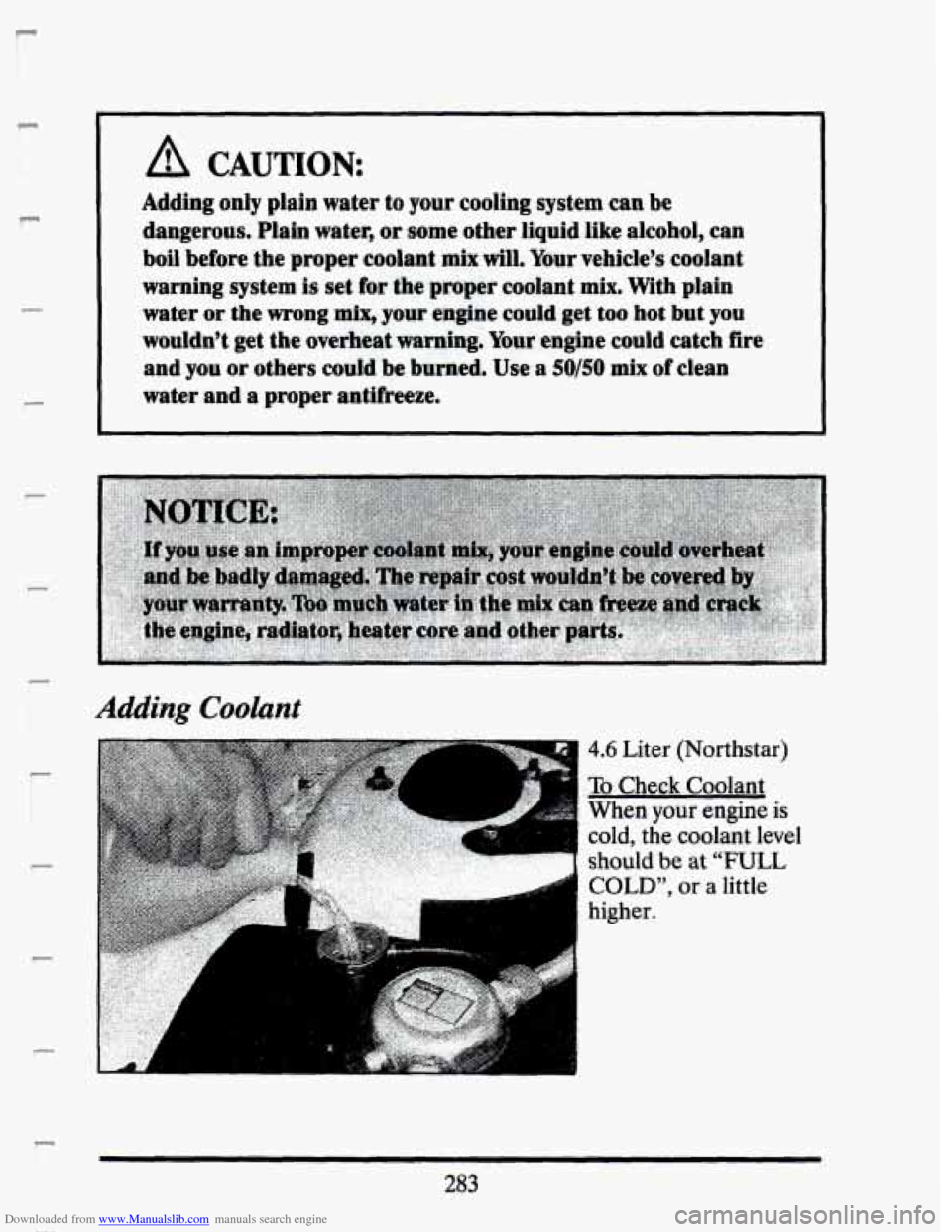
Adding Coolant
I 4.6 Liter (Northstar)
TO Check Coolant
When.
your engine is
cold, the coolant level
should be at “FULL
COLD”, or a little
higher.
283
P
Page 305 of 407
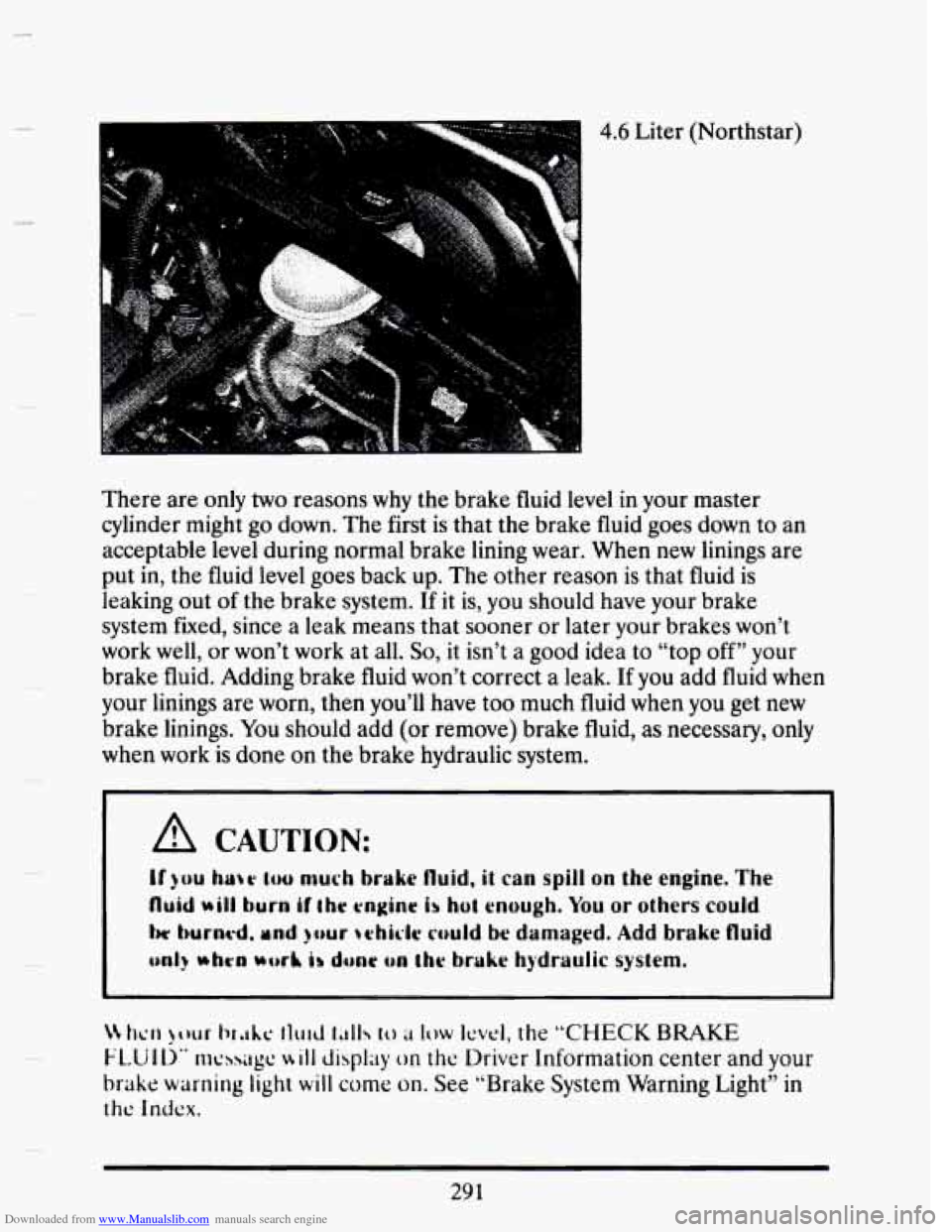
Downloaded from www.Manualslib.com manuals search engine There are only two reasons why the brake fluid level in your master
cylinder might go down. The first is that the brake fluid goes down to an
acceptable level during normal brake lining wear. When
new linings are
put in, the fluid level goes back up. The other reason is that fluid is
leaking out
of the brake system. If it is, you should have your brake
system
fixed, since a leak means that sooner or later your brakes won’t
work well, or won’t work at all.
So, it isn’t a good idea to “top off” your
brake fluid. Adding brake fluid won’t correct a leak. If you add fluid when
your linings are worn, then you’ll have too much fluid when you get new
brake linings.
You should add (or remove) brake fluid, as necessary, only
when work
is done on the brake hydraulic system.
A CAUTION:
If ),ou hate loo much brake fluid, it can spill on the engine. The
fluid will burn if the engine is hot enough. You or others could
tw borntd. and )our whicle could be damaged. Add brake fluid
onl) whco wcC h dune on the bruke hydraulic system.
\C hc‘n !our tmk tlu~cj 1,1115 10 ;I Iuw Icvel, the “CHECK BRAKE
FLU ID” ~nc~gc L+ ill display on the Driver Information center and your
brake warning light will come on. See “Brake System Warning Light” in
the Index.
291
Page 326 of 407
Downloaded from www.Manualslib.com manuals search engine Deadwear
The treadwear grade is a comparative rating based on the wear rate of
the tire
when tested under controlled conditions on a specified
government test course. For example,
a tire graded 150 would wear one
and
a half (1 1/2) times as well on the government course as a tire graded
100. The relative performance of tires depends upon the actual
conditions of their use, however,
and may depart significantly from the
norm
due to variations in driving habits, service practices and differences
in road characteristics and climate.
Traction - A, B, C
The traction grades, from highest to lowest are: A, B, and C. They
represent the tire’s ability to stop
on wet pavement as measured under
controlled conditions on specified government test surfaces of asphalt
and concrete.
A tire marked C may have poor traction performance.
Warning: The traction grade assigned
to this tire is based on braking
(straight-ahead) traction tests and does not include cornering (turning)
traction.
Temperature - A, B, C
The temperature grades are A (the highest), B, and C, representing the
tire’s resistance to the generation of heat and its ability to dissipate heat
when tested under controlled conditions on a specified indoor laboratory
test wheel. Sustained high temperature can cause the material
of the tire
to degenerate and reduce tire life, and excessive temperature can lead to
sudden tire failure.
The grade C corresponds to a level of performance
which all passenger car tires must meet under the Federal Motor Vehicle
Safety Standard
No. 109. Grades B and A represent higher levels of
performance on the laboratory test wheel than the minimum required by
law.
Warning: The temperature grade for this tire is established for a tire that
is properly inflated and not overloaded. Excessive speed, underinflation,
or excessive loading, either separately
or in combination, can cause heat
buildup and possible tire failure.
Those grades are molded on the sidewalls of passenger car tires.
312
.H
c
-
Page 351 of 407
Downloaded from www.Manualslib.com manuals search engine I
The Northstar engine is designed to require less maintenance than many
other
DOHC V-8 engines. Engine systems are designed to remind the
driver when service is required.
An oil life index indicator monitors
ongoing operating conditions and reminds the driver when an oil change
is needed.
A low coolant warning message keeps track of the level of this
vital fluid. Direct acting hydraulic tappets provide maintenance free zero
lash operation
of the 32 valves from idle to the 6500 rpm redline. The
camshafts are driven by a two stage roller chain assembly which is
designed to provide quiet maintenance free operation. Platinum tipped
spark plugs increase the replacement interval
to 100,OO miles.
The four valve per cylinder design provides more efficient engine
breathing which results in higher power than comparable
two valve
engines. The central location
of each spark plug ensures a fast and
complete burning
of the fuel/air mixture. The induction system uses
smooth thermoplastic tubes
to channel air into the cylinders. The
smoothness
of the tubes is equivalent to the elaborate port polishing
methods used for race car engines. Careful design using the shape and
length
of the tubes boosts horsepower by using sonic pressure waves
created by the motion
of the inlet valves to increase the amount of air
entering each cylinder.
The Northstar engine
is also designed to be very durable. The aluminum
block has cast-in-place iron cylinder liners for greater wear resistance.
High strength forged steel connecting rods support the free floating
piston pins
in bronze bushings for superior high speed performance. The
fillits
of the nodular iron crankshaft undergo a high pressure compression
rolling operation
to improve their resistance to fatigue.
Quiet operation
is enhanced by the use of special materials and designs.
The front cover of the engine is stamped from laminated steel which
damps out noise. Special cam cover gasket seals isolate valve train
operation.
The fuel injectors are placed inside the induction system
housing
to eliminate the clicking noise which is common to other fuel
injected engines.
The Northstar engine
is designed to provide years of efficient, reliable,
satisfying operation. We
think it is also just plain fun to drive.
33 7
Page 390 of 407
Downloaded from www.Manualslib.com manuals search engine r
r
F
r
P
P
r
t
SUBJECT INDEX
A
Acc (Ignition Key Position) ............................ 80
Accessory Power. Retained .......................... 327
Adding
Brake Fluid
..................................... 293
Electrical Equipment ............................. 326
Engine Coolant ....................... 240.245.283. 285
EngineOil ...................................... 271
Power Steering Fluid ............................. 288
Transaxle Fluid .................................. 281
Additives. Engine Oil ............................... 275
Adjustment. Brake ................................. 184
Adult Safety Belt Usage .. 1 ........................... 18
-Air Bag ............................................ 30
Aircleaner ....................................... 277
Air Cleaner Replace ................ See Maint . Book. p.22
Air Cleaner Filter Replacement ...................... 301
Air Conditioner .................................... 147
Air Outlets .................................... ._. .. 146
Air System ........................................ 146
Alarm. How To Turn Off Theft ......................... 77
Alcohol. Driving Under The Influence Of .............. 175
Alcohol in Gasoline ................................. 263
Aluminum Wheels. Cleaning ......................... 322
AMAX@ .......................................... 154
AM Radio Reception ............................... 153
AM Stereo Radio Reception ......................... 154
Antifreeze ..................................... 237. 245
Anti-Lock Brakes .................................. 181
Anti-Lock Brake System Warning Light ............. 129. 181
Anti-Theft Tips ..................................... 75
Appearance Care ................................... 315
Arm. Wearing A Safety Belt Under Your ................ 28
Ashtrays .......................................... 121
Astroroof .......................................... 119
Automatic Air Conditioning System ................... 147
Automatic Door Lock ................................ 68
Automatic Overdrive ................................. 86
Antenna. Cleaning Radio .-. .. _ ........................ 164
r I I
1