1993 BUICK PARK AVENUE tires
[x] Cancel search: tiresPage 123 of 340
The anti-lock brake system warning light may also come
on when you are driving with a compact spare tire. If
this happens, the light means you won’t have anti-lock
until you replace the compact spare with a full-size tire.
If the warning light stays on after you replace the
compact spare
with a full-size tire, or if it comes on
again when
you’re driving, your Buick needs service.
Traction Control System Warning Light
(Option)
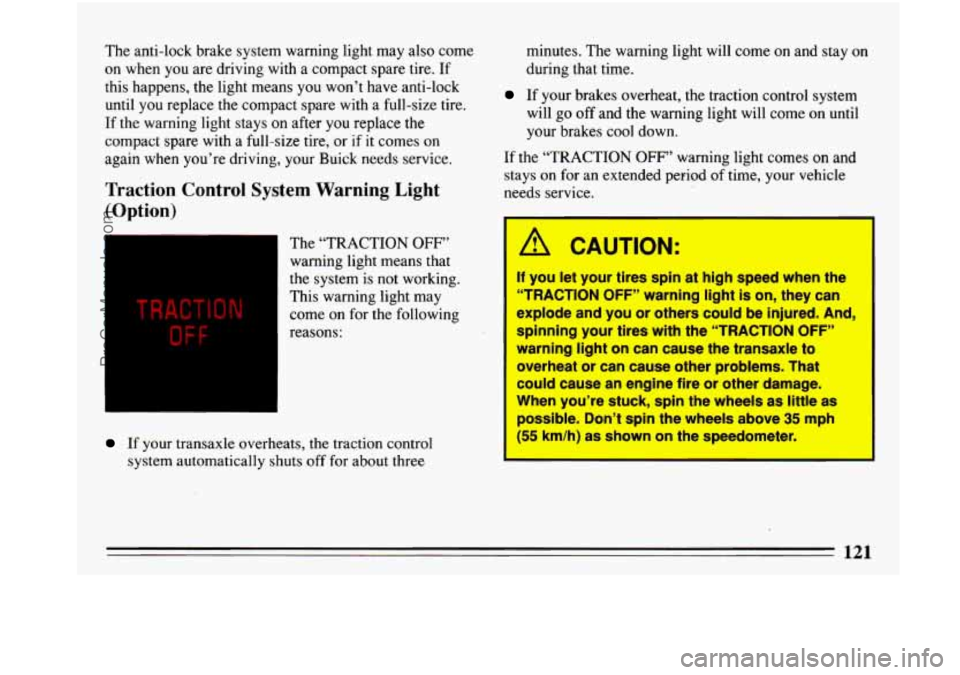
I The “TRACTION OFF”
warning light means that
the system is not working.
This warning light may
come on for the following
reasons:
If your transaxle overheats, the traction control
system automatically shuts off for about three minutes.
The warning light will come on and stay on
during that time.
If your brakes overheat, the traction control system
will
go off and the warning light will come on until
your brakes cool down.
If the “TRACTION OFF” warning light comes on and
stays on
for an extended period of time, your vehicle
needs service.
A CAUTION:
1 If you let your tires spin at high speed when the
“TRACTION
OFF” warning light is on, they can
explode and you or others could be injured. And,
spinning your tires with the “TRACTION
OFF”
warning light on can cause the transaxle to
overheat or can cause other problems. That
could cause an engine fire or other damage.
When you’re stuck, spin the wheels as little as
possible. Don’t spin the wheels above
35 mph
(55 km/h) as shown on the speedometer.
I
121
ProCarManuals.com
Page 124 of 340
I NOTICE:
Spinning your wheels when the “TRACTION
OFF” warning light is on can destroy parts of
your vehicle as well as the tires.
If you spin your
wheels too fast while shifting your transaxle
back and forth, you can destroy your transaxle.
When you’re stuck, spin the wheels
as little as
possible.
~~~~~~
1
working. If you have been operating your vehicle under
normal driving conditions,
you should pull off the road,
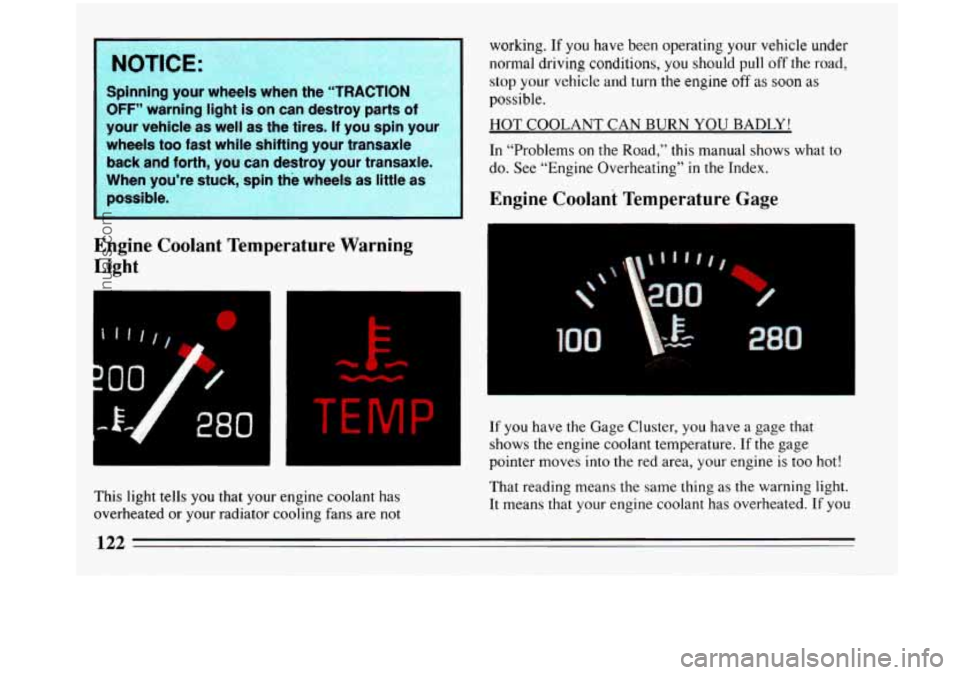
Engine Coolant Temperature Warning
Light
7
280
stop your vehicle and turn the engine off as soon as
possible.
HOT COOLANT CAN BURN YOU BADLY!
In “Problems
on the Road,” this manual shows what to
do. See “Engine Overheating”
in the Index.
Engine Coolant Temperature Gage
100
.Id pointer moves into the red area, your engine is too hot!
If you have the Gage Cluster, you have a gage that
shows the engine coolant temperature.
If the gage
This light
tells you that your engine coolant has
overheated or your radiator cooling fans are
not
That reading means the same thing as the warning light.
It means that your engine coolant has overheated.
If you
122
ProCarManuals.com
Page 172 of 340
alcohol in a person’s system can make crash injuries
worse. That’s especially true for brain, spinal cord and
heart injuries. That means that if anyone who has been
drinking
-- driver or passenger -- is in a crash, the
chance of being killed or permanently disabled is higher
than if that person had not been drinking. And we’ve
already
seen that the chance of a crash itself is higher for
drinking drivers.
/I CAUTION:
Drlnklng and then driving Is very dangerous.
Your reflexes, perceptions, and judgment wlll be
affected by even a small amount of alcohol. You
could have a serious - or even fatal - accident if
you drive after drinking. Please don’t drink and
drive or rlde with a driver who has been drinking.
Ride home in a cab; or if you’re with a group,
designate a driver who will not drink
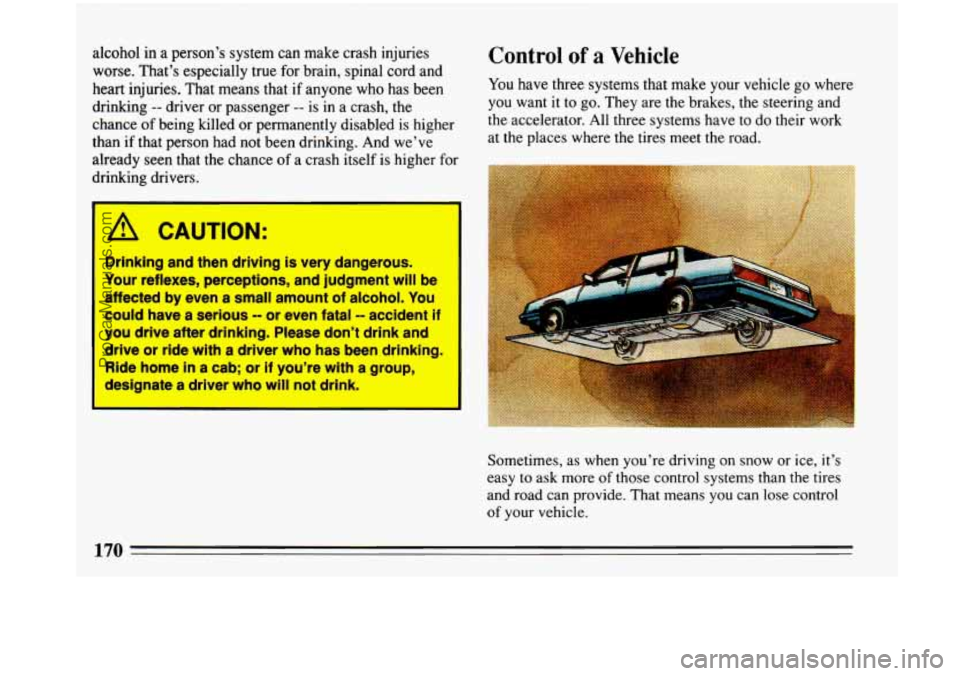
Control of a Vehicle
You have three systems that make your vehicle go where
you want it to go. They are the brakes, the steering and
the accelerator. All three systems have to do their work
at
the places where the tires meet the road.
Sometimes, as when you’re driving on snow or ice, it’s
easy
to ask more of those control systems than the tires
and road can provide. That means you can lose control
of your vehicle.
ProCarManuals.com
Page 177 of 340
and go or be heard all the time your vehicle is moving
(except when you are pushing on the brake pedal
firmly).
I
A CAUTION:
The brake wear warning sound means that I
sooner or later your brakes won’t work well. That
could lead to an accident. When you hear the
brake wear warning sound, have your vehicle
serviced.
I
could result in costly brake repair. I
Some driving conditions or climates may cause a brake
squeal when the brakes are first applied or lightly
applied.
This does not mean something is wrong with
your brakes.
Rear Drum Brakes
Your rear drum brakes don’t have wear indicators, but if
you ever hear a rear brake rubbing noise, have the rear
brake linings inspected. Also, the rear brake drums
should be removed and inspected each time the tires are
removed for rotation or changing. When
you have the
front brakes replaced, have the rear brakes inspected,
too.
Brake linings should always be replaced as complete
axle sets.
Brake Pedal Travel
See your dealer if the brake pedal does not return to
normal height, or if there is a rapid increase in pedal
travel. This could be a sign of brake trouble.
Brake Adjustment
Every time you make a moderate brake stop, your
brakes adjust for wear.
If you rarely make a moderate or heavier stop, then your
brakes might not adjust correctly. If you drive in that
way, then
-- very carefully -- make a few moderate
brake stops about every
1000 miles (1 600 km), so your
brakes will adjust properly.
175
ProCarManuals.com
Page 178 of 340
Braking in Emergencies
Use your anti-lock braking system when you need to.
With anti-lock, you ‘can steer and brake at the same time.
In many emergencies, steering can help you more than
even the very best braking.
Steering
Power Steering
If you lose power steering assist because the engine
stops
or the system fails to function, you can steer but it
.will take much more effort.
Steering Tips
Driving on Curves
It’s important to take curves at a reasonable speed.
A lot of the “driver lost control” accidents mentioned on
the news happen on curves. Here’s
why:
Experienced driver or beginner, each.of us is subject to
the same laws of physics when driving on curves. The
traction of the tires against the road surface makes it
possible for the vehicle to changejts path when you
turn
the front wheels. If there’s no traction, inertia will keep
the vehicle going in the same direction. If you’ve ever
tried to steer a vehicle on wet ice, you’ll understand this. The
traction you can get in a curve depends on the
condition of your tires and the road surface, the angle
at
which the curve is banked, and your speed. While
you’re in a curve, speed is the one factor you can
control.
Suppose you’re steering through a sharp curve. Then
you suddenly accelerate.
Those two control systems
-- steering .and acceleration --
can overwhelm those places where the tires meet the
road and make you lose control.
What should you do
if this ever happens? Let up on the
.accelerator pedal, steer the vehicle the way you want it
to go, and slow down.
Speed limit signs near curves
warn that you should
adjust your speed. Of course,
the posted speeds are
based on good weather and road conditions. Under less
favorable conditions you’ll want to go slower.
If you need to reduce your speed as you approach a
curve, do it before you enter the curve, while your front
wheels are straight ahead.
Try to adjust
your speed so you can “drive” through the
curve. Maintain a reasonable, steady speed. Wait to
accelerate until you are out of the curve, and then
accelerate gently into the straightaway.
176 I
ProCarManuals.com
Page 182 of 340
0
0
0
Try not to pass more than one vehicle at a time on
two-lane roads. Reconsider before passing the next
vehicle.
Don’t overtake a slowly moving vehicle too rapidly.
Even though the brake lights are not flashing, it may
be slowing down or starting to turn.
If you’re being passed, make it easy for
the
following driver to get ahead of you. Perhaps you
can ease a little to the right.
Loss of Control
Let’s review what driving experts say about what
happens when the three control systems (brakes, steering
and acceleration) don’t have enough friction where the
tires meet the road to do what the driver has asked.
In any emergency, don’t give up. Keep trying to steer
and constantly seek an escape route or area of less
danger.
Skidding
In a skid, a driver can lose control of the vehicle.
Defensive drivers avoid most skids by taking reasonable
care suited to existing conditions, and by not
“overdriving” those conditions. But skids are always
possible. The three
types of skids correspond to your Buick’s
three control systems. In the braking skid your wheels
aren’t rolling. In
the steering or cornering skid, too
much speed or steering in a curve causes tires to slip and
lose cornering force. And in the acceleration skid too
much throttle causes the driving wheels to spin.
A cornering skid and an acceleration skid are best
handled by easing your foot
off the accelerator pedal.
If your vehicle starts to slide (as when
you turn a corner
on a wet, snow- or ice-covered road), ease your foot off
the accelerator pedal as soon as you feel the vehicle start
to slide. Quickly steer the way you want the vehicle to
go. If
you start steering quickly enough, your vehicle
will straighten
out. As it does, straighten the front
wheels.
Of course, traction is reduced when water, snow, ice,
gravel, or other material is on the road. For safety, you’ll
want to slow down and adjust your driving to these
conditions. It is important
to slow down on slippery
surfaces because stopping distance will be longer and
vehicle control more limited.
While driving on a surface with reduced traction, try
your best to avoid.sudden steering, acceleration, or
braking (including engine braking by shifting to a lower
gear). Any sudden changes could cause the tires to slide.
You may not realize the surface is slippery until your
ProCarManuals.com
Page 185 of 340
makes inside glass surfaces very filmy and can be a
vision hazard if it’s left there.
Dirty glass makes lights dazzle and
flash more than
clean glass would, making the pupils of your eyes
contract repeatedly. You might even want to keep a cloth
and some glass cleaner in your vehicle if you need to
clean your glass frequently.
Remember that your headlights light up far less of
a
roadway when you are in a turn or curve.
Driving in the Rain
Keep your eyes moving; that way, it’s easier to pick out
dimly lighted objects.
Just as your headlights should be checked regularly for
proper aim,
so should your eyes be examined regularly.
Some drivers suffer from night blindness
-- the inability
to see in dim light
-- and aren’t even aware of it.
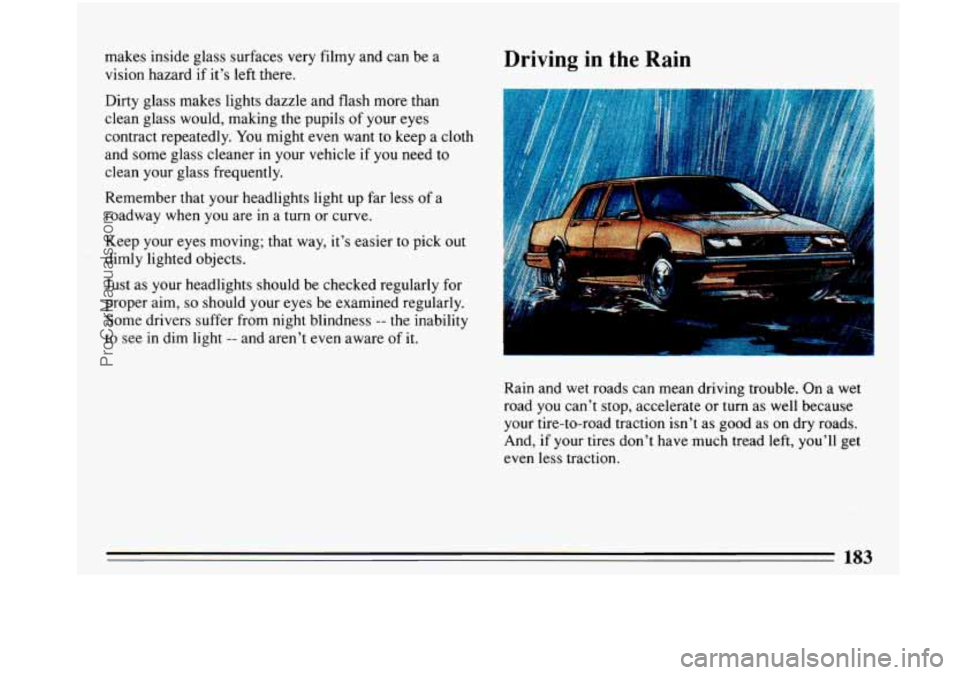
Rain and wet roads can mean driving trouble. On a wet
road you can’t stop, accelerate or turn as well because
your tire-to-road traction isn’t as good as on dry roads.
And, if your tires don’t have much tread left, you’ll get
even less traction.
ProCarManuals.com
Page 187 of 340
A CAUTION:
Wet brakes can cause accidents. They won’t
work well in a quick stop and may cause pulling to one side. You could lose control
of the vehicle.
After driving through a large puddle
of water or a
car wash, apply your brake pedal lightly until
your brakes work normally.
Hydroplaning
Hydroplaning is dangerous. So much water can build up
under your tires that they can actually ride on the water.
This can happen if the road is wet enough and you’re
going fast enough. When your vehicle is hydroplaning,
it has little or no contact with the road.
You might not be aware of hydroplaning. You could
drive along for some time without realizing your tires
aren’t in constant contact with the road. You could find
out the hard way: when you have to slow, turn, move out
to pass
-- or if you get hit by a gust of wind. You could
suddenly find yourself out
of control.
Hydroplaning doesn’t happen often. But
it can if your
tires haven’t much tread
or if the pressure in one or more
is low.
It can happen if a lot of water is standing on the road.
If you can
see reflections from trees, telephone
poles, or other vehicles, and raindrops “dimple” the
water’s surface, there could be hydroplaning.
Hydroplaning usually happens at higher speeds. There
just isn’t a’hard and fast rule about hydroplaning. The
best advice is to slow down when it
is raining, and be
careful.
Some Other Rainy Weather Tips
0
0
0
0
0
Turn on your headlights -- not just your parking lights
-- to help make you more visible to others.
Look for hard-to-see vehicles coming from behind..
You may want
to use your headlights even in daytime
if it’s raining hard.
Besides slowing down, allow some extra following
distance. And be especially careful when you pass
another vehicle. Allow yourself more clear room
ahead, and
be prepared to have your view restricted
by road spray.
If the road spray is so heavy you are
actually blinded, drop back. Don’t pass until
conditions improve. Going more slowly is better than
having an accident.
Use your defogger
if it helps.
Have good tires with proper tread depth. (See
“Tires” in the Index.)
.,
ProCarManuals.com