1993 BUICK PARK AVENUE tires
[x] Cancel search: tiresPage 207 of 340
Driving with a Trailer
Towing a trailer requires a certain amount of experience.
Before setting
out for the open road, you’ll want to get
to know your rig. Acquaint yourself with the feel of
handling and braking with the added weight of the
trailer. And always keep in mind that the vehicle
you are
driving is now a good deal longer and not nearly
so
responsive as your vehicle is by itself.
Before you start, check the trailer hitch and platform,
safety chains, electrical connector, lights, tires and
mirror adjustment.
If the trailer has electric brakes, start
your vehicle and trailer moving and then apply the
trailer brake controller by hand
to be sure the brakes are
working. This lets you check your electrical connection
at the same time.
Passing
During your trip, check occasionally to be sure that the
load is secure, and that the lights and any trailer brakes
are still working.
Following Distance
Stay at least twice as far behind the vehicle ahead as you
would when driving your vehicle without a trailer. This
can help you avoid situations that require heavy braking
and sudden turns. You’ll
need more passing distance up ahead when
you’re towing a trailer. And, because you’re a good deal
longer, you’ll need to go much farther beyond the
passed vehicle before you can return to your lane.
Backing Up
Hold the bottom of the steering wheel with one hand.
Then, to move the trailer
to the left, just move that hand
to the
left. To move the trailer to the right, move your
hand to the right. Always back up slowly and, if
possible, have someone guide you.
Making Turns
When you’re turning with a trailer, make wider turns
than normal. Do this
so your trailer won’t strike soft
shoulders, curbs, road signs, trees, or other objects.
Avoid jerky or sudden maneuvers. Signal well
in
advance.
lbrn Signals When Towing a Trailer
When you tow a trailer, your vehicle has to have a
different turn signal flasher and extra wiring. The green
arrows on your instrument panel will flash whenever
you signal a turn or lane change. Properly hooked up,
ProCarManuals.com
Page 219 of 340
Towing Your Car
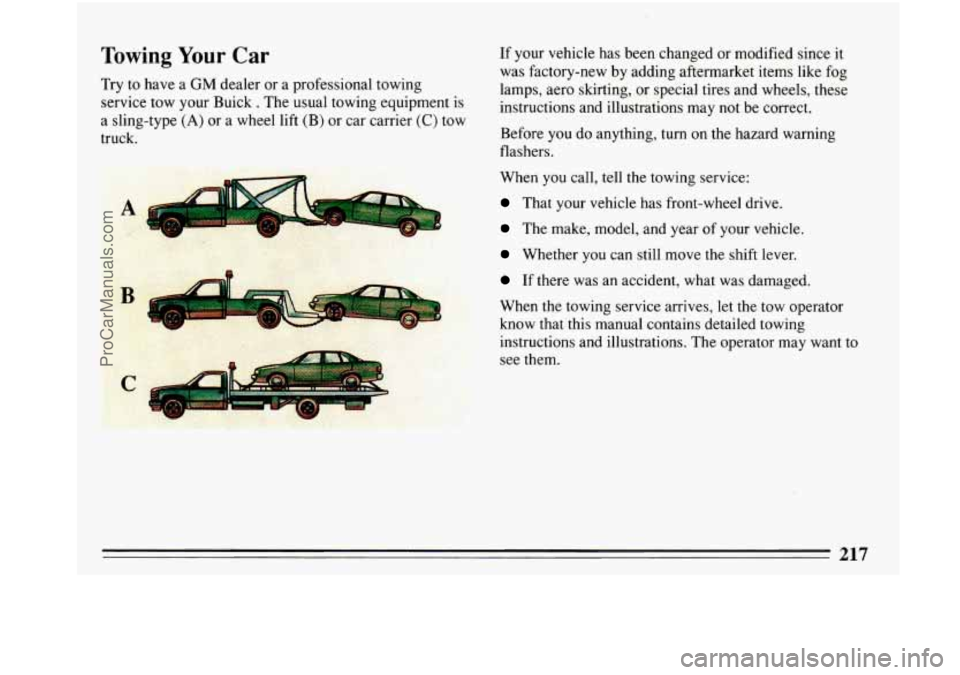
Try to have a GM dealer or a professional towing
service tow your Buick
. The usual towing equipment is
a sling-type
(A) or a wheel lift (B) or car carrier (C) tow
truck.
If your vehicle has been changed or modified since it
was factory-new by adding aftermarket items like fog
lamps, aero skirting, or special tires and wheels, these
instructions and illustrations may not be correct.
Before you do anything,
turn on the hazard warning
flashers.
When you call, tell the towing service:
That your vehicle has front-wheel drive.
The make, model, and year of your vehicle.
Whether you can still move the shift lever.
If there was an accident, what was damaged.
When the towing service arrives, let the tow operator
know that this manual contains detailed towing
instructions and illustrations. The operator may want to
see them.
217
ProCarManuals.com
Page 230 of 340
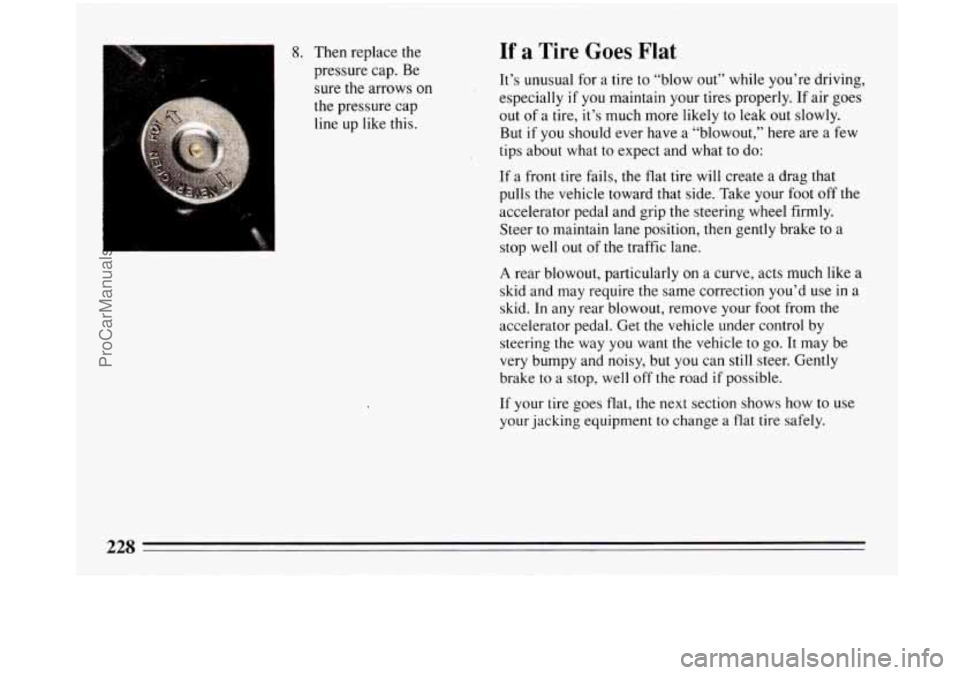
8. Then replace the
pressure cap. Be
sure the arrows
on
the pressure cap
line up like this.
If a Tire Goes Flat
It’s unusual for a tire to “blow out” while you’re driving,
especially
if you maintain your tires properly. If air goes
out of a tire, it’s much more likely to leak out slowly.
But if you should ever have
a “blowout,” here are a few
tips about what to expect and what
to do:
If a front .tire fails, the flat tire will create a drag that
pulls the vehicle toward that side. Take your foot
off the
accelerator pedal and grip the steering wheel firmly.
Steer to maintain lane position, then gently brake to a
stop well out
of the traffic lane.
A rear blowout, particularly on a curve, acts much like a
skid and may require the same correction you’d use in
a
skid. In any rear blowout, remove your foot from the
accelerator pedal. Get the vehicle under control by
steering the way you want the vehicle to
go. It may be
very bumpy and noisy, but you can still steer. Gently
brake to
a stop, well off the road if possible.
If your tire goes flat, the next section shows how to use
your jacking equipment
to change a flat tire safely.
ProCarManuals.com
Page 240 of 340
Don't take your compact spare through an
automatic car wash with guide rails. The
compact spare can get caught on the rails. That
can damage the tire and wheel, and maybe other
Don't use your compact spare on some other vehicle.
And don't
mix your compact spare or wheel with other
wheels or tires. They won't
fit. Keep your spare and its
wheel together.
Tire chains won't fit your compact
them will damage your vehicle and destroy
the
chains too. Don't use,.,,tjce: , , .,,b :" 'ix., chains on you
compact spare. ,., (,:, ,.,4'#i ,, . .Ai v*: ,, j '2
L
/d CAUTION:
Storing a jack, a tire, or other equipment in the
passenger compartment of the vehicle could
cause injury. In a sudden stop or collision,
loose
equipment could strike someone. Store all thesc
in the proper place.
238
ProCarManuals.com
Page 241 of 340
If You’re Stuck: In Sand, Mud, Ice or
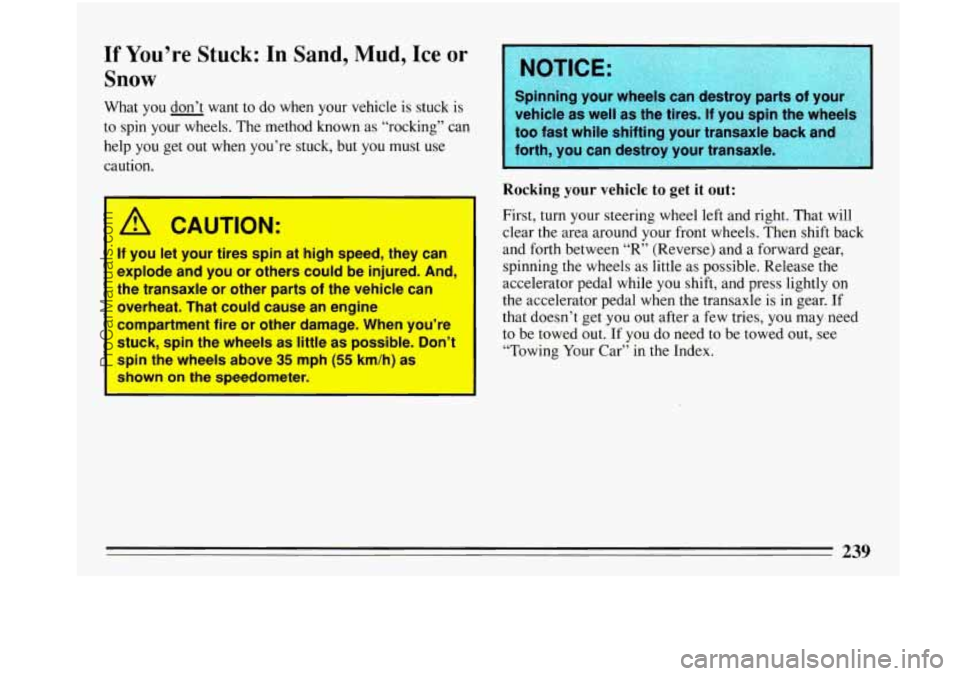
Snow
What you don’t want to do when your vehicle is stuck is
to spin your wheels. The method known as “rocking” can
help
you get out when you’re stuck, but you must use
caution.
I A CAUTION:
If you let your tires spin at high speed, they can
explode and you or others could be injured. And,
the transaxle or other parts of the vehicle can
overheat. That could cause an engine
compartment fire or other damage. When you’re
stuck, spin the wheels as little as possible. Don’t
spin the wheels above
35 mph (55 km/h) as
shown
on the speedometer.
I = I
Spinning your wheels lestroy par __ of your
vehicle as well as the tires. If you spin the whe
too fast while shifting your transaxle back
forth, you can destroy your transaxle.
Rocking your vehicle to get it out:
First, turn your steering wheel left and right. That will
clear the area around your front wheels. Then shift back
and forth between
“R” (Reverse) and a forward gear,
spinning the wheels as little as possible. Release the
accelerator pedal while you shift, and press lightly on
the accelerator pedal when the transaxle is
in gear. If
that doesn’t get
you out after a few tries, you may need
to be towed out.
If you do need to be towed out, see
“Towing Your Car”
in the Index.
ProCarManuals.com
Page 243 of 340
I
I
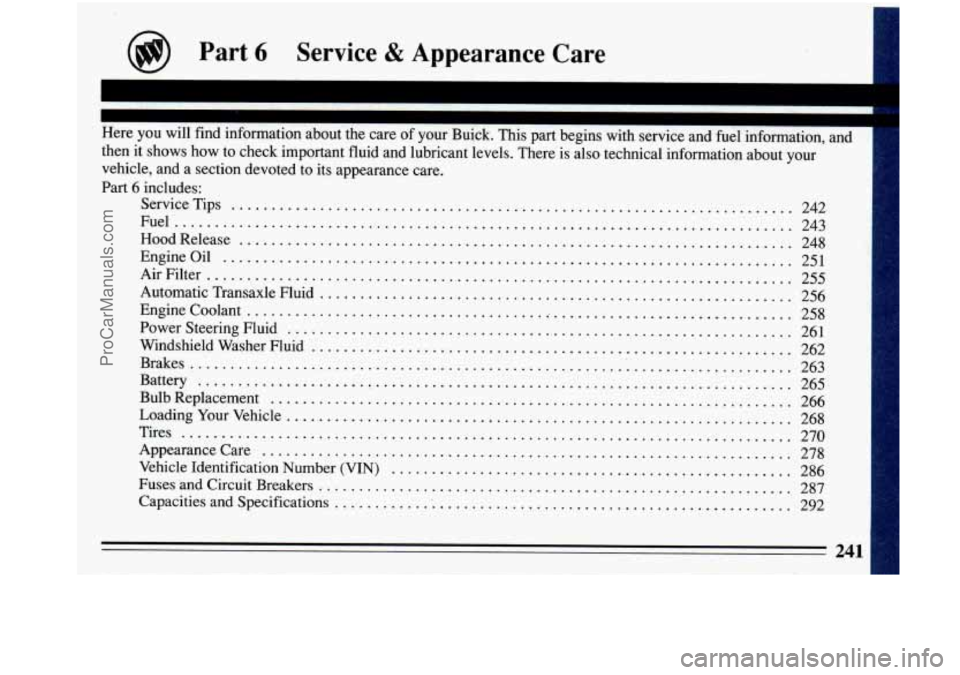
Here you will find information about the care of your Buick . This part begins with service and fuel information. and
then it shows how to check important fluid and lubricant levels
. There is also technical information about your
vehicle. and a section devoted to its appearance care
.
Part 6 includes:
ServiceTips
......................................................................
Engineoil ....................................................................... \
242
Fuel
........................................................................\
..... 243
Hood Release 248
251
AirFilter
........................................................................\
. 255
Automatic Transaxle Fluid
...........................................................
Enginecoolant .................................................................... 258
PowerSteeringFluid
............................................................... 261
Windshield Washer Fluid
............................................................ 262
Brakes
........................................................................\
... 263
Battery
........................................................................\
... 265
266
268
270
278
Vehicle Identification Number (VIN)
.................................................. 286
Fuses .and Circuit Breakers
........................................................... 287
Capacities and Specifications
.......................................................... 292
.....................................................................
256
BulbReplacement
.................................................................
LoadingYourVehicle ...............................................................
Tires ........................................................................\
....
Appearancecare ..................................................................
241
ProCarManuals.com
Page 270 of 340
1
Loading Your Vehicle
The taillamp, sidemarker and back-up lights can now be
accessed. Two of the taillamp bulbs are on a tabbed
assembly. Squeeze the release in and pull the assembly
out. Pull the bulb straight out from the socket. To
replace the assembly, the tabs must be inserted into the
slots. Push the other end in until it locks into place.
To replace the third taillamp bulb and sidemarker bulb,
turn the socket
1/4 turn and pull it out. Pull the bulb
straight out from the socket.
The backup bulb can be replaced by squeezing the lock
on the socket, turning it
l/4 turn and pulling it out. Pull
the bulb straight out. Reverse the above steps
to
reassemble the light and the trunk trim.
Tm OCCUPANTS
VEHICLE CAP. WT.
TIRE-LOADING INFORMATION
FRT. CTR.
RR. TOTAL LBS.
.~ ~~ . . ~
KG-
MAX. LOADING
& GVWR SAME AS VEHICLE
CAPACITY WEIGHT XXX COLD TIRE
TIRE SIZE SPEED PRESSURE RTG PSVKPa
FRT.
RR.
SPA.
IF TIRES ARE HOT, ADD 4PSV28KPa
SEE OWNER'S MANUAL FOR ADDITIONAL
INFORMATION
ll]m\:l .$$;;r#, : M
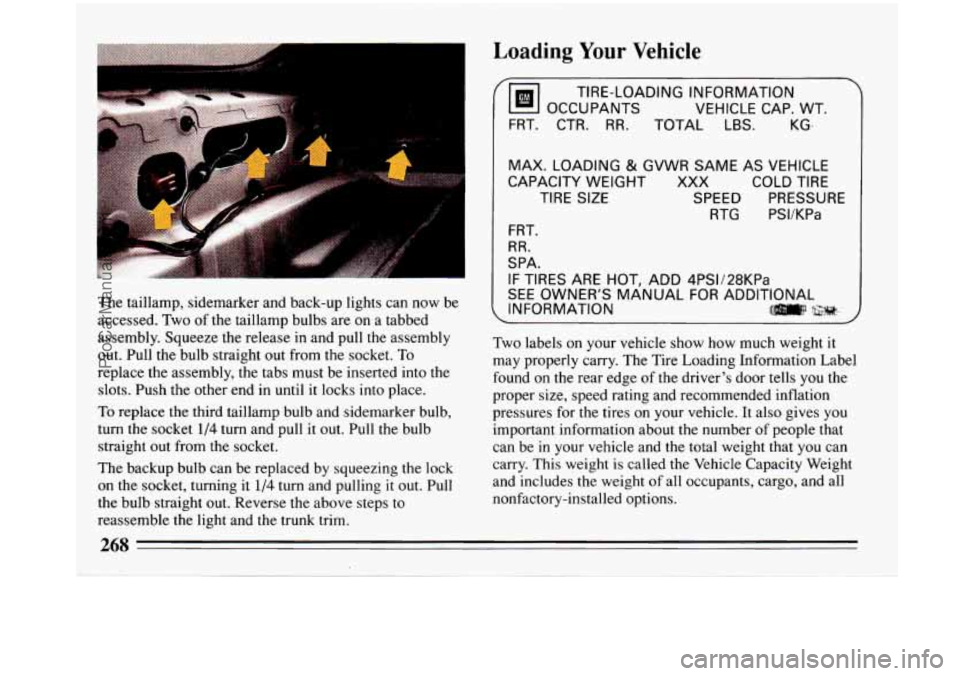
Two labels on your vehicle show how much weight it
may properly carry. The Tire Loading Information Label
found on the rear edge of the driver's door tells you the
proper size, speed rating and recommended inflation
pressures for the tires
on your vehicle. It also gives you
important information about the number
of people that
can be in your vehicle and the total weight that you can
carry. This weight
is called the Vehicle Capacity Weight
and includes the weight of all occupants, cargo, and all
nonfactory-installed options.
268
ProCarManuals.com
Page 272 of 340
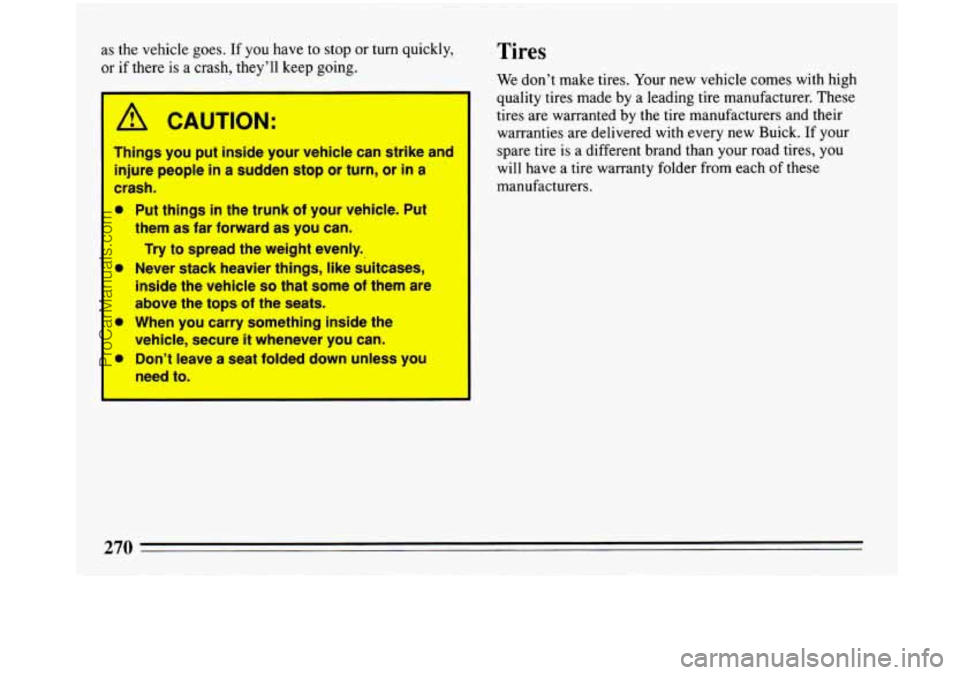
as the vehicle goes. If you have to stop or turn quickly,
or if there
is a crash, they'll keep going.
k!, CAUTION':
Things you put inside your vehicle can strike and
injure people
in a sudden stop or turn, or in a
crash.
Put things
in the trun'k of your vehicle. Put
them as far forward as you can.
Try to spread the weight evenly.
0 Never stack heavier things, like suitcases,
inside the vehicle
so that some of them are
above
the tops of the seats.
When
you carry something inside the
vehicle, secure
it whenever you can.
need to.
0 Don't leave a seat folded down unless you
Tires
We don't make tires. Your new vehicle comes with high
quality tires made by a leading tire manufacturer. These
tires are warranted by the tire manufacturers and their
warranties are delivered with every new Buick. If your
spare tire is a different brand than your road tires, you
will have a tire warranty folder from each of these
manufacturers.
ProCarManuals.com