Page 81 of 324
Leaving Your Vehicle With the Engine
Running
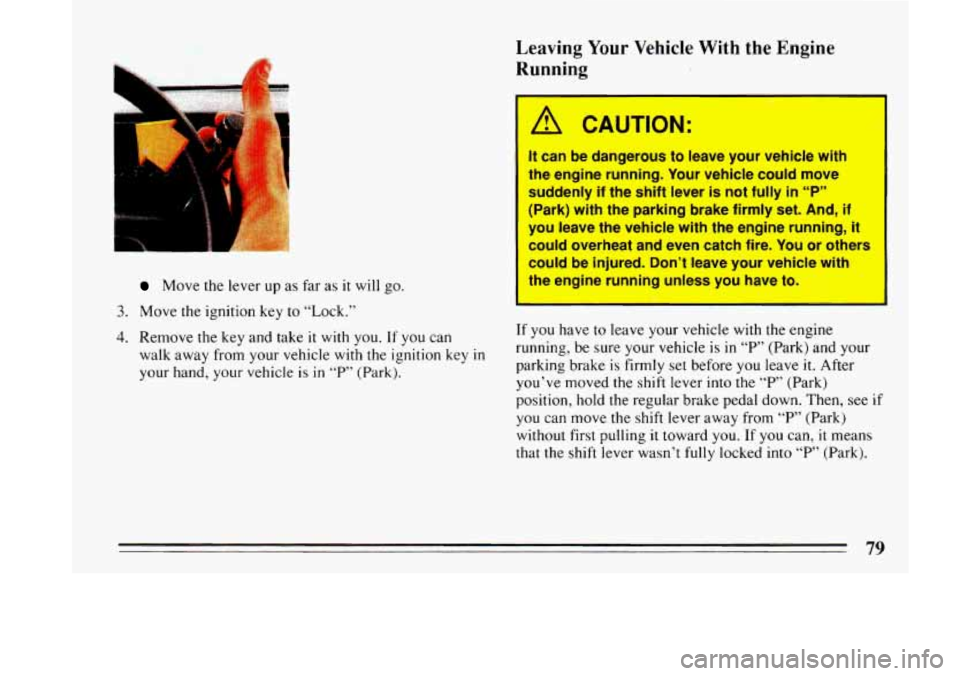
Move the lever up as far as it will go.
3. Move the ignition key to “Lock.”
4. Remove the key and take it with you. If you can
walk away from
your vehicle with the ignition key in
your hand, your vehicle is in “P” (Park).
It can be dangerous to leave your vehicle with
the engine running. Your vehicle could
move
suddenly if the shift lever is not fully in “P”
[Park) with the parking brake firmly set. And, if
you leave the vehicle with the engine running, St
could overheat and even catch fire. You or others
could be injured. Don’t leave your vehicle with
the engine running unless you have to.
If you have to leave your vehicle with the engine
running, be sure your vehicle is
in “P” (Park) and your
parking brake is firmly set before you leave it. After
you’ve moved the shift lever into the “P” (Park)
position, hold the regular brake pedal down. Then,
see if
you can move the shift lever away from
“P” (Park)
without first pulling it toward you. If
you can, it means
that the shift lever wasn’t fully locked into “P” (Park).
79
Page 82 of 324
Shifting Out of ‘‘P” (Park)
Your Buick has a brake-transaxle shift interlock. You
have to fully apply your regular brake before you can
shift from
T“ (Park) when the ignition is in the “Run”
position. See “Automatic Transaxle” in the Index.
If you cannot shift out of “P” (Park), ease pressure on
the shift lever -- push the shift lever all the way into “P”
(Park) as you maintain brake application. Then move the
shift lever into the gear
you wish. If you ever hold the
brake pedal down but still can’t shift out of
“P” (Park),
try this:
1. Turn the key to “Off.”
2. Apply and hold the brake until the end of Step 4.
3. Shift to “N” (Neutral).
4. Start the vehicle and then shift to the drive gear you
want.
5. Have the vehicle fixed as soon as you can.
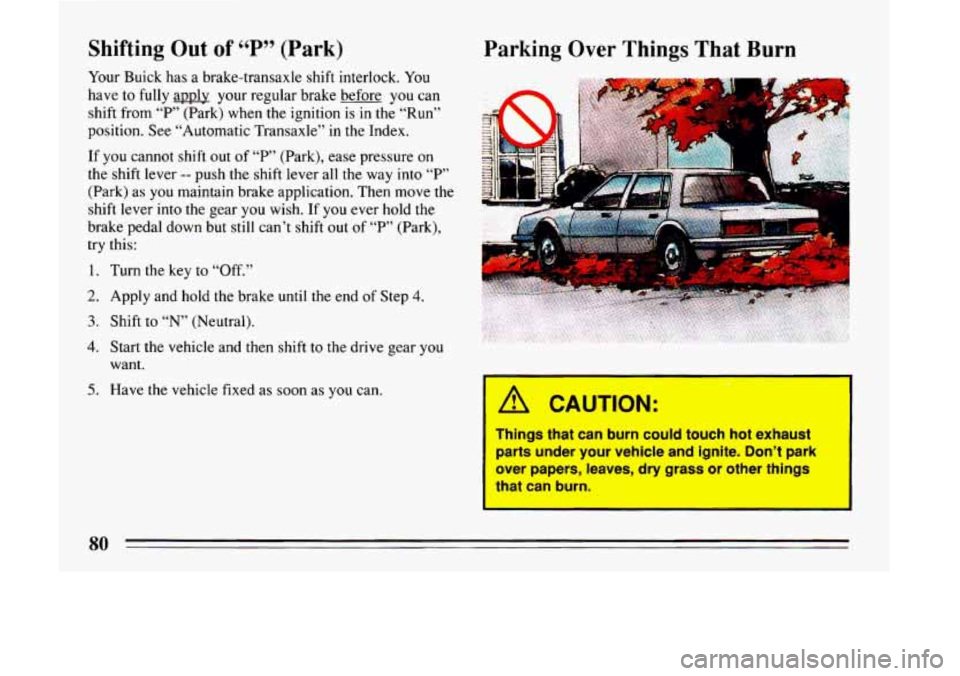
Parking Over Things That Burn
. ”. ..
6& VAU’. ,ON:
I
lings that can burn could touch hot exhaust
parts under your vehicle and ignite. Don’t park
over papers, leaves, dry grass or other things
that can burn.
80
Page 84 of 324
CAUTION: (Continued)
It can be dangerous to get out of your vehicle if
the shift lever
is not fully in “P’ (Park) with the
parking brake firmly
set. Your vehicle can roll.
Don’t leave your vehicle when the engine
is
running unless you have to. If you’ve left the
engine running, the
vehicle can move suddenly.
You or others could be injured. To be sure your
vehicle won’t move, even when you’re
on fairly
level ground, always set your parking brake
and
after you move the shift lever to “P” (Park).&
Follow the proper steps to be sure your vehicle
won’t move. See “Shifting Into ‘P’ (Park)’’ in the’
Index.
If you are parking OR a hill, or if you’re pulling a
trailer, also $&e “Parking on Hills’’ or “Towing a
Trailer” in the Index. , I
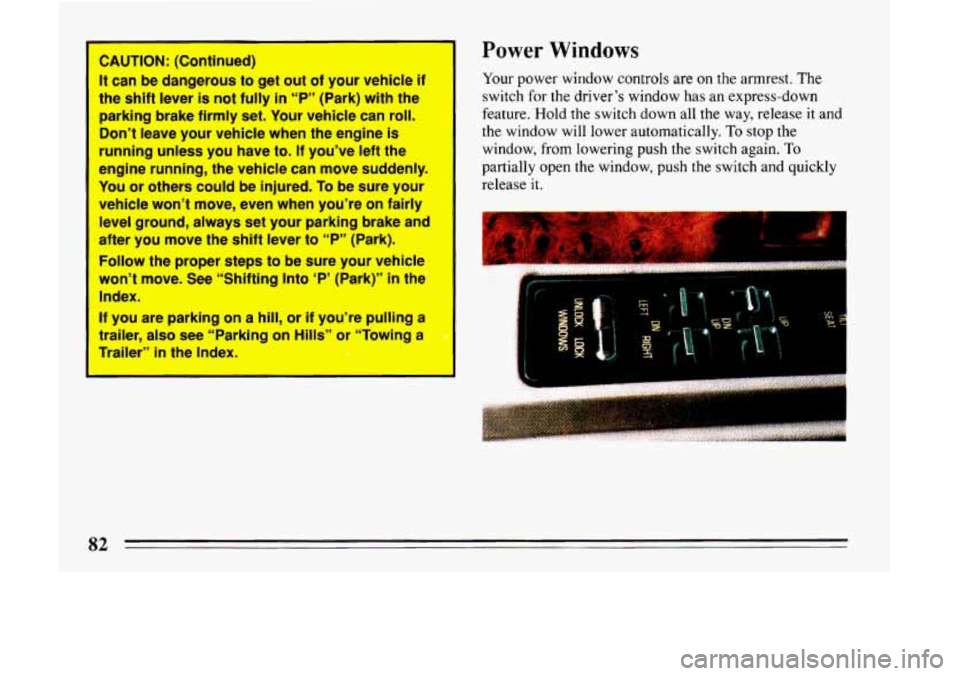
Power Windows
Your power window controls are on the armrest. The
switch for the driver’s window has an express-down
feature. Hold the switch down all the way, release it and
the window will lower automatically.
To stop the
window, from lowering push the switch again.
To
partially open the window, push the switch and quickly
release it.
82
Page 91 of 324
NOTICE:
When using concentrated washer fluid
iollow the manufacturer instructions for
~ Idding water.
I 0 Don’t mix water with ready to use washe
fluid
. Water can cause the solution to
freeze and damage your washer fluid tank
and other parts of
t
water doesn’t clean as well as washer
0 Fill your washer fluid tank only 3/4 full
when it’s very cold. This
allows for
expansion, which c
it is completely full.
0 Don’t use radiator a
windshield washer. It c
paint.
I
Cruise Control (Option)
With Cruise Control, you can maintain a speed of about
25 mph (40 km/h) or more without keeping your foot on
~ the accelerator. This can really help on long trips. Cruise
Control
does not work at speeds below about 25 mph
(40 km/h).
When you apply your brakes, the Cruise Control shuts
off.
Page 93 of 324
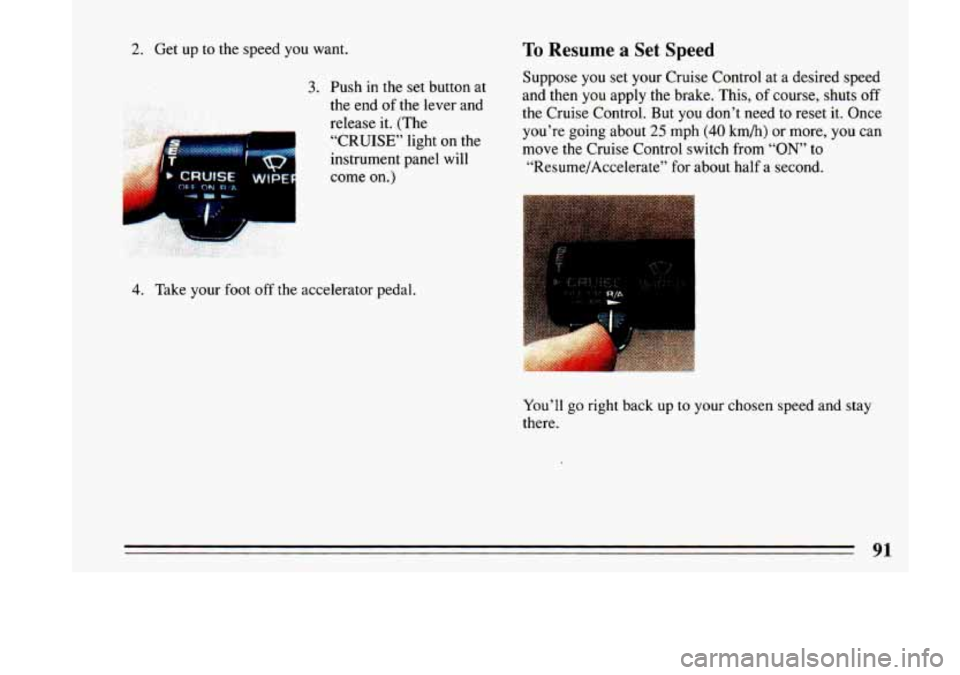
2. Get up to the speed you want.
3. Push in the set button at
the end of the lever and
release it. (The
“CRUISE’ light
on the
instrument panel will come on.)
4. Take your foot off the accelerator pedal.
To Resume a Set Speed
Suppose you set your Cruise Control at a desired speed
and then you apply the brake. This, of course, shuts off
the Cruise Control. But you don’t need to reset it. Once
you’re going about
25 mph (40 km/h) or more, you can
move the Cruise Control switch from
“ON” to
“Resume/Accelerate”
for about half a second.
You’ll go right back up to your chosen speed and stay
there.
91
Page 94 of 324
I A CAUTION:
If you hold the switch at “ResumelAccelerate” .
longer than half a second, the vehicle will keep
going faster until you release the switch or apply
the brake. You could be startled and even lose
control.
So unless you want to go faster, don’t
hold the switch at “Resume/Accelerate.”
To Increase !heed While Using Cruise
Control
There are two ways to go to a higher speed. Here’s the
first:
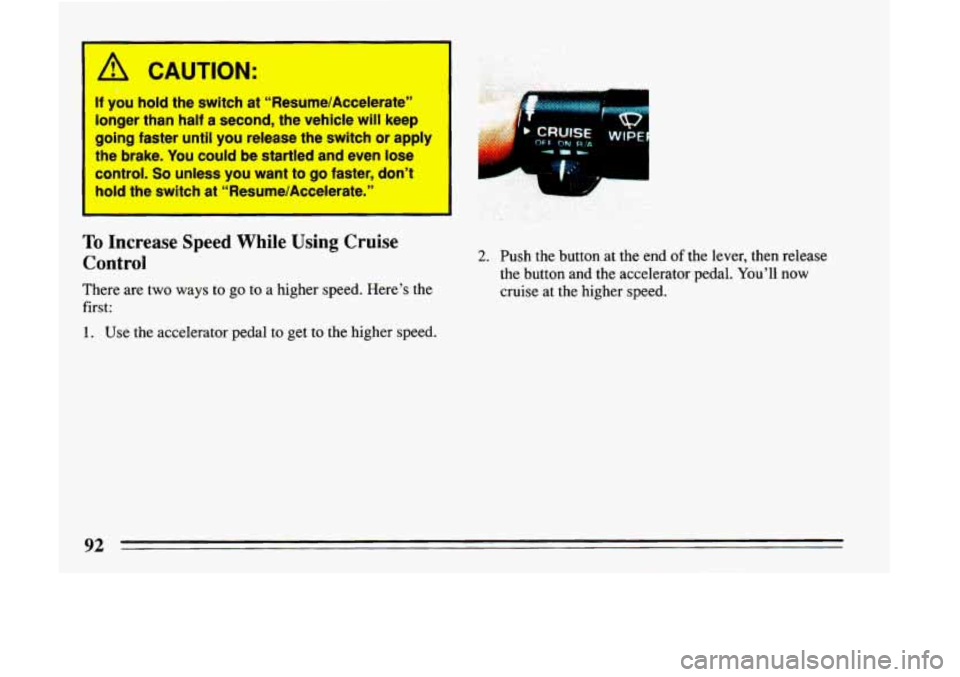
1. Use the accelerator pedal to get to the higher speed.
2. Push the button at the end of the lever, then release
the button and
the accelerator pedal. You’ll now
cruise at the higher speed.
92
-
Page 96 of 324
Passing Another Vehicle While Using Cruise Control
Use the accelerator pedal to increase your speed. When
you take your foot
off the pedal, your vehicle will slow
down to the Cruise Control speed you set earlier.
Using Cruise Control on Hills
How well your Cruise Control will work on hills
depends upon your speed, load, and the steepness
of the
hills. When going up steep hills, you may have to step
on the accelerator pedal to maintain your speed. When
going downhill,
you may have to brake or shift to a
lower gear to keep your speed down. Of course,
applying the brake takes you out of Cruise Control.
Many drivers find this to be too much trouble and don't
use Cruise Control on steep hills.
To Get Out of Cruise Control
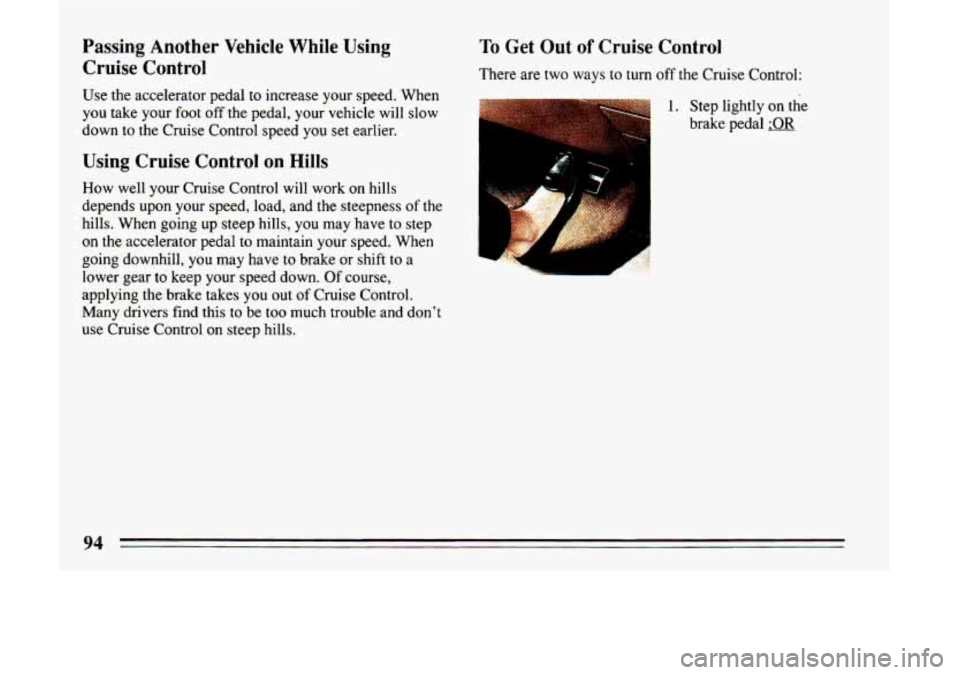
There are two ways to turn off the Cruise Control:
1. Step lightly on the
brake pedal
:OR
94
Page 109 of 324

Your fuel gage shows about how much fuel is in your
tank. It works
only when the engine is on. When the
indicator nears
“E,” you still have a little fuel left. You
need to get more
fuel right away.
Here are four concerns some owners have had about the
fuel gage. All these situations are normal and indicate
nothing wrong with the
fuel gage.
0
0
0
0
At the gas station, the gas pump shuts off before the
gage reads
“F’.
It takes more (or less) gas to fill up than the gage
indicated. For example, the gage may have indicated
1/2
full, but it took more (or less) than half of the
tank’s capacity to fill it.
The gage moves a little when you turn a corner,
speed up, or stop your vehicle.
When
you turn the engine off, the gage doesn’t go all
the way back to “E”.
Low Fuel Light
If your Buick has this option, a yellow light near the fuel
gage, will
go on when your vehicle is low on fuel.
You should get more fuel as soon as you can.
Brake System Warning Light
Your Buick’s hydraulic brake system is divided into two
parts. If one part isn’t working, the other part can still
work and stop
you. For good braking, though, you need
both parts working well.
If the warning light goes on, there could be a brake
problem. Have your brake system inspected right away.
This light should come on as
you start the vehicle. If it
doesn’t come on then, have it fixed so it will be ready to
warn you if there’s a problem.
This light will also come on when you set your parking
brake, and the light will stay on
if your parking brake
doesn’t release
fully. If you try to drive off with the
107