1993 BUICK LESABRE brake
[x] Cancel search: brakePage 110 of 324

parking brake set, a chime will also come on until you
release the parking brake. If the light and chime stay on
after your parking brake is
fully released, it means you
have a brake problem. If the light and chime come on
while driving, pull
off the road and stop carefully. You
may notice that the pedal is harder to push. Or, the pedal
may go closer to the floor. It may take longer to stop. If
the light is still on, have the vehicle towed for service.
(See “Towing Your Car” in the Index.)
1 &!A CAUTION:
Your brake system may not be working properly
if the brake warning light is on. Rriving with the
brake warning light on can lead to an accident. If
the light is still on after you’ve pulled off the road
and stopped carefully, have the vehicle towed for
service.
Anti-Lock Brake System Warning Light
1-
ANTI
LOCK
With anti-lock, this light will go on when you start your
engine and may stay on for several seconds or
so. That’s
normal. If the light doesn’t come on, have it fixed
so it
will be ready to warn you if there is a problem.
If the light stays on or comes
on when you’re driving,
stop as soon as possible and turn the key off. Then start
the engine
to reset the system. If the light still stays on,
or comes
on again while you’re driving, your Buick
needs service. Unless
the regular brake system warning
light is also
on, you will still have brakes, but not
anti-lock brakes. If the regular brake system warning
light
is also on, see “Brake System Warning Light”
earlier
in this part.
108
Page 111 of 324
The anti-lock brake system warning light may also come Traction Control System Warning Light
on when you are driving with a compact spare tire. If (Option)
this happens, the light means you won’t have anti-lock
until you replace the compact spare with a full-size tire.
If the warning light stays on after you replace the
compact spare with a full-size tire, or
if it comes on
again when you’re driving, your Buick needs service.
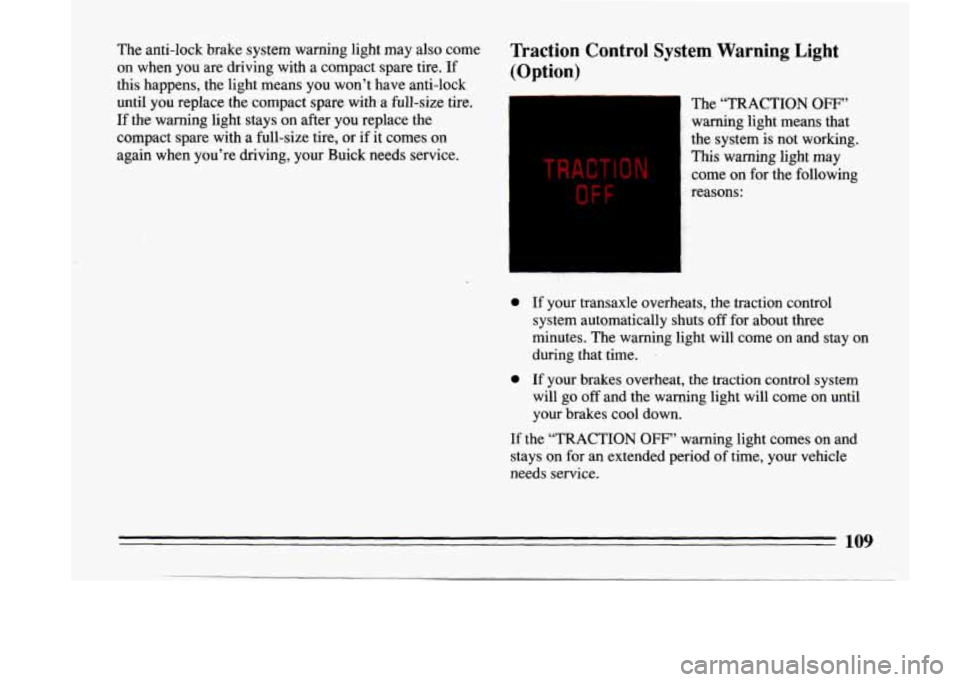
TRACTION
OFF
The “TRACTION OFF”
warning light means that
the system is not working.
This warning light may
come on for the following
reasons:
0 If your transaxle overheats, the traction control
system automatically shuts
off for about three
minutes. The warning light will come on and stay on
during that time.
.
0 If your brakes overheat, the traction control system
will
go off and the warning light will come on until
your brakes cool down.
If the “TRACTION
OFF” warning light comes on and
stays on for an extended period
of time, your vehicle
needs service.
109
Page 155 of 324
Pavement Markings
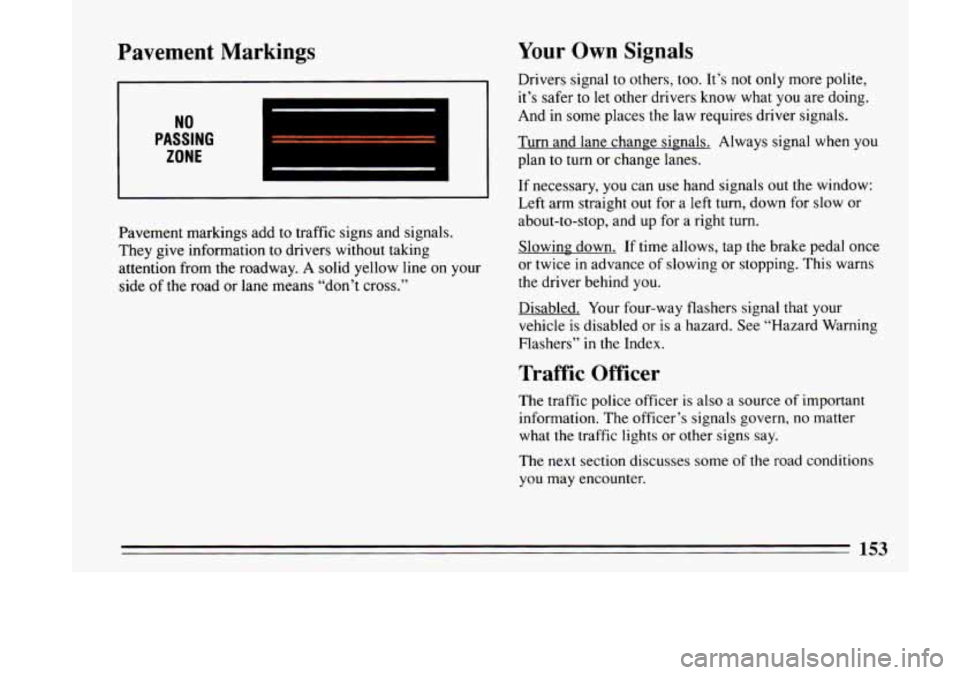
NO
PASSING
ZONE
Pavement markings add to traffic signs and signals.
They give information to drivers without taking
attention from the roadway. A solid yellow line on your
side
of the road or lane means “don’t cross.’’
Your Own Signals
Drivers signal to others, too. It’s not only more polite,
it’s safer to let other drivers know what
you are doing.
And in some places the law requires driver signals.
Turn and
lane change signals. Always signal when you
plan to turn or change lanes.
If necessary, you can use hand signals
out the window:
Left arm straight out for a left turn, down for slow or
about-to-stop, and
up for a right turn.
Slowinn down. If time allows, tap the brake pedal once
or twice in advance of slowing or stopping. This warns
the driver behind
you.
Disabled. Your four-way flashers signal that your
vehicle is disabled
or is a hazard. See “Hazard Warning
Flashers” in the Index.
Traffic Officer
The traffic police officer is also a source of important
information. The officer’s signals govern, no matter
what the traffic lights or other signs say.
The next section discusses some
of the road conditions
you may encounter.
153
Page 156 of 324
Defensive Driving
The best advice anyone can give about driving is: Drive
defensively.
Please start with a very important safety device in your
Buick: Buckle up. (See “Safety Belts” in the Index.)
Defensive driving really means “be ready for anything.”
On city streets, rural roads, or freeways, it means
“always expect the unexpected.”
Assume that pedestrians or other drivers are going to be
careless and make mistakes. Anticipate what they might
do. Be ready for their mistakes.
Expect children
to dash out from behind parked cars,
often followed by other children. Expect occupants in
parked cars
to open doors into traffic. Watch for
movement in parked cars
-- someone may be about to
open a door.
Expect other drivers to run stop signs when you are
on a
through street. Be ready
to brake if necessary as you go
through intersections. You may not have to use the
brake, but if you do, you will be ready.
If you’re driving through a shopping center parking lot
where there are well-marked lanes, directional arrows,
and designated parking areas, expect some drivers
to
ignore all these markings and dash straight toward one
part of the lot.
Pedestrians can be careless. Watch for them. In general,
you must give way to pedestrians even if you know you
have the right of way.
Rear-end collisions are about the most preventable of
accidents. Yet they are common. Allow enough
following distance. It’s the best defensive driving
maneuver, in both city and rural driving. You never
know when the vehicle in front
of you is going to brake
or turn suddenly.
Here’s a final bit
of information about defensive driving.
The most dangerous time for driving in the
U.S. is very
early
on Sunday morning. In fact, GM Research studies
show that the most and the least dangerous times for
driving, every week, fall on the same day. That day is
Sunday. The most dangerous time is Sunday from
3 a.m.
to
4 a.m. The safest time is Sunday from 10 a.m. to 11
a.m. Driving the same distance on a Sunday at 3 a.m.
isn’t just
a little more dangerous than it is at 10 a.m. It’s
about 134 times more dangerous!
That leads to the next section.
Page 160 of 324
Control of a Vehicle
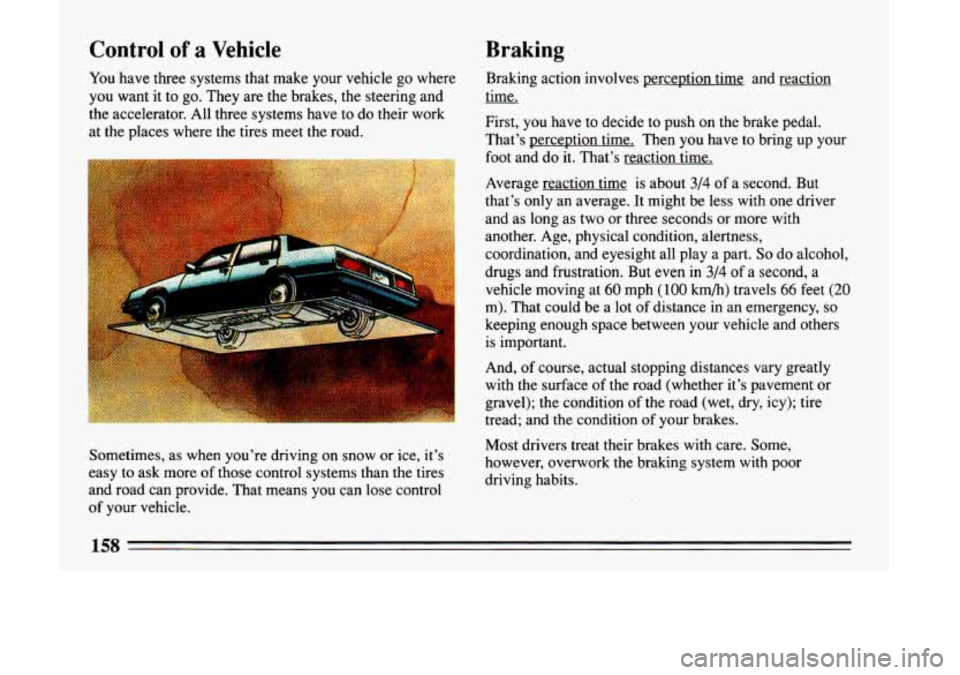
You have three systems that make your vehicle go where
you want it to go. They are the brakes, the steering and
the accelerator. All three systems have to do their work
at the places where the tires meet the road.
Braking
Braking action involves perception time and reaction
time.
First,
you have to decide to push on the brake pedal.
That’s perception time. Then you have to bring up your
foot and do it. That’s reaction time.
Sometimes, as when you’re driving on snow or ice, it’s
easy
to ask more of those control systems than the tires
and road can provide. That means you can lose control
of your vehicle. Average
reaction time is about
3/4 of a second. But
that’s
only an average. It might be less with one driver
and as long as two or three seconds or more with
another. Age, physical condition, alertness,
coordination, and eyesight all play a part.
So do alcohol,
drugs and frustration. But even in
3/4 of a second, a
vehicle moving at
60 mph (100 km/h) travels 66 feet (20
m). That could be a lot of distance in an emergency, so
keeping enough space between your vehicle and others
is important.
And,
of course, actual stopping distances vary greatly
with the surface
of the road (whether it’s pavement or
gravel); the condition of the road (wet, dry, icy); tire
tread; and the condition
of your brakes.
Most drivers treat their brakes with care. Some,
however, overwork the braking system with poor
driving habits.
Page 161 of 324
0 Avoid needless heavy braking. Some people drive in
spurts
-- heavy acceleration followed by heavy
braking
-- rather than keeping pace with traffic. This
is a mistake. Your brakes may not have time to cool
between hard stops. Your brakes will wear
out much
faster
if you do a lot of heavy braking.
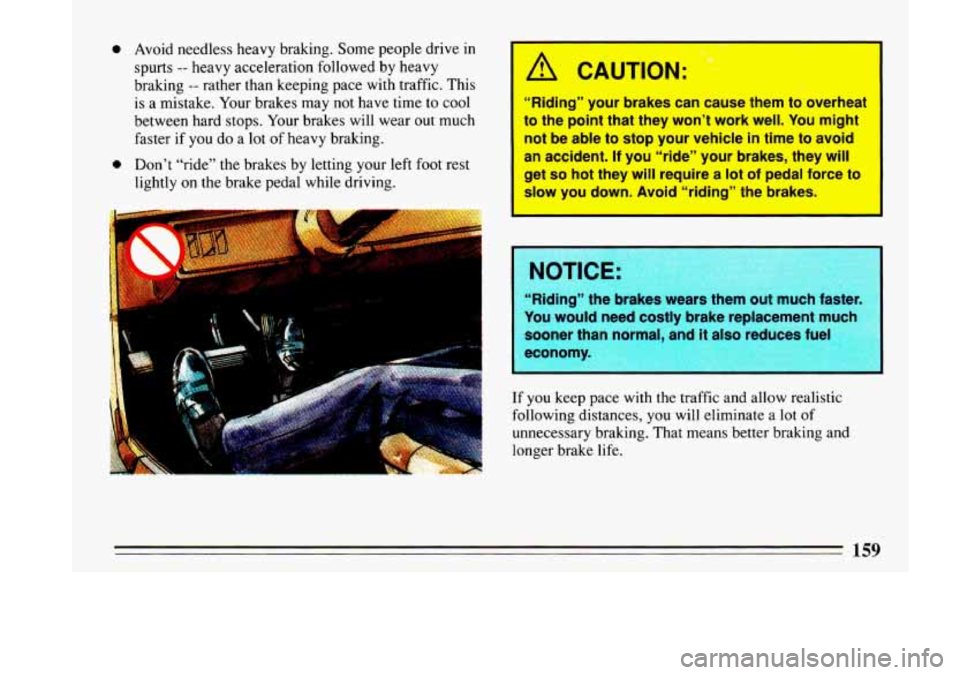
0 Don’t “ride” the brakes by letting your left foot rest
lightly
on the brake pedal while driving.
I A CAUTION: -’+
“Riding” your brakes can cause them to overheat
to the point that they won’t work well. You might
not be able to stop your vehicfe
in time to avoid
an accident. If you “ride’’ your brakes, they will
get so hot they will iequire a lot of pedal force to
slow you down. Avoid “riding” the brakes.
Riding” the brakes wears them
out much
I You would need costly brake replacement much
If you keep pace with the traffic and allow realistic
following distances,
you will eliminate a lot of
unnecessary braking. That means better braking and
longer brake life.
159
Page 162 of 324

0 If your engine ever stops while you’re driving, brake
normally but don’t pump your brakes.
If you do, the
pedal may get harder to push down.
If your engine
stops, you will still have some power brake assist.
But
you will use it when you brake. Once the power assist
is used up, it may take longer to stop and the brake
pedal will be harder to push.
Anti-Lock Brakes (ABS)
Your Buick has an advanced electronic braking system
that will help prevent skidding.
This light
on the instrument panel will go on when you
start your vehicle.
See “Anti-lock Brake System Warning Light”
in the
Index.
@
ANTI
LOCK
‘1 ”. j ’ ;I
- -’ y- ..-
a,
rn
e,
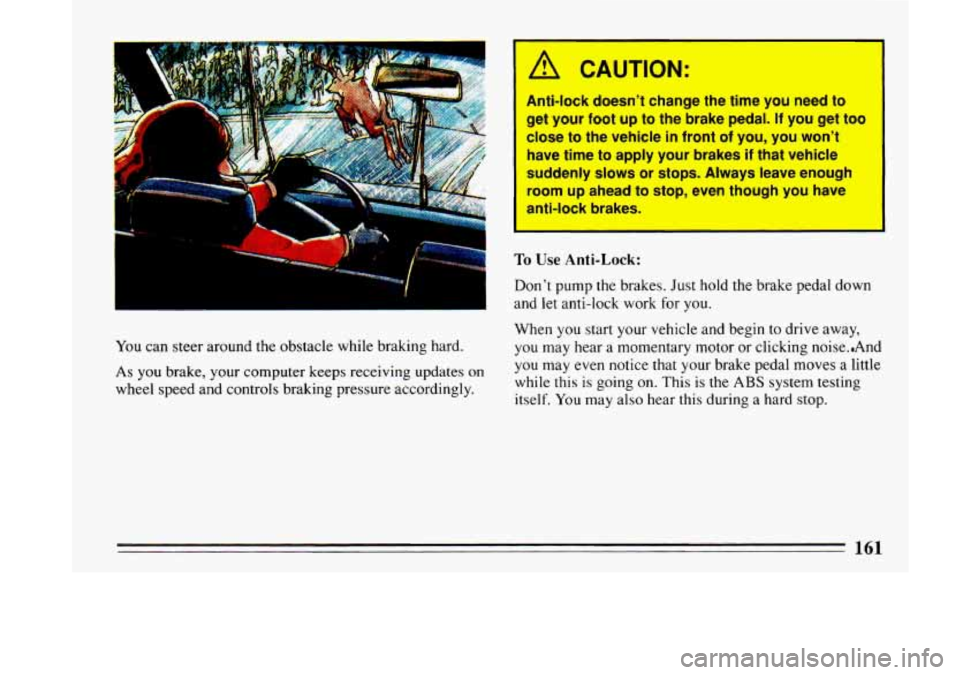
Here’s how anti-lock works. Let’s say the road is wet.
You’re. driving safely. Suddenly an animal jumps
out in
front
of you.
You slam on the brakes. Here’s what happens with ABS.
A computer senses that wheels are slowing down. The
computer separately works the brakes at each front
wheel and at the rear wheels.
The anti-lock system can change the brake pressure
faster than any driver could. The computer
is
programmed to make the most of available tire and road
conditions.
160
Page 163 of 324
I
You can steer around the obstacle while braking hard.
As you brake, your computer keeps receiving updates on
wheel speed and controls braking pressure accordingly.
/A CAUTION:
1
1
Anti-lock doesn’t change the time you need to
get your foot up to the brake pedal. If you get too
close
to the vehicle in front of you, you won’t
have time to apply your brakes
if that vehicle
suddenly slows or stops. Always leave enough
room up ahead
to stop, even though you have
anti-lock brakes.
To Use Anti-Lock:
Don’t pump the brakes. Just hold the brake pedal down
and let anti-lock work for
you.
When you start your vehicle and begin to drive away,
you may hear a momentary motor or clicking noise..And
you may even notice that your brake pedal moves a little
while this
is going on. This is the ABS system testing
itself.
You may also hear this during a hard stop.