1993 BUICK LESABRE brake
[x] Cancel search: brakePage 244 of 324

Wait at least 30 minutes before checking the transaxle
fluid level if
you have been driving:
0 When outside temperatures are above 90 " F (32 " C).
0 At high speed for quite a while.
0 In heavy traffic -- especially in hot weather.
While pulling a trailer.
To get the right reading, the fluid should be at normal
operating temperature, which is
180 F to 200 " F (82 " C
to 93 "C).
Get the vehicle warmed up by driving about 15 miles
(24 km) when outside temperatures are above 50 " F
(10' C). If it's colder than 50 " F (1 0 ' C), you may have
to drive longer.
To check the fluid level:
Park your vehicle on a level place.
Place the shift lever in 7'" (Park) with the parking
With your foot on the brake pedal, move the shift
brake
applied.
lever through each gear range, pausing for about
three seconds in each range.
Then, position the shift
lever in "P" (Park).
Let the engine run at idle for three to five minutes. Then, without
shutting off the engine, follow these
steps:
1. Pull out the dipstick and wipe it with a clean rag or
paper towel.
2. Push it back in all the way, wait three seconds and
then pull it back out again.
242
Page 250 of 324

Brake Master Cylinder
Your brake master cylinder is here. It is filled with
DOT-3 brake fluid. won’t
work at all.
So, it isn’t a good idea to “top off’
your brake fluid. Adding brake fluid won’t correct a
leak.
If you add fluid when your linings are worn, then
you’ll have too much fluid when you get new brake
linings. You should add (or remove) brake fluid, as
necessary, only when work
is done on the brake
hydraulic system.
A CAUTION:
If you have too much brake fluid, it can spill on
the engine. The fluid will burn if the engine is hat
,..ough. You or others could be burned, and you1
vehicle could be damaged. Add brake fluid only
when work is done on the brake hydraulic
system.
There are only two reasons why the brake fluid level in
your master cylinder might
go down. The first is that the
brake fluid goes down to an acceptable level during
normal brake lining wear. When new linings are put in,
the fluid level goes back up.
The other reason is that
fluid
is leaking out of the brake system. If it is, you
should have your brake system fixed, since a leak means
that sooner
or later your brakes won’t work well, or When your brake
fluid falls to a low level, your brake
warning light will come on. See “Brake System Warning
Light” in the Index.
When your brake fluid falls to a low
level, your brake
warning light will come
on and a chime will sound.
248
Page 251 of 324

What to Add:
When you do need brake fluid, use only DOT-3 brake
fluid
-- such as Delco Supreme 11 @ (GM Part
No. 1052535). Use new brake fluid from a sealed
container only.
DOT-5 silic
your vehicle. Don’t use it.
0 Don’t let someone put in the wrong kind o
fluid. For example, just a few drops of
mineral-based oil, such as engine
oil, in
your brake system can damage brake
system parts
so badly that they’ll have to
Brake fluid can damage paint,
so be caref
Replacing Brake System Parts
The braking system on a modern vehicle is complex. Its
many parts have to be of top quality and work well
together if the vehicle is to have really good braking. Vehicles
we design and test have top-quality GM brake
parts in them, as your Buick does when it is new. When
you replace parts of your braking system -- for example,
when your brake linings wear down and you have to
have new ones put in
-- be sure you get new genuine
GM replacement parts.
If you don’t, your brakes may no
longer work properly. For example, if someone puts in
brake linings that are wrong for your vehicle, the
balance between your front and rear brakes can change,
for the worse. The braking performance you’ve come to
expect can change in many other ways if someone puts
in the wrong replacement brake parts.
Battery
Every new Buick has a Delco Freedoms battery. You
never have to add water to one of these. When it’s time
for a new battery, we recommend a Delco Freedoms
battery. Get one that has the catalog number shown
on
the original battery’s label.
Vehicle Storage
If you’re not going to drive your vehicle for 25 days or
more, take
off the black, negative (-) cable from the
battery. This will help keep your battery from running
down.
249
Page 263 of 324
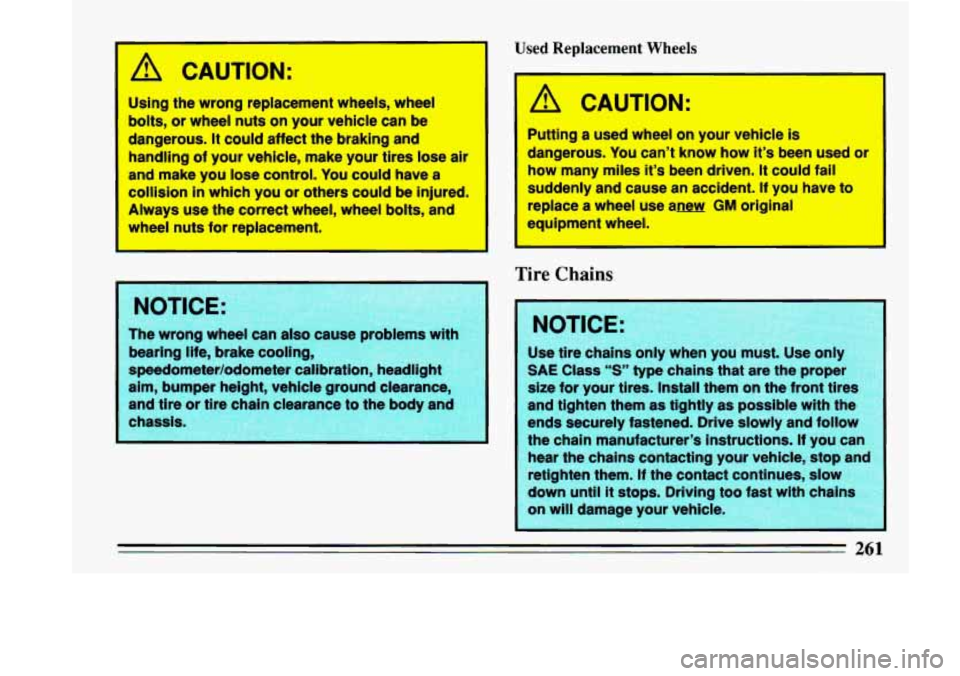
‘A CAUTION:
0
Using the wrong replacement wheels, wheel
bolts,
or whwl nuts on your vehicle can be
dangerous. It could affect the braking and
handling
of your vehicle, make your tires lose air
and make you lose control.
You could have a
collision in which you or others could be injured.
Always use the correctwheel, wheel bolts, and
wheel
nuts for replacement.
NOTICE:
I
The wrong wheel can also cause problems with
bearing life, brake cooling,
speedometerlodometer calibration, headlight
aim, bumper height, vehicle ground clearance,
and tire
or tire chai
Used Rep1 Vheels - - -
’A CAUTION:
Putting a used wheel on your vehicle is
dangerous. You can’t know how it’s been used or
how many miles it’s been driven.
It could fail
suddenly and cause an accident. If you have to
replace a wheel use anew
GM original
equipment wheel.
I
Tire Chains
NOTICE
Use tire chains
SAE Class “S”
size for your
and tighten them as tightly as possible with
ends securely fastened. Drive
slowly and fol
the chain ma
hear the chai
retighten them.
If the contact continues, .elow
down until it stops. Driving ton fast with 4
on will damage your vehicle.
261
Page 272 of 324
Fuses and Circuit Breakers
The wiring circuits in your car are protected from short
circuits by a combination
of fuses, circuit breakers, and
fusible thermal links
in the wiring itself. This greatly
reduces the chance
of fires caused by electrical
problems.
You’ll find some spare
fuses in the fuse block. Be sure
to use the correct fuse.
If you ever have a problem on
the road and don’t have a spare fuse,
you can “borrow”
one
of the correct value. Just pick some feature of your
car that
you can get along without -- like the radio or
cigarette lighter
-- and use its fuse, if it is of the value
you need. Replace it as soon as you can.
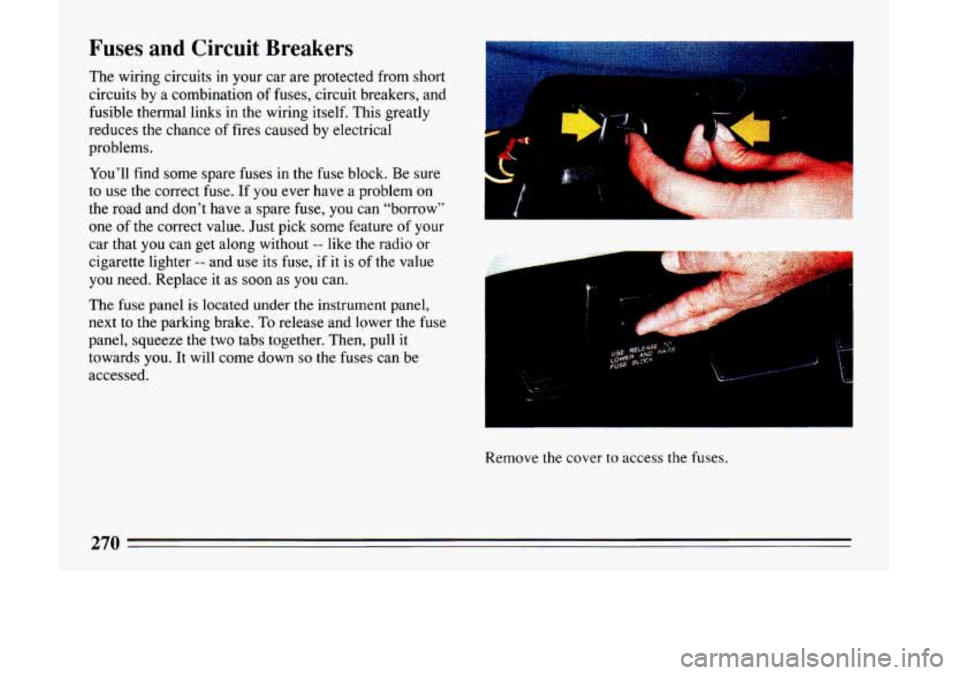
The fuse panel
is located under the instrument panel,
next to the parking brake.
To release and lower the fuse
panel, squeeze the two tabs together. Then, pull it
towards you.
It will come down so the fuses can be
accessed.
c m
k
Remove the cover to access the fuses.
270
Page 273 of 324
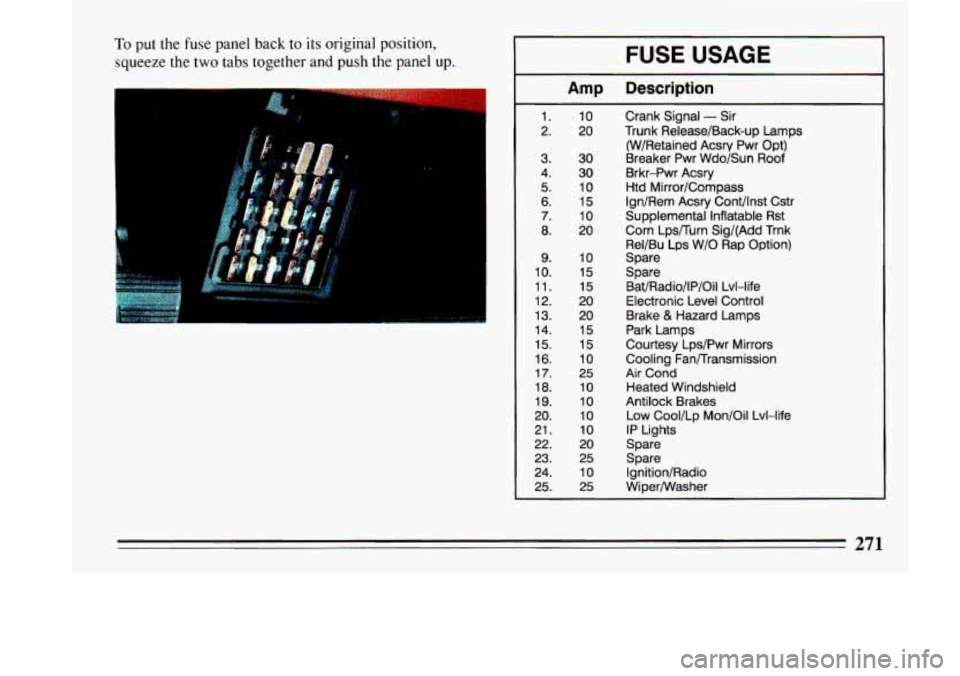
To put the fuse panel back to its original position,
squeeze the two tabs together and push the panel up.
r
E
6
P-
..
-
FUSE USAGE
--- ~
Amp Description
1.
2.
3.
4.
5.
6.
7.
8.
9.
10.
11.
12.
13.
14.
15.
16.
17.
18.
19.
20.
21.
22.
23.
24.
25. 10
20
30
30
10
15
10
20
10
15
15
20
20
15 15
10
25
10
10 10
10
20
25
10
25
Crank Signal - Sir
Trunk Release/Back-up Lamps (W/Retained Acsrv Pwr Opt)
Breaker Pwr Wdo/Sun Roof
Brkr-Pwr Acsry
Htd Mirror/Compass
Ign/Rem Acsry Cont/lnst Cstr
Supplemental Inflatable
Rst
Corn Lpsflurn Sig/(Add Trnk
Rel/Bu Lps W/O Rap Option)
Spare
Spare
Bat/Radio/lP/Oil Lvl-life
Electronic Level Control
Brake
& Hazard Lamps
Park Lamps
Courtesy Lps/Pwr Mirrors
Cooling Fanflransmission
Air Cond
Heated Windshield
Antilock Brakes Low Cool/Lp Mon/Oil Lvl-life
IP Lights
Spare
Spare Ignition/Radio
WiperWasher
271
Page 288 of 324
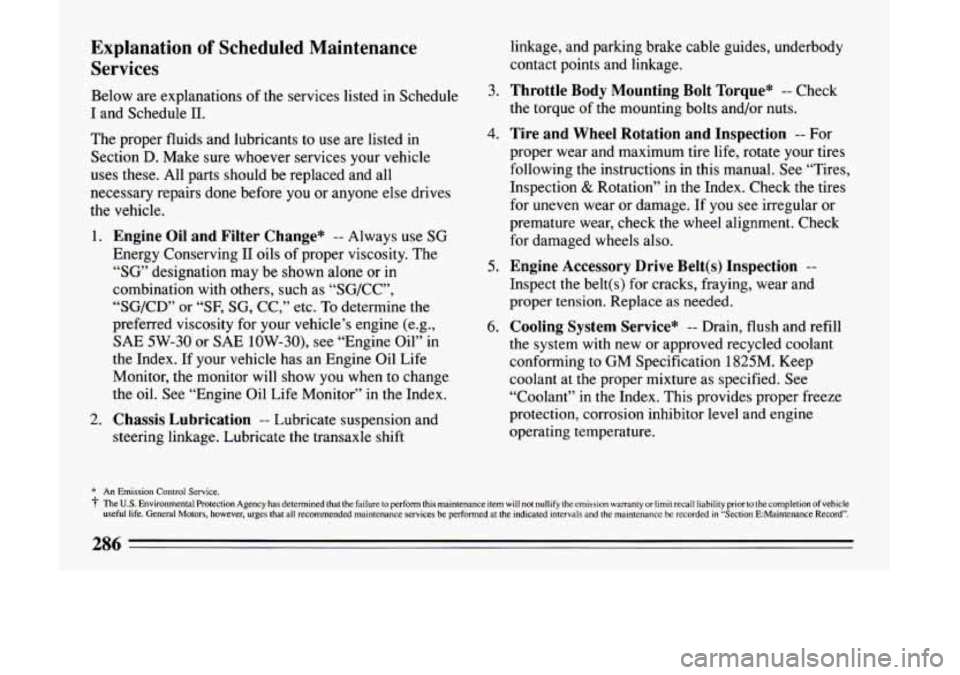
Explanation of Scheduled Maintenance
Services
Below are explanations of the services listed in Schedule
I and Schedule 11.
The proper fluids and lubricants to use are listed in
Section
D. Make sure whoever services your vehicle
uses these. All parts should be replaced and all
necessary repairs done before
you or anyone else drives
the vehicle.
1. Engine Oil and Filter Change* -- Always use SG
Energy Conserving I1 oils of proper viscosity. The
“SG” designation may be shown alone or in
combination with others, such as “SG/CC”,
“SG/CD” or “SF, SG, CC,” etc. To determine the
preferred viscosity for your vehicle’s engine (e.g.,
SAE
5W-30 or SAE 10W-30), see “Engine Oil” in
the Index. If your vehicle has an Engine Oil Life
Monitor, the monitor will show
you when to change
the oil. See “Engine Oil Life Monitor” in the Index.
2. Chassis Lubrication -- Lubricate suspension and
steering linkage. Lubricate the transaxle shift linkage, and parking brake
cable guides, underbody
contact points and linkage.
3. Throttle Body Mounting Bolt Torque* -- Check
the torque of the mounting bolts and/or nuts.
4. Tire and Wheel Rotation and Inspection -- For
proper wear and maximum tire life, rotate your tires
following
the instructions in this manual. See “Tires,
Inspection
& Rotation” in the Index. Check the tires
for uneven wear or damage. If you see irregular or
premature wear, check the wheel alignment. Check
for damaged wheels also.
5. Engine Accessory Drive Belt(s) Inspection --
Inspect the belt(s) for cracks, fraying, wear and
proper tension. Replace as needed.
6. Cooling System Service” -- Drain, flush and refill
the system with new or approved recycled coolant
conforming to GM Specification 1825M. Keep
coolant at the proper mixture as specified. See
“Coolant” in
the Index. This provides proper freeze
protection, corrosion inhibitor level
and engine
operating temperature.
* An Emission Control Service.
3‘ The U.S. Environmental Protection Agency has determined that the failure to perfonn this maintenance item will not nullify the emission warranty or limit recall liability prior to thecompletion of vehicle
useful life. General Motors, however, urges that all recommended maintenance services be performed at the indicated intervals and the maintenance be recorded in “Section E:Maintenance Record”.
286
Page 291 of 324
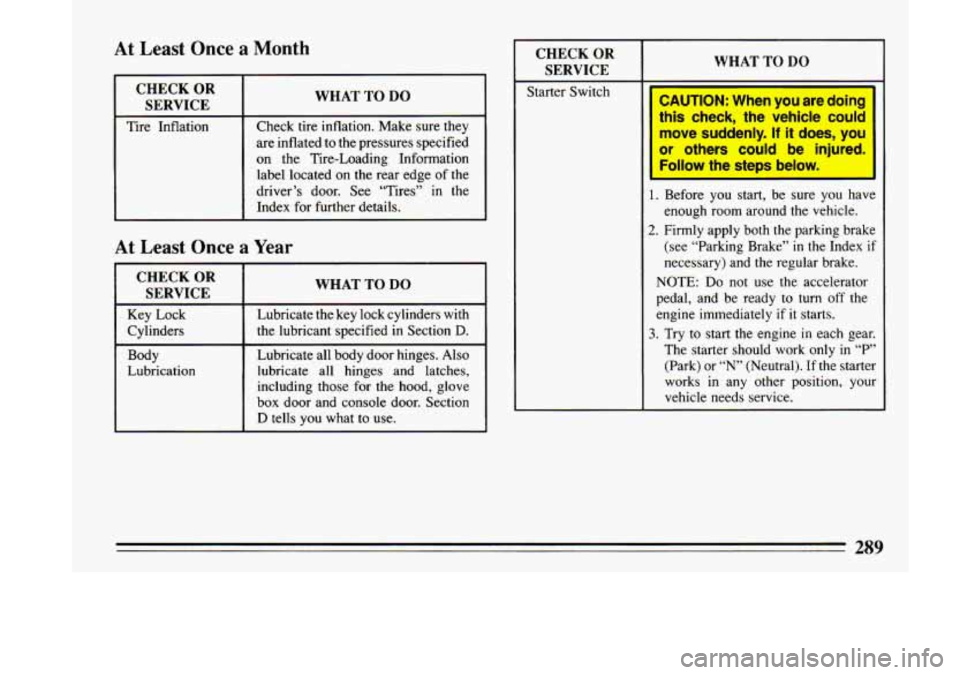
At Least Once a Month
1 CHECKOR SERVICE
I WHAT TO DO
~ ~~~
Tire Inflation Check tire inflation. Make sure
they
are inflated to the pressures specified
on the Tire-Loading Information label located on the rear edge of the
driver’s door. See “Tires”
in the
Index for further details.
At Least Once a Year
CHECK OR
SERVICE
Key Lock
Cylinders
Body
Lubrication
WHAT TO DO
Lubricate the key lock cylinders with
the lubricant specified in Section
D.
Lubricate all body door hinges. Also
lubricate all hinges and latches,
including those
for the hood, glove
box door and console door. Section
D tells you what to use.
CHECK OR
SERVICE
Starter Switch
L
WHAT TO DO
CAUTION: When you are doing
this check, the vehicle could move suddenly.
If it does, you
or others could be injured. Follow the steps below.
1. Before you start, be sure you have
enough room around
the vehicle.
2. Firmly apply both the parking brake
(see “Parking Brake” in
the Index if
necessary) and the regular brake.
NOTE:
Do not use the accelerator
pedal, and be ready to turn
off the
engine immediately
if it starts.
3. Try to start the engine in each gear.
The starter should work only
in “P’
(Park) or “N’ (Neutral). If the starter
works
in any other position, your
vehicle needs service.