Page 46 of 324
A CAUTION:
An unsecured child restraint can move around in
a collision or sudden stop and injure people in
the vehicle. Be sure to properly secure any child restraint in your vehicle
-- even when no child is
in
it.
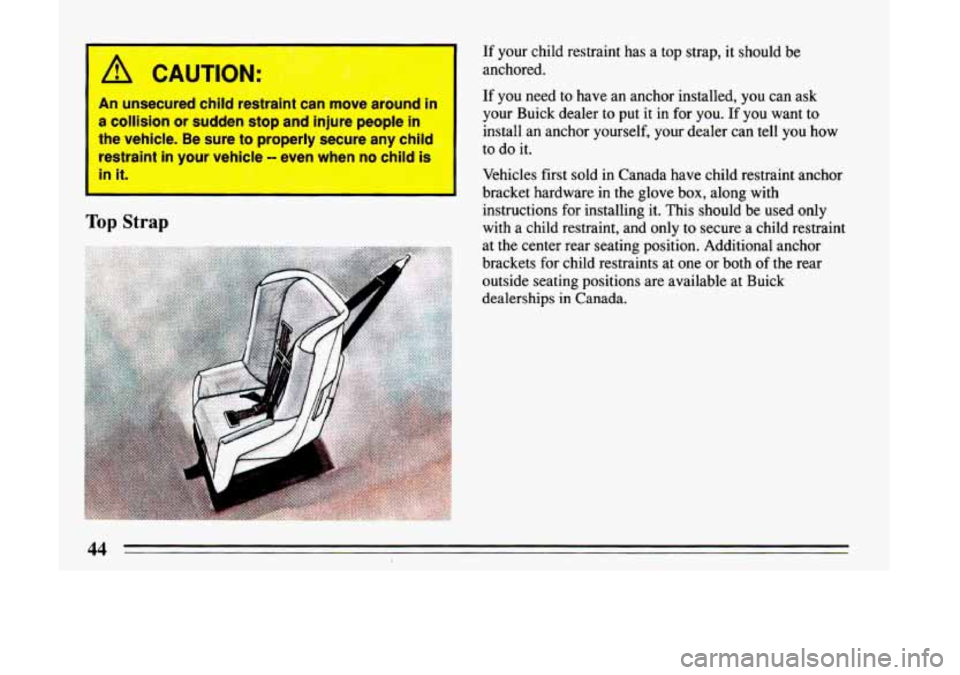
Top Strap
If your child restraint has a top strap, it should be
anchored.
If you need to have an anchor installed,
you can ask
your Buick dealer to put it in for you. If you want to
install an anchor yourself, your dealer can tell you how
to do it.
Vehicles first sold in Canada have child restraint anchor
bracket hardware in the glove
box, along with
instructions for installing it. This should be used only
with a child restraint, and only to secure a child restraint
at the center rear seating position. Additional anchor
brackets for child restraints at one or both of the rear
outside seating positions are available at Buick
dealerships
in Canada.
44
Page 69 of 324
e Put your valuables in a storage area, like your trunk
0 Lock the glove box.
Lock all the doors except the driver’s.
Then take the door key with you.
or glove box.
PASS-Key I1 TM
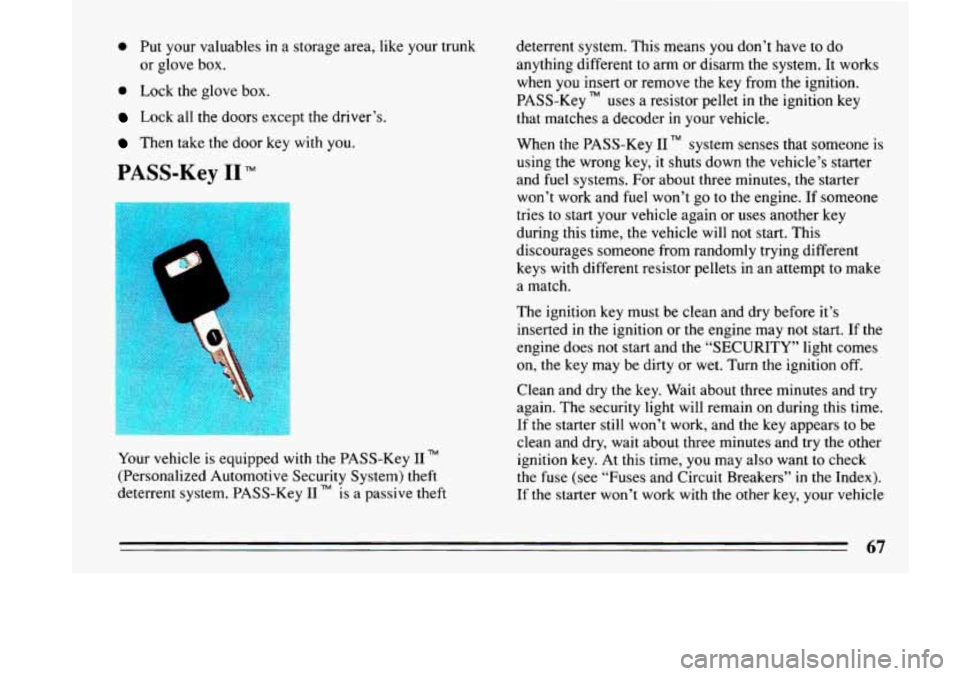
Your vehicle is equipped with the PASS-Key I1 TM
(Personalized Automotive Security System) theft
deterrent system. PASS-Key I1
TM is a passive theft deterrent system.
This means you don’t have to do
anything different
to arm or disarm the system. It works
when you insert or remove the key from the ignition.
PASS-Key uses a resistor pellet in the ignition key
that matches
a decoder in your vehicle.
When the PASS-Key I1
TM system senses that someone is
using the wrong key, it
shuts down the vehicle’s starter
and fuel systems. For about three minutes, the starter
won’t work and
fuel won’t go to the engine. If someone
tries to start your vehicle again or uses another key
during this time, the vehicle will not start. This
discourages someone from randomly trying different
keys with different resistor pellets in an attempt to make
a match.
The ignition key must be clean and dry before it’s
inserted in the ignition or the engine may not start.
If the
engine does not start and the “SECURITY” light comes
on, the key may be dirty or wet. Turn the ignition off.
Clean and dry the key. Wait about three minutes and try
again. The security light will remain on during this time.
If the starter still won’t work, and the key appears to be
clean and dry, wait about three minutes and try the other
ignition key. At this time, you may also want to check
the
fuse (see “Fuses and Circuit Breakers” in the Index).
If the starter won’t work with the other key, your vehicle
67
Page 85 of 324
You may also have a lock out button. Push LOCK to
disable the power window switches. This will prevent
passengers from opening and closing the windows. Push
UNLOCK to allow your passengers to be able to use
their window switches again.
Horn
To sound the horn, press a pad with the horn symbol on
either side
of the steering wheel.
Remote Trunk Release
I! The trunk release switch in
the glove
box must be
“ON” for the “TRUNK”
button to work.
This feature allows
you to secure items in the trunk
when you must leave the ignition key with an attendant.
To secure the trunk, turn OFF the TRUNK RELEASE,
lock the glove box, then take the door key with you.
83
Page 291 of 324
At Least Once a Month
1 CHECKOR SERVICE
I WHAT TO DO
~ ~~~
Tire Inflation Check tire inflation. Make sure
they
are inflated to the pressures specified
on the Tire-Loading Information label located on the rear edge of the
driver’s door. See “Tires”
in the
Index for further details.
At Least Once a Year
CHECK OR
SERVICE
Key Lock
Cylinders
Body
Lubrication
WHAT TO DO
Lubricate the key lock cylinders with
the lubricant specified in Section
D.
Lubricate all body door hinges. Also
lubricate all hinges and latches,
including those
for the hood, glove
box door and console door. Section
D tells you what to use.
CHECK OR
SERVICE
Starter Switch
L
WHAT TO DO
CAUTION: When you are doing
this check, the vehicle could move suddenly.
If it does, you
or others could be injured. Follow the steps below.
1. Before you start, be sure you have
enough room around
the vehicle.
2. Firmly apply both the parking brake
(see “Parking Brake” in
the Index if
necessary) and the regular brake.
NOTE:
Do not use the accelerator
pedal, and be ready to turn
off the
engine immediately
if it starts.
3. Try to start the engine in each gear.
The starter should work only
in “P’
(Park) or “N’ (Neutral). If the starter
works
in any other position, your
vehicle needs service.