Page 239 of 324
Then, without shutting off the engine, follow these
steps:
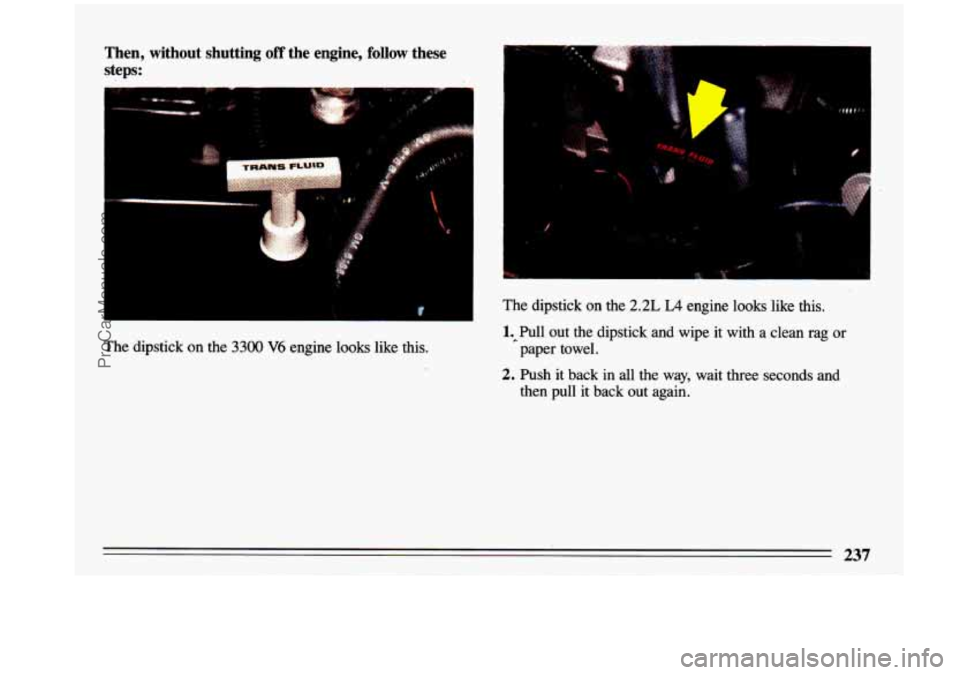
rhe dipstick on the 3300 V6 engine looks like this.
k
The dipstick on the 2.2L L4 engine looks like this.
1,Pull out the dipstick and wipe it with a clean rag
or
2. Push it back in all the way, wait three seconds and
paper towel.
then pull it back out again.
237
ProCarManuals.com
Page 248 of 324
Front Turn and Parking Bulb and/or Side
Marker Bulb Replacement
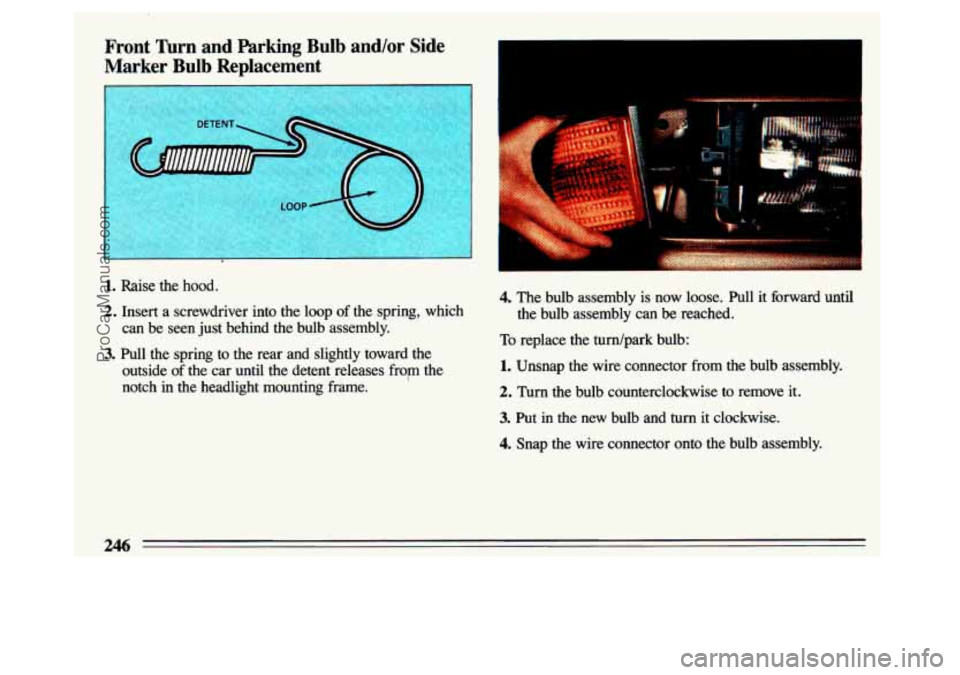
1. Raise the hood.
2. Insert a screwdriver into the loop of the spring, which
3. Pull the spring to the rear and slightly toward the can be seen just behind
the bulb assembly.
outside
of the car until the detent releases from the
notch in the headlight mounting frame.
4. The bulb assembly is now loose. Pull it forward until
To replace the turn/park bulb:
the bulb assembly can be reached.
1. Unsnap, the wire connector from the bulb assembly.
2. Turn the bulb counterclockwise to remove it.
3. Put -in the
new bulb and turn it clockwise.
4. Snap the wire connector onto the bulb assembly.
246
ProCarManuals.com
Page 255 of 324
Tire Inspection and Rotation
To make your tires last longer, have them inspected and
rotated at the mileages recommended
in the Maintenance
Schedule. See “Scheduled Maintenance Services”
in the
Index.
Use this rotation pattern.
After the tires have been rotated, adjust the front and rear
inflation pressure as shown on the Tire-Loading
Information label. Make certain that -all wheel
nuts are
properly tightend. See “Wheel
Nut Torque” in the
Index.
1
I A CAUTION:
Rust or dirt on a wheel, or on the parts to
which
It Is fastened, can make the’wheel nuts
become loose after a Qlme. The wheel could
come off and cause an accident. When you
change a wheel, remove any rust or dirt from
places where the wheel attaches to the
vehlcle.
In an emergency, you can use a cloth
or a paper towel to do this; but be sure to us8
a scraper or wire brush later, if you need to, to
get
all the rust or dirt off. (See “Changing a
Flat Tlre” in the Index.)
253
ProCarManuals.com
Page 261 of 324
Using Foam-Qpe Cleaner on Fabric
Vacuum and brush the area to remove any loose dirt.
Always clean a whole trim panel or section. Mask
Mix Multi-Purpose Powdered Cleaner following the
Use suds only and apply with a clean sponge.
Don’t saturate the material.
Don’t rub it roughly.
As soon as you’ve cleaned the section, use a sponge to
remove the suds.
Rinse the section with a clean, wet sponge.
Wipe off what’s left with a slightly damp paper towel
Then dry it immediately with an air hose, a hair dryer
surrounding
trim along stitch or welt lines.
directions on the container label.
or cloth.
or a heat lamp.
Wipe with a clean cloth.
Using Solvent=Qpe Cleaner on Fabric
First, see if you have to use solvent-type cleaner at all.
Some
spots and stains will clean off better with just water
and mild soap.
If you need to use it, then:
Gently scrape excess soil from the trim material with a
clean, dull knife or scraper. Use very little cleaner,
light pressure and clean cloths (preferably cheesecloth).
Cleaning should start at the outside
of the stain,
“feathering” toward the center. Keep changing to a
clean section of the cloth.
When you clean a stain from fabric, immediately dry
the area with an air hose, hair dryer, or heat lamp to
help prevent a cleaning ring. (See the previous
NOTICE.)
259
ProCarManuals.com
Page 264 of 324
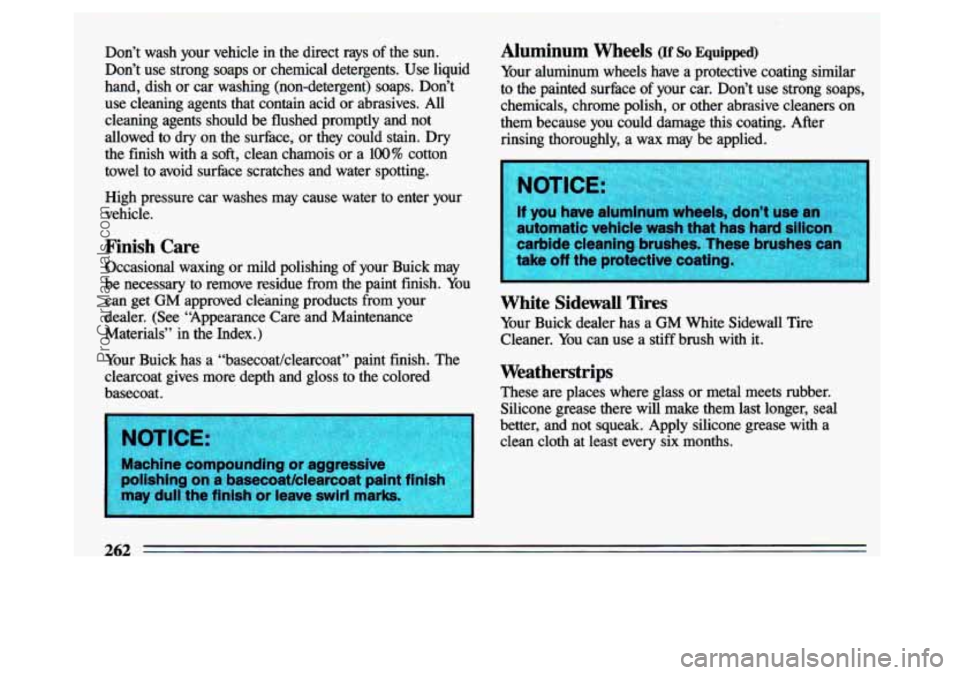
Don’t wash your vehicle in the direct rays of the sun.
Don’t use strong soaps or chemical detergents. Use liquid
hand, dish or car washing (non-detergent) soaps. Don’t
use cleaning agents that contain acid or abrasives. All
cleaning agents should be flushed promptly and not
allowed to dry on the surface, or they could stain. Dry
the finish with a
soft, clean chamois or a 100% cotton
towel to avoid surfhce scratches and water spotting.
High pressure car washes may cause water to enter your
vehicle.
Finish Care
Occasional waxing or mild polishing of your Buick may
be necessary to remove residue from the paint finish. You
can get
GM approved cleaning products from your
dealer. (See “Appearance Care and Maintenance Materials” in the Index.)
Your Buick has a “basecoat/clearcoat” paint finish. The
clearcoat gives more depth and gloss to the colored
basecoat.
Aluminum Wheels (If SO Equipped)
Your aluminum wheels have a protective coating similar
to the painted surface of your car. Don’t use strong soaps,
chemicals, chrome polish, or other abrasive cleaners on
them because you could damage this coating. After
rinsing thoroughly, a wax may be applied.
White Sidewall Tires
Your Buick dealer has a GM White Sidewall Tire
Cleaner. You can use a stiff brush with it.
Weatherstrips
These are places where glass or metal meets rubber.
Silicone grease there will make them last longer, seal
better, and not squeak. Apply silicone grease with a
clean cloth at least every six months.
262
ProCarManuals.com
Page 281 of 324
Selecting the Right Schedule
First you’ll need to decide which of the two schedules is
right for your vehicle. Here is how to decide which
schedule to follow:
Schedule I
Is any one of these true for your vehicle?
Most trips are less than 4 miles (6 km).
Most trips are less than 10 miles (16 km) when outside
temperatures are below freezing.
The engine is at low speed most of the time (as in
door-to-door delivery, or
in stop-and-go traffic).
You operate your vehicle in dusty areas.
You tow a trailer.
If any one (or more) of these is true for your driving,
follow Schedule
I.
Schedule 11
Follow Schedule II only if none of the above conditions
is true.
279
ProCarManuals.com
Page 282 of 324
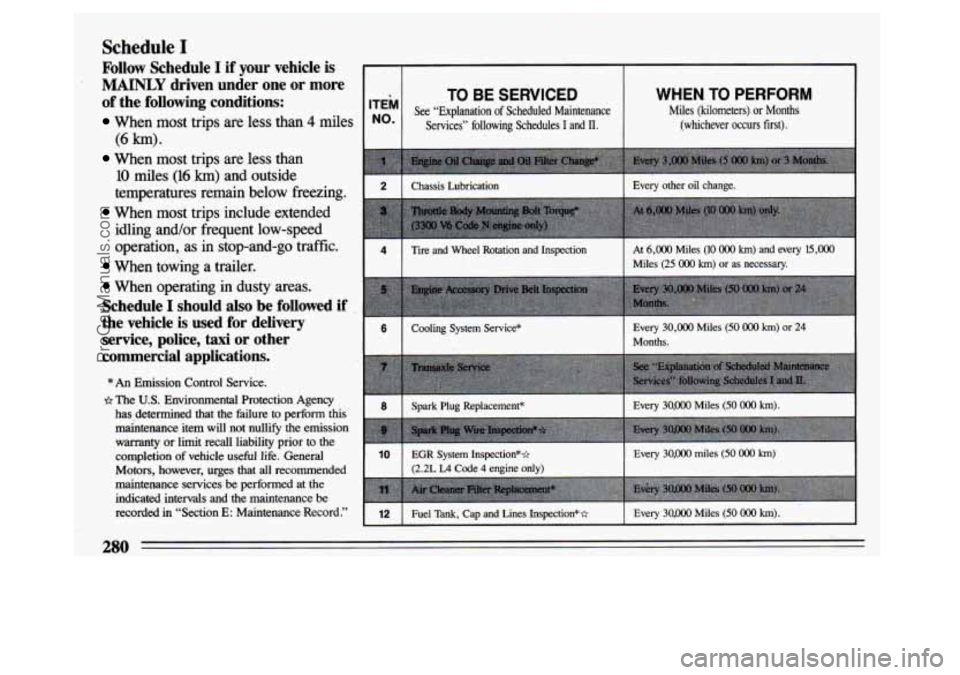
Schedule I
Follow Schedule I if your vehicle is
MAINLY driven under one or more
of the following conditions:
When most trips are less than 4 miles
When most trips are less than
10 miles (16 km) and outside
temperatures remain below freezing.
When most trips include extended
idling and/or frequent low-speed
operation, as
in stop-and-go’ traffic.
(6 km).
When towing a trailer.
When operating in dusty areas.
Schedule I should also be followed if
the vehicle
is used for delivery
service, p?lice,
taxi or other
commercial applications.
* An Emission Control Service.
z2T The U.S. Environmental Protection Agency
has.determined that the failure to perform this
maintenance item will not nullify the emission
wamty
or limit recall liability prior to the
completion of vehicle useful life. General
Motors, however, urges that all recommended
maintenance services
be performed at the
indicated intervals and the maintenance be
recorded in “Section E: Maintenance Record.”
ITEM
NO.
TO BE SERVICED WHEN TO PERFORM
See “Explanation of Scheduled Maintenance Miles (kilometers) or Months
Services” following Schedules
I and D[. (whichever occurs first).
2 I Chassis Lubrication I Every other oil change.
Tire
and Wheel Rotation and Inspection At 6,000 Miles (10 000 km) and every 15,000
Miles (25 000 km) or as necessary. I
61
Cooling System Service* Every 30,000 Miles (50 O00 km) or 24
Months. I
8 I Spark
Plug Replacement* I Every 30,000 Miles (50 000 km). I
EGR System Inspection** Every 30,000 miles (50 OOO km)
(2.2L LA Code 4 engine only)
12 I Fuel Tank, Cap and Lines Inspection** I Every 30,000 Miles (50 OOO km). I
280
ProCarManuals.com
Page 287 of 324

ITEM
NO. SERVICE
5 Engine Accessory Drive Belt Inspection-
* Inspect the belt for cracks, fraying, wear and
proper tension. Replace as needed.
6 Cooling System Service*-Drain, flush and
refill the system with new or approved recycled
coolant conforming to
GM Specification 1825M.
Keep coolant at the proper mixture as specified. See “Engine Coolant” in the Index. This
provides proper freeze protection, corrosion inhibitor level and engine operating temperature.
Inspect hoses and replace if they are cracked,
swollen or deteriorated. Tighten screw-type hose
clamps. Clean the outside of the radiator and air
conditioning condenser. Wash the pressure cap
and neck.
To help ensure proper operation, we recommend
a pressure test of
both the cooling system and the
pressure cap.
ITEM
NO. SERVICE
7 Transaxle Service-Change both the fluid and
filter every
l5,O00 miles (25 O00 km) if the
vehicle is mainly driven under one or more of
these conditions:
In heavy city traffic where the outside tem-
perature regularly reaches
90°F (32OC) or
higher.
In hilly or mountainous terrain.
When doing frequent trailer towing.
Uses such as found in taxi, police car or
If you do’not use your vehicle under any of
these conditions, change both the fluid and filter every
100,000 miles (160 0o0 km).
plugs with the proper type. See “Specifications
‘and Capacities” in the Index. delivery service.
8 Spark
Plug Replacement*-Replace spark
285
ProCarManuals.com