1992 VOLKSWAGEN TRANSPORTER lock
[x] Cancel search: lockPage 73 of 164
Downloaded from www.Manualslib.com manuals search engine
CONTROLS AND
EQUIPMENT
Sliding/tilting
roof*
! I I
[B
70-3201
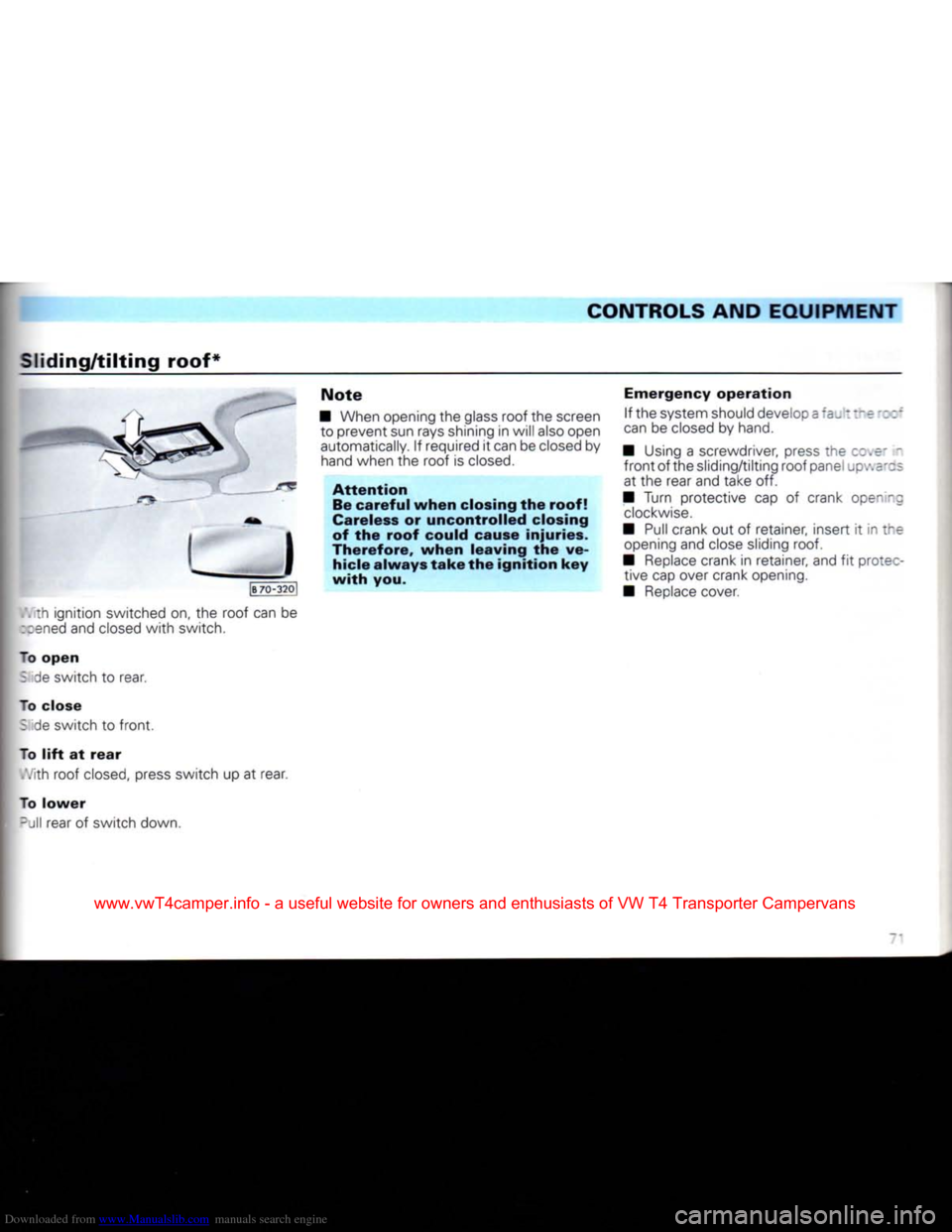
. th ignition switched on, the roof can be
::ened
and closed
with
switch.
~o
open
: de switch to rear.
To close : de switch to
front.
To
lift
at
rear
,','ith
roof closed, press switch up at rear.
To
lower
-JII
rear of switch down.
Note
• When opening the glass roof the screen to prevent sun rays shining in will also open
automatically. If required it can be closed by hand when the roof is closed.
Attention
Be
careful
when
closing the
roof!
Careless or
uncontrolled
closing
of the
roof
could cause
injuries.
Therefore,
when
leaving
the ve
hicle
always
take
the
ignition
key
with
you.
Emergency
operation
If the system should develop a t:~e
can
be closed by hand.
• Using a screwdriver, press the cove' -
front
of the sliding/tilting roof panel upv.e'os at the rear and take off.
• Turn protective cap of crank opening
clockwise.
• Pull crank out of retainer, insert it in i^e opening and close sliding
roof.
• Replace crank in retainer, and fit protec tive cap over crank opening.
• Replace cover.
www.vwT4camper.info - a useful website for owners and enthusiasts of VW T4 Transporter Campervans
Page 76 of 164
Downloaded from www.Manualslib.com manuals search engine
CONTROLS AND
EQUIPMENT
Glove box
Dropside
(Pick-up)
ns lockable
lid*
in the instrument panel can
only be opened with the main key.
Attention For safety reasons all stowage
box lids should always be closed
when vehicle is moving.
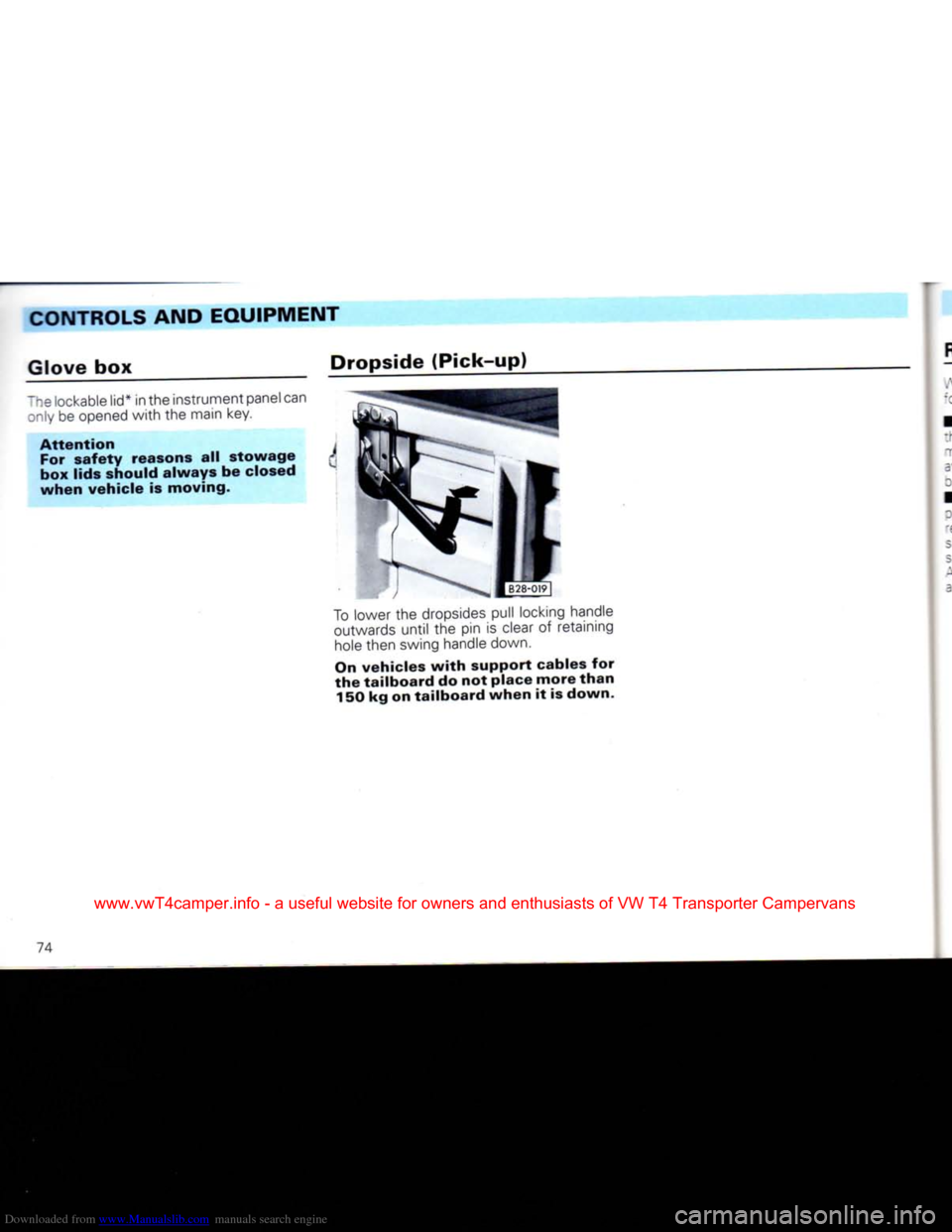
To lower the dropsides pull locking handle outwards until the pin is clear of retaining hole then swing handle down.
On vehicles with support cables for
the tailboard do not place more than 150 kg on tailboard when it is down.
74
www.vwT4camper.info - a useful website for owners and enthusiasts of VW T4 Transporter Campervans
Page 85 of 164

Downloaded from www.Manualslib.com manuals search engine
DRIVING
TIPS
• Where possible make
full
use of the maximum permissible drawbar weight on
call
of the towing bracket - see page 151 -
cut do not exceed it.
• While observing the permissible trailer
and
drawbar weight, distribute the load in
the trailer so
that
heavy objects are as near
as
possible to the axle. The objects must
a
so be secured so
that
they cannot slip
aoout.
• Check the
tyre
pressures on the towing
/ehicle
and the trailer.
• The headlight settings, should be
:hecked
with
trailer attached before mov- ng off and adjusted as necessary.
On
vehicles
with
headlight beam control it
is
only necessary to
turn
the knurled disc in
:ash
in the appropriate direction.
Driving
instructions
To
obtain the best possible handling of ve
hicle
and trailer, the following should be
noted:
• Try to avoid driving
with
an unladen ve
hicle
and a loaded trailer. If this cannot be
avoided,
only drive slowly to allow for the unfavourable weight distribution.
• As driving stability of vehicle and trailer
decreases
when the speed increases do not
drive at the maximum permissible top
speed
in unfavourable road, weather or
wind conditions - particularly when going downhill. In any
case
the speed must be reduced im
mediately the trailer shows the slightest
sign
of snaking. On no account try to stop
the snaking by accelerating.
• For safety reasons one should not drive faster than 80 km/h (50 mph). This also
applies
in countries where higher speeds
are permitted. • Always brake in good time. If the trailer
has
an overrun brake, apply the brakes gen
tly at
first
then firmly. This will avoid the
jerk
ing caused by the trailer wheels locking.
Change
down before going down a steep hill so
that
the engine can act as a brake.
• When a long climb in a low gear
with
ex tremely high engine revs must be nego
tiated at exceptionally high ambient temperatures the coolant temperature gauge must be observed. When the gauge needle
moves
to the
>~zza'
e~z of :ne
scale,
the road speed must be reduced immediately. If nevertheless ~g amp flashes,
stop immediately and si ow the engine to
cool
off at idling speed for several minutes.
• The cooling effect of the radiator fan
can
not be increased by changing down, be
cause
the speec of t~e
~a~
s ~o! dependent
on the engine
speed.
One should therefore not change down even when towing a
trailer as long as :-e e-g -e zar cope with out the vehicle speed dropping too much.
83
www.vwT4camper.info - a useful website for owners and enthusiasts of VW T4 Transporter Campervans
Page 87 of 164
Downloaded from www.Manualslib.com manuals search engine
GENERAL
MAINTENANCE
Filling the
tank
The
filler neck is on the left-hand side of the
vehicle.
The
tank holds about 80 litres. Trouble-free
refuelling
calls
for correct
use
of filler
nozzle.
•
Insert
nozzle
fully into tank neck and do not
tilt
it.
On
vehicles with a catalytic converter the
spring-loaded
flap below the filler opening
must be
pressed
open with the filler
nozzle.
This
should
also
be noted when using a pet rol can to
fill
the tank. As soon as the
correctly
oper
ated
automatic
nozzle
switches
off for the
first
time,
the
tank
is
full.
Do not try
then
to put
more
fuel
in
because the expansion space in
tank
will
be
filled
- the
fuel
can
then
over
flow
when
it becomes
warm.
After
filling tank, screw cap on tightly and
lock
it.
Note
•
Never
drive
until
the
fuel
tank
is completely
empty
on vehicles
with
a catalyst. The
irregular
fuel
supply
can cause misfiring. This
allows
un-
burnt
fuel
into
the exhaust system.
Which can cause
overheating
and damage to the catalyst.
•
When carrying a spare can of petrol on the vehicle, official regulations must be ob
served.
For safety reasons we advise you not to carry a spare can of petrol. In an
acci
dent the can could become damaged and petrol
escape.
55
www.vwT4camper.info - a useful website for owners and enthusiasts of VW T4 Transporter Campervans
Page 91 of 164
Downloaded from www.Manualslib.com manuals search engine
GENERAL
MAINTENANCE
Washing
the
vehicle
by
hand
In the
interests
of
environmental
B
protection
the
vehicle
should
only
be
washed
in
specially
pro
vided
wash
bays.
In
some
districts,
washing
cars
elsewhere
may
even
be
forbidden.
Irst
soften the
dirt
with
plenty of water and
-ise
off as well as possible.
~nen clean the car
with
a soft sponge, glove
or brush starting on the roof and going from :3p to bottom using only slight pressure. :aint shampoo should only be used for very
cersistent
dirt.
=
:nse
the sponge or glove out thoroughly at
snort intervals.
.'.'heels
and sill panels should be cleaned
last, using a different sponge if possible.
After cleaning the vehicle, rinse thoroughly
vith
water and leather it off.
Notes
• The vehicle should not be washed in strong sunshine.
• If the vehicle is rinsed
with
a
hose,
do not direct the jet of water at the lock cylinders
- they can freeze up in the winter.
Washing
vehicle
with
high
pres
sure
cleaner
• The operating instructions for the high
pressure
cleaner must be followed closely
- particularly
with
regard to pressure and working distance.
• Do not use a concentrated jet. • The water temperature must not be above 60 degrees C.
Attention
Tyres
must
never
be
cleaned
with
a
concentrated
jet! Even at a
rela
tively
large
working
distance
and a
very
short
spraying
time,
dam
age can occur.
Waxing
A
good coat of wax protects the .s~ : e
paintwork to a large extent against the e". -
ronmental influences listed under
"Wash
ing"
on the previous page and even agars:
light
mechanical damage.
At the latest when water on the clean paint
does
not form small drops and roll off, the
vehicle should be protected by applying a
coat of good hard wax.
Even
when a wax solution is used regularly in the washing
water it is advisable to protect the paint
with
a
coat of hard wax at least twice a year.
Polishing
Should
only be done if paint has lost its shine
and gloss cannot be brought back
with
wax. If the polish used does not contain preserv
ative compounds, the paint must oe waxed
afterwards.
Note
Matt
painted
and
plastic
parts
should not be treated
with
polish or hard wax..
89
www.vwT4camper.info - a useful website for owners and enthusiasts of VW T4 Transporter Campervans
Page 96 of 164
Downloaded from www.Manualslib.com manuals search engine
GENERAL
MAINTENANCE
Bonnet
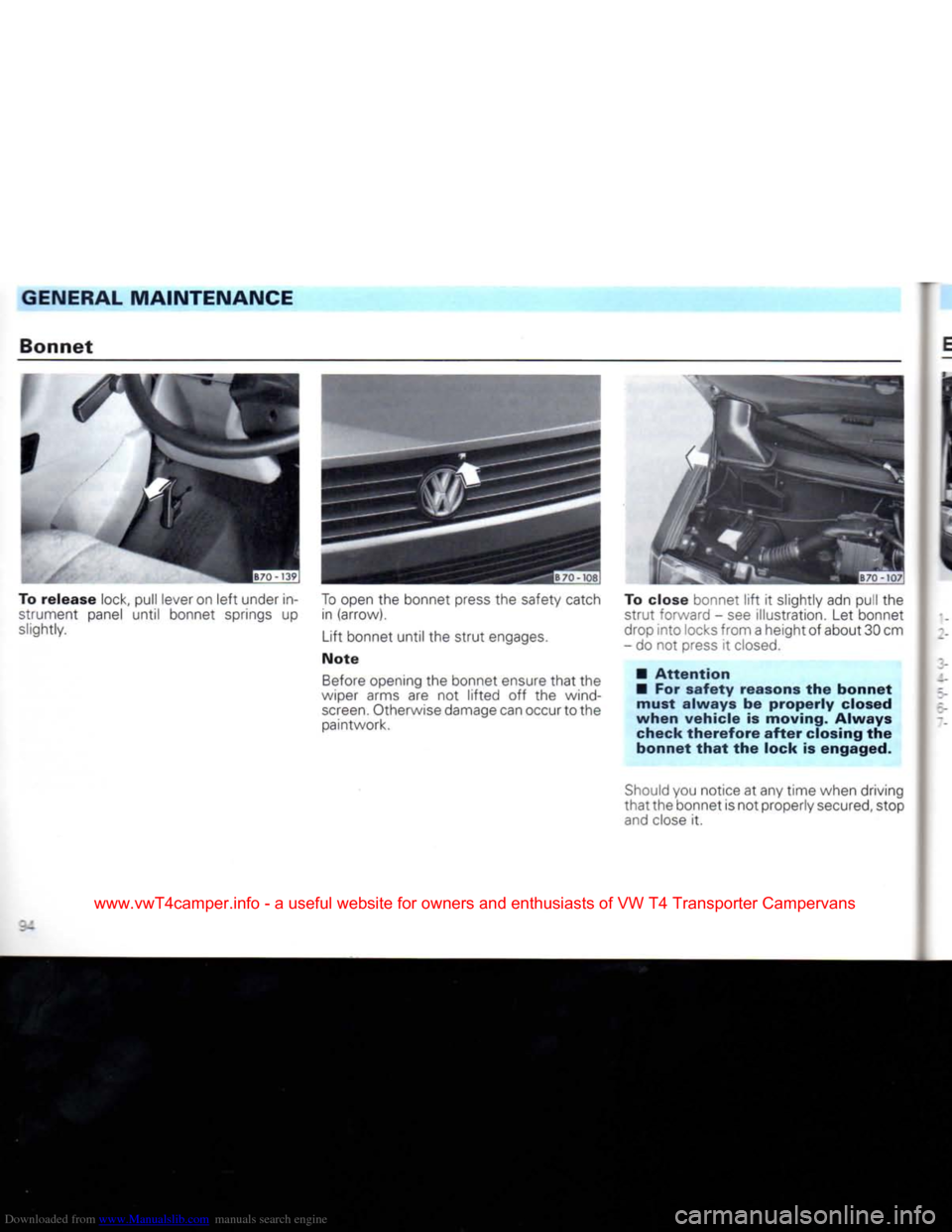
To
release
lock, pull lever on
left
under in strument panel until bonnet springs up
slightly.
To
open the bonnet press the safety catch
in (arrow).
Lift bonnet until the strut engages.
Note
Before
opening the bonnet ensure that the
wiper arms are not lifted off the wind
screen.
Otherwise damage can occurto the paintwork. To close bonnet
lift
it slightly adn pull the
strut forward - see illustration. Let bonnet
drop into locks from a height of about 30 cm
- do not press it
closed.
•
Attention
• For
safety
reasons the
bonnet
must
always
be
properly
closed
when
vehicle is moving. Always
check
therefore
after
closing the
bonnet
that
the lock is engaged.
Should
you notice at any time when driving
that the bonnet is not properly
secured,
stop
and
close it.
www.vwT4camper.info - a useful website for owners and enthusiasts of VW T4 Transporter Campervans
Page 102 of 164
Downloaded from www.Manualslib.com manuals search engine
GENERAL
MAINTENANCE
Air
cleaner
Power
assisted
steering
The
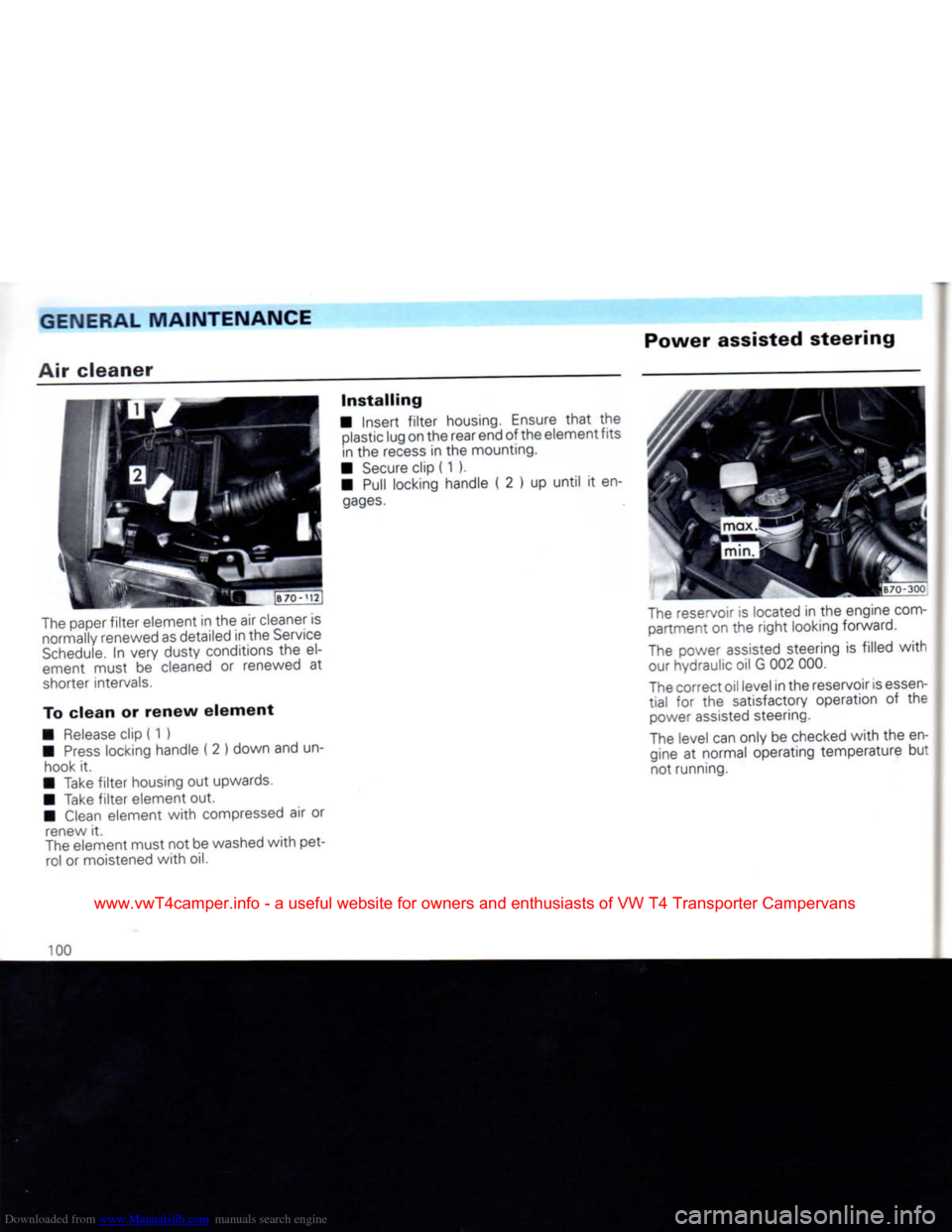
paper
filter
element in the air cleaner is normally renewed as detailed in the Service
Schedule.
In very dusty conditions the el
ement must be cleaned or renewed at
shorter intervals.
To clean or
renew
element
•
Release
clip (1 ) •
Press
locking handle ( 2 ) down and un hook it.
• Take
filter
housing out upwards.
• Take
filter
element out. •
Clean
element
with
compressed air or renew it.
The
element must not be washed
with
pet rol or moistened
with
oil.
Installing
• Insert
filter
housing. Ensure
that
the
plastic
lug on the rearend of the elementfits
in the recess in the mounting.
• Secure clip (1 ).
• Pull locking handle ( 2 ) up until it en
gages.
The
reservoir is located in the engine compartment on the
right
looking forward.
The
power assisted steering is filled
with
our hydraulic oil G 002 000.
The
correct oil level in the reservoir is
essen
tial for the satisfactory operation of the power assisted steering.
The
level can only be checked
with
the en gine at normal operating temperature but not running.
100
www.vwT4camper.info - a useful website for owners and enthusiasts of VW T4 Transporter Campervans
Page 112 of 164
Downloaded from www.Manualslib.com manuals search engine
GENERAL
MAINTENANCE
Wheels
General
notes
• New tyres do not give maximum grip straight away and should therefore be run in
at moderate speeds and a careful style of
driving for about the
first
100 km. This will help to make the tyres last longer.
• Check tyres for damage from time to time (cuts, splits, cracks and lumps) and remove any foreign bodies embedded in the
treads.
• To avoid damage to tyres and wheels crive over curbs and similar obstacles very
slowly and as nearly at
right
angles as
poss
ible.
Damage
to wheels and tyres is not always
easy
to see, so if you
think
that
a wheel is
damaged,
it must be checked by a Volks
wagen dealer.
• Keep grease, oil and fuel off the tyres.
• Replace missing dust caps as soon as
possible.
• Mark wheels before taking them off so
that
they rotate in the same direction when put back on again. • When taken off, the tyres should be
stored in a
cool,
dry and preferably dark
place.
Tyres
which are not on wheels should be stored in a vertical position.
Tyre
life
Tyre life depends to a considerable extent on the following factors:
Inflation
pressure
The inflation pressure is very important par
ticularly at high
speeds.
Therefore, the pres
sures
should be checked at least once a month and before every long journey.
At this opportunity do not forget the spare
wheel:
• The spare wheel should always be in flated to the highest pressure required on
the vehicle.
Always
check the pressures when the tyres are cold.
When
warm,
the pressure is
higher
but do not
reduce.
The pressur
es
are given on page 147 and on a sticker on
the driver's door lock pillar.
Pressures
which are too high or too low
shorten
tyre
life - quite apart from the detri mental influence on vehicle handling.
Attention
At
continuous
high
speeds a
tyre
in
which
the pressure is too low
flexes
more
and
heats
up excess
ively.
This can cause
tread
separ
ation
and
tyre
blow
out.
pCU
A
pressure
which
is too low in- oo
creases
the
fuel
consumption
and
this
burdens
the
environment
unnecessarily.
Mode
of
driving
Fast
cornering, hard acceleration and viol
ent braking also increase
tyre
wear.
'0
www.vwT4camper.info - a useful website for owners and enthusiasts of VW T4 Transporter Campervans