Page 674 of 1146

33B-12ELECTRONIC CONTROL SUSPENSION (EC9 - i?:~~u:‘?s*men*
12FOOOESERVICE ADJUSTMENT PROCEDURES
I
ON-VEHICLE INSPECTIONIM33FHAD1. WARNING INDICATION BY ECS INDICATOR LIGHT
If a problem associated with the following items occurs, theECS indicator light (Tour Sport) in the combination light
flashes at intervals of 0.5 sec. At the same time, the
self-diagnosis code associated with the problem is outputto the diagnosis connector.
Warning Indication Items
l G sensor
l Steering angular velocity sensor
l Vehicle speed sensor
lDamping force changeover actuator (including position
detection switch)
2. SELF-DIAGNOSIS OUTPUT CHECK
(I) Check the self-diagnosis code.
(2) After the defective portion has been repaired, erase theself-diagnosis code. (If the defective portion is not
completely repaired, it may be impossible to erase the’self-diagnosis code by the MUT.)d
(3) Perform self-diagnosis output check again and checkthat the self-diagnosis code is good.
(1) Set the ignition switch to OFF.
(2) Connect the positive (+) terminal of the voltmeter to
the No. 3 terminal of the diagnosis connector beside the
junction block and connect the negative (--) terminal ofthe voltmeter to the No. 12 terminal.
(3) Set the ignition switch to ON.
(4) Read the self-diagnosis code on the basis of the
deflection of the pointer of the voltmeter.
(5) Based on the self-diagnosis code, repair the associated
defective portion.(6) Set the ignition switch to OFF.
(7) Disconnect the battery cables from the battery termi-
nals and reconnect them more than
10 seconds
thereafter.(8) Set the ignition switch to ON, perform self-diagnosis
check again, and check that the self-diagnosis code is
good.
TSB Revision
Page 678 of 1146

339-l 6ELECTRONIC CONTROL SUSPENSION (ECS) - ;;:%,:?‘Stment5. CONTROL FUNCTION SIMULATION CHECK
Using the MUT, check all control functions during operationwith the vehicle in stationary condition.
5-1. Anti-Roll Control Function Check:d
(1) Raise the front wheels on a jack and have them supportedby rigid racks.
(2) Place the steering wheel in straight ahead position.
(3) Select the Tour mode by the ECS switch.
(4) Enter a simulated vehicle speed of 100 km/h (62 mph) fromthe MUT.
(5) Using the MUT, check the indications of service data itemsNo. 61 through 64.
MUT indication: SOFT
12FOO64(6) Turn the steering wheel clockwise or counterclockwise
from the straight ahead position.
(7) Using the MUT, check that the indications of service dataitems No. 61 through 64 change over.
Approx. 0.2 seconds for 90” rotation
(8) Check that the original damping force indication (SOFT) isrestored a second later.
5-2. Anti-Dive Control Function Check
(1) Select the Tour mode by the ECS switch.
(2) Enter a simulated vehicle speed of 100 km/h (62 mph) fromthe MUT.
(3) Using the MUT, check the indications of service data itemsNo. 61 through 64.
MUT indication: SOFT
(4) Depress the brake pedal and simultaneously change the
entered simulated vehicle speed by the MUT. (Change thespeed in 0.4 seconds after depressing the brake pedal.)
(5) Using the MUT, check that the indications of service dataitems No. 61 through 64 change over.
Changing entered simulated
vehicle speedMUT indication
100 km/h (62 mph) to 80 km/h (50 mph)HARD
(6) Check that the original damping force indication (SOFT) isrestored a second later.
Ls5-3. Anti-Squat Control Function Check
(1) Select the Tour mode by the ECS switch.
(2) Enter a simulated vehicle speed of 30 km/h (19 mph) fromthe
MUT.
(3) Using the MUT, check the indications of service data itemsNo. 61 through 64.
MUT indication: SOFT
l/i
TSB Revision
Page 681 of 1146

ELECTRONIC CONTROL SUSPENSION (ECS)ECS Switch I Steering Angular Velocity- Sensor I G Sensor I Vehicle Speed Sensor3:3B-19
12FOO6t3INSPECTION12FOO71
i
\\12FOO72
ECS SWITCHMUZCAB
To mount or remove the ECS switch, refer to GROUP 54
-
Meters and Gauges. Remove the meter bezel before rnountingor removing the ECS switch.
Operate the switch to check for continuity between the
individual terminals.
3
ECS switchON0
OFF0IIIIII1
NOTEO-O indicates that there is continuity between the terminals.STEERING ANGULAR VELOCITY SEN-
SORM33ZHAB
To mount or remove the steering angular velocity sensor, referto GROUP 54
- Column Switch. Remove the steerilng wheel
and clock spring
*before mounting or removing the sensor.
G SENSORM33ZIAB
To mount or remove the G sensor, refer to GROUP 52A-Front
Seat. Remove the front seat
(L.H.) before removing or
mounting the sensor.
VEHICLE SPEED SENSORM33ZJAB
To mount or remove the vehicle speed sensor, refer to GROUP54
- Meters and Gauges.
INSPECTIONRefer to GROUP 54
- Meters and Gauges.
TSB Revision
I
Page 691 of 1146
A-L!?., ’ cLr”“l‘412F002E
SERVICE ADJUSTMENT PROCEDURES
REAR WHEEL ALIGNMENT INSPECTIONM34FAAH
CAMBERSt")
REAR SUSPENSION - Service Adjustment Procedures34-5
0 camber
“\
er
ewer arm (L.H.)A-L!?., ’ cLr”“l‘412F002E
SERVICE ADJUSTMENT PROCEDURES
REAR WHEEL ALIGNMENT INSPECTIONM34FAAH
CAMBERStandard value: 0” + 30
To adjust camber, turn the lower arm mounting bolt
(cross-
member side).
NOTE(1) Make the adjustment with the assist link mounting bolt
(crossmember side) loosened.
(2) The difference between the right and left wheels should be30’ or less.
(3) Left wheel: Clockwise
(0 camber)
Right wheel: Clockwise
(0 camber)
One graduation changes camber by about 15’.
TOE-INStandard value: 0.5
-+ 2.5 mm (.Ol + .09 in.)
To adjust toe, turn the assist link mounting bolts (on crossmem-ber side) on both sides
t,he same amount.
NOTE
(1) The difference between right and left wheels should be 3mm (.I2 in.) or less.
(2) Left wheel: Clockwise (toe-in)
Right wheel: Clockwise (toe-out)
One graduation changes toe by about 4.8 mm
(.19 in.)
.
Caution1. Adjust the eccentric bolt within 90” from the central
position.
2.Adjust camber and toe, in that order, and, if camber isadjusted, be sure to adjust toe also.
TSB Revision
Page 692 of 1146

34-6REAR SUSPENSION - Service Adiustment Procedures12NOOOl
WHEEL BEARING END PLAY INSPECTIONM34FBAG
1.Inspect the play of the bearings while the vehicle is jackedup and resting on floor jack.
2. Remove the hub cap and then release the parking brake.
s&i3. Remove the caliper assembly and the brake disc.
4. Check the bearing’s end play.
Place a dial gauge against the hub surface; then move the
hub in the axial direction and check whether or not there is
end play.Limit: 0.05 mm
(.002 in.) or less
NOTEIf the limit value is exceeded, the lock nut should be
tightened to the specified torque and check the end play
again.5. Replace the rear hub bearing unit if an adjustment cannot
be made to within the limit.
REAR HUB ROTARY-SLIDING RESISTANCE (TOR-
QUE) INSPECTION
M34FCAC
1.Inspect the play of the bearings while the vehicle is jackedup and resting on floor jack.
2. Release the parking brake.
3. Remove the caliper assembly and the brake disc.
..J
4.After turning the hub a few times to seat the bearing, attach
a spring balance to the hub bolt, and, pulling at a 90” anglefrom the hub bolt, measure to determine whether or not
the rotary-sliding resistance of the rear hub (the
rotary-sliding torque of the rear hub) is the standard value.
Limit:
Rear hub rotary-sliding resistance
31 N (7 Ibs.) or lessRear hub rotary-sliding torque
1.8 Nm (1.30 ftlbs.) or less
NOTEIf the limit value is exceeded, the lock nut should be
tightened to the specified torque and check the end play
again.5. Replace the rear hub unit bearing if an adjustment cannot
be made to within the limit.
TSB Revision
Page 695 of 1146

REAR SUSPENSION -Upper Arm, Lower Arm and Assist Link34-9UPPER ARM, LOWER ARM AND ASSIST LINK
iREMOVAL AND INSTALLATION
LPre-removal Operation
l Removal of the Shock Absorber
(Refer to P.34-13.)Post-installation Operation
l Check of Wheel Alignment
(Refer to P.34-5.)l Installation of the Shock Absorber
(Refer to P.34-13.)Upper arm removal steps
1. Brake line clamp bolta*2. Self-locking nut
140- 160 Nm*IOl-116ft.lbs.”\
\
2
/7
75-89Nm54 - 64 ft.lbs.
140 - 160 Nm*101 - 116ft.lbs.*
8
3. Upper arm mounting bolt and nut
4. Upper armLower arm removal steps
5. Lower arm mounting bolt and nutl *6. Self-locking nut
7. Lower armAssist link removal steps
8. Assist link mounting bolt and nut4*9. Self-locking nut10. Assist link
NOTE*:indicates parts which should be temporarily tightened, and
then fully tightened with the vehicle in the unladen
condition.
M34SA-S
Dustcover
rz412R0487
12A009$3TSB Revision
SERVICE POINTS OF REMOVALMSBAB2. 6. 9. REMOVAL OF SELF-LOCKING NUT
Using the special tool, disconnect the knuckle from the
upper arm, lower arm, and assist link.
NOTE(1) Do not remove the nut from the ball joint, but just
loosen it.
(2) Suspend the special tool with a rope to prevent it from
dropping.
Page 697 of 1146
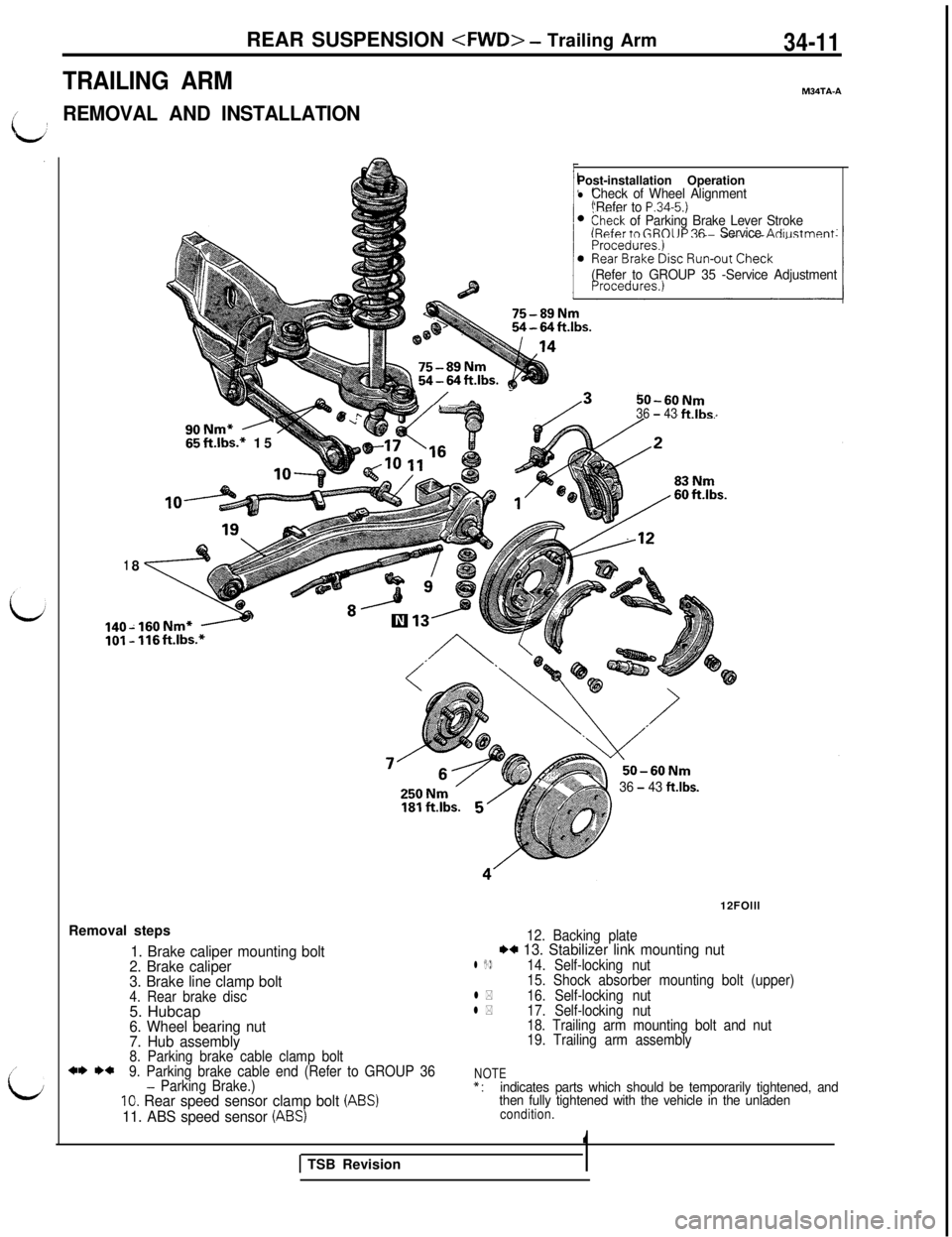
REAR SUSPENSION - Trailing Arm34-11
TRAILING ARMM34TA-A
t’REMOVAL AND INSTALLATION
,’
i;
18
90Nm* A65ft.lbs.* 15Post-installation Operation
lCheck of Wheel Alignment
‘Refer to P.34-5.)>heck of Parking Brake Lever Stroke(Refer tn GROIJP 36 - Service Adiustment
r/A -50-60Nm36 - 43ftlbs.
(Refer to GROUP 35 -Service Adjustment
-160Nm* -- 116ft.lbs.*Removal steps
1. Brake caliper mounting bolt
2. Brake caliper
3. Brake line clamp bolt
4. Rear brake disc5. Hubcap
6. Wheel bearing nut
7. Hub assembly
8. Parking brake cable clamp bolt*I) I)*9. Parking brake cable end (Refer to GROUP 36- Parking Brake.)IO. Rear speed sensor clamp bolt (ABS)
11. ABS speed sensor (ABS)
36 - 43 ftlbs.12FOlll
12. Backing plateI)+ 13. Stabilizer link mounting nutl I)14. Self-locking nut
15. Shock absorber mounting bolt (upper)
l *16. Self-locking nutl *17. Self-locking nut
18. Trailing arm mounting bolt and nut
19. Trailing arm assembly
NOTE*:indicates parts which should be temporarily tightened, and
then fully tightened with the vehicle in the unladen
condition.
1 TSB Revision1
Page 698 of 1146
34-12REAR SUSPENSION - Trailina Arm
I12A009E
Pressure fittingRemoval
MB991 38912N009t
_ Hold with
wrenchA12AOlOC
SERVICE POINTS OF REMOVALM34TBAB14.16. 17. REMOVAL OF SELF-LOCKING NUT
Using the special tool, remove the knuckle from the lower,arm, upper arm, and assist link.
NOTE
(1) Do not remove the nut from the ball joint, but just
loosen it.
(2) Suspend the special tool with a rope to prevent it from
dropping.
INSPECTIONM34TCABl
l Check trailing arm for cracks and deformation.
l Check bushing for cracks, deterioration and wear.
TRAILING ARM BUSHING REPLACEMENTM34TEABl
Use the special tool to remove and press-fit the bushing.
SERVICE POINT OF INSTALLATIONM34lDAA
13. INSTALLATION OF STABILIZER LINK MOUNTING NUTHolding the stabilizer link with a wrench, tighten the
self-locking nut so that the protrusion of the stabilizer link
(dimension A indicated in illustration) is within the standard
,,
value.dStandard value: 5
- 7 mm
1 TSB Revision
(.197 -.276 in.)I
