Page 197 of 4087
1
NG
OK
(1) Turn ignition switch LOCK, and wait at least 20
seconds.
(2) Turn ignition switch ACC or ON, and wait at least 20 seconds.
(3) Repeat operation in step (1) and (2) at least 5 times.
(4) Using SST, connect terminals Tc and E
1 of TDCL.
SST 09843±18020
(5) Check diagnostic code.
Is diagnostic code 31 output again?
Using simulation method, reproduce
malfunction symptoms (See page IN±20).
Clear malfunction code stored in memory
(See page
AB±32).
Replace center airbag sensor assembly.
INSPECTION PROCEDURE
HINT:When a malfunction code other than code 31 is displayed at the same time, fi\
rst repair the malfunction indicated by the malfunction code other than code 31.
±
SRS AIRBAG TroubleshootingAB±81
WhereEverybodyKnowsYourName
Page 198 of 4087
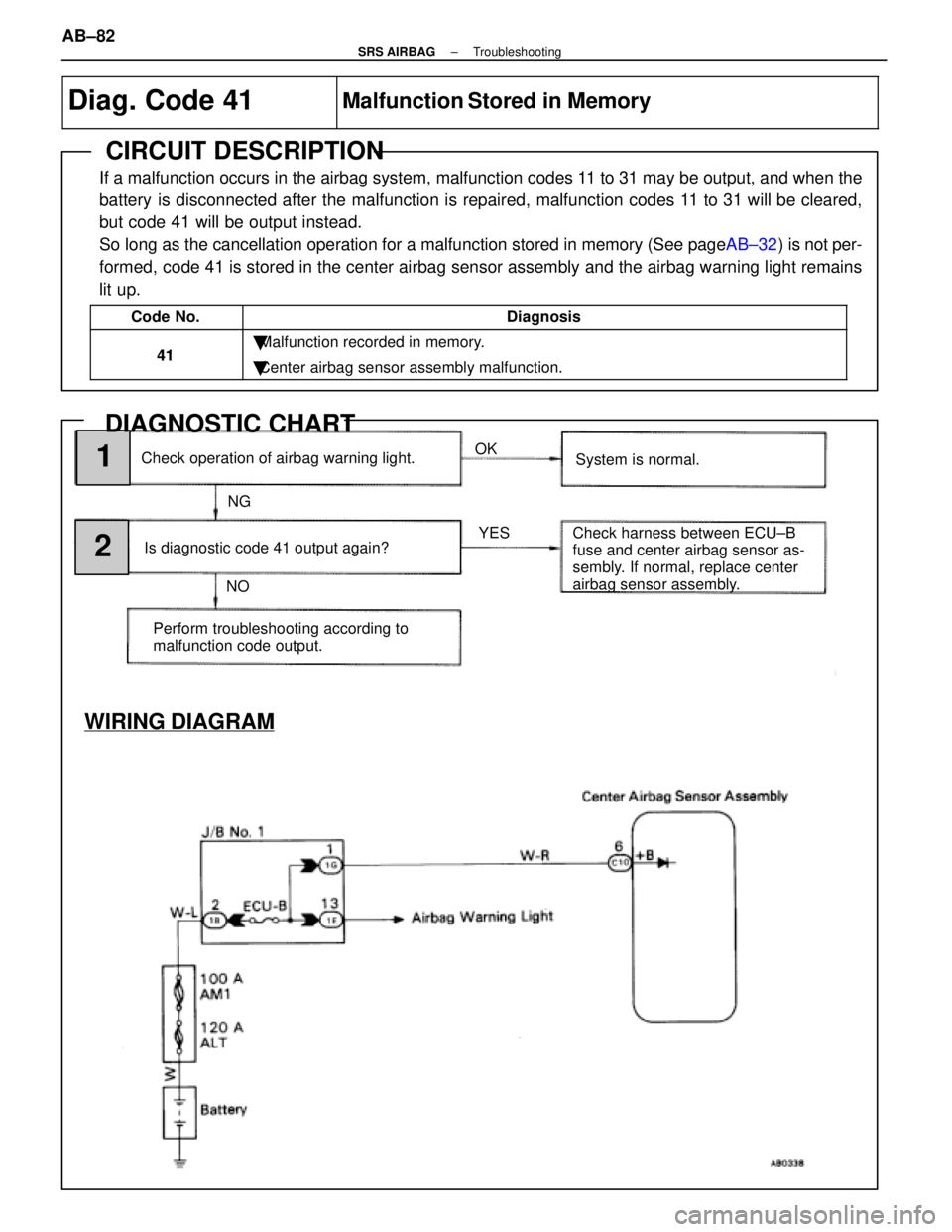
OK
Check operation of airbag warning light.
NG1
WIRING DIAGRAM
2Is diagnostic code 41 output again? System is normal.
Check harness between ECU±B
fuse and center airbag sensor as-
sembly. If normal, replace center
airbag sensor assembly.
Perform troubleshooting according to
malfunction code output. NO
YES
Diag. Code 41Malfunction Stored in Memory
CIRCUIT DESCRIPTION
If a malfunction occurs in the airbag system, malfunction codes 11 to 31 may be output, and when the
battery is disconnected after the malfunction is repaired, malfunction codes 11 to 31 will be cleared,
but code 41 will be output instead.
So long as the cancellation operation for a malfunction stored in memory (\
See page
AB±32) is not per-
formed, code 41 is stored in the center airbag sensor assembly and the airbag w\
arning light remains
lit up.
Code No.Diagnosis
41 � Malfunction recorded in memory.41 � Center airbag sensor assembly malfunction.
DIAGNOSTIC CHART
AB±82±
SRS AIRBAG Troubleshooting
WhereEverybodyKnowsYourName
Page 199 of 4087
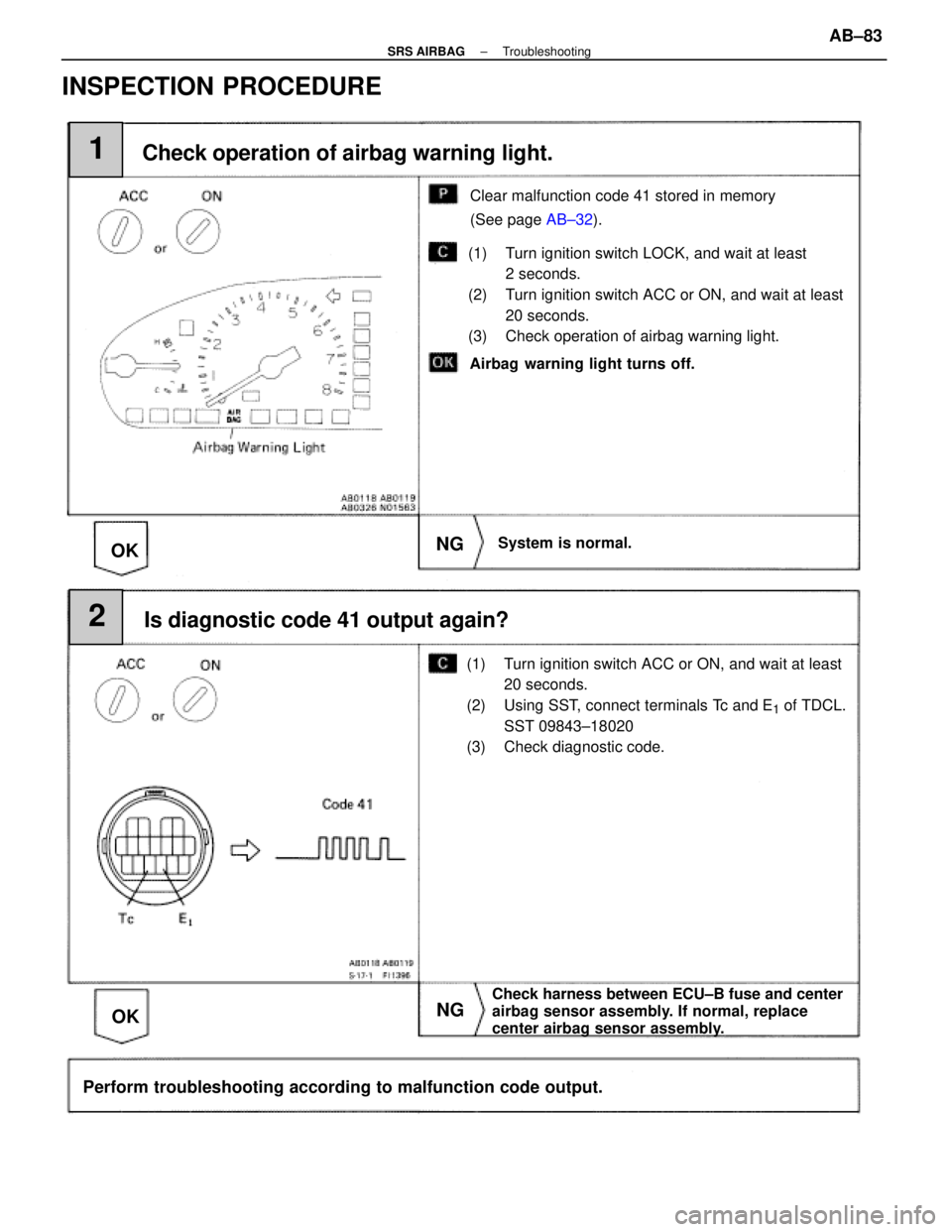
Clear malfunction code 41 stored in memory
(See page AB±32).
Check operation of airbag warning light.
NG
OK
1
Airbag warning light turns off.
(1) Turn ignition switch LOCK, and wait at least
2 seconds.
(2) Turn ignition switch ACC or ON, and wait at least 20 seconds.
(3) Check operation of airbag warning light.
System is normal.
2Is diagnostic code 41 output again?
(1) Turn ignition switch ACC or ON, and wait at least 20 seconds.
(2) Using SST, connect terminals Tc and E
1 of TDCL.
SST 09843±18020
(3) Check diagnostic code.
Check harness between ECU±B fuse and center
airbag sensor assembly. If normal, replace
center airbag sensor assembly.
Perform troubleshooting according to malfunction code output.
NG
OK
INSPECTION PROCEDURE
±
SRS AIRBAG TroubleshootingAB±83
WhereEverybodyKnowsYourName
Page 200 of 4087
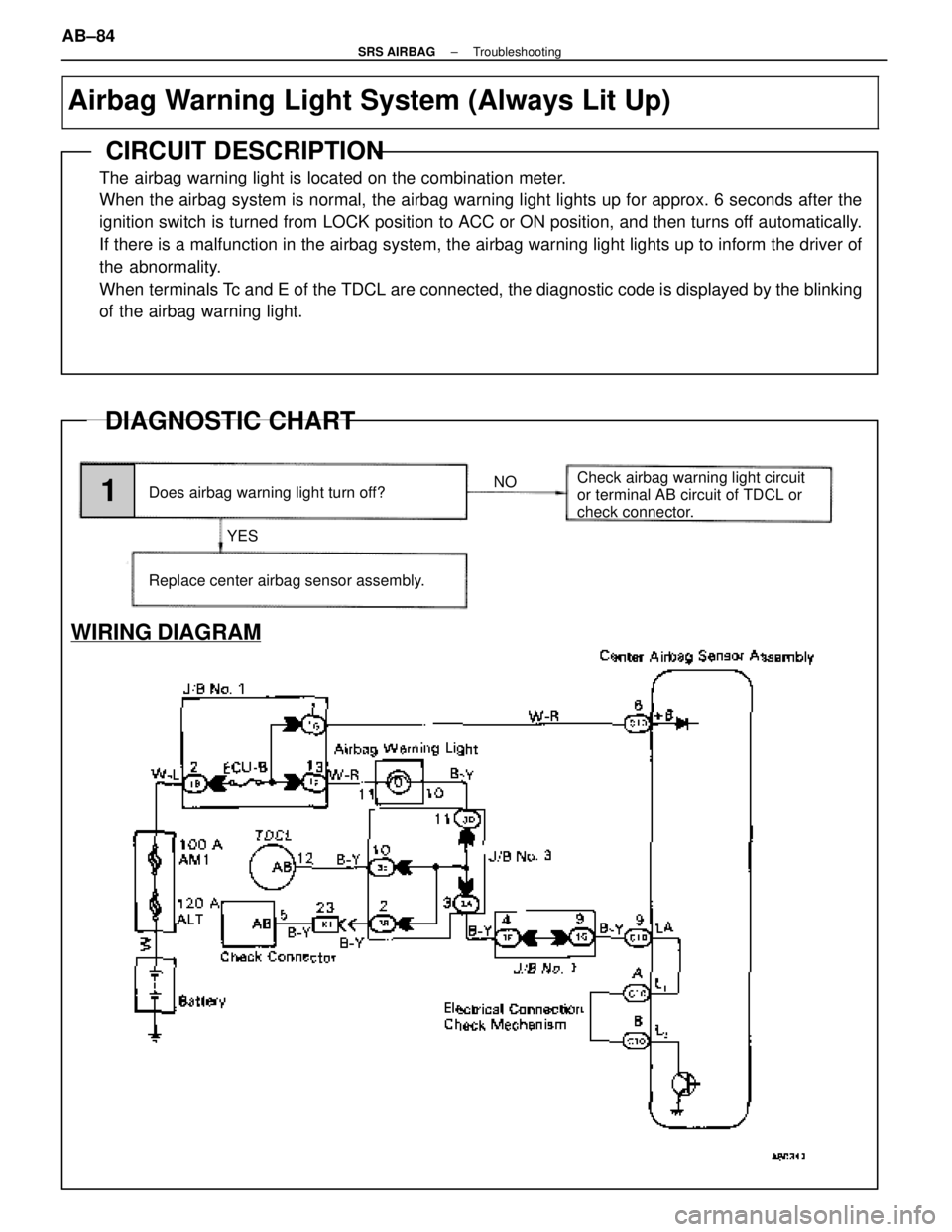
YES
Does airbag warning light turn off?
NO
1
Replace center airbag sensor assembly. Check airbag warning light circuit
or terminal AB circuit of TDCL or
check connector.
WIRING DIAGRAM
Airbag Warning Light System (Always Lit Up)
CIRCUIT DESCRIPTION
The airbag warning light is located on the combination meter.
When the airbag system is normal, the airbag warning light lights up for\
approx. 6 seconds after the
ignition switch is turned from LOCK position to ACC or ON position, and then turns off automatically.
If there is a malfunction in the airbag system, the airbag warning light\
lights up to inform the driver of
the abnormality.
When terminals Tc and E of the TDCL are connected, the diagnostic code is displayed by t\
he blinking
of the airbag warning light.
DIAGNOSTIC CHART
AB±84±
SRS AIRBAG Troubleshooting
WhereEverybodyKnowsYourName
Page 202 of 4087
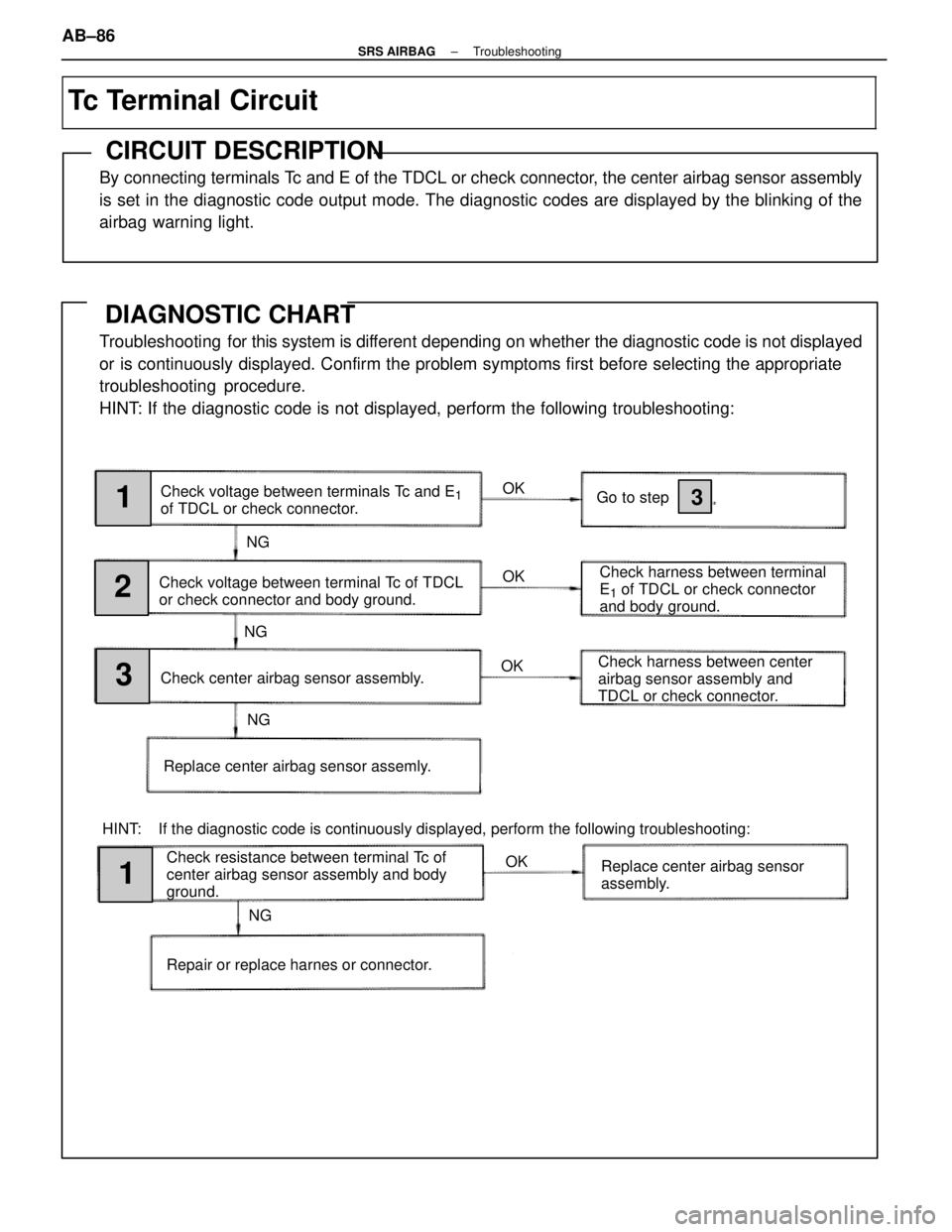
NG
Check voltage between terminals Tc and E
1of TDCL or check connector.
OK1
2
3
1
NG
NG
NG OK
OK
OK
3
Check voltage between terminal Tc of TDCL
or check connector and body ground.Check center airbag sensor assembly.
Replace center airbag sensor assemly.
Check resistance between terminal Tc of
center airbag sensor assembly and body
ground.
HINT: If the diagnostic code is continuously displayed, perform the following \
troubleshooting:
Repair or replace harnes or connector. Replace center airbag sensor
assembly.
Check harness between center
airbag sensor assembly and
TDCL or check connector.
Check harness between terminal
E1 of TDCL or check connector
and body ground.
Go to step
Tc Terminal Circuit
CIRCUIT DESCRIPTION
By connecting terminals Tc and E of the TDCL or check connector, the center airbag sensor assembly
is set in the diagnostic code output mode. The diagnostic codes are disp\
layed by the blinking of the
airbag warning light.
DIAGNOSTIC CHART
Troubleshooting
for this system is dif ferent depending on whether the diagnostic code is not displayed
or is continuously displayed. Confirm the problem symptoms first before se\
lecting the appropriate
troubleshooting procedure.
HINT: If the diagnostic code is not displayed, perform the following trouble\
shooting:
AB±86
±
SRS AIRBAG Troubleshooting
WhereEverybodyKnowsYourName
Page 204 of 4087
INSPECTION PROCEDURE
HINT: If the diagnostic code is not displayed, perform the following troubles\
hooting:
Check voltage between terminals Tc and E1 of TDCL or check connector.
nector
Turn ignition switch ACC or ON. Measure voltage between terminals Tc and E
1 of
TDCL or check connector.
Voltage: 10 ± 14 V
Measure voltage between terminal Tc of TDCL or
check connector and body ground.Voltage: 10 ± 14 V
Check harness between terminal E1 of TDCL
or check connector and body ground
Check voltage between terminals Tc or TDCL or check connector and
body ground.
AB±88±
SRS AIRBAG Troubleshooting
WhereEverybodyKnowsYourName
Page 206 of 4087
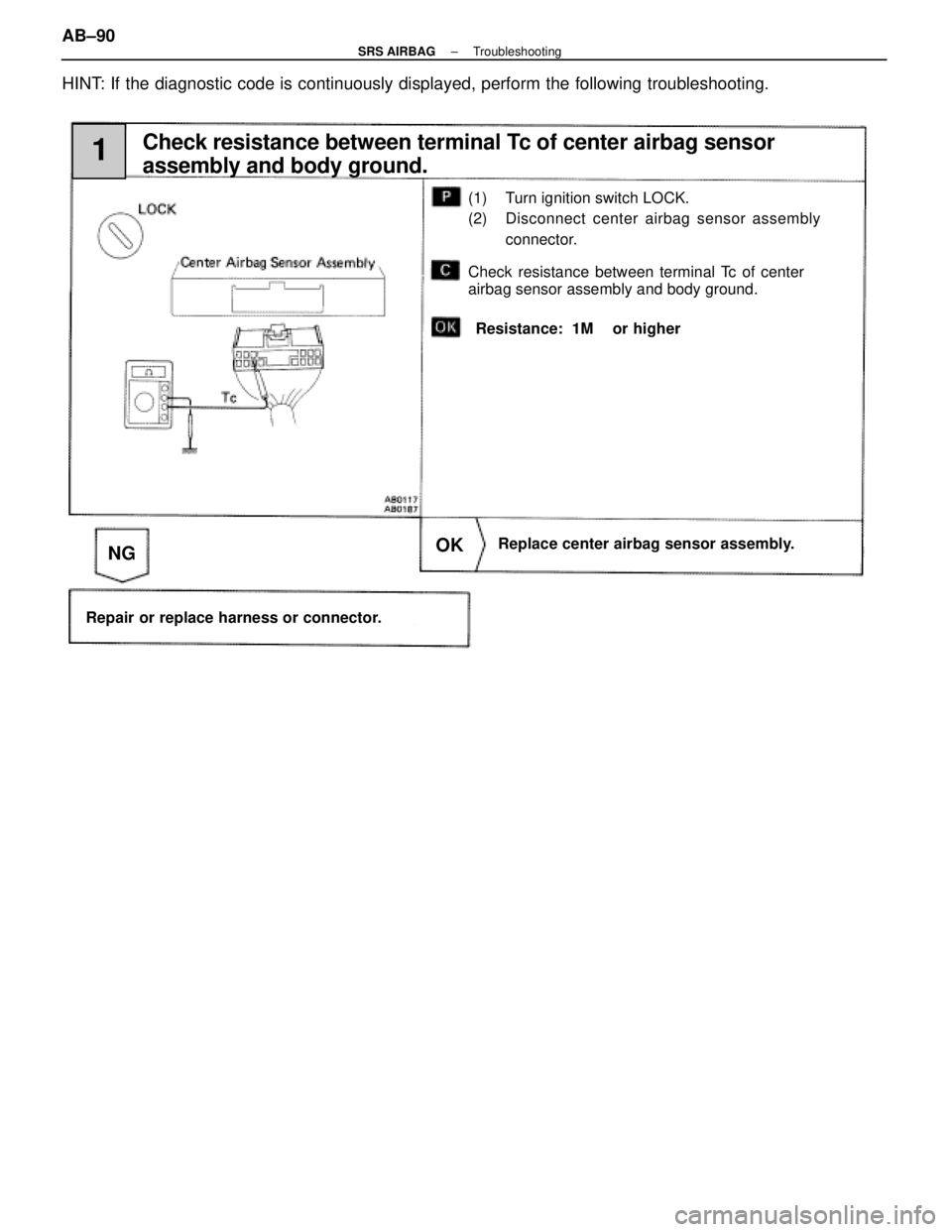
NGOK
Check resistance between terminal Tc of center airbag sensor
assembly and body ground.1
Check resistance between terminal Tc of center
airbag sensor assembly and body ground.
Replace center airbag sensor assembly.
Resistance: 1M
� or higher
(1) Turn ignition switch LOCK.
(2) Disconnect center airbag sensor assembly
connector.
Repair or replace harness or connector.
HINT: If the diagnostic code is continuously displayed, perform the followin\
g troubleshooting. AB±90
±
SRS AIRBAG Troubleshooting
WhereEverybodyKnowsYourName
Page 216 of 4087
 a\
irbag.
Failure to carry out service operations in the correct sequence could cause the\
airbag system t")
GENERAL DESCRIPTION
The LEXUS SC400 is equipped with an SRS (Supplemental Restraint System) a\
irbag.
Failure to carry out service operations in the correct sequence could cause the\
airbag system to unex-
pectedly deploy during servicing, possibly leading to a serious accident.
Further, if a mistake is made in servicing the airbag system, it is possible the\
airbag may fail to operate
when required.
Before performing servicing (including removal or installation of parts, insp\
ection or replacement), be
sure to read the following items carefully, then follow the correct procedure described in the repair
manual.
1. Malfunction symptoms of the airbag system are difficult to confirm, so the diagnostic codes become themost important source of information when troubleshooting.
When troubleshooting the airbag system, always inspect the diagnostic co\
des before disconnecting the
battery (See page AB±25).
2. Work must be started after approx. 20 seconds or longer from the time the ig\
nition switch is turned to the LOCK position and the negative (±) terminal cable is disconnec\
ted from the battery. (The
airbag system is equipped with a back±up power source so that if work is sta\
rted within 20 seconds
of disconnecting the negative (±) terminal cable of the battery, the airbag may be deployed.)
When the negative (±) terminal cable is disconnected from the battery, memory of the clock and audio sys-
tems will be cancelled. So before starting work, make a record of the conten\
ts memorized by the audio
memory system. Then when work is finished, reset the audio systems as before a\
nd adjust the clock. When
the vehicle has power tilt and power telescopic steering, power seat, power \
outside rear view mirror and
power shoulder belt anchorage, which are all equipped with memory function, it\
is not possible to make
a record of the memory contents. So when the work is finished, it will be\
necessary to explain this fact to
the customer, and ask the customer to adjust the features and reset the memory. To avoid erasing the
memory of each memory system, never use a back±up power supply from outside\
the vehicle.
3. Even in cases of a minor collision where the airbag does not deploy, the front airbag sensors and
the steering wheel pad should be inspected (See page AB±9).
4. Never use airbag parts from another vehicle. When replacing parts, replace them with new parts.
5. Before repairs, remove the airbag sensors if shocks are likely to be applied to the sensors during repairs.
6. Never disassemble and repair the front airbag sensors, center airbag sensor a\
ssembly or steering
wheel pad in order to reuse it.
7. If the front airbag sensors, center airbag assembly or steering wheel pa\
d have been dropped, or if there are cracks, dents or other defects in the case, bracket or conn\
ector, replace them with new
ones.
8. Do not expose the front airbag sensors, center airbag sensor assembly or\
steering wheel pad directly to hot air or flames.
9. Use a volt/ohmmeter with high impedance (10 kW/V minimum) for troubleshoo\
ting of the electrical circuit.
10. Information labels are attached to the periphery of the airbag components. Follow t\
he instructions
on the notices.
11. After work on the airbag system is completed, perform the airbag warning\
light check (See page AB±30 ).
AB±2
SRS AIRBAG
± General Description
WhereEverybodyKnowsYourName