Page 546 of 4087
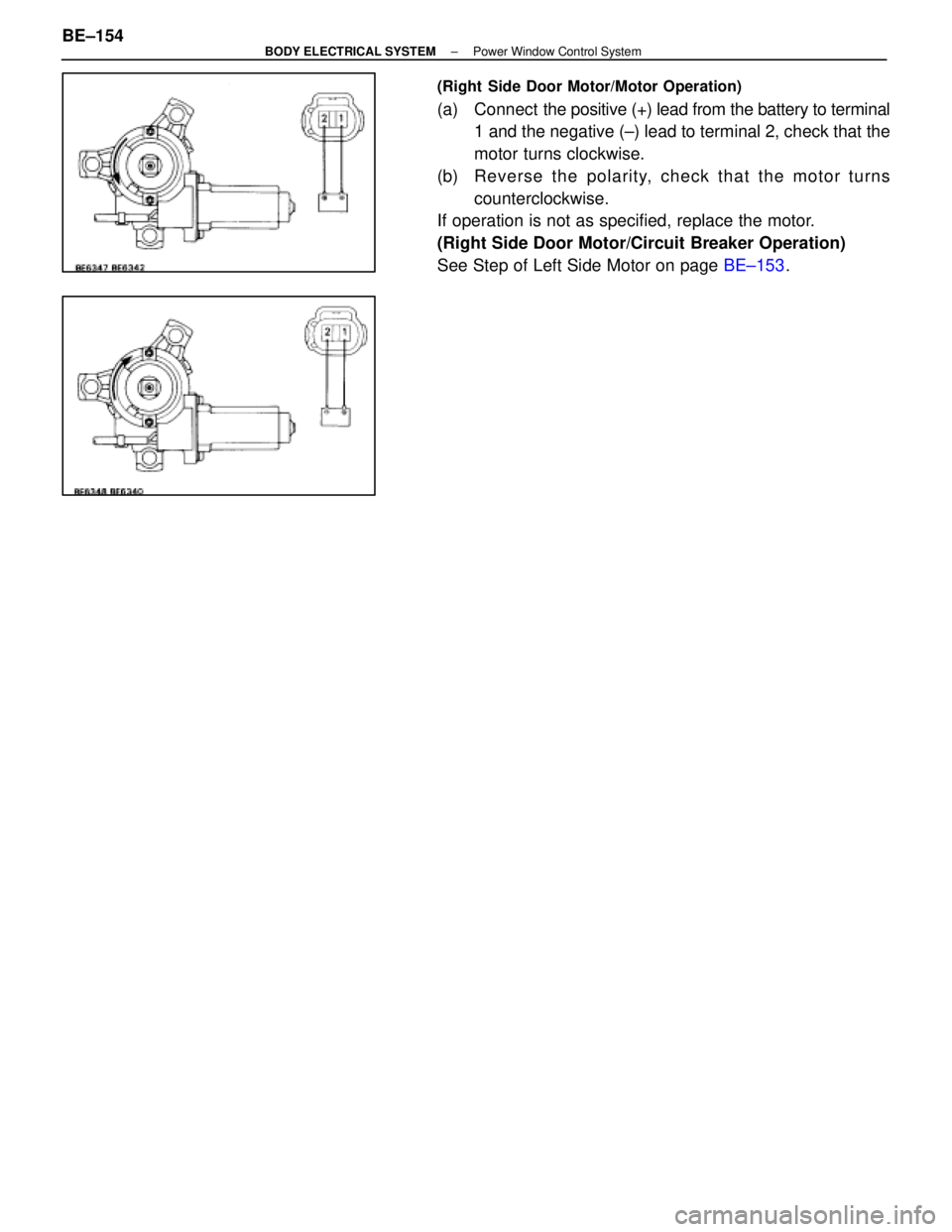
(Right Side Door Motor/Motor Operation)
(a) Connect the positive (+) lead from the battery to terminal
1 and the negative (±) lead to terminal 2, check that the
motor turns clockwise.
(b) Re ve rse th e po la rity, ch e ck th a t th e mo to r tu rn s counterclockwise.
If operation is not as specified, replace the motor.
(Right Side Door Motor/Circuit Breaker Operation)
See Step of Left Side Motor on page BE±153.
BE±154
±
BODY ELECTRICAL SYSTEM Power Window Control System
WhereEverybodyKnowsYourName
Page 565 of 4087
Parts Inspection
(Power Window Main Relay)
INSPECTION OF POWER WINDOW MAIN
RELAY
(See Power Window Main Relay on page BE±152)
(Sliding Roof Switch)
REMOVAL AND INSTALLATION OF
SLIDING ROOF SWITCH
(See Sliding Roof on page BO±85)
INSPECTION OF SLIDING ROOF SWITCH
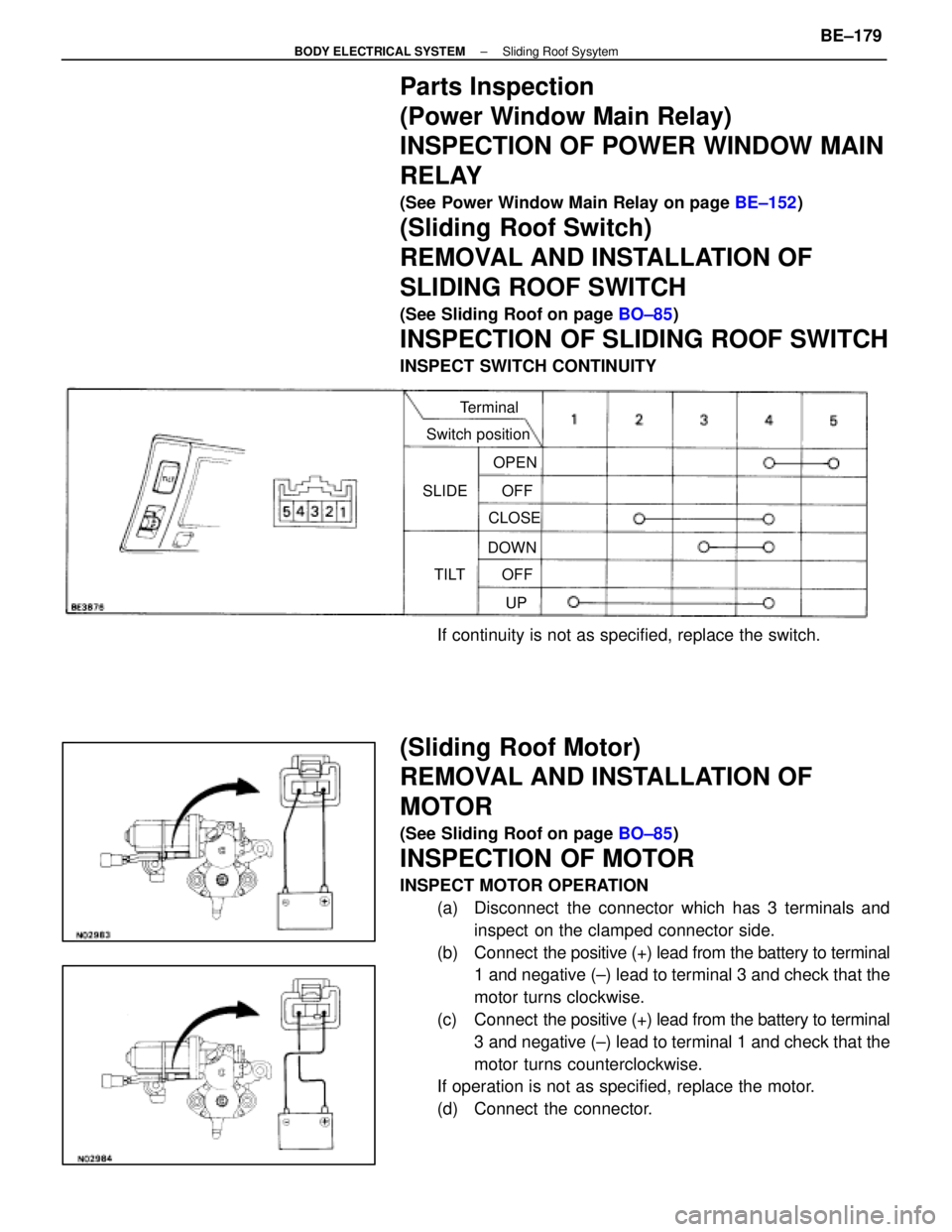
INSPECT SWITCH CONTINUITY
Terminal
Switch position
SLIDE
TILT OFF
OPEN
CLOSE
OFFUP
DOWN
If continuity is not as specified, replace the switch.
(Sliding Roof Motor)
REMOVAL AND INSTALLATION OF
MOTOR
(See Sliding Roof on page
BO±85)
INSPECTION OF MOTOR
INSPECT MOTOR OPERATION
(a) Disconnect the connector which has 3 terminals andinspect on the clamped connector side.
(b) Connect the positive (+) lead from the battery to terminal
1 and negative (±) lead to terminal 3 and check that the
motor turns clockwise.
(c) Connect the positive (+) lead from the battery to terminal
3 and negative (±) lead to terminal 1 and check that the
motor turns counterclockwise.
If operation is not as specified, replace the motor.
(d) Connect the connector.
±
BODY ELECTRICAL SYSTEM Sliding Roof SysytemBE±179
WhereEverybodyKnowsYourName
Page 580 of 4087
CLOCK
Troubleshooting
HINT: Troubleshoot the clock according to the table below.
Clock will not operate1
Clock loses or gains time2
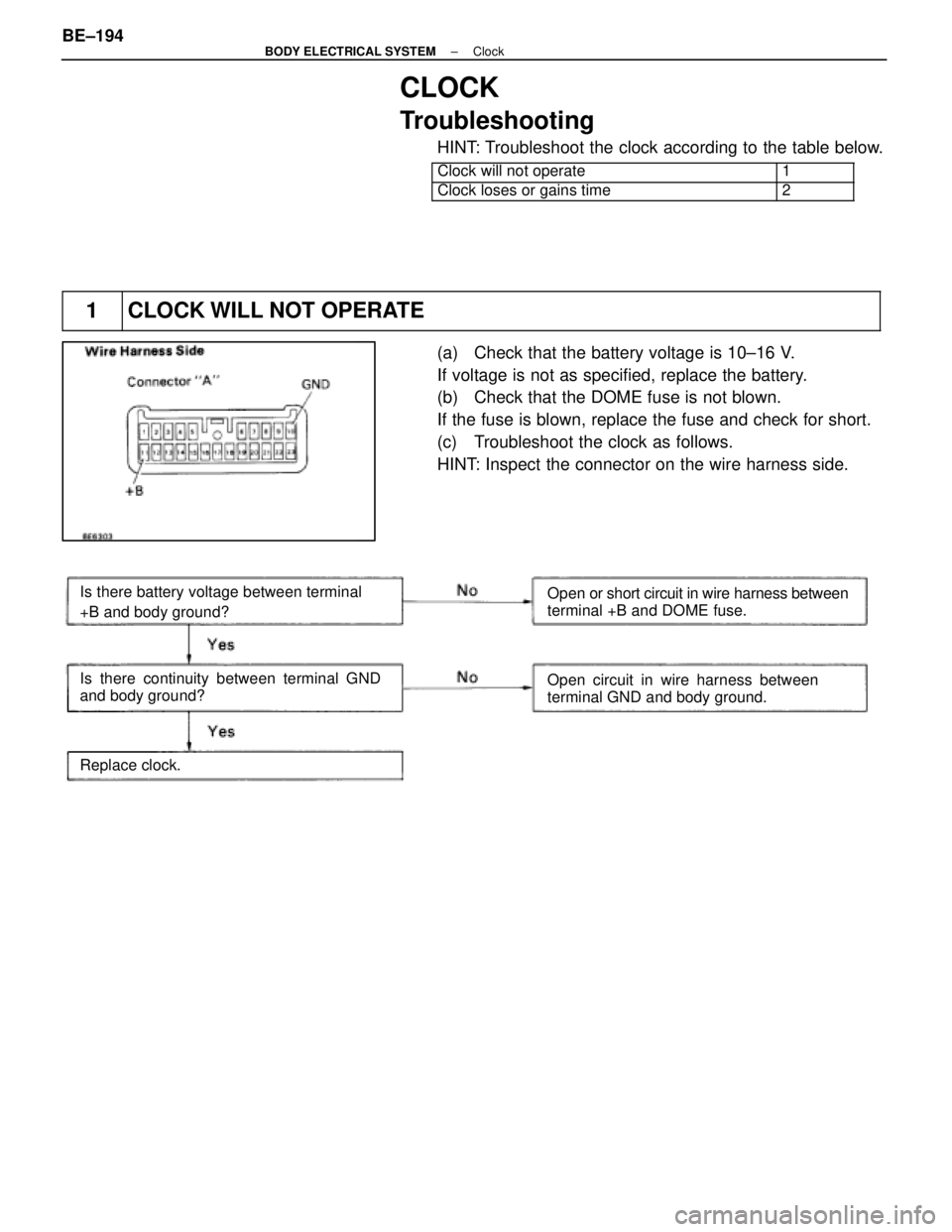
1CLOCK WILL NOT OPERATE
(a) Check that the battery voltage is 10±16 V.
If voltage is not as specified, replace the battery.
(b) Check that the DOME fuse is not blown.
If the fuse is blown, replace the fuse and check for short.
(c) Troubleshoot the clock as follows.
HINT: Inspect the connector on the wire harness side.
BE±194
±
BODY ELECTRICAL SYSTEM Clock
Is there battery voltage between terminal
+B and body ground?
Is there continuity between terminal GND
and body ground?
Replace clock. Open or
short circuit in wire harness between
terminal +B and DOME fuse.
Open circuit in wire harness between
terminal GND and body ground.
WhereEverybodyKnowsYourName
Page 581 of 4087
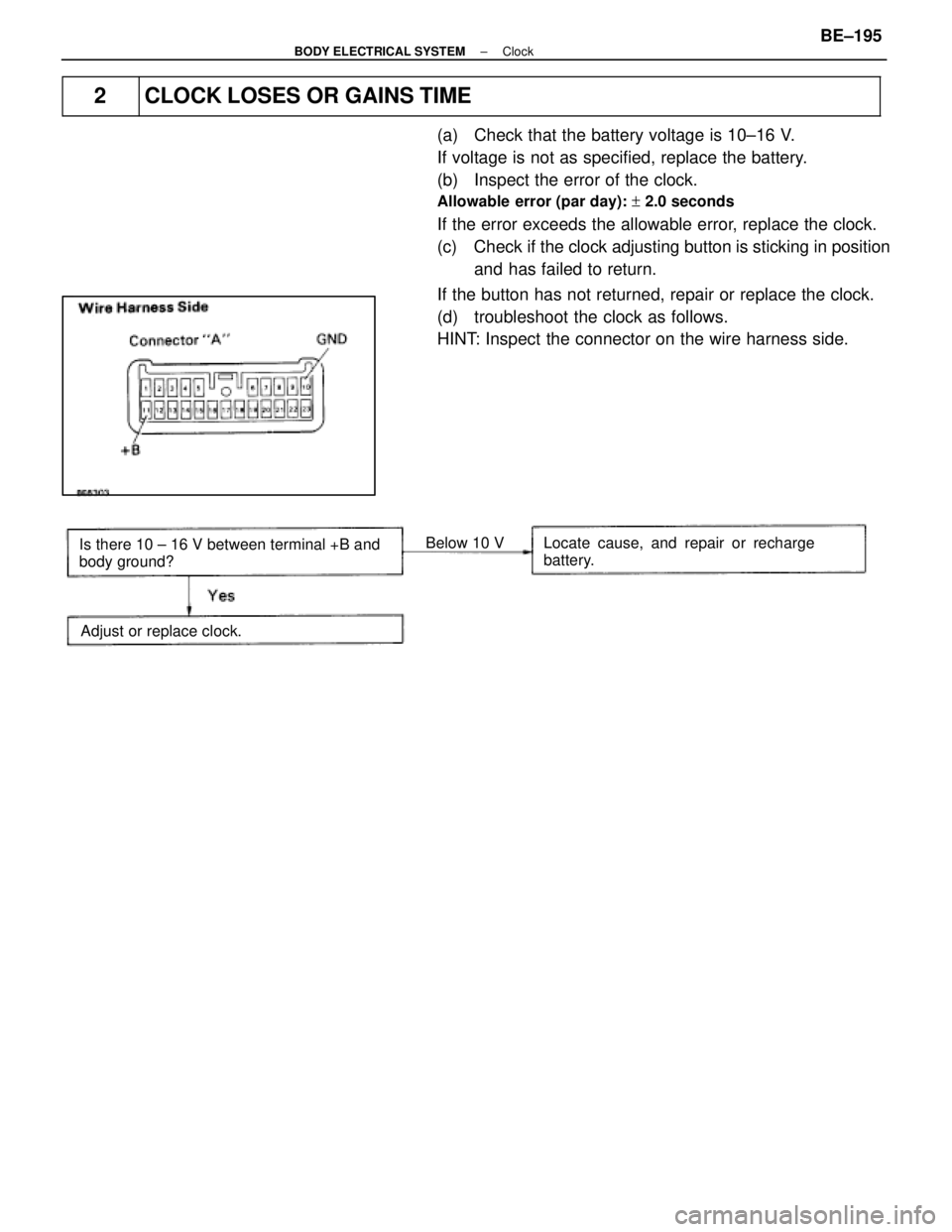
2CLOCK LOSES OR GAINS TIME
(a) Check that the battery voltage is 10±16 V.
If voltage is not as specified, replace the battery.
(b) Inspect the error of the clock.
Allowable error (par day): + 2.0 seconds
If the error exceeds the allowable error, replace the clock.
(c) Check if the clock adjusting button is sticking in position
and has failed to return.
If the button has not returned, repair or replace the clock.
(d) troubleshoot the clock as follows.
HINT: Inspect the connector on the wire harness side.
±
BODY ELECTRICAL SYSTEM ClockBE±195
Is there 10 ± 16 V between terminal +B and
body ground?
Adjust or replace clock. Locate cause, and repair or recharge
battery.
Below 10 V
WhereEverybodyKnowsYourName
Page 836 of 4087
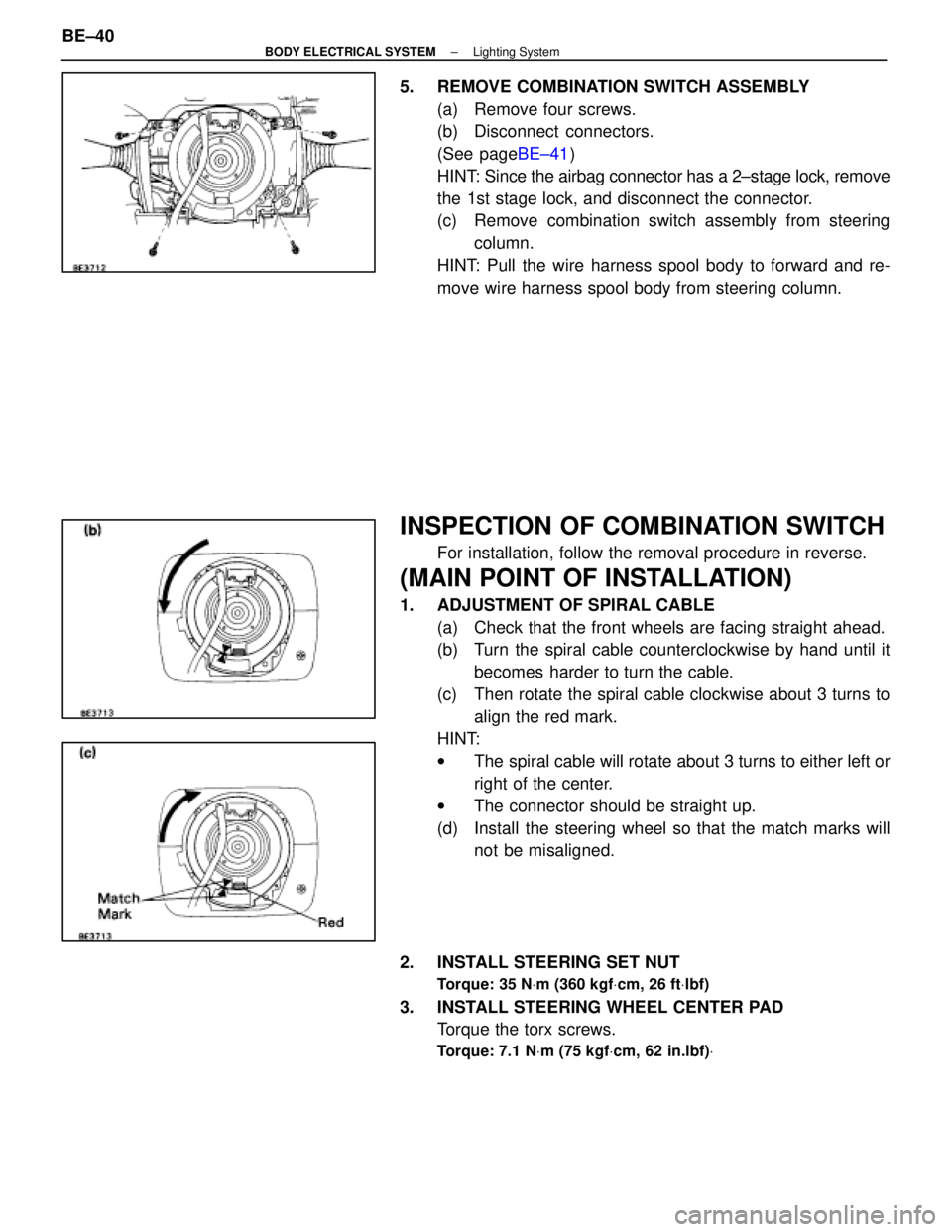
5. REMOVE COMBINATION SWITCH ASSEMBLY(a) Remove four screws.
(b) Disconnect connectors.
(See page BE±41)
HINT: Since the airbag connector has a 2±stage lock, remove
the 1st stage lock, and disconnect the connector.
(c) Remove combination switch assembly from steering column.
HINT: Pull the wire harness spool body to forward and re-
move wire harness spool body from steering column.
INSPECTION OF COMBINATION SWITCH
For installation, follow the removal procedure in reverse.
(MAIN POINT OF INSTALLATION)
1. ADJUSTMENT OF SPIRAL CABLE (a) Check that the front wheels are facing straight ahead.
(b) Turn the spiral cable counterclockwise by hand until itbecomes harder to turn the cable.
(c) Then rotate the spiral cable clockwise about 3 turns to align the red mark.
HINT:
w The spiral cable will rotate about 3 turns to either left or
right of the center.
w The connector should be straight up.
(d) Install the steering wheel so that the match marks will not be misaligned.
2. INSTALL STEERING SET NUT
Torque: 35 N Vm (360 kgf Vcm, 26 ft Vlbf)
3. INSTALL STEERING WHEEL CENTER PAD
Torque the torx screws.
Torque: 7.1 N Vm (75 kgf Vcm, 62 in.lbf) V
BE±40±
BODY ELECTRICAL SYSTEM Lighting System
WhereEverybodyKnowsYourName
Page 872 of 4087
Parts Inspection ± ILLUMINATION
LIGHT SYSTEM
(Rheostat Light Control Volume)
REMOVAL AND INSTALLATION OF
RHEOSTAT LIGHT CONTROL VOLUME
(See page BE±103 )
INSPECTION OF RHEOSTAT LIGHT
CONTROL VOLUME
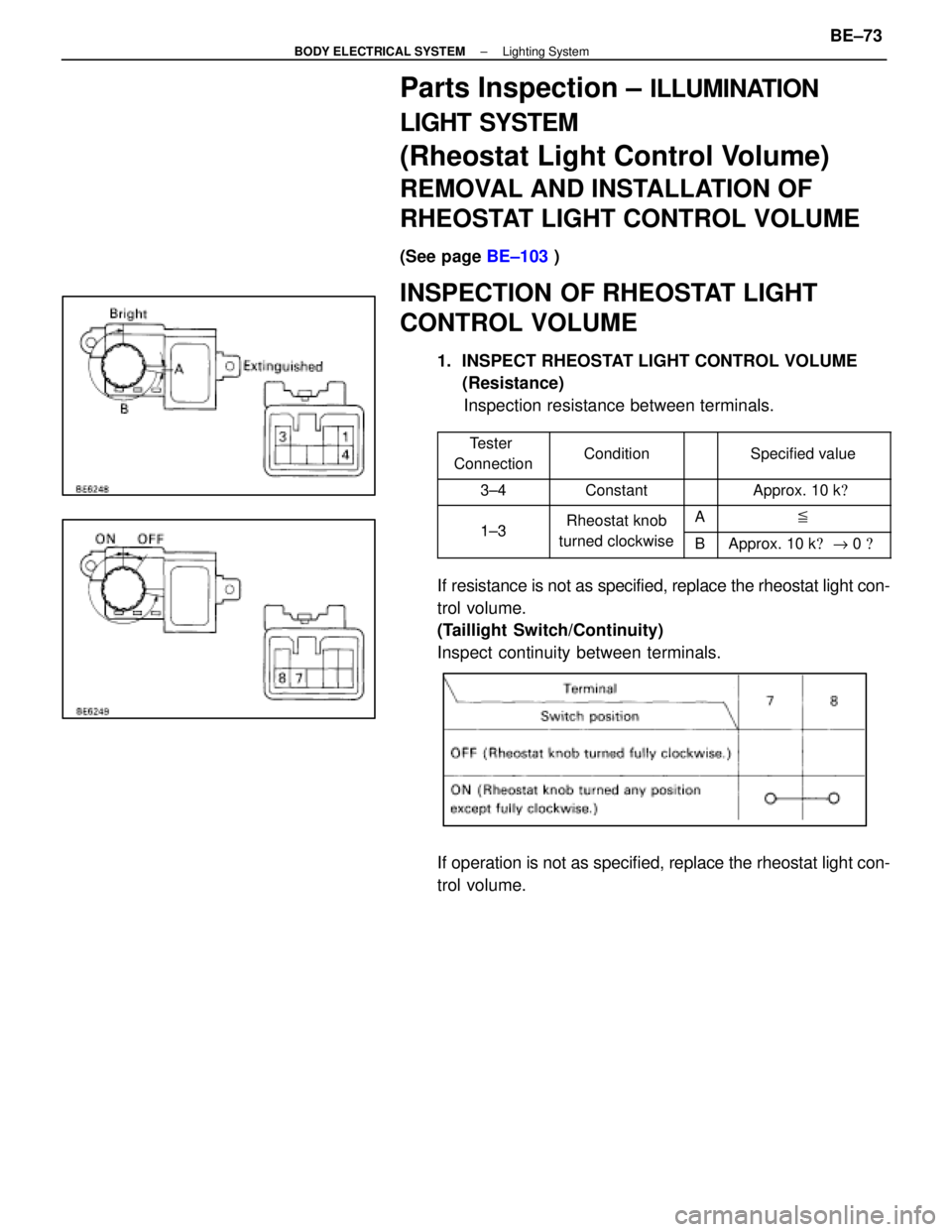
1. INSPECT RHEOSTAT LIGHT CONTROL VOLUME
(Resistance)
Inspection resistance between terminals.
Tester
ConnectionConditionSpecified value
3±4ConstantApprox. 10 k �
1±3Rheostat knobA�1±3turned clockwiseBApprox. 10 k� " 0 �
If resistance is not as specified, replace the rheostat light con-
trol volume.
(Taillight Switch/Continuity)
Inspect continuity between terminals.
If operation is not as specified, replace the rheostat light con-
trol volume.
±
BODY ELECTRICAL SYSTEM Lighting SystemBE±73
WhereEverybodyKnowsYourName
Page 905 of 4087
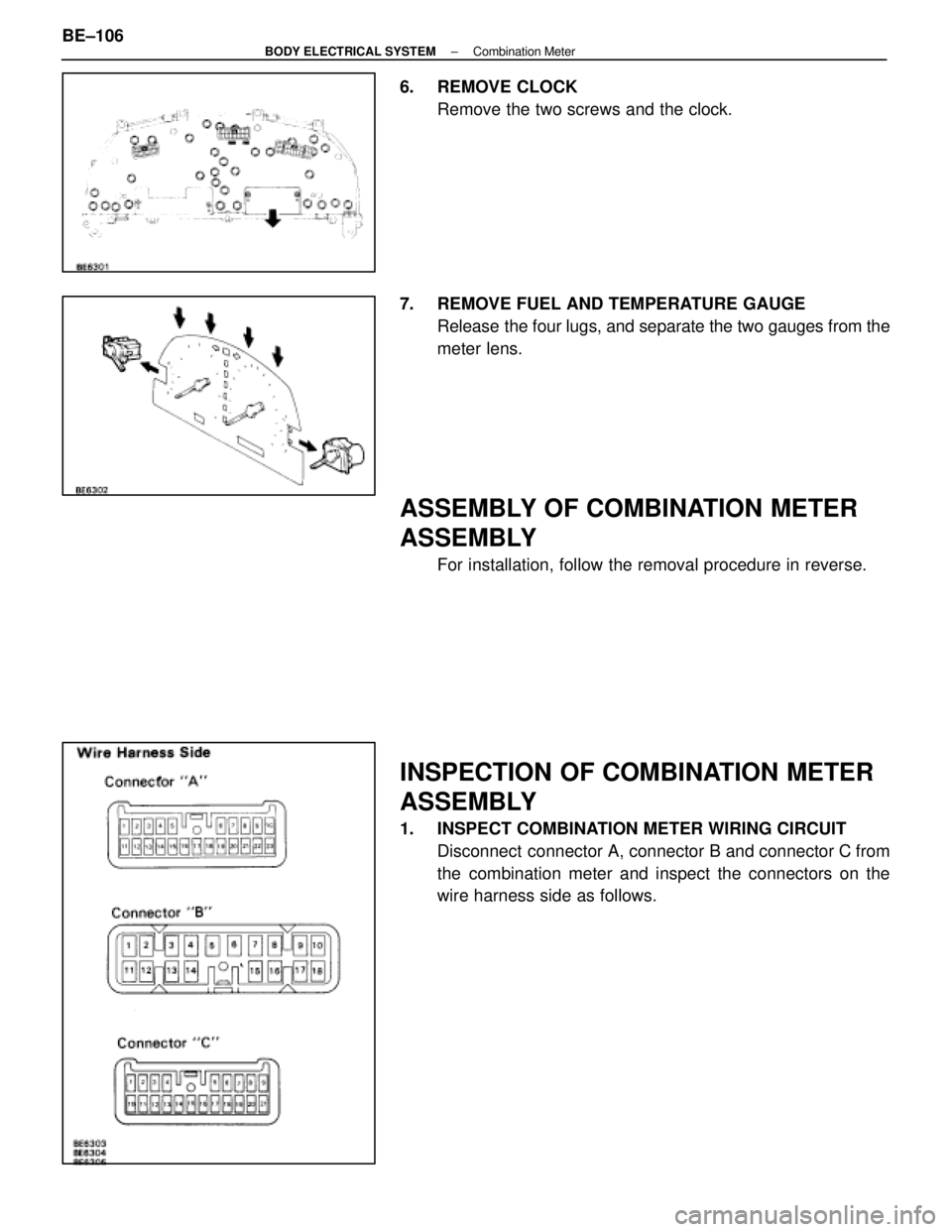
6. REMOVE CLOCKRemove the two screws and the clock.
7. REMOVE FUEL AND TEMPERATURE GAUGE Release the four lugs, and separate the two gauges from the
meter lens.
ASSEMBLY OF COMBINATION METER
ASSEMBLY
For installation, follow the removal procedure in reverse.
INSPECTION OF COMBINATION METER
ASSEMBLY
1. INSPECT COMBINATION METER WIRING CIRCUITDisconnect connector A, connector B and connector C from
the combination meter and inspect the connectors on the
wire harness side as follows.
BE±106
±
BODY ELECTRICAL SYSTEM Combination Meter
WhereEverybodyKnowsYourName
Page 907 of 4087

ConnectionCheck forTester connectionConditionSpecified value
Turn signalHazard warning switch ONBattery positiveTurn signal
SW andB 16 Ground
Hazard warning switch ONBattery ositive
voltage e 0V
HazardB±16±Ground
IG SW ON and turn signal SW ºLeftºBattery positive
Warning
Si hVoltage
IG SW ON and turn signal SW ºLeftºBattery ositive
voltage e 0V
SwitchVoltage
Hazard warning switch ONBattery positive
B 17 Ground
Hazard warning switch ONBattery ositive
voltage e 0VB±17±Ground
IG SW ON and turn signal SW ºRightºBattery positiveIG SW ON and turn signal SW ºRightºBattery ositive
voltage e 0V
HeadlightLi ht t l SWDimmer SW ºHIº orBattery positiveHeadlight
VoltageB7±GroundLight control SW
ºHEADº
Dimmer SW HI or
ºFlashº
Battery ositive
voltageVoltageB7±GroundºHEADºDimmer SW ºLOºNo voltage
ContinuityB6±GroundLight control SW
º
HEADº
Dimmer SW ºHIº or
ºFlashºContinuityContinuityB6 GroundºHEADºDimmer SW ºLOºNo continuity
IgniterVoltageA9±GroundEngine RunningVoltage
fluctuates
ECT patternVoltageB4 GroundIG SW ON and ECT patternPWRBattery positive voltageECT attern
Select switchVoltageB4±GroundIG SW ON and ECT attern
select SW positionNORMNo voltage
Engine oilOil temperature below approx. 55 5C (131 5F)Continuityg
Level warn-
ing Switch
ContinuityB8±Ground
Oil temperature
above approx. 55 5CON (float up)ContinuitygContinuityB8 Groundabove a rox. 55 C
(131 5F) and SW
positionOFF (float off)No continuity
GAUGE fuseVoltageA1 GroundIgnition switchONBattery positive voltageVoltageA1±GroundIgnition switch
positionLOCK, ACC, STARTNo voltage
Neutral StartVoltageA12±GroundIgnition switch
position
START (ºPº or ºNº
range)Battery positive voltage
switch
VoltageA12 GroundpositionLOCK, ACC, ONNo voltage
ECU±BVoltageC11 GroundIgnition switchONBattery positive voltage
FuseVoltageC11±GroundIgnition switch
positionLOCK, ACC, STARTNo voltage
Rheostat
Li ht t l
ON (Rheostat knob
t d itiBtt ltLight control
VolumeLight control SWturned any position
except fully clock-
Battery voltage or
5V or moreVolume
VoltageA2±Ground
g
HEAD or TAIL and
rheostat volume
except fully clock-
wise)5V or more
VoltageA2 Groundrheostat volume
knob positionOFF (Rheostat knob)
turned fully clockNo voltageknob ositionturned fully clock-
wise)No voltage
GroundA8±GroundConstantContinuity
ContinuityA10±GroundConstantContinuityContinuityA22±GroundConstantContinuity
A23±GroundConstantContinuity
*1 Jack up the vehicle.*2 Shift lever position is ºPº range.
If circuit is not as specified, refer to BE±100 wiring diagrams
and inspect the circuits connected to other parts.
BE±108
±
BODY ELECTRICAL SYSTEM Combination Meter
WhereEverybodyKnowsYourName